-01%201.svg)
Key takeaways
- Shortlist tools that excel at ingestion, matching, and actionable ITC decisioning, not just basic comparisons.
- Choose a reconciliation engine that supports exact and fuzzy rules, amendments across months, and PAN level logic for multi GSTIN vendors.
- Prioritize automation for vendor follow ups, exception workflows, and ERP sync to compress month end close cycles.
- Use dashboards for ITC availability, mismatch trends, and vendor performance to drive faster, compliant decisions.
- Evaluate security, scale, and governance early, including SOC 2, ISO, RBAC, and audit trails.
- Run a proof of concept on two months of live data, target over 90 percent mismatch resolution, under 30 minutes per 10,000 entries.
- Anchor your business case to cash flow uplift from recovered ITC, reduced reversals, and time saved.
Quick Recap of GSTR 2B Reconciliation
GSTR 2B is a static, month wise snapshot of eligible and ineligible ITC from supplier filings, it locks on the 14th. GSTR 2A remains dynamic. Monthly reconciliation validates claims, detects reversals, and prevents penalties. Your key sources are Purchase Register, credit and debit notes, journal vouchers, and the GSTR 2B JSON or PDF. The task is to match books with portal data, then explain and act on every gap. Source, Source, Source
Think of reconciliation as finishing a puzzle. If a piece is missing or looks different, you need to find it, fix it, or document why it does not belong.
Modern GSTR 2B reconciliation tools automate most of this heavy lifting while maintaining an audit ready trail.
Must Have Capabilities in GSTR 2B Reconciliation Tools
1. Data Ingestion and Standardization
Insist on bulk Excel, CSV, JSON, and PDF imports with schema validation, duplicate detection, and auto mapping of GSTINs and document types. A preview that flags invalid GSTINs or wrong tax rates before import saves hours. The right tool normalizes 5,000 plus invoices across formats in minutes, flags errors upfront, and standardizes vendor outputs from Tally exports, manual Excel, and scanned PDFs. Source, Source
2. Matching Engine to Match Purchase Register
Use engines that support exact and fuzzy matching on GSTIN, invoice number, date, value, and tax. Configure tolerances, handle amendments across months, and match at PAN level for multi branch vendors. Example, match billing versus shipping GSTIN variations for distributors with many branches. Source, Source, Source
3. Ability to Identify Missing Invoices
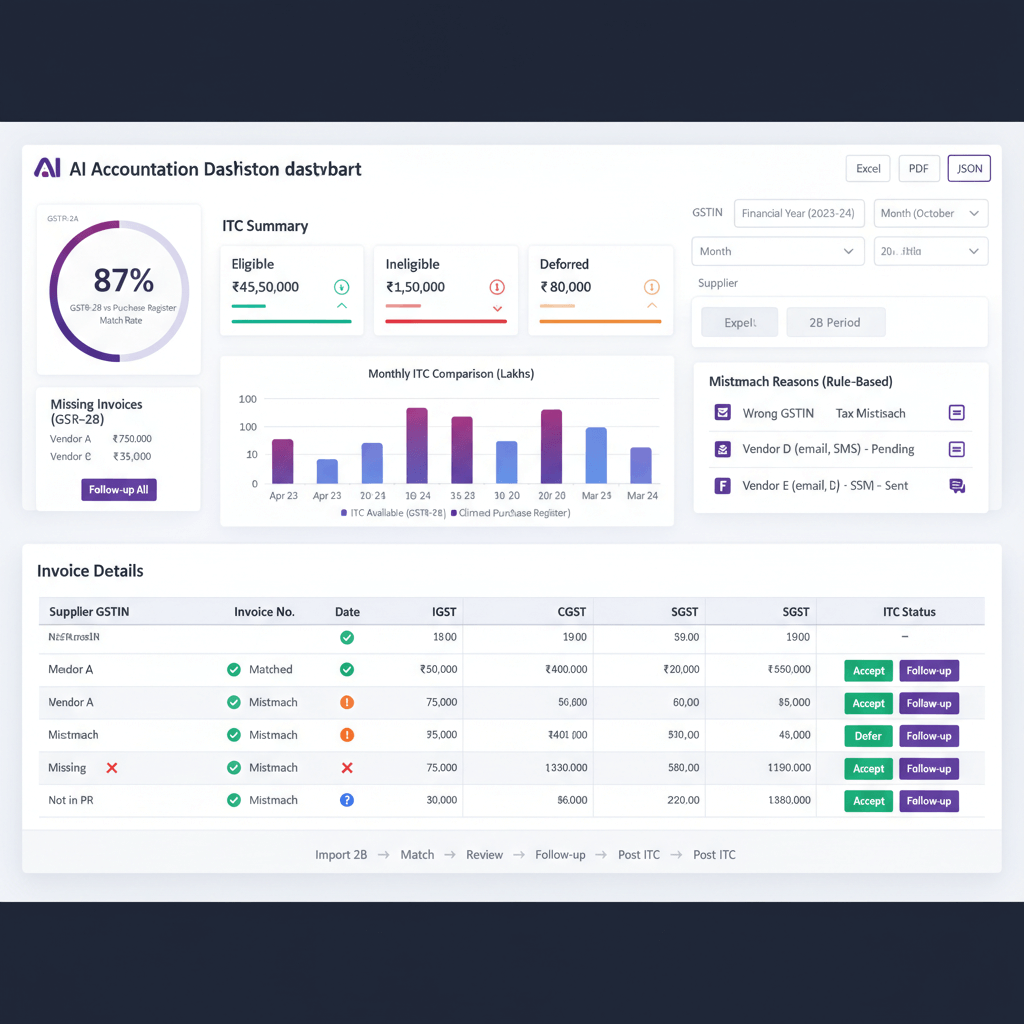
Flag invoices present only in 2B, only in PR, duplicates, cancellations, amendments, and wrong GSTINs distinctly. Filters for Exact Match, Suggested Match, and Mismatch accelerate triage. Prioritize high value gaps for immediate action and use a dashboard that summarizes matched, books only, and 2B only counts. Source, Source, Source
4. ITC Decisioning and ITC Claim Optimisation
Go beyond matching. Auto bucket credits as Eligible, Ineligible under Section 17(5), Deferred for vendor non filing, and marked for Reversal/Reclaim. Recommend claiming 2B backed ITC first, draft journal entries for your ERP, and link notes across periods for amended invoices, credit notes, and debit notes. Source, Source
5. Vendor Follow Up Automation
Automate targeted reminders on email and WhatsApp with specific invoice lists, due dates, and filing guidance. Track status, escalate, and score vendor compliance to change behavior over time. Provide a vendor portal when possible for self service. Source
6. Exception Workflows and Approvals
Adopt maker checker flows, notes and attachments, thresholds for CFO or partner approval, and full audit trails. Route exceptions to the right reviewer, store evidence, and answer assessments with documented rationale. Source
7. ERP Integrations
Use native push pull sync with Zoho Books and Tally. Post reconciled entries, ITC journals, reversals, and vendor updates automatically, respect custom fields and multi company structures, and reduce double entry. Source
Additional Critical Features
Reporting and Monthly Dashboard
Track ITC available versus claimed, mismatch rates, aging, and top non compliant vendors. Drill down to transactions and export to Excel, CSV, or PDF. Monthly dashboards should answer, what is the ITC utilization rate, who are the worst vendors, how much ITC is deferred, what is the six month trend. Source, Source
Scale, Security, and Governance
Demand multi org, role based access, encryption at rest and in transit, SOC 2 and ISO certifications, detailed logs, two factor authentication, and backups. As volumes grow from 1,000 to 10,000 invoices monthly, the system should remain responsive. Source, Source
Usability and Support
Look for auto column mapping, guided workflows, and responsive Indian business hours support. Your team should be productive within days, not months. Source
Pricing and TCO
Compare per org and usage based models, include implementation and overage charges, and compute payback by time saved and reversals avoided. Source
Top GSTR 2B Reconciliation Software Options
- AI Accountant offers comprehensive GST reconciliation, deep Zoho Books and Tally integration, scale proven on hundreds of millions of records, and enterprise grade certifications.
- ClearTax GST, popular reconciliation with good portal connectivity.
- Tally Prime with GST, built in reconciliation for existing Tally users.
- Zoho GST, integrated choice for Zoho Books users.
- IRIS Sapphire, enterprise focused matching and analytics.
- TaxiVaahan, cloud platform with vendor collaboration features.
Evaluate based on your workflows, data volumes, and current systems, not only on feature checklists.
Evaluation Checklist and Comparison Matrix
Ingestion Capabilities
- Bulk Excel, CSV, JSON, PDF support
- Auto mapping of GSTINs and document types
- Duplicate detection and error preview
- OCR or PDF parsing as needed
Matching Intelligence
- Exact and fuzzy rules on GSTIN, invoice, date, value, tax
- Amendments across months
- PAN level logic, multi GSTIN handling
- Configurable tolerances
Missing Invoice Detection
- Clear 2B not PR and PR not 2B flags
- Duplicates, cancellations, wrong GSTIN identification
- Visual buckets and filters
ITC Optimization
- Eligible, Ineligible, Deferred, Reversal, Reclaim buckets
- Auto journal entry drafts
- Credit note and debit note linking
- Section 17(5) rules
Vendor Automation
- Email, WhatsApp reminders with invoice lists
- Escalations and vendor performance scores
- Optional vendor portal
Workflow Management
- Maker checker approvals
- Exception routing, notes, attachments
- Full audit trail
Integration Depth
- Zoho Books and Tally, bi directional sync
- Custom field support
- Multi company handling
Reporting Power
- Real time dashboards, KPIs, trends
- Excel, CSV, PDF exports
- Custom report builder
Security and Scale
- SOC 2 and ISO certifications
- RBAC, encryption, 2FA
- Performance at high volume
Implementation and Support
- Fast setup and training
- Indian hours, month end support
- Clear documentation
Pricing Transparency
- Clear tiers and overages
- TCO and payback estimates
- No hidden fees
Run a proof of concept with two recent months, target over 90 percent mismatch resolution and under 30 minutes per 10,000 entries. Ask about amendment handling and API limits upfront. Source
Ideal Reconciliation Workflow
Step 1: Import PR and GSTR 2B
Upload PR and 2B JSON or PDF, let the tool normalize, validate, and de duplicate automatically.
Step 2: Auto match purchase register with 2B
Run exact and fuzzy rules, review suggested matches, and lock confirmed pairs.
Step 3: Identify missing invoices and duplicates
Use clear buckets for matched, books only, and 2B only, then drill into root causes.
Step 4: Apply ITC claim optimisation rules
Draft ITC claims, reversals, and deferrals, with notes for Section 17(5) and amendments.
Step 5: Trigger vendor follow up automation
Send targeted reminders with invoice lists, track responses, and escalate as needed.
Step 6: Review and approve exceptions
Route to approvers, attach evidence, and finalize treatments, then sync with the ERP.
Step 7: Review monthly dashboard
Close with KPIs, archive the audit trail, and prepare for next month. Source, Source, Source, Source, Source, Source
ROI and Business Case
Manual reconciliation of 15,000 entries can take days. The right system completes it in about 30 minutes, reduces reversals, and protects cash flow. Example with automated vendor nudges, an 80 percent recovery on mismatches can lift eligible ITC significantly.
Simple ROI Formula:
(Invoices per month × Mismatch rate × Recovery percent × Average ITC per invoice) − Tool cost = Monthly gain
Illustration:
10,000 invoices × 20 percent mismatch = 2,000 problem invoices
2,000 × 80 percent recovery = 1,600 recovered invoices
1,600 × Rs. 5,000 average ITC = Rs. 80 lakhs recovered ITC
Rs. 80 lakhs − Rs. 50,000 tool cost = Rs. 79.5 lakhs monthly benefit
Implementation Tips and Pitfalls
Best Practices for Success
- Enforce data hygiene. Standardize GSTINs and invoice formats, tag branches consistently.
- Set tolerances upfront. Define value variance limits and document the rationale.
- Document exceptions. Clarify when to reverse, defer, or reclaim ITC.
- Invest in training. Ensure team fluency in GST concepts and tool workflows.
Common Pitfalls to Avoid
- Over reliance on fuzzy matching. Always review suggestions before accepting.
- Claiming beyond 2B. Keep claims conservative until vendors comply.
- Ignoring amendments. Track and link month shifted edits diligently.
- Delaying reconciliation. Close monthly to catch and fix issues early.
Real World Success Stories
One CA firm with 25 clients reduced reconciliation time by 60 percent and moved from spreadsheets to dashboard driven reviews. An SME manufacturer increased eligible ITC by 15 percent in two cycles by automating vendor nudges and tightening follow up discipline. Source, Source, Source
Next Steps
Transform reconciliation from a monthly scramble into a predictable process that runs in hours, not days. Pilot with your last two months of data, evaluate against the checklist, and compare three to four shortlisted tools.
Focus on features that drive outcomes, ingestion accuracy, matching intelligence, ITC optimization, vendor automation, and ERP sync. Measure success with mismatch resolution, cycle time, and ITC uplift. The time you invest today will pay back every month through clean closes and stronger cash flow.
FAQs
What data files should a CA upload for 2B reconciliation, and can an AI tool like AI Accountant parse PDFs reliably?
Upload your monthly Purchase Register in Excel or CSV, credit and debit notes, and the GSTR 2B JSON or PDF from the portal. AI Accountant ingests Excel, CSV, JSON, and commonly structured PDFs, it validates schemas, detects duplicates, and normalizes fields such as GSTIN, invoice number, date, taxable value, and tax split for high accuracy.
How do I set tolerance thresholds that will stand up in an audit, especially for rounding or minor value differences?
Define tolerances per field, for example zero variance on GSTIN and invoice number, 1 to 2 percent on value or up to Rs. 50 for rounding, and document these in your SOP. In AI Accountant, keep tolerances conservative, approve exceptions through maker checker, and ensure the audit trail records who approved each deviation and why.
How should I reconcile transactions where billing and shipping GSTINs differ under the same PAN?
Use PAN level logic that can match across branches while maintaining entity wise bookkeeping. Configure the engine to allow cross GSTIN suggestions under a shared PAN, then route to approvers. AI Accountant supports PAN aware matching with clear labels so you can book to the correct branch while closing the match confidently.
If an invoice appears in GSTR 2B but is not recorded in my PR, can I claim ITC and book later?
Best practice is to record the purchase first, then claim the ITC backed by 2B. AI Accountant flags 2B only invoices, generates an import ready file to create the PR entry in your ERP, and marks the item Eligible after booking, reducing compliance risk.
What is the practical month end cut off given that GSTR 2B locks on the 14th?
Plan a two phase close, operational PR freeze by month end, then a compliance close post 14th once 2B locks. AI Accountant supports rolling reconciliations, so teams can pre match using provisional data, then finalize after the 14th with minimal rework.
How do I handle reverse charge mechanism supplies during 2B reconciliation?
RCM liabilities may not flow as claimable ITC in 2B the same way as forward charge supplies. Track RCM entries in PR, ensure tax payment in 3B, then recognize ITC as eligible subject to rules. AI Accountant separates RCM tags, posts proper journals, and prevents accidental double claims.
What controls do I need for Section 17(5) blocked credits and how can automation help?
Maintain rule based tagging for common blocked categories such as motor vehicles, personal consumption, and goods lost. AI Accountant auto buckets these as Ineligible, enforces approval if someone tries to override, and preserves a trail for assessments.
How can I automate ITC reversal for 180 day vendor non payment under Rule 37 and reclaim later?
Track invoice aging against payment status, trigger reversal entries when invoices cross 180 days, and maintain a reclaim watchlist. AI Accountant links AP payments to invoices, auto drafts reversal on breach, and auto drafts reclaim when payment clears, keeping the ledger and 3B aligned.
What documentation will auditors ask for, and can I export it cleanly from an AI tool?
Auditors typically need matched and unmatched lists, exception logs with notes and approvals, vendor communication history, and month wise ITC roll forward. AI Accountant exports Excel, CSV, and PDF packs with transaction level details and an audit trail per exception.
How do I evidence vendor communication for invoices missing in GSTR 1, and reduce repeat offenders?
Use automated reminders with invoice level details, capture replies, and time stamps, and escalate if no action is taken. AI Accountant stores email and WhatsApp attempts, aggregates a vendor compliance score, and helps you revise credit terms for chronic defaulters.
What is a robust maker checker structure for a CA firm managing many clients?
Set preparer roles for ingestion and initial matching, reviewer roles for suggested matches and tolerance approvals, and approver roles for ITC decisions and reversals. AI Accountant supports multi org RBAC, so partners get portfolio views while staff see only assigned entities.
Can I integrate with Tally without changing my chart of accounts or custom fields?
Yes, map reconciliation outputs to your existing COA and preserve custom fields through the connector. AI Accountant syncs masters, pushes journals and vendor updates, and respects your multi company setup without forcing structural changes.
How do I measure ROI during a pilot, and what targets should I set?
Track time per 10,000 invoices, mismatch resolution percentage, ITC uplift from recovered invoices, and exception cycle time. AI Accountant customers commonly target under 30 minutes per 10,000 entries, over 90 percent resolution in month one, and double digit ITC recovery from vendor nudges.
What is the recommended approach for handling invoice amendments across months?
Link amended entries to originals, compute net effect on ITC, and annotate the reason and period impact. AI Accountant auto detects amendments, maintains cross month links, and adjusts eligibility and journals while preserving a detailed trail.
How do I prevent over claims when 2A shows entries but 2B does not?
Use 2B as the golden source for claim, monitor 2A for vendor compliance. AI Accountant highlights 2A only versus 2B backed items, recommends a Deferred bucket, and tracks reclaim when the vendor files correctly in a later month.
What safeguards should I put in place for data security and client confidentiality?
Insist on SOC 2 and ISO certifications, encryption at rest and in transit, role based access, two factor authentication, and immutable audit logs. AI Accountant adheres to these controls and provides access logs you can review during firm wide IT audits.

Rohan Sinha is a fintech and growth leader building aiaccountant.com, focused on simplifying accounting and compliance for Indian businesses through automation. An IIT BHU alumnus, he brings hands-on experience across 0 to 1 product building, growth, and strategy in B2B SaaS and fintech.