-01%201.svg)
Key takeaways
- Modern GSTR 2B reconciliation tools automate matching between your purchase register and the government snapshot, recovering missed ITC and cutting manual effort by 80-90%.
- Quality tools go beyond exact matches, using fuzzy logic, configurable tolerances, and explainable reasoning so your team can trust results and close exceptions faster.
- Proactive capabilities that identify missing invoices, trigger vendor follow up automation, and quantify ITC at risk, protect cash flow and improve vendor discipline.
- A robust ITC claim optimisation engine, with audit trails and rules for blocked, deferred, and RCM credits, is essential for compliance and assessments.
- Deep integrations with Zoho Books and Tally, plus role-based access and enterprise security, distinguish professional-grade platforms from basic utilities.
- Dashboards that narrate your month, from reconciliation rates to vendor scorecards, turn data into action, not just reports.
- Evaluate with your real data, benchmark accuracy, and weigh total cost of ownership to select a tool that scales with your firm or SME finance team.
Why GSTR 2B reconciliation tools matter in 2025
If your weekends disappear into spreadsheets, invoice mismatches, and vendor chasers, you already know the cost of manual reconciliation. GSTR 2B reconciliation tools change the rhythm of the month. They ingest your purchase register, standardize formats, and produce trustworthy matches in minutes. They surface what matters, where money is leaking, and which vendors need nudging, so your team can move from grunt work to governance and insight.
Automation is not just about speed, it is about certainty, documentation, and confidence when the audit letter arrives.
What a GSTR-2B reconciliation workflow should cover
Inputs that set you up for success
- Purchase Register in CSV or Excel, credit and debit notes, journal vouchers
- GSTR-2B via JSON download or API fetch
- Validated GSTINs so typographical errors do not derail matching
Standardization, validation, and intelligent matching
The engine normalizes formats, validates GSTINs, then works to match purchase register entries with GSTR-2B records. It accommodates invoice number variations, rounding differences, and splits. It recognizes amendments, imports, advance payments, and handles RCM transactions with clarity.
Proactive detection of gaps and leakage
Best-in-class systems identify missing invoices from both sides, what is in your books but not in GSTR-2B, and vice versa. They age these gaps, vendor wise, and quantify the ITC at risk so you can prioritize outreach.
Classification and ITC decisioning
Every line falls into matched, partially matched, or unmatched buckets. The tool then runs ITC claim optimisation and flags blocked credits, eligibility issues, and deferrals, including the 180-day payment rule, documenting each decision for audit readiness.
Follow-ups that actually get responses
Vendor follow up automation sends templated outreach via email or WhatsApp, attaches invoice-level mismatch lists, tracks delivery and responses, and escalates when needed. Scorecards make conversations objective.
Accounting sync and decision dashboards
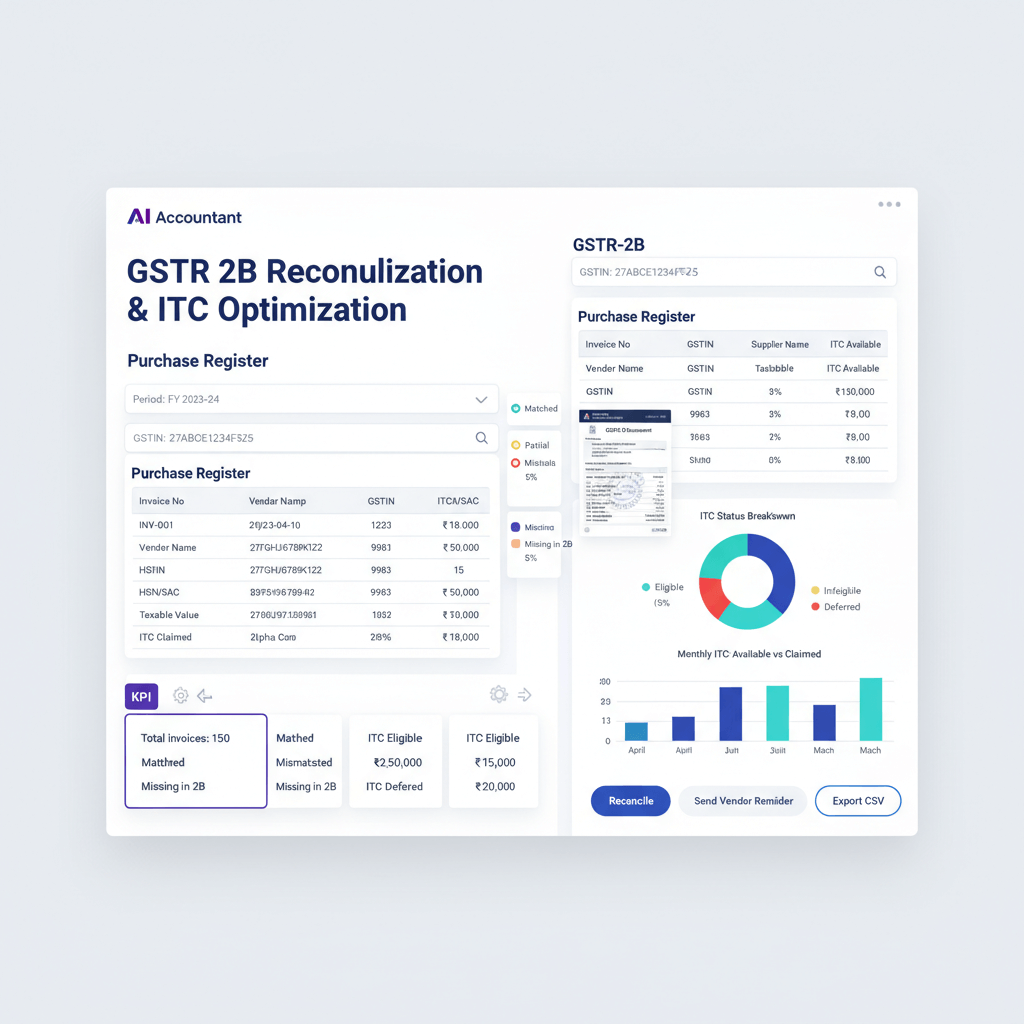
Clean, approved records sync back to your accounting system. The monthly dashboard shows claimable ITC, reconciliation rates, exception closure, and vendor performance, ready for management and audit packs.
Further reading: GSTR-2B tools overview, Feature deep-dive, Reconciliation playbook, Third-party comparison
Must-have features in GSTR 2B reconciliation tools
Intelligent matching capabilities
Precision with transparency is non-negotiable. Expect fuzzy logic for invoice numbers and dates, configurable tolerances for values, graceful handling of credit notes, debit notes, RCM, imports, and advances, with explainable reasoning for every match.
Missing invoice detection
Tools that identify missing invoices produce vendor-wise gap reports, spot duplicates, and quantify ITC at risk, providing a money map rather than a mystery list.
ITC optimization engine
Configurable eligibility rules, blocked credit scenarios, and defer versus claim logic near the 180-day payment rule, all with airtight audit trails, separate serious platforms from basic utilities.
Automated vendor communication
Vendor follow up automation should include personalized templates, attachments with mismatches, delivery and read tracking, and escalation paths, ideally culminating in vendor scorecards.
Comprehensive dashboards
A monthly dashboard that narrates your story, claimable versus deferred ITC, reconciliation trends, vendor breakdowns, and exception closure rates, with credible exports for auditors and leadership.
Additional power features
- Bulk edits and approvals for speedy exception handling
- Explainable AI for trust and training
- Role-based access, multi-org support, and strong APIs for Zoho Books and Tally
- Enterprise security, ISO 27001 and SOC 2 Type II
Further reading: GSTR-2B tools overview, Feature deep-dive, Reconciliation playbook, Third-party comparison
Evaluation checklist for choosing the right tool
- Matching accuracy, 25%: Benchmark with your data, aim for 85-90% auto-match on clean data, check false positives and amendment handling.
- ITC sophistication, 20%: Customizable rules for industry context, airtight audit trails, and complex scenarios like partial payments.
- Integration capabilities, 15%: Reliable, bidirectional sync with Zoho Books and Tally, resilient retries, stable field mappings.
- Scale and performance: Latency at volume, SLAs for large files, predictable month-end throughput.
- Security standards: ISO 27001, SOC 2 Type II, encryption, detailed audit logs.
- Usability: Bulk actions, powerful filters, guided exception workflows.
- Implementation support: Templates, sandbox, structured onboarding, real specialists.
- Total cost of ownership: Licenses, integrations, training, plus ROI from time saved and ITC recovered.
Tools to consider:
- AI Accountant, comprehensive automation with strong Zoho, Tally integration
- Octa GST, specialized GST compliance platform
- ClearTax, established player with broad tax features
- Vyapar TaxOne, SME-focused solution
- Tally Prime, integrated within the Tally ecosystem
- Zoho GST, native to Zoho Books users
Further reading: GSTR-2B tools overview, Feature deep-dive, Third-party comparison, Pricing and value analysis
End-to-end example workflow in action
Upload your Purchase Register, GSTR-2B, CDNs, and JVs. Formats standardize instantly, GSTIN errors surface early. The engine then works to match purchase register entries at scale, explaining why a Rs 5 difference still qualifies as a match or why an invoice split in GSTR-2B is a partial match. Next, it helps you identify missing invoices, aging each gap and quantifying ITC at risk. Vendor follow up automation kicks off with personalized messages that attach vendor specific lists. Then ITC claim optimisation applies configured rules, deferring credits that breach the 180-day payment rule and flagging blocked credits with reasons. After review, clean entries flow back to Zoho Books or Tally. Your monthly dashboard shows ITC trends, vendor scorecards, and exception closure, all export ready. A mid-sized company, 500-1000 invoices monthly, completes this in under two hours.
Further reading: GSTR-2B tools overview, Feature deep-dive, Reconciliation playbook
ROI and business case for automation
Teams routinely save 20-40 hours a month, per entity. CA firms multiply that across clients, unlocking capacity for advisory. ITC recovery improves when automation stops leakage from missed, misclassified, or delayed invoices. Compliance risk falls due to consistent, timely filing and complete audit trails. One avoided penalty, often pays months of subscription. SMEs feel it immediately in cash flow, while firms expand margins without extra headcount.
Further reading: GSTR-2B tools overview, Reconciliation playbook
How AI Accountant fits into your GST reconciliation strategy
AI Accountant delivers end-to-end coverage for GSTR 2B reconciliation. Its explainable AI clarifies match logic, while bulk edits accelerate fixes. When it helps you identify missing invoices, you get vendor aging, ITC at risk, and automatic vendor follow up automation with tracking and escalation. The ITC claim optimisation engine adapts to your business context and documents every decision. A practical monthly dashboard shows ITC trends, vendor scorecards, and reconciliation KPIs. Deep Zoho Books and Tally integrations sync masters and transactions bidirectionally. Multi-org support, ISO 27001 and SOC 2 Type II, and proven scale across hundreds of customers make it a reliable choice.
Explore more: GSTR-2B tools overview, Feature deep-dive, Reconciliation playbook
Questions to ask during software demos
- How are amendments, supplementary invoices, and multi-GSTIN vendors handled, with tolerance profiles per vendor or per transaction type?
- Can I customize follow-up templates, track delivery and responses, and escalate to senior vendor contacts automatically?
- Which monthly dashboard metrics are configurable, which exports exist for auditors, and can reports be auto-scheduled?
- What are integration rollback options if a sync goes wrong, and can I review entries pre-posting to books?
- How complete are audit trails for ITC claims, reversals, and deferrals, including user, timestamp, and rationale?
- What training and sandbox facilities are provided, and how quickly can my team reach steady state productivity?
Reference: Demo prep guide, Feature checklist
Implementation playbook and common pitfalls
Preparation phase
- Clean vendor masters, validate 15-character GSTINs, standardize vendor names and invoice numbering.
- Harmonize date formats and spreadsheet templates before the first import.
Pilot approach
- Start with 1-2 months of data, run parallel manual and automated reconciliation, blend early adopters with skeptics on the pilot team.
Common pitfalls to avoid
- Messy spreadsheets with merged cells or special characters, fix them upfront.
- Uncaptured credit and debit notes, causing perpetual mismatches.
- Skipping vendor communication setup, losing the compounding benefits of consistent reminders.
Governance framework
- Establish a monthly calendar, define vendor SLAs, and set escalation paths for chronic late uploaders.
- Assign clear roles for import, exception review, ITC approvals, and vendor outreach, with SOPs for amendments and reversals.
Further reading: Implementation blueprint, Governance checklist, Playbook and templates
Taking the next step
Spin up a sandbox, upload a real Purchase Register and GSTR-2B, and watch automated matching, gap discovery, ITC claim optimisation, and vendor follow up automation reduce a month-end scramble to a measured, documented flow. Prioritize the pain that hurts most, whether ITC leakage, vendor delays, or fragile integrations with Zoho Books or Tally. The right choice does more than automate, it transforms cash flow, compliance, and vendor accountability, while returning your weekends to you.
Start here: GSTR-2B tools overview, Feature deep-dive, Reconciliation playbook
FAQ
How should a CA structure a GSTR-2B reconciliation SOP for consistent ITC claims across multiple clients?
Create a monthly calendar that locks dates for data import, engine run, exception review, vendor outreach, and ITC approval. Standardize Purchase Register templates, validate GSTINs, and insist on capturing credit and debit notes. Use a tool like AI Accountant to centralize matching, identify missing invoices, and maintain audit trails for every ITC decision, then export packs for each client’s file.
What is the practical difference between GSTR-2A and GSTR-2B for ITC eligibility, and how should firms reconcile both?
GSTR-2B is a static monthly snapshot, it anchors the ITC claim. GSTR-2A is dynamic, it provides early visibility. Firms should reconcile with 2B for claims, monitor 2A mid-month to catch laggards early, and use automation to align both. For background, see this overview on maximizing ITC through accurate 2A and 2B reconciliation: maximizing input tax credit with 2A and 2B.
How do professional tools classify and manage RCM transactions without manual tagging?
They use rules based on HSN or SAC and supplier types to auto-detect RCM, then categorize ITC as deferred or ineligible as per configuration. Platforms such as AI Accountant maintain explainable logic for each RCM entry and link to documentation, simplifying review and audits.
For partial matches and rounding differences, what tolerance settings should a CA configure?
Start with a conservative absolute tolerance for low-value invoices, and a percentage tolerance for higher values, with separate profiles for sensitive vendors. Require date matching within a configurable window, for example plus or minus three days, for vendors with known delays. Tools should let you override case by case, while logging the reason.
How can I quantify ITC at risk from vendors who delay uploads, and which follow-up cadence works best?
Use vendor-wise aging in your reconciliation tool to compute ITC at risk per vendor and per period, then rank by value. Adopt a weekly soft reminder, a second nudge with attached invoice lists, and a third escalation to finance heads. AI Accountant’s vendor follow up automation tracks delivery, opens, and responses, allowing you to prove patterns and negotiate improvements.
What is the right approach to handle amendments and credit notes so the audit trail remains intact?
Treat the original and amendment as linked but distinct records, preserve the association in the tool, and ensure the ITC delta is computed explicitly. For credit notes, insist on document number, date, and reason capture. AI Accountant maintains these linkages automatically, documenting each adjustment for assessments.
How do I structure user roles and approvals in a CA firm to minimize reconciliation risk?
Separate duties: preparer imports data and runs matching, reviewer clears exceptions and validates ITC, approver finalizes postings. Enforce role-based access so juniors cannot change rules, and mandate comments on overrides. Your platform should provide full audit logs by user and timestamp.
What KPIs should appear on a monthly reconciliation dashboard for partners and CFOs?
Priority KPIs include auto-match rate, exception closure rate within SLA, claimable versus deferred ITC, ITC at risk by vendor, duplicate detection counts, and amendment impacts. Add vendor scorecards for discipline, and trend views for three to six months. AI Accountant’s monthly dashboard covers these out of the box.
How quickly can an SME or a CA firm expect value after go-live, assuming clean masters?
With clean vendor masters and a standardized Purchase Register, SMEs typically complete setup in one to two weeks, including an initial sandbox cycle. CA firms with multiple entities can stagger rollouts over three to four weeks. Value is immediate in time saved, often 80% reduction, and ITC recovered in the first cycle.
What evidence do I need to defend ITC positions during departmental scrutiny?
Maintain the reconciliation pack that maps each claimed invoice to GSTR-2B, include the tool’s reasoning for exceptions and tolerances, vendor communication logs for missing invoices, and the ITC decision log including blocked and deferred cases. AI Accountant generates export-ready documentation with line-level rationale to support your case.
How do integrations with Zoho Books and Tally reduce manual errors in postings?
Bidirectional sync for vendors, items, and ledgers avoids duplicate masters, while controlled posting from the reconciliation tool ensures only reviewed entries reach books. Pre-posting review queues, rollback options, and field mapping consistency reduce rework. AI Accountant provides these guardrails for stable month-ends.
What security assurances should I insist on before onboarding a reconciliation platform?
Ask for ISO 27001 certification, SOC 2 Type II, encryption at rest and in transit, role-based access controls, and immutable audit logs. Confirm data residency if applicable, and review breach notification policies. Enterprise-grade tooling, such as AI Accountant, openly shares attestations and architecture notes.

Rohan Sinha is a fintech and growth leader building aiaccountant.com, focused on simplifying accounting and compliance for Indian businesses through automation. An IIT BHU alumnus, he brings hands-on experience across 0 to 1 product building, growth, and strategy in B2B SaaS and fintech.