-01%201.svg)
Key takeaways
- GSTR 2B reconciliation tools cut reconciliation time by 80 to 90%, boost ITC recovery, and reduce compliance risk through automation.
- Best in class features include automatic purchase register matching, missing invoice detection, ITC optimization, vendor follow up automation, and robust audit trails.
- Deep, stable integrations with Tally and Zoho Books, plus clear error logs and bulk exception handling, are non negotiable for CA firms and SMEs.
- Security matters, look for ISO 27001 or SOC 2, encryption, role based access, and multi organization support for client scale.
- Evaluate tools using an accuracy, speed, exception handling, automation depth, and dashboard driven decision checklist.
- AI Accountant delivers end to end reconciliation, vendor coordination, and ITC governance, with seamless Tally and Zoho Books sync.
- Independent comparisons from TaxOne Vyapar, SoftwareSuggest, and Technology Counter validate 2026 leaders and capabilities.
Why GSTR 2B Reconciliation Matters Now
Manual reconciliation drains time and cash. CAs and finance teams spend 20 plus hours monthly on VLOOKUPs, vendor chasers, and still miss eligible ITC. Enforcement is tighter, one mismatch can trigger notices and 18% annual interest. Automation changes the game.
GSTR 2B reconciliation tools match thousands of invoices in minutes, flag discrepancies early, and provide audit ready trails. Teams report faster closes, lower ITC leakage, and fewer vendor disputes because every conversation is backed by data.
Claim every rupee of eligible ITC, prove every decision, and close books with confidence.
Independent roundups from TaxOne Vyapar, SoftwareSuggest, and Technology Counter reflect the growing need for accurate, automated reconciliation.
Understanding GSTR 2B and Reconciliation Basics
GSTR 2B is your monthly ITC statement based on suppliers’ GSTR 1 filings. It is static, arrives mid month, and often contains surprises, late filings, typos, missed credit notes, or GSTIN mismatches. Each gap can block ITC and create interest exposure.
Reconciliation means line by line matching of your purchase register to GSTR 2B, identifying missing entries on both sides, correcting via vendor follow ups, and documenting outcomes for audits. Without the right software, this becomes endless spreadsheets and fatigue. With structured workflows, it becomes predictable, fast, and defensible.
For a deeper primer and market scans, see The Munim’s in depth comparison, SoftwareSuggest’s reconciliation software grid, and AI Accountant’s GSTR 2B tools guide.
Must Have Capabilities in GSTR 2B Reconciliation Tools
Automatic purchase register matching
The tool should ingest from Tally, Zoho Books, or Excel automatically, then apply smart hierarchies, match by GSTIN first, then invoice details, then amounts with tolerances. Special cases like credit notes, debit notes, RCM transactions, and advances need explicit logic.
Missing invoice identification
Catch invoices in GSTR 2B but not in books, and vice versa. Detect duplicates, correct common typos, and provide vendor wise gap analysis so follow ups focus on high value items.
ITC claim optimization
Classify eligible versus ineligible credits automatically, enforce timing rules like the 180 day payment requirement, and attach audit notes explaining blocked or deferred ITC.
Vendor follow up automation
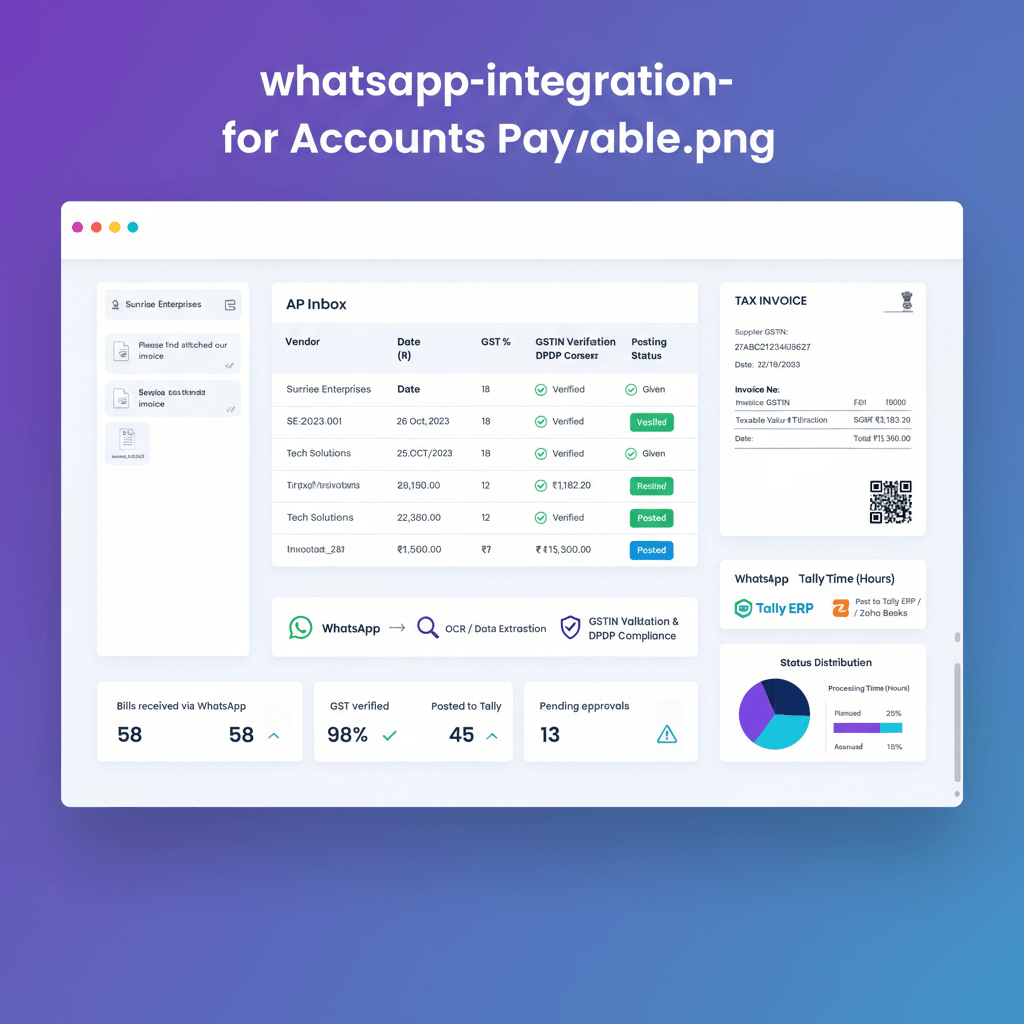
Send targeted reminders via email and WhatsApp with invoice lists, track responses, and maintain vendor scorecards to fix chronic filing behavior.
Dashboards and reporting
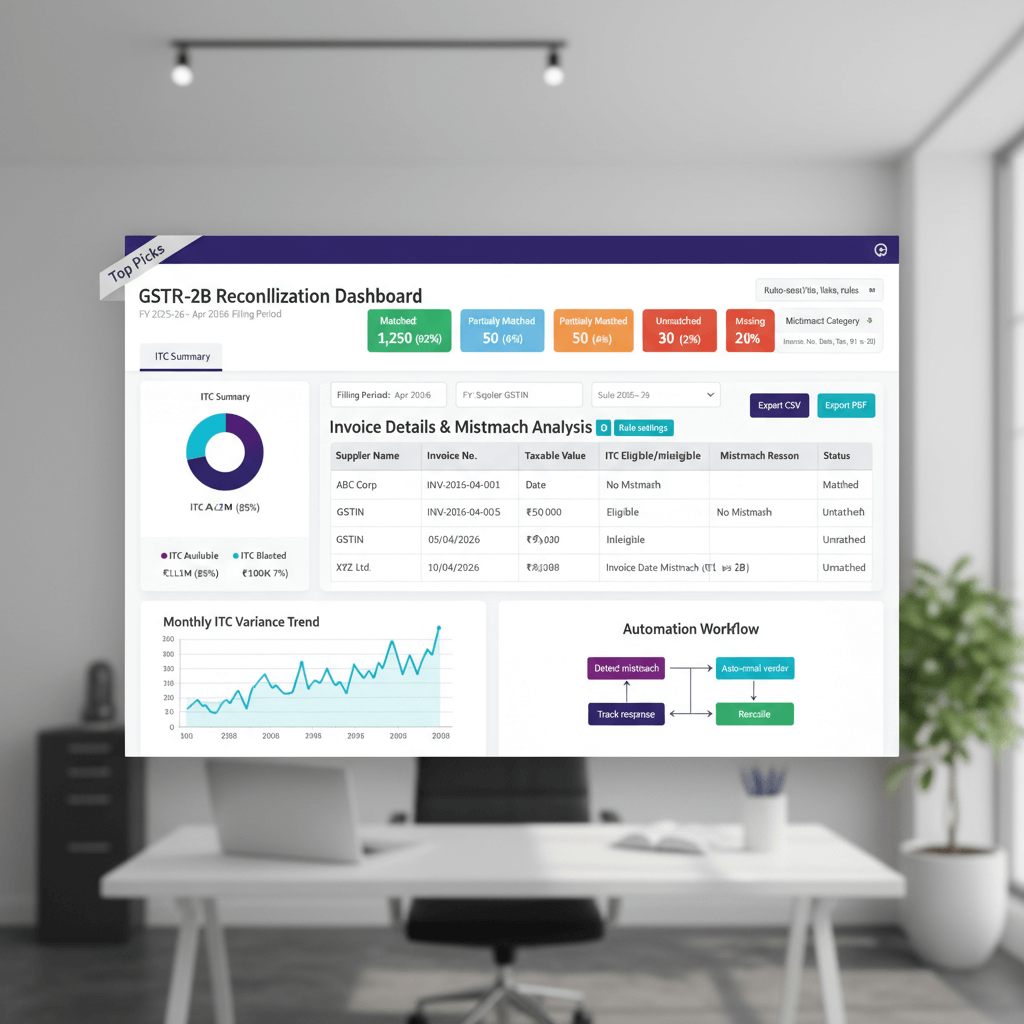
Use Monthly dashboards to monitor ITC claimed versus eligible, drill into mismatches, export packs for management, and trend reconciliation quality month over month.
Security, scalability, and integration
Expect ISO 27001 or SOC 2 controls, encryption at rest and in transit, role based access, and multi organization management. Test reliable GSTR 2B pulls and resilient Tally or Zoho sync with clear error logs.
Capability roundups from TaxOne Vyapar, The Munim, SoftwareSuggest, AI Accountant’s guide, and Technology Counter outline these must haves.
Top GSTR 2B Reconciliation Tools Comparison
1. AI Accountant
Deep Zoho Books and Tally integrations, intelligent matching across purchase registers, JVs, and credit notes, multi org for CA firms, and enterprise grade ISO 27001 and SOC 2 security. Results sync back for a single source of truth.
2. Vyapar TaxOne
AI driven matching across GSTR 2A, 2B, and 3B, smooth Tally integration, and WhatsApp follow ups. Cost effective for high volume teams.
3. ClearTax GST
High match rates across diverse formats, multi GSTIN handling, 50 plus reports, and broad ERP integrations. Quote based pricing suits larger orgs.
4. Zoho Books GST
Built in reconciliation for the Zoho ecosystem, collaborative exception handling, and affordable tiers for SMEs.
5. Tally Prime
In app matching for Tally users, strong GSTIN controls and audit trails, accessible pricing, but limited outside Tally stack.
6. Munim
Auto matching with clear buckets, web and desktop access, SME friendly pricing, straightforward interface for smaller practices.
7. Gen GST
Modular, ERP friendly, Excel support, customizable reports, steeper learning curve for consultants who want control.
Comparisons validated by TaxOne Vyapar, The Munim, and SoftwareSuggest reflect 2026 performance and user feedback.
Evaluation Checklist for Commercial Success
- Accuracy metrics, test with your own data, verify false positives, ask for proof of match rates.
- Processing speed, measure import to reconciliation completion, estimate savings per invoice volume.
- Exception handling, bulk resolutions, templates, and support for partial matches.
- Automation depth, vendor reminders, escalations, and templates per vendor segment.
- ITC controls, configurable rules, audit notes, and timing flags before filing.
- Dashboards, drill downs from summary to line items, clean exports, useful visuals.
- Integration stability, resilient Tally or Zoho sync, graceful retries, actionable error logs.
- Security and compliance, ISO 27001 or SOC 2, encryption, MFA, activity logs.
- Support and onboarding, SLA clarity, trials, timeline to value, account management.
- Pricing structure, per org versus per document, hidden add ons, scale reasonableness.
- References, industry peers, documented outcomes, not vague testimonials.
Use buyer guides from TaxOne Vyapar, The Munim, SoftwareSuggest, and Technology Counter to benchmark vendors.
How AI Accountant Addresses the Checklist
Seamless integrations, pulls purchase registers and masters from Tally and Zoho Books automatically, then pushes reconciled results back to maintain a single source of truth.
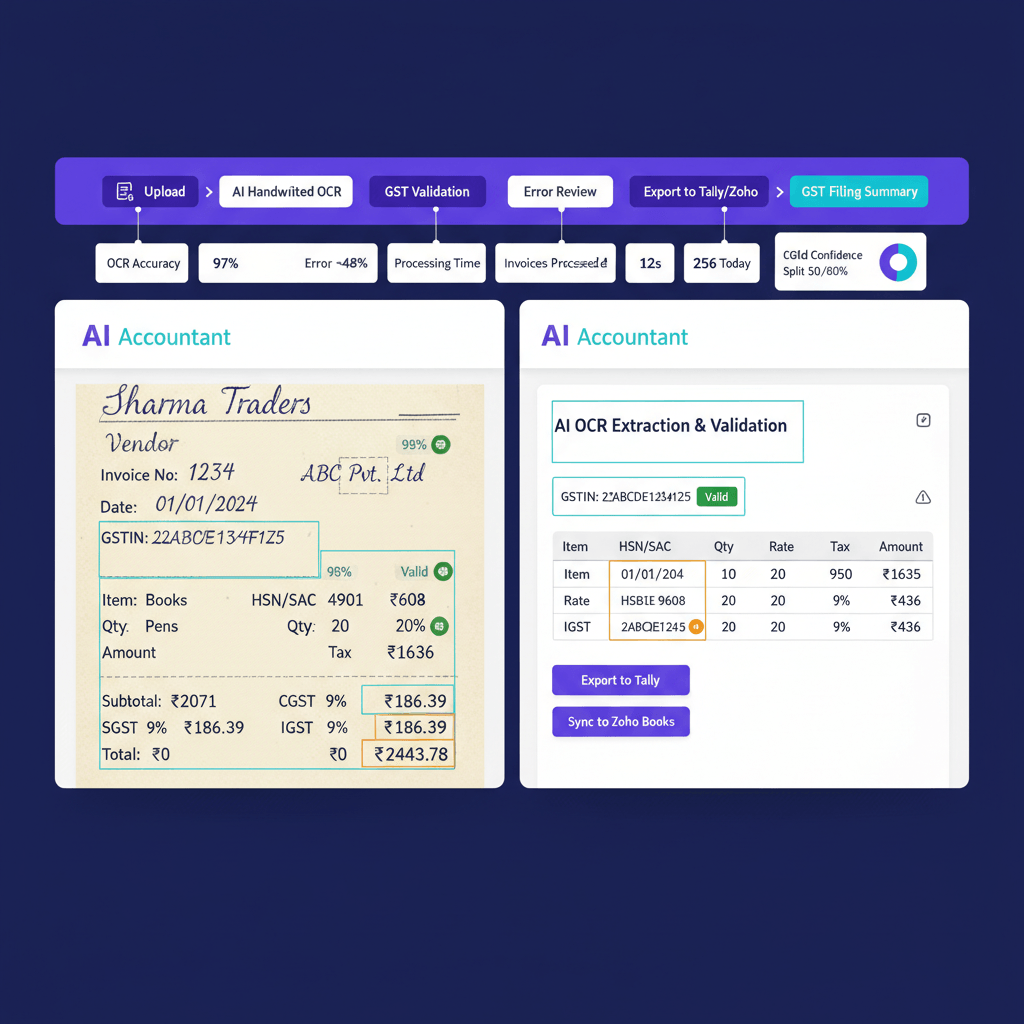
Flexible ingestion, PDF and Excel parsing with early validations, row level errors that pinpoint fixes, and zero guesswork.
Intelligent matching, hierarchy based comparisons, clear matched, partially matched, unmatched tags, bulk exception edits, and quantified missing invoice alerts that show potential ITC loss instantly.
Governed ITC, auto classification aligned to GST rules, timing flags like the 180 day criterion, and audit notes on every decision.
Vendor coordination, automated reminders with invoice lists, escalation workflows, and performance analytics for chronic late filers.
Real time visibility, dashboards for ITC utilization, payables aging, drill downs, and clean exports for management reviews.
Enterprise security, multi org with role based access, ISO 27001 and SOC 2 Type II, and encryption across the lifecycle. Explore capabilities in AI Accountant’s guide.
Example Month End Workflow Using AI Accountant
Day 1, ingest static GSTR 2B and sync purchase registers from Tally or Zoho Books, normalize formats.
Day 2, run automatic matching, review matched, partial, unmatched buckets, share initial reports.
Day 3, resolve exceptions in bulk, attach support, document overrides for audits.
Day 4, generate ITC recommendations, approve with reasoning, queue final claims.
Day 5, trigger vendor follow ups for missing invoices, track responses and escalations.
Day 6, push reconciled results back to systems, lock periods, update statuses.
Day 7, management reviews dashboards, export audit packs, analyze patterns for continuous improvement.
Workflow accelerators validated by TaxOne Vyapar and explained in AI Accountant’s tools guide.
ROI and Business Case
Time savings, from 20 to 25 hours for 1,000 invoices down to under 2 hours, an 80 to 90% cut in reconciliation time using tools like Vyapar TaxOne and AI Accountant.
Cash benefits, 5 to 10% extra ITC recovered via better matching and vendor follow up, faster claims improve cash flow timing.
Risk reduction, avoid 18% interest on incorrect ITC, use audit trails as your assessment defense. Even one avoided notice can cover months of subscription cost.
Illustration, a CA firm with 10 clients saves 10 hours per client monthly at ₹500 per hour, ₹50,000 per month, ₹6 lakh annually, plus ₹2 to 5 lakh ITC recovery per client, typical payback in under three months.
See market evidence across TaxOne Vyapar, The Munim, SoftwareSuggest, and Technology Counter.
Implementation and Change Management
- Data prep, confirm portal access, clean vendor masters, standardize invoice numbering.
- Pilot first, reconcile one month or one client, fix integrations, then scale within 1 to 2 months.
- Training, two focused sessions on core workflows, SOPs for scenarios, escalation paths, hands on with real data.
- Governance, maker checker for ITC approvals, monthly checklists, periodic reviews, clear accountability.
- Measure adoption, track cycle time, match rate improvements, and vendor response metrics, iterate continuously.
Rollout guidance is consistent with buyer coverage from SoftwareSuggest, Technology Counter, and TaxOne Vyapar.
Common Pitfalls and How to Avoid Them
- Relying only on invoice numbers, enable GSTIN first matching with tolerances to avoid false positives.
- Missing credit notes and RCM, codify rules so special cases are auto handled.
- Late vendor chasers, automate follow ups and escalations from day one.
- No audit notes on overrides, enforce mandatory documentation and periodic reviews.
- Ignoring partial matches, route to a separate workflow, resolve systematically, feed learnings back into rules.
For more lessons learned, see The Munim’s comparison, SoftwareSuggest’s listings, TaxOne Vyapar’s roundup, and Technology Counter.
FAQ
Should we reconcile weekly or only at month end for static GSTR 2B data?
Perform weekly checks to surface vendor gaps early, then complete full reconciliation post the GSTR 2B release. This blended cadence reduces month end pressure and improves ITC recovery. Teams using AI Accountant typically run a light weekly sweep and a final month end close.
How do leading tools handle GSTR 2B amendments and version changes?
Modern platforms fetch updates through secure APIs, track amendment history, and diff changes between versions. AI Accountant maintains a versioned ledger of pulls, so you can see what changed, when, and why, with retry logic for failed syncs.
Can the software auto classify blocked ITC under Section 17(5) and manage RCM?
Yes, rules engines identify blocked categories, apply reverse charge logic, and mark timing deferrals automatically. AI Accountant highlights suspect lines, explains the rule applied, and allows controlled overrides with audit notes.
What is the best practice structure for vendor follow ups to improve filing discipline?
Start with automated emails listing exact invoices, escalate to WhatsApp on day three, then phone outreach for high value cases. Dashboards should show response SLAs and chronic late filers. AI Accountant’s workflows implement this cadence out of the box.
How secure is financial data, and what certifications should we insist on?
Insist on ISO 27001 or SOC 2, encryption at rest and in transit, MFA, and detailed activity logs. AI Accountant is ISO 27001 and SOC 2 Type II compliant, with granular role based access and continuous monitoring.
What happens if connectivity drops mid reconciliation or during portal sync?
Cloud platforms checkpoint progress, resume automatically, and flag any incomplete batches. AI Accountant’s error logs identify documents that need reprocessing, preventing silent data loss.
How do we evaluate match accuracy without relying on vendor demos?
Run a controlled pilot using last month’s actual purchase register and 2B. Measure true positives, false positives, and resolution effort. AI Accountant provides a trial environment with transparent accuracy dashboards.
Can tools handle multi GSTIN, multi entity operations for CA firms?
Yes, look for multi organization workspaces, entity level permissions, and consolidated reporting. AI Accountant supports firm wide views with client specific roles, perfect for multi client CA practices.
How are partial matches treated to avoid ITC leakage?
Effective systems isolate partials into a separate queue, highlight variance drivers, and allow bulk fixes. AI Accountant tags partials with reasons, for example rounding, credit note pending, enabling quick reconciliation.
What KPIs should partners track to prove ROI to clients?
Track cycle time per 1,000 invoices, match rate improvement, ITC recovered, vendor response SLAs, and audit note completeness. AI Accountant’s dashboards expose these KPIs and export management ready packs.
Is Excel upload sufficient, or is native Tally and Zoho Books integration mandatory?
Excel works for a pilot, but native integrations remove manual steps and errors, and enable write back for a single source of truth. AI Accountant supports both, with production users preferring native sync.
Where can I read a comprehensive buyer’s guide tailored to India’s GST and ITC nuances?
For a market wide overview, review Taxilla’s 2026 buyer’s guide, plus comparisons from SoftwareSuggest and TaxOne Vyapar. AI Accountant’s blog also publishes India specific explainers and checklists.
Making Your Decision
Test leading GSTR 2B reconciliation tools on your data, compare match rates, exception effort, and ITC recovery versus your current process. Favor tools that integrate cleanly with Tally or Zoho Books, understand Indian GST complexities like RCM and ISD credits, and offer responsive support your team will actually use.
The payoff arrives quickly, faster closes, higher ITC realized, and fewer compliance surprises. Start with a pilot, use the evaluation checklist, and trial AI Accountant to see how automation turns month end from chaos to clockwork.

Rohan Sinha is a fintech and growth leader building aiaccountant.com, focused on simplifying accounting and compliance for Indian businesses through automation. An IIT BHU alumnus, he brings hands-on experience across 0 to 1 product building, growth, and strategy in B2B SaaS and fintech.