-01%201.svg)
Key takeaways
- Start AP reconciliation seven days early to prevent last minute chaos, improve ITC accuracy, and protect client relationships.
- Build a linked workflow where bills, payments, vendor statements, GSTR-2B, and the GL validate each other for a clean close.
- Use a T-7 to T-0 cadence with clear ownership so exceptions are resolved while there is still time to act.
- Prepare the India stack upfront, purchase registers, vendor GSTIN masters, bank data, and GSTR-2B, to accelerate matching.
- Follow a structured checklist that blends global discipline with Indian specifics, including TDS, RCM, MSME, and e-invoicing.
- Automate ingestion, duplicate detection, 2B matching, and bank normalization to scale across multiple clients efficiently.
- Track KPIs such as percentage matched by T-3, ITC eligibility, and GL to subledger variance to drive continuous improvement.
What is AP Reconciliation Before Month Close?
AP reconciliation before month close is a pre close review that starts at least seven days before the period ends. Instead of discovering issues after the books are closed, you validate bills, payments, vendor balances, and tax data early, so errors can be fixed before filings and sign offs.
The outcome is simple, clean AP aging, correct accruals, matched payments, and a GST ready purchase register that agrees with the general ledger. Each step reinforces the next, creating a reliable chain of verified data.
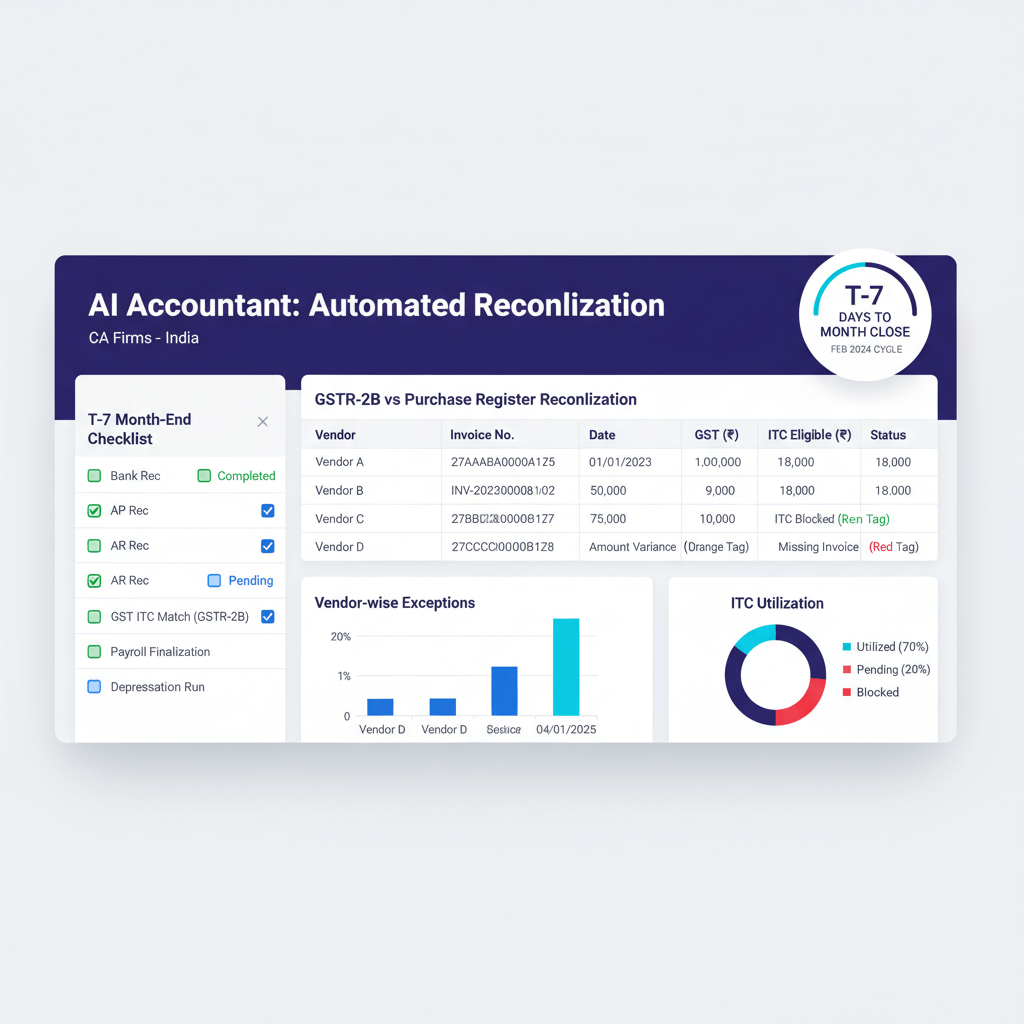
Picture the flow, bills are ingested in bulk, GSTINs and POs are validated, payments are matched to invoices, ITC eligibility is checked against 2B, then clean entries are posted to the GL.
The real advantage is time. You can chase missing invoices, resolve PO mismatches, and correct GSTIN errors while vendors and internal teams are still responsive.
Why It Matters for CA Firms in India
CA firms in India handle multiple clients, each with tight GSTR-3B timelines, with complex demands like GSTR-2B matching, TDS deduction accuracy, MSME payment timelines, e-invoice IRN validation, and RCM tracking. Month end recon CA firms india becomes manageable when you shift to a proactive pre close approach.
Starting early consistently reduces exceptions by 40 to 60 percent. That means fewer ITC reversals, fewer audit flags, fewer rework loops, and a calmer close. Your clients experience you as proactive because you resolve issues by T-5, not after the month ends.
Pre-Close Timeline and Ownership (T-7 to T-0)
T-7, foundation and previews
Sync vendor masters and GSTINs, pull bank and card statements, and download the GSTR-2B preview. AP Executive executes, CA Reviewer is accountable.
T-5, capture and validate bills
Ingest all bills, deduplicate, verify GSTINs, and obtain vendor statements. AP Executive is responsible and accountable.
T-3, payments matching and exceptions
Match payments to bills, flag exceptions to procurement or vendors, and involve the client SPOC for disputes.
T-2, accruals and GRIR clearing
Book unbilled accruals, clear GRIR, post credit and debit notes. CA Reviewer signs off on accuracy.
T-1, final tie out and lock
Complete subledger to GL reconciliation, recheck ITC eligibility, and lock books. Controller signs off.
This cadence gives breathing room to correct vendor statements, investigate 2B surprises, and finalize reconciliations without last minute fire drills.
Data You Need Ready (India Stack)
- Purchase documents, complete purchase register, vendor masters with GSTIN and addresses validated, purchase orders, goods receipt notes, advances, debit notes.
- Payment data, normalized bank statements, credit card statements with merchant clarity, employee reimbursements with supporting proofs.
- Compliance files, GSTR-2B for the period, TDS rate mappings by vendor type, e-invoice proofs with IRN and QR code.
When this data is at hand, reconciliation becomes a straight run rather than a scavenger hunt.
The Pre-Close AP Reconciliation Checklist
This checklist blends global controls with Indian specifics. Work through it methodically.
- Subledger versus GL tie out, reconcile AP subledger with the control account, clear suspense, and target variance under one percent.
- Vendor statement reconciliation, match balances, apply old credits, confirm TDS deduction and reflection.
- Clear goods receipt and invoice receipt differences, link pending GRNs, accrue services consumed but not billed, and flag RCM items.
- Book unbilled accruals, estimate recurring costs like utilities, rent, AMC, and validate place of supply for GST.
- Review advances and deposits, map advances to POs, track security deposits separately, verify MSME classification for payment terms.
- Apply credit and debit notes, ensure proper impact on payables and aging buckets.
- Detect duplicates, scan for same vendor, date, amount combinations, and watch for split invoices booked twice.
- Link all payments, match full and partials, handle split payments across bills, and ensure bank feeds are current.
- Handle foreign exchange, revalue foreign currency payables and book unrealized gains or losses.
- Tax compliance checks, match GSTINs to 2B, exclude ineligible ITC, verify e-invoice IRNs, and target 95 percent plus ITC eligibility.
- Review aging analysis, highlight overdue amounts, estimate MSME interest exposure, and flag items beyond 90 days.
- Document everything, maintain an exception log, preserve vendor communications, obtain sign offs, and prepare audit workpapers.
Handling Exceptions Quickly
- Categorize fast, missing invoice, wrong GSTIN, PO mismatch, quantity variance.
- Use templates, standardized vendor and internal emails save hours.
- Decision rules, accrue at T-2 if invoice is missing, document and proceed for variances below a threshold like ₹10,000.
- Escalation matrix, AP handles first level, procurement for vendor disputes, CA reviewer for tax matters.
Vendor note, “Invoice number 12345 shows GSTIN mismatch with PO 7788, please confirm the correct GSTIN or revised invoice within 48 hours.”
Clarity plus deadlines turn exceptions into quick closures.
Automation to Operationalize at Scale
Manual reconciliation does not scale across many clients or high volumes. Tools like AI Accountant automate bulk PDF or Excel ingestion, duplicate detection, fast GSTR-2B matching, and bank statement normalization. Multi organization dashboards help CA firms track status across clients and sync cleaned data back to Tally or Zoho Books.
The impact is tangible, teams report faster closes, fewer errors, and more time for advisory, rather than data chasing.
Mini Case: CA Firm Transformation Story
A Bangalore based CA firm with 25 SME clients adopted the T-5 pre close routine, synced Tally, and automated GSTR-2B matching. Within three months, AP exceptions fell by up to 60 percent, GSTR-2B mismatches dropped by 30 percent, and average close time reduced by two days per client, all without hiring additional staff.
What Happens If You Skip Reconciliation India
- Permanent ITC loss, unnoticed 2B mismatches cause reversals, interest hits, and working capital strain.
- Vendor friction, incorrect balances trigger payment disputes, stricter credit terms, and cash flow pressure.
- MSME penalties, interest at 18 percent annually adds up quickly when timelines are breached.
- Audit qualifications, unreconciled differences invite qualifications, weakening lender and investor confidence.
- Bad decisions, late and inaccurate reports mislead management, compounding errors over time.
KPIs and Governance
Process metrics
Percentage matched by T-3, unmatched vendor statements, duplicate detection rate, ITC eligibility rate, GL to subledger variance.
Efficiency metrics
Average time to resolve exceptions, percentage closed within SLA, and reduction in post close adjustments month over month.
Governance structures
Close week standups, daily exception dashboard reviews, standardized checklists, and monthly retros to harden the SOP.
30-Day Rollout Plan
Week 1, foundation
Define the T-5 cutoff calendar, assign RACI, customize the checklist, draft vendor statement templates, and set up an exception tracker.
Week 2, tools
Configure Tally or Zoho Books extraction, set up automation like AI Accountant, pilot bill ingestion with two vendors, and document configurations.
Week 3, integration
Add GSTR-2B download and matching, implement payment linking, create accrual templates, run end to end tests, and train the team.
Week 4, scale
Review KPIs, tune timelines, roll out to all vendors or clients, lock the SOP with version control, and schedule monthly improvement reviews.
Start small, learn fast, and scale steadily. Within three cycles, pre close discipline transforms month end from chaos into routine.
FAQ
Is AP reconciliation before month close necessary if we already do month end reconciliation?
Yes, pre close catches the majority of issues early, giving you time to correct GSTIN errors, accrue missing bills, and resolve vendor queries before filings. It converts the final reconciliation into a confirmation step, not a firefight.
How should CA firms handle month end recon CA firms india across multiple clients with limited staff?
Standardize a T-7 to T-0 cadence across all clients, use multi organization tools like AI Accountant, assign fixed owners per client, and review a single cross client exception dashboard daily. Consistency beats heroics.
What is the best approach if vendors do not provide statements in time?
Send balance confirmations early, escalate at T-3, and if still pending at T-2, accrue based on PO or historical run rate. Document outreach attempts and reconcile formally in the following cycle when statements arrive.
How do we handle RCM and ineligible ITC items during pre close?
Flag RCM at bill entry, maintain a dedicated RCM ledger, and exclude ineligible ITC in the T-1 review. Keep documentation explaining why specific ITC was not claimed to satisfy audits.
Which Tally or Zoho Books reports are essential for an efficient AP pre close?
Pull AP aging, the full purchase register, individual vendor ledgers, bank reconciliation reports, and outstanding bills for accrual verification. These reports create the backbone for matching and tie outs.
How should we reconcile for multi state operations with multiple GSTINs?
Reconcile by GSTIN location, match place of supply meticulously, exclude inter state stock transfers from AP, and align ITC claims to the receiving location. Consider automation that supports multi GSTIN configurations.
What T-7 to T-0 cadence works for a small CA firm with two team members?
Compress the cycle, T-6 for vendor master and bank pulls, T-4 for bill capture, T-3 for payment matching, T-2 for accruals and GRIR, T-1 for GL tie out and ITC confirmation. Use AI Accountant to automate ingestion and matching to keep workload manageable.
How do we produce audit ready evidence for AP reconciliation?
Maintain a dated exception log, vendor confirmations, 2B match reports, GL to subledger reconciliations, and sign offs. Archive copies of IRN proofs and TDS workings. An AI Accountant audit pack can compile these artifacts for each period.
How do we reconcile GSTR-2B when supplier invoices land in the next month?
Record the bill in the correct period for expense recognition, accrue if the invoice is missing at T-2, and reconcile ITC in line with the month the supplier reported in 2B. Track timing differences and reverse or claim ITC accordingly in the subsequent filing.
How should MSME vendors be treated in aging and interest calculations?
Tag MSME status in the vendor master, enforce the 45 day limit in aging, estimate interest exposure during pre close, and prioritize payments accordingly. This reduces penalty risk and preserves supplier goodwill.
What is the recommended method to book accruals for recurring services like rent or AMC?
Use templates with pre approved rates and GL codes, book accruals at T-2 based on contracts or historicals, and reverse automatically when invoices arrive. Example, debit expense and credit accrued liabilities, then clear against the invoice on receipt.
How does AI Accountant integrate with Tally or Zoho Books and what data syncs back?
AI Accountant ingests PDFs or Excels, runs duplicate checks, matches to 2B, and normalizes bank statements. Clean bills, payment links, and reconciled statuses sync back to Tally or Zoho Books, reducing manual posting and ensuring books reflect verified data.