-01%201.svg)
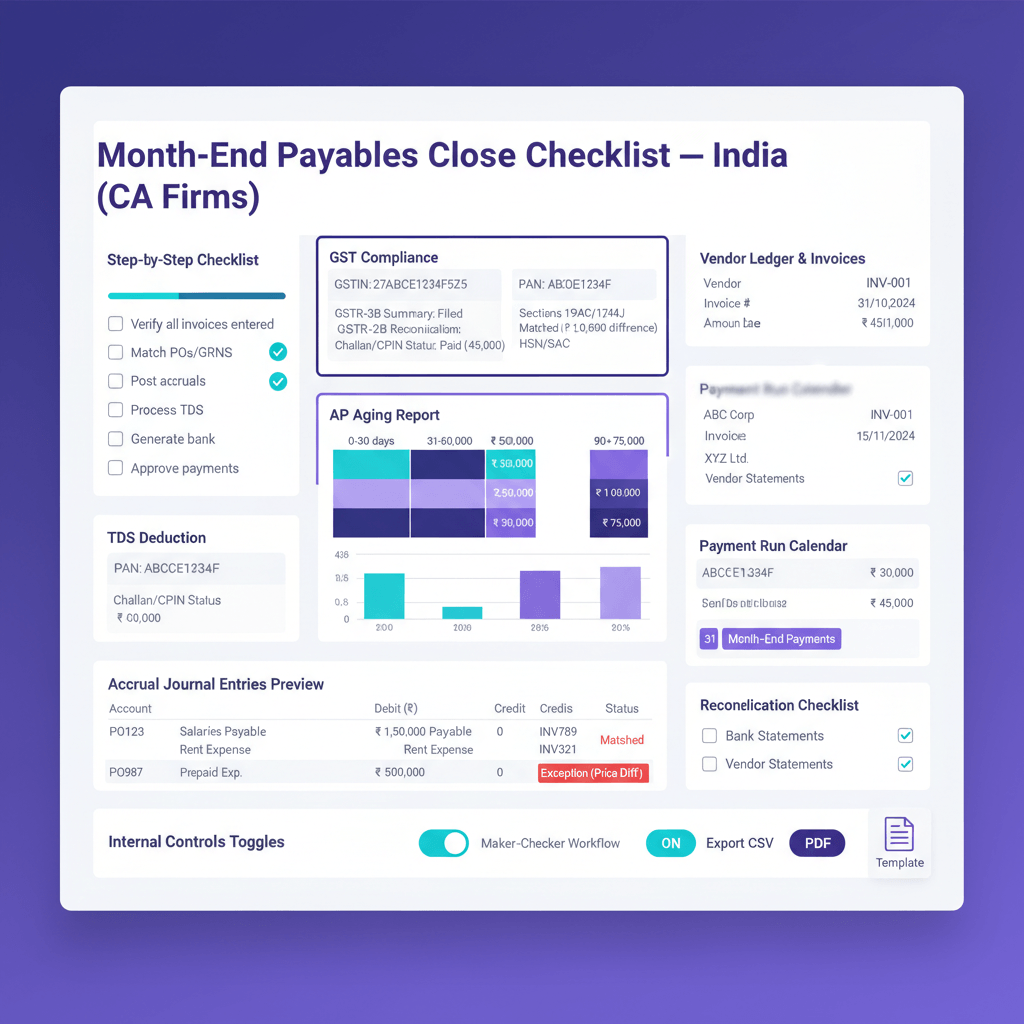
Key takeaways
- A structured, India specific AP checklist reduces risk, speeds up closing, and improves compliance across GST, TDS, and MSME obligations.
- Ingest and validate every bill quickly, confirm GSTINs, HSN, and tax splits, and prevent duplicates before they hit your ledger.
- Reconcile your purchase register with GST 2B, classify mismatches, and document vendor follow ups for a clean ITC position.
- Apply correct TDS sections, record liabilities on booking, and reconcile TDS payable to avoid penalties and disputes.
- Use consistent accruals, reversals, and MSME interest provisioning to reflect true period costs, not just cash movements.
- Enforce payment controls with maker checker approvals, bank matching, and exception tracking to eliminate leakages.
- Leverage AI Accountant to automate ingestion, reconciliation, and approvals, turning a week long close into a two day routine.
Why Your Month End Close Process Needs Structure
Without a clear process, AP closing becomes a scramble, invoices get missed, and compliance risk rises. A structured workflow turns chaos into repeatable steps, your GST filings align to your books, TDS is deducted and recorded correctly, and vendor aging stays accurate. Most importantly, your team closes faster with fewer surprises.
What gets standardized gets faster, what gets documented gets audited without stress.
Bottom line, when you standardize the sequence and ownership of tasks, you reduce rework, protect cash, and raise confidence in reported numbers.
Pre Close Preparation: Setting the Foundation
Start early, around the 25th
Review pending bills, chase missing invoices, and maintain a tracker for vendor, expected amount, and follow up date. Remind departments to submit expenses by the 27th, including original invoices, approval emails, and support.
Stabilize recurring items
List rent, utilities, AMCs, and subscriptions, then flag anomalies. Keep bank and card statements ready by the 28th so reconciliations can start immediately.
Organize your workspace
Create current month folders, refresh reconciliation templates, and update vendor master data. These simple steps prevent last minute firefighting.
Bill Ingestion and Data Capture
Ingest all invoices, whether they arrived by email, portals, or WhatsApp. Scan physical bills immediately to secure a digital backup. For each bill, capture vendor GSTIN, invoice number, date, taxable value, GST breakup, and HSN codes. Watch for duplicates, interstate tax type errors, and advances treated as regular bills.
Pro tip: AI Accountant can auto extract details from PDFs, images, and even handwritten invoices, reducing manual entry from days to hours while validating vendor master data along the way.
GST Reconciliation and Compliance Checks
Download your 2B, then reconcile it to your purchase register with clean vendor GSTINs and invoice metadata. Use invoice number and amount for first pass matches, then investigate books only entries or tax type mismatches. Remember that RCM purchases will not appear in your 2B, record liability and ITC appropriately where eligible. For a deeper overview of matching approaches and tools, see GST 2B.
Classify items as Matched, Vendor filing pending, Under query, or ITC not eligible, then document vendor communications for audit trails. This classification accelerates return filing and later notice handling.
TDS and Withholding Tax Management
Evaluate every vendor bill for applicable sections, for example 194J for professional fees, 194C for contractors, and 194I for rent. Consider the earlier of booking or payment rule, verify PANs, and apply higher rate where PAN is unavailable. Record TDS payable entries against each vendor bill, reducing vendor liability and creating the government liability.
Issue provisional Form 16A monthly to curb vendor disputes, track lower deduction certificates under section 197 with validity checks, and reconcile TDS ledgers to confirm deposit amounts by the 7th. For automation ideas on deduction and posting, review TDS compliance.
Expense Accruals and Provisions
Accrue utilities, salaries, professional fees, and interest so financials reflect usage, not billing dates. Reverse prior month accruals on the first day to avoid double counting. Assess MSME interest where dues exceed forty five days, even if not demanded. Track accruals versus actuals so estimates improve over time.
Vendor Reconciliation and Aging Analysis
Reconcile high value vendors first using their statements, match payments accurately, and settle credit or debit notes before close. Park advances in separate accounts and clear them against invoices. Produce aging buckets, highlight MSME vendors nearing forty five days, and maintain a disputed items log with reason and expected resolution date.
Payment Processing and Controls
Prioritize statutory dues, then vendors based on terms, discounts, MSME timelines, and cash availability. Reconcile payments to bank entries in real time, track UPI and card reference mappings, and maintain stop payment and failure logs. Strengthen authorization with Payment approval workflows, using maker checker, thresholds, and documented exceptions.
Bank and GL Reconciliation
Match every payment and receipt to bank statements, capture bank charges via standard journals, and age outstanding cheques. Align card cycles to your cutoff, track unbilled charges, and reconcile vendor subledgers to control accounts. Clear suspense items, book realized forex gains or losses at payment time, and eliminate intercompany transactions where you consolidate.
Documentation and Audit Trail
Maintain searchable digital invoices with consistent naming, preserve approvals, and archive reconciliation workbooks for GST, TDS, vendor, and bank. Keep change logs, highlight exceptions such as bills without PO or unusual terms, and compile a month end signoff checklist with reviewer acknowledgments. Attach aging summaries, payment runs, and accrual schedules to your close pack.
Tip for audits: Save email threads for disputes, vendor confirmations, and GST mismatch chasers, they resolve questions faster than rework later.
Common Pitfalls and Solutions
- Missing invoices: Start follow ups by the 25th, maintain an expected bills tracker, and use portal fetch where possible.
- GST mismatches: Reconcile during the month, not just at close, and escalate vendors with consistent delays.
- TDS errors: Maintain a vendor TDS master, verify PANs quarterly, and automate section picks in your AP tool.
- Duplicate payments: Enforce three way matching and implement a payment run tracker that flags repeats.
- Forex confusion: Book realized differences on payment date, document your rate sources, and apply them consistently.
- Accrual reversals missed: Use auto reversal entries dated the first, then true up on bill receipt.
- Cutoff mistakes: Define a clear cutoff policy, record expenses in the period incurred, and document exceptions.
Technology and Automation Opportunities
Automation compresses timelines, raises accuracy, and enforces policy. AI Accountant, QuickBooks, Xero, FreshBooks, and Zoho Books ingest invoices automatically, extract tax data, and validate vendor masters. Vendor portal integrations reduce misses, three way matching slashes exceptions, and automated GST 2B reconciliation turns multi day work into a focused review. Payment automation and dashboards give real time visibility into aging, outflows, and bottlenecks. Integrations remove double entry between AP, accounting, and banking.
Many CA firms have already moved from manual AP workflows to AI-assisted processes, cutting close timelines and reducing reconciliation effort without expanding their teams. Looking at real-world implementation examples can help you plan a smoother transition and avoid common adoption challenges.
Let the system handle the routine, let your team handle the exceptions.
Building Your Custom Checklist
Tailor the framework to your industry, vendor mix, and systems. Add items for consignment or intercompany flows, include MSME focused alerts, and capture software specific close steps. Set realistic timelines, define escalation paths, and review the checklist quarterly to remove noise and add new requirements. A living checklist sustains speed and accuracy as your business evolves.
Conclusion
A disciplined, India specific AP close checklist delivers speed, compliance, and confidence. Start early, stay organized, and use automation where it counts. Your process will mature with each cycle, regulations will change, and your stack will evolve, yet a clear checklist keeps month end predictable. Begin with the essentials today, refine as you learn, and watch your close become smoother with every period.
FAQ
What are the non negotiable items on an India focused AP month end checklist for a CA serving multiple clients?
Capture and validate every invoice, reconcile purchase register with GST 2B, evaluate TDS on booking, post accruals and reversals, reconcile vendor statements and bank, and finalize a documented signoff. Use AI Accountant for bulk ingestion and reconciliation to standardize across clients.
How do I structure GST reconciliation when the client has delayed vendor filings and frequent RCM entries?
Split the register into three buckets, matched, vendor filing pending, and RCM. Record RCM liability and eligible ITC in books regardless of 2B, and document vendor follow ups with dates. AI Accountant can auto classify and surface exceptions for faster action.
What is the correct TDS timing, on booking or on payment, and how do I avoid month end misses?
Apply the earlier of booking or payment rule. Configure your AP system to auto create TDS payable on bill posting, then reconcile the TDS payable ledger against deductions before the 7th. AI Accountant can post entries and produce provisional 16A summaries.
How should a CA handle MSME interest provisioning at month end for clients with delayed payments?
Identify MSME vendors, compute interest for dues beyond forty five days, and provision monthly even if the vendor has not demanded it. Flag these invoices in aging to prioritize payment runs next month.
What controls should I enforce in payment runs to prevent duplicate or unauthorized payouts?
Implement maker checker approvals with thresholds, restrict payment runs to approved invoices only, perform pre run duplicate checks, and reconcile payment confirmations to bank entries. AI Accountant supports automated approval routes and exception logs.
How do I estimate accruals reliably when bills arrive after close, for example utilities and professional fees?
Use rolling averages adjusted for seasonality, add known rate changes, and compare against usage metrics where available. Reverse on the first of next month, then true up to the actual bill. Track estimate versus actual variance to improve accuracy.
What is the best approach to vendor reconciliation when payments are split across multiple invoices and credit notes?
Obtain the vendor statement, map each payment to invoice references, allocate partials systematically, and settle credit notes before close. Maintain a disputed items register with reason and expected resolution date to keep aging clean.
How do I manage foreign currency vendor payments at close, especially for software subscriptions and imports?
Record bills at transaction date rate, record payments at actual bank rate, book realized gain or loss immediately, and reconcile statement fees. Maintain a central rate log with sources to support audit queries.
What documents must be in my AP audit pack to survive scrutiny without last minute chasers?
Invoice copies, approvals, GST 2B reconciliation workbook, vendor statements with tie outs, TDS deduction summary and certificates, payment run approvals, bank reconciliations, accrual schedules, and the signed month end checklist.
How can AI Accountant reduce my month end close time across multiple client books?
AI Accountant automates invoice ingestion, validates GSTINs, performs 2B matching with exception surfacing, applies TDS rules with postings, and routes approvals. CAs report moving from week long closes to two day routines with far fewer post close corrections.
What cutoff policy should I enforce to prevent January expenses appearing in February and vice versa?
Define a clear rule, record expenses in the period incurred, supported by GRNs, service completion, or consumption logs, not bill dates. Allow a brief grace window with accruals, then reverse. Communicate the cutoff to all departments by the 25th.
How do I design a scalable AP checklist for a fast growing startup that is onboarding new vendors every week?
Standardize vendor onboarding with PAN, GSTIN, and MSME capture, enforce PO usage, automate invoice ingestion and three way matching, schedule weekly mini reconciliations, and keep the checklist modular so new steps can be added without disrupting signoffs.