-01%201.svg)
Key takeaways
- Manual AP processes create duplicate payments, GST errors, and weak audit trails, automation embeds preventive checks directly into the workflow.
- Build controls around verified vendor masters, maker checker changes, and threshold based approvals, every action should be logged and reconstructable.
- Practical segregation of duties AP India for small teams separates request, receive, record, approve, pay, and reconcile, even with two or three people.
- Design an approval workflow AP India with amount thresholds, risk based routing, and immutable approvals, mobile approvals speed cycle time without sacrificing control.
- Automate duplicate detection, three way matching, and GSTIN validation to cut AP cycle time from 15 days to under 5, while staying audit ready.
- CA firms can standardize AP controls CA firm India with SOPs, RACI, and close checklists, then tailor for industry specifics.
- Integrations with Tally or Zoho Books, powered by AI Accountant, deliver India first compliance, clean data flow, and measurable ROI.
Why AP controls fail in Indian SMEs
The real cost of manual AP processing
Duplicate vendor bills slip in when different team members key the same invoice with minor variations, the pain appears during month end reconciliations. Fake or blocked GSTINs pass manual checks, ITC gets claimed, then notices arrive. PO bypass and split billing evade limits, MSME delays trigger interest. Without automation, detective controls come too late.
Tip, treat every manual handoff as a risk, then insert a system check or a clear approval before money moves.
Control objectives that actually work
- Accuracy and validity, verified GSTIN, PAN, bank, and MSME status, bills validated against POs and receipts.
- Authorization, approvals by level, vendor risk, and category.
- Completeness, every transaction captured, nothing lost across email, WhatsApp, and paper.
- Timeliness, MSME 45 days, TDS by the 7th, GST filings as scheduled.
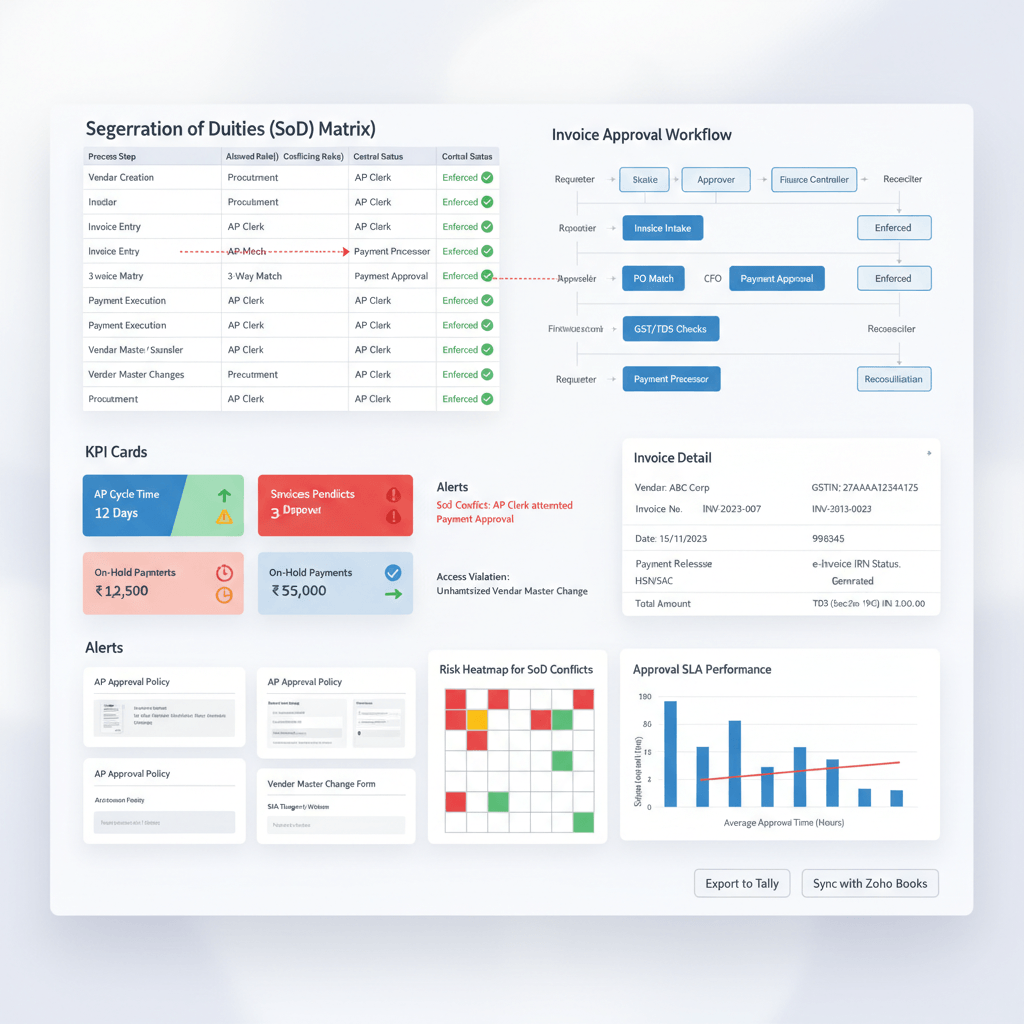
- Segregation of duties, no one person can request, receive, record, approve, and pay.
- Auditability, immutable trails, timestamps, and change logs.
Core control framework for Indian AP operations
Build a reliable vendor master
Start with verified onboarding, see this vendor onboarding automation India guide. Verify GSTIN via APIs, match legal name, confirm not blocked or cancelled. Match PAN, run penny drop for bank accounts over payment thresholds, capture MSME registration upfront.
- Maker raises a new vendor or change request, checker validates documents, approver authorizes, all changes logged.
- Monthly de duping, block on disputes, separate flows for related parties and foreign suppliers.
Map procure to pay with controls at each gate
- Requisition, budget check, PO issuance.
- Goods receipt, quantity and quality confirmation against PO.
- Bill capture, OCR or import, system validations, automatic duplicate detection.
- Three way matching within tolerances, exceptions routed to owners.
- Approval routing by thresholds and risk, dual authorization for bank releases.
- Posting, and continuous GSTR 2B reconciliation.
Preventive controls block errors before entry, detective controls surface exceptions quickly, corrective controls define the remediation path, use all three.
Segregation of duties AP India
Role separation that fits small teams
- Requester, raises need, cannot approve own requests.
- Purchaser, converts to PO, negotiates, does not receive goods.
- Receiver, confirms GRN, does not process bills or payments.
- AP processor, enters bills and prepares batches, cannot approve or edit vendor masters.
- Approver, authorizes with documents, cannot initiate or post.
- Payment authorizer, releases funds, view only otherwise.
- Reconciler, matches bank to books, flags differences, no posting of adjustments.
For very small teams, combine compatible roles carefully, for example, the bill entry person can prepare but not approve payments, the receiver can verify bills but not post or pay.
Practical SoD signals and compensating checks
- Red flags, shared logins, end to end control by one user, undocumented overrides, frequent manual adjustments.
- Compensating controls, weekly variance reviews, monthly vendor statement reconciliations, surprise audits, mandatory narratives for overrides with second level sign off.
Approval workflow AP India
Design threshold based routing
- Up to 25,000, department manager.
- 25,000 to 2 lakhs, department head plus finance manager.
- Above 2 lakhs, CFO or founder, above 10 lakhs, board or committee when material.
Apply risk based layers, new vendors need extra verification, capital expenditure follows technical and financial reviews, non PO spends need stronger justification, related parties go via audit committee, foreign currency payments include forex and regulatory checks.
Emergency payments get a fast track with strict monitoring and post facto approval, frequent emergencies signal poor planning, address root causes.
Documents by level
- Routine, PO, vendor bill, GRN for goods, completion note for services.
- Medium, three quotes above 50,000, budget confirmation, contracts or work orders.
- High value, vendor evaluation, technical specs, legal opinions when complex.
- Compliance, GSTIN verification result, GSTR 2B match for ITC, RCM tracking, TDS workings and proofs, MSME certificates for 45 day monitoring.
Implement immutable approvals
Use native Zoho Books workflows or Tally extensions, approvals lock records, edits re trigger approval, timestamps and digital signatures add legal standing.
Enable mobile approvals with MFA, handle delegations and escalations with expiry, integrate capture and matching so only clean, validated bills enter queues, tools like AI Accountant streamline this path.
AP controls CA firm India
Templates that scale across clients
- RACI for every AP task, onboarding, PO, GRN, bill process, approvals, payments, reconciliations, GST, TDS, MSME.
- SOPs with control points marked, month end close lists, exception reporting formats, standardized vouchers and coversheets.
- Assessment questionnaires to score maturity, gap remediation plans with timelines.
Close and audit, done right
- Vendor statement reconciliations, resolve differences, separate disputes.
- Aging review, MSME interest accruals where delayed, forward payment plans.
- Monthly GSTR 2B reconciliation, ITC reversals for non compliant vendors with documentation.
- TDS rate checks, deposits by due date, 26AS tie outs, quick corrections if needed.
- Binders with approvals, duplicate detection logs, exception registers, retention schedules.
Outsourced AP with independence
Keep processor and approver roles separate between firm and client, use client specific mailboxes and credentials, define SLAs, report volumes and exceptions, apply peer review and sample testing before client sign off.
Automation techniques for stronger controls
Duplicate detection, from flagging to prevention
- Fuzzy matching across vendor, invoice number, amount, and date with calibrated tolerances.
- Behavioral patterns, sequential numbers across vendors, round amounts, just below thresholds.
- Prevention, enforce unique invoice numbers, block likely duplicates at source, require explanations for near matches, use vendor portals for direct submission.
Automated three way matching
Compare PO, GRN, and bill automatically, apply quantity and price tolerances by category, route quantity issues to receiving, price variances to procurement, and non PO bills to higher approvals, integrate ERP and warehouse data so over billing cannot pass.
GST and compliance automation
Embed GSTIN validation at vendor creation, bill entry, and pre payment, use real time checks for legal name and status, schedule periodic re validations. Automate GSTR 2B matching, TDS computations with thresholds and certificates, MSME timers with interest, and RCM self invoices with return ready reports.
Technology stack and integration options
Recommended tools for Indian businesses
- AI Accountant, seamless Tally and Zoho Books integration, bulk bill extraction, automatic GSTIN validation, fast GSTR 2B reconciliation, India first compliance.
- Zoho Books, native GST and TDS, solid approvals, mobile friendly.
- Tally Prime, familiar backbone with workflow add ons and robust ledgers.
- QuickBooks India, solid bank reconciliation, basic approvals.
- FreshBooks, simple AP for service firms, OCR and expense tracking.
- Xero, strong reconciliations and integrations for multi currency exporters.
Integration architecture with Tally and Zoho
- Keep ERP as ledger of record, sync masters one way, post validated transactions back.
- Use APIs and webhooks for real time, batches for volume, with retries and exception queues.
- Validate data at the boundary, formats, business rules, duplicates, and reconciliation reports.
Security and compliance
- Role based access, least privilege, no maker approving own items.
- Encryption in transit and at rest, immutable audit logs with reviews.
- Data residency in India, backups, DR drills, API key rotation, IP whitelisting, rate limits.
Implementation roadmap
Phase 1, policy and process
Document current flows, define approval limits and SoD, map controls to system enforcements, draft SOPs per role, agree objectives such as duplicate rates under one percent, three way matches above ninety five percent, and one hundred percent on time TDS deposits.
Phase 2, data cleanup
De duplicate vendors, standardize names and invoice numbering, clear old POs and disputes, verify GSTIN, PAN, bank, MSME, align formats across systems, and train users on data quality.
Phase 3, tool setup
Configure approvals and tolerances, connect AI Accountant to Tally or Zoho, enable real time GSTIN checks, schedule GSTR 2B reconciliation, deploy dashboards, and enforce roles and logging from day one.
Phase 4, pilot and refine
Run parallel pilots, track cycle time, match rates, and exception volume, adjust thresholds and routing, test edge cases, and validate GST, TDS, MSME outcomes.
Phase 5, full scale rollout
Expand category by category, lock down bypasses, visualize performance, review monthly, train continuously, and pursue incremental automation wins.
Measuring success, KPIs and metrics
Operational efficiency
- Duplicate payment rate, target under one percent, investigate spikes.
- First pass three way match, target above ninety five percent, diagnose PO or GRN gaps if low.
- AP cycle time, target under five days, resolve bottlenecks by stage.
- Straight through rate, aim for eighty percent, shrink exception queues.
- Cost per invoice, prove ROI year over year.
Compliance performance
- TDS deposit timeliness at one hundred percent, alerts before due dates.
- MSME payments within forty five days, interest tracking where breached.
- GST reconciliation completeness against GSTR 2B, documented ITC reversals.
- Audit trail completeness, near zero missing approvals.
Financial impact
- Working capital gains from faster processing, early payment discounts captured.
- Duplicate recoveries and prevention rates, visible month on month.
- Penalty avoidance on TDS, GST, MSME, with quantified savings.
- Productivity lift, invoices per FTE pre and post automation, audit effort reduction.
Common challenges and solutions
Managing change resistance
Reassure teams that automation removes drudgery, not roles, nominate champions, train with hands on labs, phase the rollout, and celebrate quick wins.
Handling integration complexity
Use experienced integrators for legacy Tally and Zoho versions, standardize master data, scale with batches and queues, implement robust retries and error handling, and monitor integration health continuously.
Ensuring sustained adoption
Keep leadership attention on dashboards, run quarterly refreshers, solicit feedback, govern through an AP excellence forum, and manage upgrades with proper change control.
Future proofing your AP controls
Tech trends to watch
AI improves coding and anomaly detection, RPA handles routine invoices, real time payments change timing strategies, e invoicing expands, and mobile first approvals become the norm.
Staying ahead of regulation
Parameterize rules for quick updates, subscribe to alerts, test changes before go live, prepare for deeper digitization and continuous audit requirements.
Designing for scale
Anticipate new thresholds, roles, and volumes, choose cloud and API friendly tools, document thoroughly, and nurture a continuous improvement culture with strategic vendor partnerships.
Further reading, hand picked
- A practical guide to AP internal controls
- AP internal controls, a comprehensive overview
- Accounts payable automation India guide
- Internal controls for accounts payable
- Accounts payable controls with ApprovalMax
- HighRadius on AP internal controls
- AP automation for Indian real estate
- Concur guide to AP automation
- Tipalti, AP automation for controllers
- Video, AP internal controls explained
Conclusion, your path to AP excellence
Implementing internal control AP automation India prevents leakages, improves compliance, and sharpens visibility. Start with SoD that fits your headcount, layer threshold based approvals, then automate duplicate detection, three way matching, and compliance checks. Expect faster cycles, fewer errors, and stronger vendor relationships.
Tools like AI Accountant integrate with Tally and Zoho Books, validate GSTINs, extract bills, and reconcile GSTR 2B automatically, so your team focuses on analysis, not admin. Begin with documenting today’s process, close the biggest gaps first, and expand steadily, you will adapt confidently as regulations evolve.
FAQ
How should a CA firm structure segregation of duties in a three person AP team without adding headcount?
Split by process stage, one person handles requisition to PO, one person handles GRN and bill verification, one person posts bills and prepares payment batches, then route approvals to client signatories or a senior partner. Enforce that the bill poster cannot approve or release funds, and the reconciler cannot post adjustments. Use an AI tool like AI Accountant to lock approvals and maintain immutable logs.
What is a practical approval threshold matrix for Indian SMEs that balances speed and control?
Use three bands, up to 25,000 by department manager, 25,000 to 2 lakhs by department head plus finance manager, above 2 lakhs by CFO or founder, consider board level review above 10 lakhs for material spends. Add risk rules, new vendors, non PO spends, related parties, and foreign currency must get one higher level review regardless of amount.
How can I stop duplicate invoices in Tally or Zoho Books when multiple users enter bills?
Enable unique invoice number checks, deploy fuzzy duplicate detection that compares vendor, number, date, and amount, and block entry pending review. AI Accountant can scan historical data, flag near matches in real time, and prevent posting until a checker clears the exception.
What documents are mandatory at each AP approval level for GST and audit readiness?
For routine spends, PO, bill, and GRN or completion note. For mid value, add three quotes above 50,000 and budget proof. For high value, add vendor evaluation, specs, and legal review where needed. GSTIN verification, GSTR 2B match result, RCM tagging, and TDS workings must be attached before payment. Missing documents should block approval automatically.
How do I implement three way matching with partial receipts and price variances?
Track cumulative receipts against PO quantities, enforce quantity and price tolerances by category, route quantity mismatches to stores, price variances to procurement, and non PO bills to higher approvals. AI Accountant can sync POs and GRNs from Tally or Zoho, match automatically, and create exception queues with owners and due dates.
What is the best way to automate GSTIN validation and GSTR 2B reconciliation monthly?
Validate GSTIN at vendor creation, bill entry, and pre payment via real time APIs, then schedule monthly GSTR 2B downloads, auto match to your purchase register, and generate ITC mismatch reports. AI Accountant handles continuous GSTIN checks, flags blocked or cancelled registrations, and produces reconciliation dashboards with action items.
How do I track and comply with the MSME 45 day payment requirement within AP workflows?
Capture MSME status during onboarding, start the 45 day timer from bill receipt, use system alerts at 30 and 40 days, and block non essential payments that would cause a breach. Accrue interest automatically if delayed. AI Accountant can tag MSME vendors and surface aging to approvers before the breach occurs.
What compensating controls work when one person must combine bill entry and payment preparation?
Mandate second level approvals for every payment batch, lock vendor master edits to a different user, require dual authorization for bank releases, and run weekly exception and variance reviews by a senior who does not post transactions. Keep immutable logs and conduct surprise audits monthly.
How can a CA firm deliver outsourced AP while maintaining independence and clear audit trails?
Use separate mailboxes and credentials per client, firm staff process and prepare, client approvers authorize and release. Enforce SoD in tools, keep role based access, and publish SLAs and exception logs. AI Accountant can centralize documents, approvals, and GST reconciliations, giving clients read access to trails on demand.
Which KPIs should I report to management to prove AP control effectiveness and ROI?
Report duplicate rate under one percent, first pass three way match above ninety five percent, AP cycle time under five days, straight through processing above eighty percent, on time TDS deposits at one hundred percent, MSME on time percentage, and savings from duplicate prevention and penalty avoidance. Include vendor satisfaction and audit finding reductions.
How do I configure Zoho Books approvals and keep them immutable for audit?
Create rules for thresholds and risk categories, require attachments for each level, enable lock on approval, and force re approval if any header or line changes occur. Use MFA for mobile approvals and set delegation expiry. Feed only validated bills into Zoho using AI Accountant, so approvers review clean, matched data.
What is the recommended approach to handle RCM in automated AP flows?
Auto classify RCM categories during bill capture, compute tax on reverse charge, generate self invoices, and post to correct ledgers for return readiness. Ensure these are excluded from ITC until paid as per rules. AI Accountant can tag RCM bills and produce RCM specific reports for filings.