-01%201.svg)
Key takeaways
- Tally remains the de facto ledger for Indian SMB compliance, while Zoho wins on bank feeds, mobility, and collaboration.
- Mid-year migration risks fragmenting your audit trail and GST history, increasing scrutiny and rework.
- Pure cloud tools shine for sub-₹2 crore, service-first businesses, but struggle with complex inventory and TDS scenarios.
- Supplier non-compliance drives recurring ITC exposure, automation for GSTR-2B matching is now essential for CA firms.
- A hybrid stack, Tally for statutory books plus automation for bills, bank, and 2B matching, yields 2-3x productivity without migration risks, try GSTR-2B reconciliation.
Zoho Books vs Tally: the short answer for Indian CA firms
With over 2 million Tally users in India and Zoho Books capturing 15% of the cloud accounting market share per the Tracxn Market Report 2024, the real decision for CA firms is not a feature shootout, it is whether switching 20 or more clients mid-year makes economic and compliance sense.
Bottom line: Keep Tally Prime as your statutory system of record for GST, e-invoicing, inventory, and audit trails, layer automation for high-volume work, and reserve full cloud migration for simple, service-only clients that do not need deep customisation.
Both platforms can generate e-invoices for entities above the ₹5 crore threshold as per CBIC Notification 10/2023, yet Tally offers tighter control over cancellations and amendments. Zoho Books excels at automated bank feeds, mobile access, and multi-user collaboration, but it falls short in complex inventory, job costing, and nuanced TDS workflows.
Side by side, where each platform excels
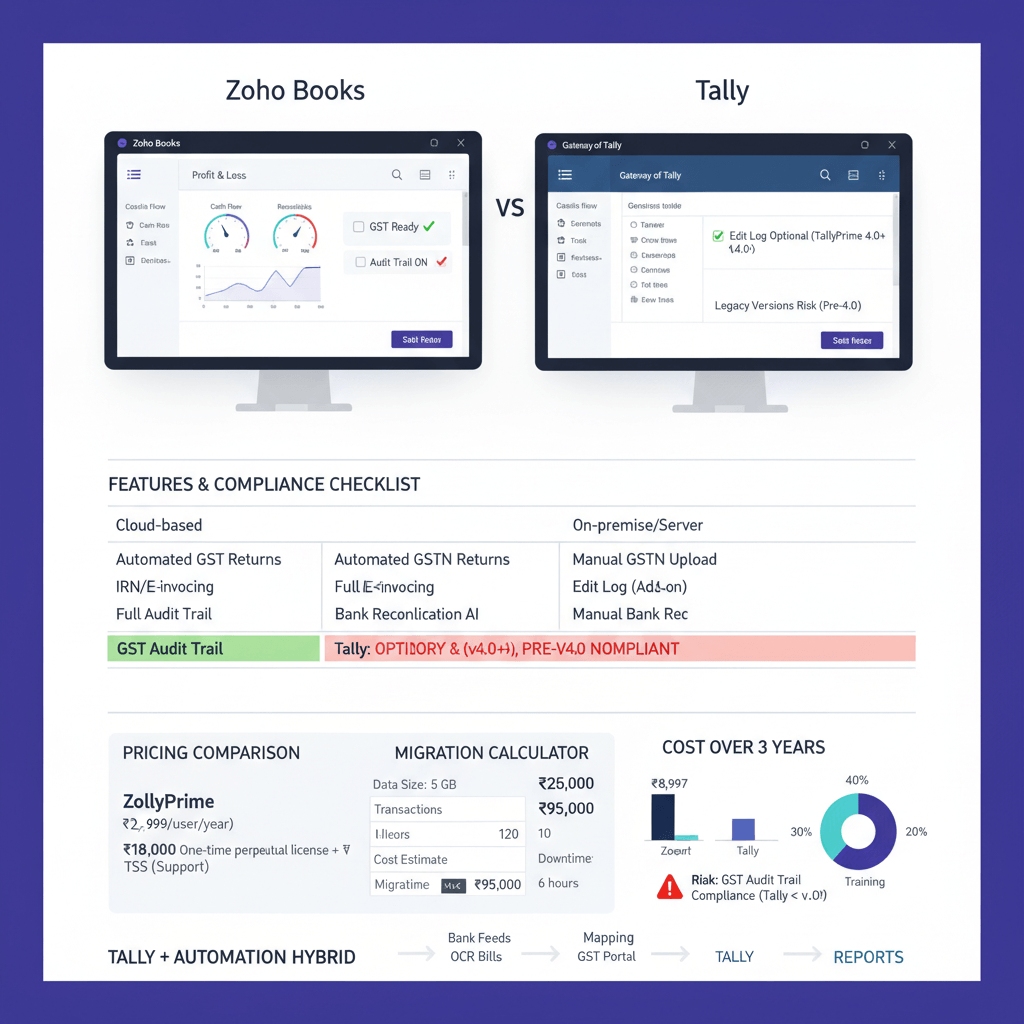
| Aspect | Tally Prime | Zoho Books |
|---|---|---|
| GST compliance | GSTR-1, 3B, 9 native, strong e-invoicing, manual 2B import | GSTR-1, 3B native, semi-automated 2B workflows |
| E-invoice and E-way | Built-in IRN generation, bulk processing and cancellation control | API based, portal driven workflows, solid for straightforward use |
| Audit trail | Non-disable edit log aligns to MCA requirements | Activity log, not in MCA mandated format |
| Bank reconciliation | Manual entry or CSV import | Auto-fetch from 45+ Indian banks, strong auto-match |
| Inventory | Multi-godown, batch, manufacturing, job work | FIFO, multi-warehouse basics, limited manufacturing depth |
| Pricing | ₹22,500 one-time single user, ₹67,500 multi-user Gold | ₹1,499 per organisation per month, 10 users included |
| Mobile access | Remote desktop setups required | Full iOS and Android apps for invoicing and approvals |
| Multi-company | Unlimited companies in one license | Separate subscription per organisation |
Most firms that try to migrate discover that Zoho’s 80% automation does not cover the 20% of complex scenarios that consume the most risk and review time, which Tally handles better.
What breaks when you switch mid-year
GST return history becomes fragmented
Switching accounting systems mid-financial year splits GSTR-1 and GSTR-3B histories across platforms, complicating annual returns and scrutiny. Section 36 of the CGST Act requires preserving records for 72 months, so you will keep Tally backups and Zoho exports for the same year. Historical ITC match states, supplier-wise reversals, and 2B mismatch logs do not port cleanly, forcing manual reconstruction during audits.
MCA audit trail rules create parallel records
MCA’s Companies, Accounts Rules mandate a non-disable edit log of every transaction, effective 1 April 2023, see MCA Notification 31 March 2022. A mid-year switch yields two trails, Tally for April to September, Zoho for October to March, breaking continuity. Auditors must sample across both systems, adding time and creating a risk of qualifications under CARO 2020.
Vendor master settings and TDS history do not migrate
Zoho imports basic vendor masters, but Tally specific settings like TDS rates, lower deduction entries, credit periods, and cost centres require manual recreation. Brought forward TDS and Form 26AS linkages stay in Tally, increasing month-end friction and rekeying for 50 vendor businesses by 4 to 6 hours.
One migration scenario that works
Service-only entities with under 20 vendors, no inventory, and simple TDS, sections 194C and 194J only, can migrate on 1 April with a clean cutover. Import opening balances from Tally, enter outstanding bills and invoices manually, and accept the loss of pre-migration drill-down. This fits consultancies and agencies under ₹2 crore turnover, not traders or manufacturers.
Where Zoho Books genuinely beats Tally
Bank reconciliation for high-velocity businesses
Zoho Books connects with 45 or more Indian banks, importing daily transactions and auto-matching about 85% of routine entries. For 500 plus transactions monthly, that is roughly 3 hours saved each week compared with Tally’s manual process.
Mobile-first operations for distributed teams
Native apps enable on-the-go approvals, invoicing, and expense capture. Replicating this with Tally requires remote desktop infrastructure, adding recurring costs and user friction. For a 10 person distributed finance team, Zoho’s native mobility typically saves ₹20,000 per month in remote access tooling.
Multi-currency with real-time forex
Zoho fetches RBI reference rates automatically, computes unrealised currency gains and losses, and produces AS-11 aligned reports. Tally supports multi-currency, but requires manual rate updates and separate vouchers for gains and losses, which adds 2 hours monthly for frequent foreign transactions.
The hybrid model: keep Tally as ledger, automate high-volume tasks
Automate document ingestion while Tally remains the book of record
Deploy OCR driven bill capture to extract GSTIN, invoice numbers, taxable values, and taxes from PDFs and images, then push draft purchase vouchers into Tally for review. Moving from 2 minutes per bill to seconds for capture turns 100 bills into 30 minutes of review work rather than 200 minutes of data entry.
Bank and credit card statement automation
Ingest statements at scale, match by date, amount, and narration, learn patterns over time, and export reconciled entries back into Tally’s receipts and payments. A ₹10 lakh monthly turnover business with about 300 transactions saves around 2.5 hours every month, while preserving Tally’s voucher structure for GST.
GSTR-2B reconciliation without spreadsheets
Pull 2B JSON from GST portal APIs, match using GSTIN, invoice number, and tolerance on value, and flag suppliers for Rule 37A reversals early. Automation prevents avoidable ITC blocks and interest exposure that commonly reach ₹30,000 per month for a ₹2 crore turnover business, see also CBIC Notification 26/2022.
MIS and working capital from unified data
Create product wise profitability, cost centre P&L, and 45 day cash flow projections by combining Tally vouchers, bank balances, and eligible ITC from 2B. Instead of 40 hours of spreadsheet work across 20 clients, firms review dashboards and spend time on decision making.
The implementation pathway
- Pilot two clients, one service, one trading, for one month.
- Automate bank reconciliation and bill capture, validate against Tally.
- Add GSTR-2B matching and start exception workflows.
- Roll out in batches, five clients every month for three months.
- Layer MIS and cash flow analytics once reconciliation is stable.
Cost, risk, and capacity math for a 20 client CA firm
Baseline
Twenty clients, each around ₹2 crore turnover, 150 purchase bills, and 300 bank transactions monthly, quarterly GST. Manual Tally needs five accountants, each at ₹5 lakh annually, with typical ITC reversals and interest around ₹2 lakh per year due to manual errors.
Path A: Migrate all clients to Zoho Books
Migration consulting around ₹3 lakh, partner time opportunity cost around ₹5 lakh, subscriptions about ₹3.6 lakh per year. Net, four accountants can handle the portfolio, saving around ₹5 lakh in staff cost, but transition risks include broken 2B trails and potential ₹10 lakh ITC issues during changeover.
Path B: Keep Tally, remain manual
Status quo cost at ₹25 lakh staff spend, recurring reversal exposures, and a four to one client per accountant ceiling, with burnout during month end and high junior turnover.
Path C: Tally plus automation overlay
Setup around ₹50,000, platform around ₹15,000 per month. Bills, bank, and 2B matching together save roughly 145 hours per month, equal to one FTE. Three accountants manage 20 clients comfortably, saving ₹10 lakh in staff cost and reducing ITC errors by 75%, about ₹1.5 lakh annually.
The winner: Hybrid delivers around ₹11.5 lakh annual savings against a ₹2.3 lakh cost, a five to one ROI, while avoiding audit trail breaks and migration churn.
A practical rollout checklist
- Month 1, pick two pilot clients and map current workflows.
- Month 2, automate bank and bills, track exceptions weekly.
- Month 3, enable 2B matching, vendor chasing, and ITC risk flags.
- Months 4 to 6, roll out to the rest in batches with QA gates.
- Month 7 onward, enable MIS, cash flow, and advisory cadence.
Related reading and references
- Deep dive on statutory controls in Tally Prime automation.
- Step by step migration considerations in Switching accounting systems.
- Handling inter company and group scenarios in Zoho Books and Tally integration.
- Automate portal based matching with GSTR-2B reconciliation.
- Portfolio wide reporting with MIS automation.
- E-invoice threshold details in CBIC Notification 10/2023, ITC reversal timelines in CBIC Notification 26/2022, and audit trail rules in MCA Notification 31 March 2022.
FAQ
If I use Zoho Books for invoicing and Tally for GST returns, how do I keep data consistent without drowning in reconciliations?
Run a daily discipline, export sales and purchase registers from Zoho and import into Tally, then reconcile invoice numbers and tax values. Expect around 2 hours of daily overhead for a 100 invoice day, with timing differences and credit notes creating exceptions. Most firms phase this out within six months because the dual trail splits invoice PDFs in Zoho from GST workings in Tally, which increases audit queries rather than reducing them. A hybrid with Tally ledgers and automation for bank, bills, and 2B provides the same convenience with a single book of record.
How should a manufacturing or job work heavy business choose between Tally and Zoho Books?
Stay on Tally Prime. You need production vouchers, BOMs, job work challans under Rule 45, scrap and by product accounting, and multi stage WIP, all of which Tally handles natively. Zoho requires spreadsheets and workarounds for these, which introduces GST valuation risk and inventory inaccuracies. For a three stage production flow with 20% outsourced job work, the extra review time and errors in Zoho outweigh the automation gains.
Can a retail business with POS billing run on Zoho Books comfortably?
Use your POS for billing and maintain Tally for accounting. Push daily sales summaries and settlement entries into Tally via API or CSV, then do stock counts and month end reconciliations in Tally. Zoho Inventory integrates well for basics, but lacks barcode, multi counter offline resilience, and the granular POS controls typical retail chains need. The stable pattern is POS plus Tally, with automation to eliminate duplicate entry.
What is the practical impact of MCA’s audit trail rule if I migrate mid-year?
You will end up with two edit logs, one in Tally, one in Zoho, which violates the spirit of a continuous trail from 1 April. Auditors must sample both systems, reperform controls, and you risk a qualification under CARO. If you must migrate, do it on 1 April with clean opening balances, and archive a tamper evident Tally backup plus a report of the closing edit log for the previous year.
How do Zoho Books and Tally compare for TDS complexity and monthly filings?
Tally supports TDS on advances, lower deduction certificates, grossing up, multi rate in one bill, section wise thresholds, and generates Form 26Q. Zoho Books covers basic sections like 194C, 194H, 194I, and 194J, but struggles with partial payments and GST component logic. For around 50 TDS transactions per month, you will likely spend 3 hours in Tally versus 5 hours in Zoho including Excel reconciliations.
What happens to my statutory data if I stop paying for Zoho versus letting a Tally license lapse?
Zoho becomes read only on expiry, with export access for a limited window, typically 120 days. Tally continues to run the installed version indefinitely, so you can access historical company data for the full 72 month GST retention, even if you are off support. For audit and legal retention, Tally’s perpetual access model is safer, provided you keep disciplined backups.
Can Zoho Books handle a company with multiple GSTINs across states without extra cost?
No, each GSTIN requires its own Zoho Books organisation, billed separately. Tally manages multiple registrations within one company file, with location wise tax and inventory controls. A five state entity pays about ₹7,495 per month in Zoho versus a one time ₹67,500 for Tally Prime Gold, making Zoho costlier within the first year.
How well does each system integrate with income tax and audit tools used by CA firms?
Tally exports tax audit ready reports, 3CD data points, depreciation schedules, and works cleanly with Genius, Computax, and Zen ITR. Zoho produces standard financial statements, but lacks granular audit schedules, so you will spend about 2 extra hours per client transforming reports for ITR and tax audit documentation.
What is the best way to scale a 20 client practice without adding headcount?
Keep Tally as the ledger and automate bills, bank, and GSTR-2B. Expect around 145 hours saved monthly across the portfolio, equivalent to one FTE. One accountant can move from managing 4 to around 8 clients when exception queues replace manual entry. For example, use AI Accountant for automated 2B matching and vendor nudges, then focus the team’s time on complex adjustments and advisory.
When is a full move to Zoho Books the right call?
Professional services under ₹1 crore turnover, fewer than 30 vendors, no inventory, and simple TDS fit well. If the team is distributed across cities and needs mobile invoicing and bank feeds daily, Zoho’s convenience wins. Time the switch for 1 April, run parallel for one quarter, and document the cutover with opening balances, outstanding items, and a frozen Tally archive for the previous year.

Rohan Sinha is a fintech and growth leader building aiaccountant.com, focused on simplifying accounting and compliance for Indian businesses through automation. An IIT BHU alumnus, he brings hands-on experience across 0 to 1 product building, growth, and strategy in B2B SaaS and fintech.