-01%201.svg)
Key takeaways
- Integrating Tally with cloud accounting platforms eliminates double entry, reduces GST mismatches, and cuts month end close time by 60–70% for most CA firms and SME finance teams.
- Clean master data and precise ledger mapping are the foundation of any successful integration. Standardize names, validate GSTINs, and define a clear source of truth per object before syncing.
- AP automation, bank reconciliation, and GSTR 2B matching are the highest impact workflows to automate first, delivering measurable time savings and compliance improvements.
- Start with one pain point, prove value, then expand. The competitive advantage of automation compounds every month you delay.
- Platforms like AI Accountant's bookkeeping automation handle intelligent matching, GST checks, and audit trails natively, so your team focuses on review and advisory instead of repetitive data entry.
Tally integration and accounting automation: what's new in 2026
The regulatory and technology landscape for Tally based businesses has shifted meaningfully since 2025. Here is what matters most right now.
Until March 2025, GST e-invoicing applied to businesses with turnover above ₹5 crore. From April 2025, that threshold dropped to ₹1 crore, pulling a large segment of smaller businesses into the e-invoicing net. If your Tally setup was not generating IRNs automatically, you now face rejected invoices and blocked ITC claims. The CBIC's latest notifications confirm stricter validation rules for e-invoices, including mandatory HSN codes at four digit level for turnover above ₹5 crore.
On the filing side, GSTR-1 and GSTR-3B now require tighter alignment. The GST portal flags mismatches between outward supply declarations and tax liability far more aggressively than in 2025. Late or incorrect filings attract interest at 18% per annum, and repeated defaults can trigger compliance flags that delay refunds.
Who does this hit hardest? SMEs between ₹1 crore and ₹10 crore turnover, many of which relied on manual or semi-automated processes. CA firms managing 20+ such clients face compounding workload unless they adopt automated GST reconciliation workflows that catch mismatches before filing deadlines.
What to do now:
- Verify your Tally integration generates valid e-invoices with correct HSN codes and IRN fields.
- Reconcile GSTR-2B monthly (not quarterly) to avoid ITC reversals under the new matching timelines.
- Audit your ledger mapping and sync cadence. Daily sync is no longer optional for businesses processing over 500 invoices per month.
AI Accountant's sync engine already handles the updated e-invoice schema and GSTR-2B matching rules, so teams adopting it avoid the manual rework these changes demand.
Why integrate Zoho Books with Tally?
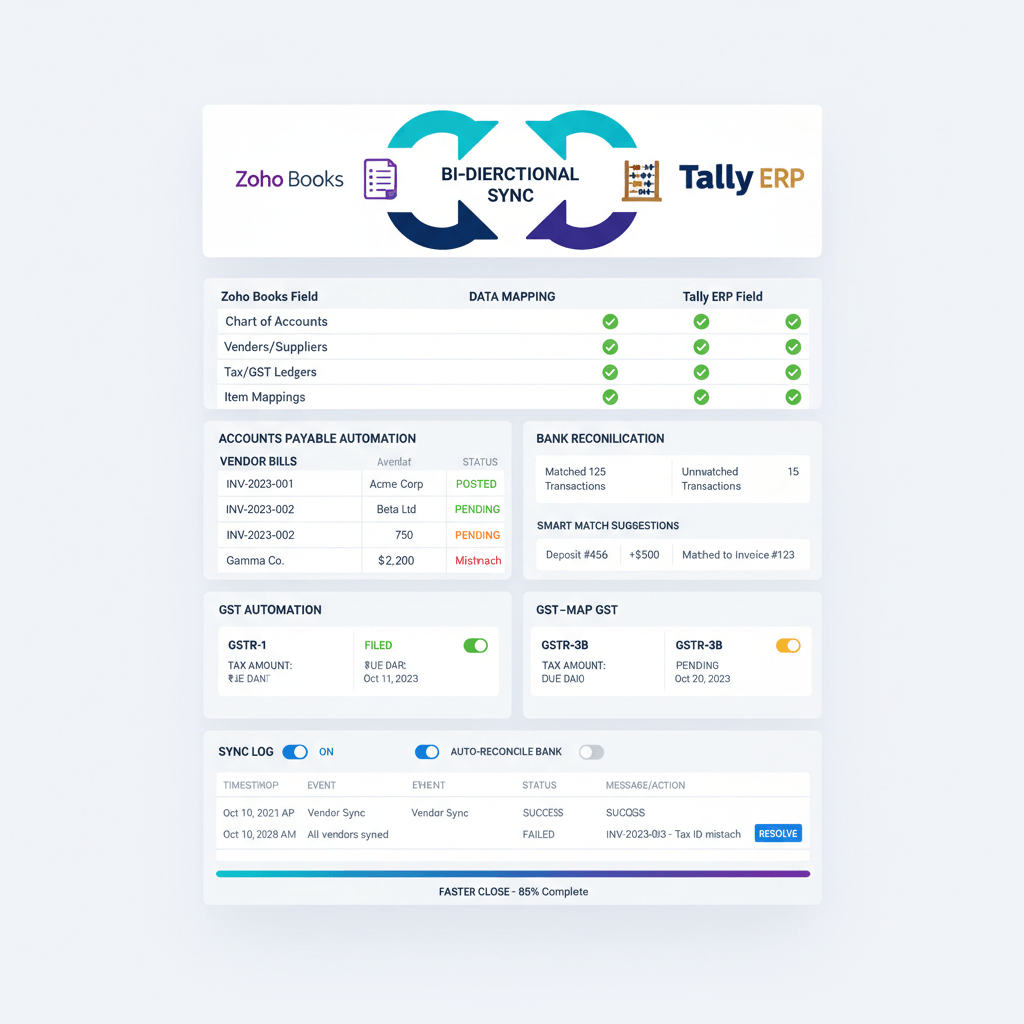
Running both systems without integration invites duplicate work, version confusion, and reconciliation fatigue. Tally excels at GST and inventory. Cloud platforms deliver bank feeds, remote access, and workflow automation. Connected, you keep Tally where it is strong while gaining modern capabilities. No more choosing between them.
The integration is not just data movement. It is context aware automation that preserves controls and auditability while removing repetitive work.
Add a capable integration platform, and your bills, receipts, and GST data flow without manual intervention. Errors fall. Closing accelerates. Teams focus on review and analysis instead of typing.
Understanding Zoho Books integration capabilities
Zoho's APIs and native connectors support real time synchronization for customers, vendors, invoices, credit notes, items, and banking. Validation checks guard integrity. GSTIN mismatches surface immediately, and subtle vendor name differences get flagged for review.
For Indian operations, built in GST logic simplifies compliance. This covers invoice sequencing, ITC tracking, and return preparation. Bank feeds add daily transactions. The system categorizes based on learned patterns, and exceptions rise to the top of your queue.
Result: fewer surprises at month end, clearer ownership of exceptions, and consistent books across systems.
Setting up Zoho Tally sync, step by step
- Prepare master data in Tally. Export Chart of Accounts, customers, and vendors as XML. Clean duplicates, standardize names, verify GSTIN and PAN.
- Configure imports. Go to Settings, then Integrations, then import masters. Map Tally ledger groups to cloud accounts with care.
- Choose middleware. Options include:
- AI Accountant, intelligent sync with GST reconciliation and anomaly detection
- Zoho Flow, for native workflow automation
- Zapier, for quick event based connectors
- Direct API integration, for in house teams
- Tally ODBC scripts, for custom needs
- Set up API credentials in both systems. Pick a sync cadence that fits your volume. Hourly for busy operations, daily for smaller teams.
- Run a pilot. Post a test invoice in Tally, then confirm it appears in the cloud system with correct tax, items, and vendor linkage.
- Monitor early cycles. Watch for mapping gaps, duplicate entries, or date format issues. Fix and re run until clean.
Tip: Define the source of truth for each object. For example, Tally for inventory and ledgers, the cloud platform for bank feeds and receipts. A clear flow direction prevents duplicates.
Automating AP with Tally integration
AP automation (accounts payable automation) turns bill capture and validation into a single pass workflow. OCR ingests PDFs and scans, then extracts vendor name, invoice number, date, amounts, and line items. It validates GSTIN, checks for duplicate vendor invoices, and confirms tax math.
Bulk uploads let you process hundreds of vendor bills in parallel. A consolidated error register makes quick fixes simple. Approval rules keep control: small recurring bills auto approve, while large or unusual ones route to managers.
Payments link back to open bills, so aging stays current without manual marking. This eliminates the tedious process of matching payment entries to outstanding invoices by hand.
For a balanced view on platforms, see Tally vs Zoho Books comprehensive comparison.
Bank reconciliation between Tally and cloud accounting
Bank reconciliation often fails on formats and descriptions. Modern statement ingestion normalizes data from major and regional banks, current and savings accounts, credit cards, and wallets into a standard format: date, description, amount, and direction.
Intelligent matching compares bank lines with ledger entries in both systems. It matches by amount, date range, references, and partial description. The engine learns from your confirmations, so match rates improve every cycle.
Unmatched items present suggested near matches. You confirm in bulk, including splits for partial payments or merges for bank charges. This robotic process automation approach replaces hours of manual comparison with minutes of exception review.
Credit card cycles get their own periods and roll forward logic. Allocation and settlement tracking remain accurate without extra spreadsheets.
GST reconciliation with GSTR 2B
Monthly ITC claims hinge on precise matching between your purchase register and GSTR 2B. A capable GSTR-2B reconciliation tool standardizes datasets, matches across typos and rounding differences, tags late filings for next month, and keeps a full audit trail.
Accepted matches update both systems. There is no double entry and no version drift. Multi GSTIN entities run separate reconciliations, handle bill to ship to flows, and account for reverse charge correctly.
The GST portal now enforces stricter matching timelines. ITC on invoices not reflected in GSTR-2B gets auto reversed if not claimed within the prescribed period. Staying on top of monthly reconciliation is no longer optional.
Transaction categorization automation for both platforms
Machine learning analyzes your historic tagging, then recommends categories with confidence scores. It learns that Airtel maps to Telephone Expenses, that recurring SaaS charges map to Software Expenses, and that familiar customers map to specific income accounts.
Ambiguous cases present top suggestions. You confirm once, and both systems stay consistent. Bulk filters and rules accelerate cleanup. For example, tag all fuel related lines to Vehicle Expenses, or route micro transactions to Petty Cash Expenses.
This automated transaction categorization reduces the time spent on ledger entry classification from hours to minutes per batch.
Pro move: Use split rules on card statements to separate travel, meals, and personal portions. This keeps expense claims and books clean in both platforms.
Achieving faster month end close
With continuous processing, most categorization and reconciliation is done before the close window begins. Parallel workflows run bank matching, AP posting, and GSTR 2B review together. Exceptions appear early. Managers see real time status on dashboards.
Adjusting entries post to both systems. Trial balances stay aligned. Audit logs capture every automated action with timestamps and users.
Multi entity groups can close in parallel, reduce intercompany breaks, and generate consolidated views without manual consolidation. The goal is an always on close, not a monthly scramble.
Best practices for Tally integration
- Invest in data hygiene. Merge duplicates, standardize names, and validate GSTINs before you sync.
- Roll out in phases. Start with AP or bank reconciliation, prove value, then expand to other workflows.
- Document SOPs, approval matrices, and escalation paths. Train the team and refresh quarterly.
- Set alerts for sync failures, large transactions, and unusual patterns. Fix issues daily, not at month end.
- Design for change. Prefer configuration over code. Avoid brittle customizations that break with updates.
- Audit samples monthly for categorization accuracy and GST math. Keep stakeholders confident in the numbers.
- Prepare a fallback plan for outages, including manual posting and later re sync steps. Test it periodically.
The ICAI has published guidance on maintaining audit trails in automated accounting environments, which is worth reviewing before your next statutory audit.
Common challenges and how to overcome them
- Date and format mismatches. Use middleware to normalize and validate automatically. Indian date formats (DD/MM/YYYY) often clash with international systems.
- Duplicate postings from bidirectional updates. Define a source of truth and use unique IDs per transaction.
- GST breaks from amended returns. Keep reconciliation history and track movement across months.
- User resistance. Run a gradual transition. Let teams keep familiar screens while the backend integrates silently.
- Scaling pain at higher volumes. Choose platforms proven at your target throughput. Monitor queue times and API response rates.
- Gaps in standard connectors. Budget for light extensions, but resist over customization that creates maintenance burdens.
- Security expectations. Enforce role based access, encryption, and audit trails. Document your controls for ISO 27001 or SOC 2 compliance reviews.
ROI and performance metrics
- Time saved. Measure data entry hours, close duration, and filing speed. Mature setups often cut time by sixty to seventy percent.
- Error rate. Track pre and post automation breaks for entries, reconciliations, and GST mismatches. Improvements of eighty to ninety percent are common.
- Throughput. Invoices processed per person per day, and bank lines reconciled per hour.
- Compliance. Notice frequency, audit findings, and penalties trend down with consistent automated processes.
- Cost per transaction. Include staff time and software costs. Expect steady declines as volume rises.
- Team sentiment. Monitor overtime and stress levels. Automation should shift work toward analysis and advisory.
- Dashboard adoption. Track how many managers check live status versus waiting for monthly reporting packs.
- For CA firms. Client retention and new wins tied to automation led service offerings. Firms offering real time dashboards consistently win over those delivering monthly Excel packs.
Future of accounting automation in India
AI is moving from rules to context. It recommends entries, flags risks, and forecasts cash flow. The Government of India continues to push digital compliance, with e-invoicing thresholds dropping and real time reporting becoming the norm.
Voice queries will democratize analysis. Continuous close will replace periodic crunches. Regulatory technology will embed compliance checks directly into accounting workflows.
Mobile first design will unchain approvals and review from desks. Advisors will spend more time on insights than on compilation.
Start small. Pick one pain point, build momentum, and expand. The tools exist, the gains are real, and the competitive advantage compounds every month.
FAQ
How should a CA decide the source of truth between cloud accounting and Tally for ledgers, inventory, and banking?
Pick Tally as the source for inventory intensive ledgers and statutory groupings. Use the cloud platform for banking, receipts, and cash application via bank feeds. Document the direction per object (for example, Tally to cloud for ledgers and items, cloud to Tally for receipts) to prevent duplicates and drift.
Can I achieve hourly sync without risking duplicate postings in both systems?
Yes, by defining unidirectional flows per module, enabling unique external IDs, and using incremental sync with watermarks. Platforms like AI Accountant track last sync state, throttle when APIs lag, and block suspected duplicates with review queues.
How do I handle vendor bill OCR accuracy for GST components and line items?
Use an AP engine with India specific tax parsers that capture CGST, SGST, IGST, and cess fields separately. Validate extracted data against vendor master GSTIN. AI Accountant applies tolerance bands and runs duplicate checks on vendor plus number plus date, then posts to both systems after approval.
What controls should I implement to satisfy audit requirements when using automation?
Maintain user level approvals, immutable logs of every action, validation checkpoints for GSTIN and tax math, and periodic sample reviews. The ICAI guidance on audit trails recommends that automated systems preserve a complete evidence chain. AI Accountant provides exception registers and exportable logs for auditors.
Is it feasible to run continuous close with daily reconciliations for a high volume client?
Yes. With bank feeds, automated categorization, and scheduled GST checks, most work shifts to daily micro cycles. Month end becomes a short review and adjustment window rather than a scramble. Dashboards show exceptions by owner, so nothing gets missed.
What changed for e-invoicing compliance in 2026?
From April 2025, the e-invoicing threshold dropped to ₹1 crore turnover, bringing a much larger pool of SMEs under mandatory e-invoice generation (2026 update). Your Tally integration must now generate valid IRNs with four digit HSN codes. Failure to comply results in rejected invoices and blocked ITC claims.
Can I use simple automation tools instead of specialized middleware for Tally integration?
Simple tools work for basic triggers and small volumes. However, for scale, GST context, and audit grade controls, specialized platforms are recommended. They handle edge cases like amended returns, partial payments, and multi GSTIN reconciliation far more reliably than generic workflow connectors.