-01%201.svg)
Key takeaways
- Build a single source of truth that reflects India specific realities, exclude GST from revenue, account for RBI e mandate churn, normalize multi currency reporting, and separate one time fees.
- Implement an MRR and ARR tracker that segments movements into new, expansion, contraction, and churn, then reconcile against billed and collected amounts to catch discrepancies early.
- Design churn and retention cohorts that distinguish logo churn, revenue churn, voluntary churn, and involuntary churn, and layer dunning workflows before marking accounts as churned.
- Track expansion revenue components, upsell, cross sell, seat growth, and contractions, to compute NRR accurately and time campaigns around Indian fiscal seasonality.
- Calculate margin adjusted LTV and channel wise CAC, include GST on marketing spend, compute CAC payback period, and avoid blended averages that mask performance.
- Overlay cash runway with growth and burn scenarios, model delayed collections, GST refunds, export incentives, and largest customer loss sensitivity.
- Establish a robust data pipeline, customers, subscriptions, invoices excluding GST, payments, credit notes, expenses, with daily syncs, weekly checks, and monthly close.
- Adopt an operating cadence with weekly exception reviews and monthly deep dives, assign ownership, and provide narrative alongside numbers.
- Use automation to reduce manual cleanup, tools like AI Accountant can normalize Zoho and Tally data, reconcile GST, and feed runway dashboards.
Why a SaaS metrics dashboard for India makes operational sense
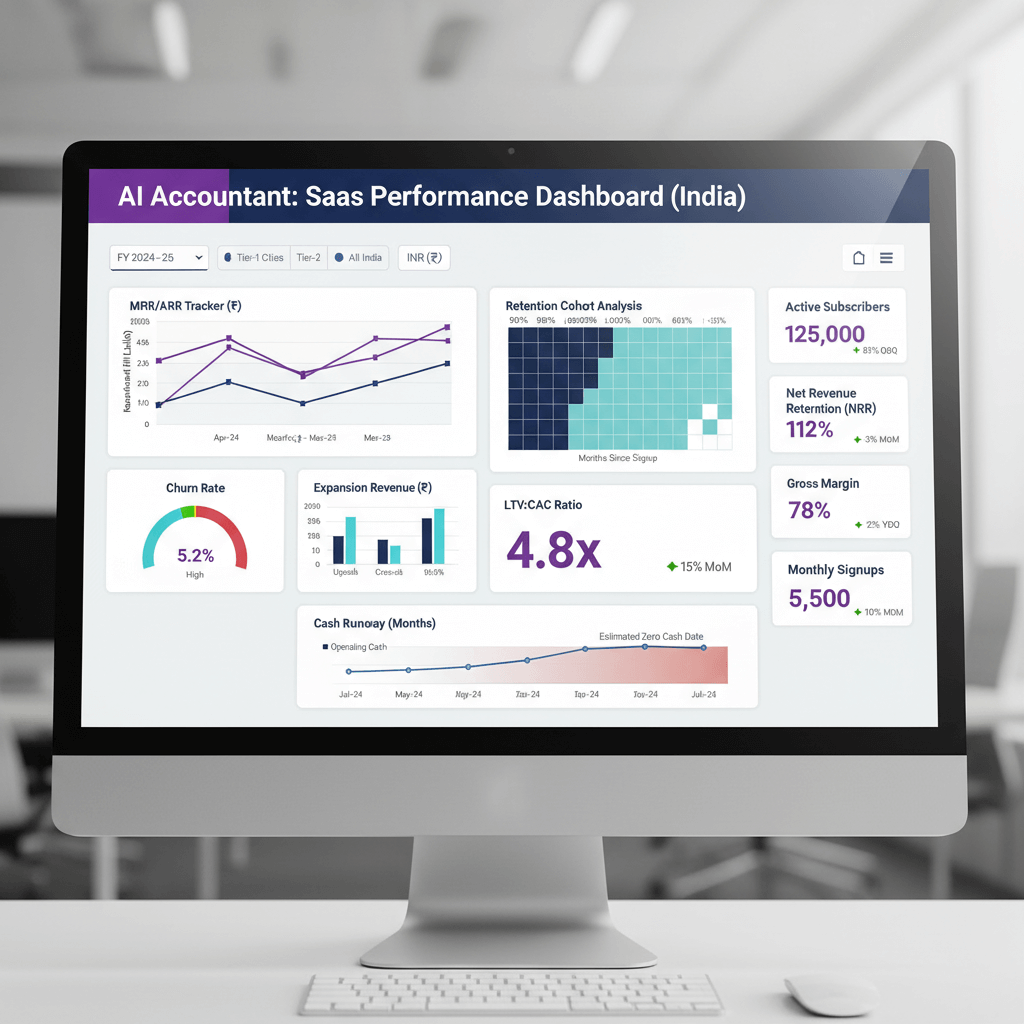
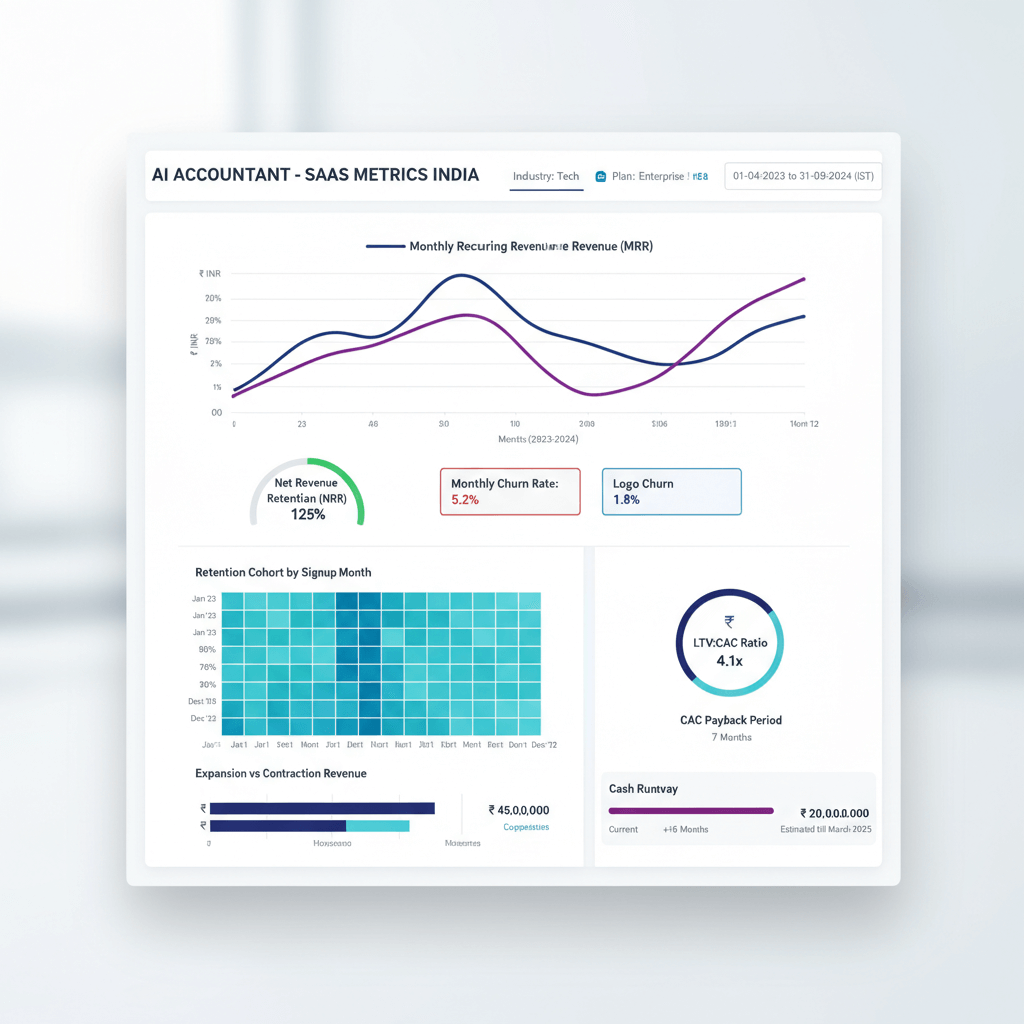
A high signal dashboard drives pricing decisions, GTM optimization, accurate cash forecasting, and investor narratives by consolidating fragmented data into one reliable view. Indian SaaS teams must deliberately address GST exclusion, RBI mandate related involuntary churn, multi currency normalization, and proration of annual plans to avoid misleading metrics that derail strategy. For a practical blueprint, see the SaaS metrics dashboard India edition and the expanded SaaS metrics dashboard India edition.
Build policy first, pipeline second, visuals last. A clean definition set prevents finance saying MRR is X while sales claims it is Y.
Data hygiene is often the hardest part, fragmented systems like Razorpay, Chargebee, Zoho Books, and spreadsheets create inconsistencies, so define FX policy, recognition versus collection rules, refund handling, and cohort logic upfront.
Core components of your SaaS dashboard
MRR and ARR tracker for accurate revenue visibility
Your MRR tracker starts with discipline, exclude GST and one time fees, normalize annual plans to monthly equivalents using proration. Calculate by product line, pricing tier, geography, and currency, then reconcile to accounting monthly. The ARR tracker should show contracted versus recognized values, segment movements into new logos, expansion, contraction, and churn, then reconcile billed versus collected to surface leakage. Deep implementation examples are in the SaaS metrics dashboard India edition and the complementary SaaS metrics dashboard India edition.
- New ARR from fresh logos
- Expansion ARR from existing customers
- Contraction ARR from downgrades
- Churned ARR from lost accounts
Granular views reveal patterns, enterprise accounts might expand reliably while SMBs churn faster, certain pricing tiers may contract more often, inform pricing and packaging accordingly.
Churn and retention cohorts that reveal true customer health
Track logo churn versus revenue churn to understand whether you are losing many small customers or a few large ones, separate voluntary and involuntary churn, in India, UPI failures and RBI autopay issues drive recoverable churn, so measure recovery by payment method and instrument targeted dunning. Build signup month retention cohorts as heatmaps, show both active logos and revenue retained over time, and treat paused subscriptions distinctly. Practical cohort patterns and dunning approaches are covered in the SaaS metrics dashboard India edition.
- Which cohorts sustain revenue beyond month 6 and 12
- Voluntary versus involuntary churn drivers
- Win back campaign success rates
- Payment method failure and recovery trends
Expansion revenue tracking for growth without new logos
Measure upsells, cross sells, seat growth, and contractions separately to compute NRR. Build waterfalls showing component impacts, then time expansion plays around Indian fiscal cycles where budgets reset. For examples and visualization ideas, explore the SaaS metrics dashboard India edition and the companion SaaS metrics dashboard India edition.
Example waterfall: Starting MRR 100,000, upsell +15,000, cross sell +8,000, seat growth +12,000, contractions -10,000, churn -5,000, ending MRR 120,000, NRR 120%.
LTV to CAC ratio calculations that account for India specifics
Use margin adjusted LTV, ARPA multiplied by gross margin divided by monthly churn rate, and compute CAC by channel including GST on marketing spend, salaries, tools, and overhead. Track CAC payback period rigorously, Indian organic channels differ from paid channels, so segment. A detailed calculator is in the unit economics calculator India, with additional guidance in the SaaS metrics dashboard India edition and the extended SaaS metrics dashboard India edition.
- Avoid blended CAC across channels
- Include retention costs when presenting a complete unit economics picture
- Document FX policy when comparing global benchmarks
Runway overlay for cash planning and scenario modeling
Overlay cash balance, net monthly burn, and revenue growth scenarios in one view, then model base, growth, conservative, and worst case scenarios. Incorporate delayed collections, GST refunds, export incentives, and customer payment terms to reflect true cash position. A practical walkthrough is in the cash runway calculation for Indian startups, and supporting context in the SaaS metrics dashboard India edition and the deeper SaaS metrics dashboard India edition.
Data model and pipeline architecture
Design a pipeline that sources subscriptions, payments, CRM, accounting, and bank statements, then normalizes them with clear recognition versus collection rules, proration, FX, GST exclusion, and deduplication. A blueprint is detailed in the data pipeline from books to dashboards.
Setting up your data sources
Source data from Chargebee or Stripe or Razorpay, CRM like HubSpot or Salesforce, accounting like Zoho Books or Tally, and bank statements for actual cash. Create tables for customers with geography, subscriptions with MRR start and end, invoices with GST excluded amounts, credit notes, payments with settlement status, and expenses for CAC. Establish daily transaction syncs, weekly metric refreshes with anomaly checks, and monthly reconciliation. More setup detail is in the SaaS metrics dashboard India edition.
Role of automation tools in your pipeline
Automation reduces manual cleanup. AI Accountant ingests and normalizes bank statements, cleans Zoho and Tally invoices, reconciles GST, pushes cleaned data back to accounting, and feeds runway dashboards automatically. ChartMogul, Baremetrics, ProfitWell, and Geckoboard can visualize subscriptions, but Indian gateway support and accounting reconciliation vary. Choose tools that handle GST exclusion, multi currency reporting, and local gateway integration. Comparative guidance appears in the SaaS metrics dashboard India edition and the follow up SaaS metrics dashboard India edition.
Step by step setup guide
Phase 1: Define your policies
Document revenue recognition, GST exclusion, FX conversion timing and sources, cohort definitions, churn definitions, and grace periods. Create a shared data dictionary, then socialize it with finance, sales, and success so everyone reads metrics the same way. Templates and examples are in the SaaS metrics dashboard India edition and the companion SaaS metrics dashboard India edition.
Phase 2: Connect and clean your data
Connect systems via APIs or exports, build schema alignment for customer and subscription IDs, deduplicate systematically, standardize names, remove tests, handle refunds via credit notes, separate one time from recurring charges, and normalize currency formats. For cleaning checklists, see the SaaS metrics dashboard India edition.
Phase 3: Build your MRR and ARR tracker
Implement filters by pricing tier, geography, channel, currency, and segment, start simple, reconcile totals monthly to accounting, then add drill downs once totals are reliable. Reference patterns in the SaaS metrics dashboard India edition and the iterative SaaS metrics dashboard India edition.
Phase 4: Create churn and retention views
Build logo and revenue cohorts, add heatmaps, set alerts for churn spikes, large accounts at risk, payment failure patterns, and underperforming cohorts, then close the loop with success and collections. Implementation notes are in the SaaS metrics dashboard India edition and the advanced SaaS metrics dashboard India edition.
Phase 5: Configure expansion revenue tracking
Classify upsells, cross sells, seat expansions, and usage growth, then build NRR waterfalls, track expansion lag from first purchase, and benchmark by segment. Examples appear in the SaaS metrics dashboard India edition.
Phase 6: Compute LTV to CAC
Calculate LTV to CAC by segment and channel, add benchmarks and payback trend lines, and run sensitivity analysis for churn, margin, CAC, and ARPA scenarios. Frameworks are in the SaaS metrics dashboard India edition and the detailed SaaS metrics dashboard India edition.
Phase 7: Add runway overlay
Include current cash, monthly burn, revenue and expense growth assumptions, and funding requirements, make scenarios interactive for planning. See examples in the SaaS metrics dashboard India edition.
Phase 8: QA and reconciliation
Reconcile metrics against trial balance, bank statements, billing system totals, and CRM opportunity values, document variances, and resolve classification errors. QA checklists are in the SaaS metrics dashboard India edition and the follow up SaaS metrics dashboard India edition.
Phase 9: Establish operating rhythm
Run daily data quality checks, weekly exception reviews, monthly full metrics reviews, and quarterly board packs, assign clear ownership, and keep reviews short, focus on exceptions not routine. Operating templates appear in the SaaS metrics dashboard India edition.
Dashboard layout and visuals for founder first design
Top level KPI tiles
Prioritize ARR, MRR with trend sparkline, NRR, gross margin, LTV to CAC, runway in months, and cash balance, and allow quick drill downs. Visualization tips are in the SaaS metrics dashboard India edition.
Trend visualizations
Include MRR growth versus net adds, churn versus expansion revenue, CAC payback period, logo retention by cohort, and revenue retention by cohort, add interactivity so hovering reveals exact values and filters cascade across views. Examples are in the SaaS metrics dashboard India edition.
Cohort heatmap views
Toggle between revenue retention, logo retention, absolute amounts, and customer counts, use consistent color scales so patterns pop quickly. Design guidance is in the SaaS metrics dashboard India edition and the complementary SaaS metrics dashboard India edition.
Expansion breakdown charts
Show upsell contribution by segment, cross sell adoption rates, seat expansion patterns, and geographic expansion trends with stacked comparisons, period over period views help spot acceleration. Examples appear in the SaaS metrics dashboard India edition.
Runway scenario chart
Display cash trajectory, multiple growth scenarios, break even, and funding markers, add assumption toggles for burn, growth, and margin changes, then review monthly with finance. Reference visuals in the SaaS metrics dashboard India edition.
Filter controls
Provide filters for pricing tier, geography, currency, acquisition channel, customer segment, and time, allow saved views for stakeholders. Implementation notes are in the SaaS metrics dashboard India edition and the deeper SaaS metrics dashboard India edition.
India specific considerations and common pitfalls
GST handling in revenue metrics
Always exclude GST from MRR and ARR, domestic sales typically carry 18% GST while exports are zero rated, including GST inflates metrics and distorts pricing decisions. Carefully handle credit notes, reflect revenue impact, but treat GST credits separately in cash forecasts. Guidance lives in the SaaS metrics dashboard India edition and the follow up SaaS metrics dashboard India edition.
Managing involuntary churn from payment failures
Adapt dunning and retry logic for UPI autopay failures, card expiry and mandates, net banking mandate cancellations, and wallet insufficiency, track recovery by payment method and recommend the most resilient instruments during onboarding. Get patterns from the SaaS metrics dashboard India edition and the practical SaaS metrics dashboard India edition.
Annual prepayment proration
Prorate annual payments, recognize revenue monthly, track cash separately from revenue, and exclude setup fees from ARR. A 120,000 INR annual invoice implies 10,000 INR monthly MRR before GST exclusion. More examples in the SaaS metrics dashboard India edition and the expanded SaaS metrics dashboard India edition.
Currency conversion consistency
Pick one FX approach and keep it consistent, monthly averages or RBI reference rates are common, avoid mixing spot and averages, document policy, and do not change mid period. More policy examples in the SaaS metrics dashboard India edition.
CAC allocation accuracy
Allocate CAC to the cohort acquired in that period, include sales salaries, commissions, marketing including GST, tools, and overhead, present retention costs separately from acquisition. Methods in the SaaS metrics dashboard India edition and supporting notes in the SaaS metrics dashboard India edition.
Subscription to ledger reconciliation
Monthly reconciliation catches missing invoices, unrecorded credit notes, timing differences, double counting, and classification errors, boosting confidence in metric accuracy and investor conversations. Reconciliation steps are in the SaaS metrics dashboard India edition.
Benchmarks and performance targets
Early stage SaaS benchmarks
For Indian SaaS, aim for NRR above 100%, >110% is excellent, CAC payback under 12 months is good, under 9 months is excellent, SMB logo churn under 2% monthly, mid market under 1%, LTV to CAC above 3, above 5 is excellent, and gross margin above 70% for pure SaaS. Expect higher involuntary churn in SMB, focus on payment recovery, optimize onboarding, and interpret global benchmarks carefully given lower ARPA and different CAC dynamics. Benchmark context appears in the SaaS metrics dashboard India edition and the deeper SaaS metrics dashboard India edition.
Operating cadence and ownership model
Weekly reviews for operational health
Hold short weekly reviews, pipeline progression and coverage, dunning and payment recovery, churn alerts and at risk accounts, and expansion triggers, growth should own acquisition metrics, success should own retention and expansion, and finance should own integrity checks. See rhythms in the SaaS metrics dashboard India edition and the companion SaaS metrics dashboard India edition.
Monthly deep dives for strategic decisions
Run comprehensive monthly reviews, full MRR and ARR movements, cohort performance, expansion breakdown, LTV to CAC by segment and channel, runway scenarios and cash position, and present a clear narrative explaining variances and actions. Templates live in the SaaS metrics dashboard India edition.
Starting simple and scaling up
Begin with basic MRR and churn accuracy, then layer cohorts, expansion metrics, LTV to CAC, and runway as data quality improves. Perfection is not the goal on day one, start at 80% accuracy, improve weekly, and lean on automation to reduce manual wrangling. Tools like AI Accountant can normalize billing and accounting data automatically, freeing you to focus on insights. The journey compounding benefits is explained in the SaaS metrics dashboard India edition and the extended SaaS metrics dashboard India edition.
Your dashboard becomes a competitive advantage, it spots problems early, identifies opportunities quickly, and provides confidence that decisions rest on solid foundations.
FAQ
How should a CA define MRR and ARR recognition policies for an Indian SaaS to avoid GST distortions?
Exclude GST from MRR and ARR, recognize revenue monthly for annual prepayments, separate one time fees from recurring, and document cash versus accrual rules. For a structured approach, refer to the SaaS metrics dashboard India edition, or use AI Accountant to automate GST exclusion in invoice data.
What is the correct method for computing margin adjusted LTV and channel wise CAC for Indian SaaS?
Compute LTV as ARPA multiplied by gross margin divided by monthly churn rate, and CAC as the sum of sales and marketing costs including GST divided by new customers acquired, segmented by channel. A practical calculator is the unit economics calculator India, and AI Accountant can tag expenses to channels for accurate CAC.
How do I separate voluntary churn from involuntary churn driven by RBI e mandates in monthly reporting?
Tag churn events by payment outcome codes and method, classify failed autopay, expired cards, mandate cancellations, and insufficient funds as involuntary, then report recovery rates by method. Cohort and dunning workflows are outlined in the SaaS metrics dashboard India edition, and AI Accountant can ingest gateway logs to automate tagging.
How can a CA reconcile Chargebee subscriptions to Zoho Books or Tally ledgers monthly without double counting?
Map subscription IDs to invoice IDs, exclude GST from revenue tables, reconcile credit notes, and run a billed versus collected comparison. A reconciliation checklist appears in the SaaS metrics dashboard India edition, while AI Accountant can push cleaned records back to Zoho or Tally.
What CAC payback period should an Indian SMB focused SaaS target, and how do I track it?
Under 12 months is good, under 9 months is excellent for early stage teams. Track monthly by channel, align acquisition cohorts to costs in the same period, and include GST. Benchmarks are in the SaaS metrics dashboard India edition, and AI Accountant can compute payback trends automatically.
What is the best way to build retention cohorts that reflect paused subscriptions common in India?
Create dual cohorts, logo and revenue, then track pause states separately from churn, apply grace periods, and integrate dunning before marking churn. Heatmap design examples are in the SaaS metrics dashboard India edition, and AI Accountant can flag pauses and grace periods.
How should a CA model cash runway with delayed collections, GST refunds, and export incentives?
Use a runway overlay that incorporates cash balance, net burn, growth scenarios, and timing offsets for collections, GST refunds, and incentives. A practical framework is in the cash runway calculation for Indian startups, and AI Accountant can ingest bank statements to align booked versus collected cash.
What NRR target is realistic for an Indian mid market SaaS, and how should expansion components be reported?
Aim for NRR above 100%, 110% is excellent, report upsell, cross sell, seat expansion, and contractions as separate components with a waterfall. See examples in the SaaS metrics dashboard India edition, and automate classification with AI Accountant.
How do I implement a consistent FX policy for USD and INR reporting that auditors will accept?
Document a single FX source and timing, monthly average or RBI reference rates, apply consistently to revenue and expenses, and disclose the policy in management reports. Policy templates are shown in the SaaS metrics dashboard India edition, while AI Accountant can normalize FX during ingestion.
What operating cadence should finance and growth adopt to keep the dashboard accurate and decision ready?
Daily data quality checks, weekly exception reviews, and monthly deep dives with narrative, assign metric ownership to finance, success, and growth leaders. Cadence guidance is in the SaaS metrics dashboard India edition, and AI Accountant can trigger anomaly alerts.
Can an AI powered tool help a CA reduce manual work across GST reconciliation, proration, and CAC tagging?
Yes, AI Accountant is built for Indian workflows, it excludes GST from revenue, normalizes annual proration, tags CAC by channel, reconciles credit notes, and pushes cleaned data back to Zoho or Tally, allowing the CA to focus on analysis instead of cleanup.

Rohan Sinha is a fintech and growth leader building aiaccountant.com, focused on simplifying accounting and compliance for Indian businesses through automation. An IIT BHU alumnus, he brings hands-on experience across 0 to 1 product building, growth, and strategy in B2B SaaS and fintech.