-01%201.svg)
Key takeaways
- A unit economics calculator India built for local realities captures GST input credits, marketplace commissions, COD returns, and UPI settlement lags, giving you a true per-unit profitability picture instead of misleading spreadsheet estimates.
- Track six essentials weekly: Contribution Margin, CAC, LTV, LTV to CAC ratio, CAC payback period, and cohort profitability. Acting on weekly data beats reacting to quarterly surprises.
- India specific variables like 18% GST slabs, 10 to 20% marketplace fees, and 20 to 30% COD return rates can silently erode margins by 5 to 18%, so bake them into every formula.
- Clean, reconciled accounting data is the foundation. Without it, your calculator outputs are fiction. Automated bookkeeping and transaction mapping eliminates manual CSV cleanup and feeds 95% accurate data into your dashboards.
- Keep LTV to CAC above 3 to 1 and payback under 6 to 9 months. If either metric slips, freeze underperforming channels and reallocate spend to cohorts with stronger retention.
- Start now: every week you delay standardizing your unit economics workflow is another week of invisible margin leakage across SKUs, channels, and customer segments.
Unit Economics and Margin Tracking in India: What's New in 2026
Until March 2025, GST e-invoicing applied only to businesses with turnover above ₹5 crore. From April 2025, the threshold dropped to ₹1 crore, as per CBIC's phased e-invoicing rollout notifications. This pulls lakhs of additional SMEs and D2C brands into the e-invoicing net, which directly affects how you capture variable costs in your unit economics calculator.
The operational shift is real. Every B2B sale now needs a valid IRN (Invoice Reference Number) before it can be reported in GSTR-1. If your invoicing workflow does not generate IRNs automatically, you risk blocked filings and delayed ITC claims. For businesses computing contribution margins, unreconciled e-invoices mean your cost base is incomplete, and your margin numbers are wrong.
This hits D2C brands selling on marketplaces and SaaS companies with annual billing above ₹1 crore hardest. If you are below that threshold, you are not affected yet, but the GST Council has signaled further reductions are under consideration. The cost of inaction is steep: missed e-invoice generation attracts penalties up to ₹50,000 per invoice under Section 122, plus interest at 18% on any ITC wrongly claimed.
What to do now:
- Confirm your current turnover against the ₹1 crore e-invoicing threshold and update your invoicing system before your next filing cycle.
- Reconcile all purchase invoices against GSTR-2B monthly to ensure ITC flowing into your unit economics formulas is accurate.
- Validate that your accounting tool generates IRNs and maps them back to your ledger entries automatically.
Platforms like AI Accountant already handle automated GST reconciliation and GSTR-2B matching, so the new e-invoicing requirements feed cleanly into your unit economics data without additional manual steps.
What Are Unit Economics in India? The Practical Overview
Running a business in India involves unique variables. GST credits, marketplace commissions, COD returns, and UPI settlement delays can distort margins if ignored. A dedicated unit economics calculator India helps you measure profitability per product or customer while factoring in these realities.
If you skip GST input credits, you overstate costs by 5 to 18 percent. If you miss COD return rates, margins vanish. Per-unit profit analysis is not optional; it is the difference between scaling profitably and burning cash.
For deeper context, see the official GST portal for current rate schedules and ITC rules, and the ICAI guidance notes on revenue recognition and cost classification.
Key Metrics You Need to Track
- Contribution Margin, the profit after variable costs (also called unit contribution or per-unit margin). Example: a latte priced at ₹200, minus ₹80 for milk, coffee, and cup, yields a 60 percent contribution margin.
- Customer Acquisition Cost (CAC), total marketing and sales spend divided by new customers acquired in that period.
- Lifetime Value (LTV), Gross Margin × (1 divided by Churn Rate) × Average Monthly Revenue. With 70 percent margins, 5 percent monthly churn, and ₹8,000 MRR, LTV is ₹11.2 lakhs.
- LTV to CAC Ratio, target above 3 to 1. For example, ₹11.2 lakhs LTV divided by ₹3.2 lakhs CAC gives 3.5 to 1.
- CAC Payback Period, months to recover customer acquisition cost from contribution margins.
- Cohort Profitability, follow customer cohorts across time to see retention trends and margin decay.
India Specific Factors That Impact Your Numbers
- GST input credits reduce net variable costs. Reconcile with GSTR-2B monthly to avoid claiming ineligible credits.
- Marketplace commissions on Amazon and Flipkart often range 10 to 20 percent plus shipping and fulfilment fees.
- COD returns for D2C brands can hit 20 to 30 percent, affecting both LTV and retention quality.
- Discounts and payment gateway fees accumulate. TCS at 0.1 percent on goods above ₹50 lakhs impacts working capital.
- Data sources include Tally ledgers, bank and UPI statements, purchase invoices, and GSTR-2B filings.
Setting Up Your Unit Economics Calculator India
Let's walk through a real example using rupee values, then plug the numbers into templates built for Indian businesses.
Required Inputs
- Selling price: ₹1,500. Include or exclude GST based on your pricing model.
- Variable costs: freight ₹200, packaging ₹50, marketplace commission 15 percent (₹225), payment gateway charges 2 percent (₹30), plus 25 percent returns adjustment.
- Discount rate: generally 10 percent.
- Channel specific CAC: Google Ads ₹300 per customer, Facebook ₹250, Amazon PPC ₹400.
Your Calculator Outputs
- Contribution margin: ₹1,500 revenue minus ₹1,300 variable costs equals ₹200, or 13 percent margin.
- LTV depends on cohort retention data and repeat purchase frequency.
- LTV to CAC ratio: aim for above 3 to 1.
- Payback period example: 5 months, based on margins and CAC.
- Cohort profitability: visualize with heatmaps across months to spot trends early.
Step by Step Implementation
First, export CSVs from your accounting software. Include sales data, expense ledgers (also called transaction records), and customer records. Then move them into your analytics workflow.
Standardize categories next. Map shipping charges to freight, tag all GST components properly, then validate against GSTR-2B to ensure input credits match. Input the cleaned data into the template. Auto formulas handle the rest.
Template Structure
Your unit economics calculator India template includes core fields:
FieldFormula or ExampleSelling Price₹1,500Variable Costs=SUM(freight, packaging, commissions) → ₹505Contribution Margin=(Price minus Variables) divided by Price → 66 percentLTV=Margin × (1 divided by Churn Rate) × MRR → ₹11.2 lakhs
For reference frameworks on calculating these metrics, the Economic Times SME section publishes regular breakdowns of Indian startup unit economics benchmarks.
Building Your LTV/CAC Dashboard
Your LTV to CAC dashboard becomes the control center for growth decisions. Think of it as your financial cockpit: one screen showing whether your business is creating or destroying value per customer.
Core Tracking Elements
- Monitor CAC by channel: Facebook at ₹250 per customer, SEO at ₹150, Google Ads at ₹400.
- Track LTV by cohort and pricing plan. Premium customers may yield double the LTV of basic tier users.
- Keep LTV to CAC above 3 to 1. Watch churn above 5 percent monthly as an early warning signal.
Data Mapping Process
- Link receipts to customers and cohorts for accurate revenue attribution.
- Handle refunds correctly. Subtract from LTV and cohort profitability, not just top-line revenue.
- Apportion split transfer transactions by invoice percentage.
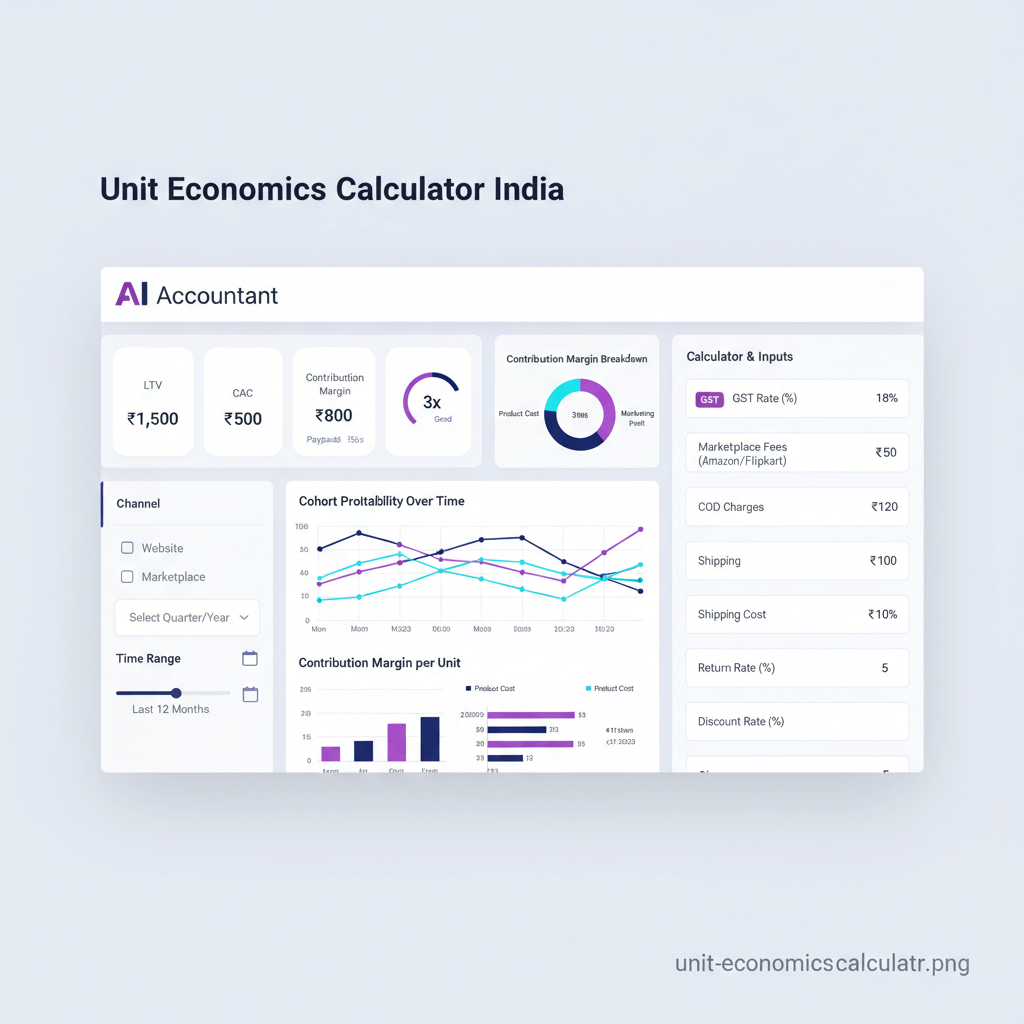
Visual Dashboard Elements
- Trend lines for LTV growth over time.
- Cohort heatmaps to reveal highest performing groups.
- Channel bar charts comparing acquisition efficiency at a glance.
Industry Benchmarks
Compare against sector norms to know where you stand.
Business ModelHealthy LTV to CACCAC Payback PeriodSaaSGreater than 3 to 1Under 6 to 9 monthsD2CGreater than 3 to 1Under 5 months with repeat purchases
The Reserve Bank of India's MSME reports provide useful macro data on SME financial health that can help contextualize your payback benchmarks against industry averages.
Deep Dive Into Contribution Margin Analysis
Contribution margin analysis reveals profitability after variable costs. Include GST net amounts, marketplace commission at 15 percent, shipping, packaging, and payment gateway fees.
The Core Formula
Contribution Margin equals (Selling Price minus Variable Costs) divided by Selling Price. Interpret both percent and rupee terms for decisions. A 40% margin in percentage terms might still mean only ₹100 per unit in absolute terms, which matters for volume planning.
SKU and Channel Analysis
Example: a D2C shirt priced at ₹1,000 with variables of ₹600 shows a 40 percent margin. With returns factored in, margin may drop to 25 percent.
Channels differ significantly. Your own website might yield 45 percent margins. Marketplaces could net only 30 percent after platform fees, fulfilment charges, and advertising costs.
Managing Margin Shifts
- Limit discount erosion. Usually cap at 10 percent. Apply strategic pricing and product bundles instead of blanket discounts.
- Raise prices 5 to 10 percent on high performers. Watch price elasticity closely.
- Shift marketing spend toward higher margin channels.
- Negotiate MOQs (minimum order quantities) and supplier payment terms to reduce per-unit costs.
Action Steps
- Review margins weekly by SKU and channel.
- Set minimum acceptable margins per product category.
- Alert teams when margins fall below thresholds.
- Use the contribution margin workbook in your unit economics calculator India pack to automate these reviews.
Mastering Payback Period Tracking
CAC payback period shows how quickly acquisition costs are recovered using contribution margins. It is arguably the most actionable metric for cash flow planning.
The Calculation
Divide CAC by monthly contribution margin per customer. For example, if monthly contribution is ₹2,000 and CAC is ₹10,000, payback is 5 months. Simple, but only accurate when your contribution margin data is clean.
Practical Applications
- Stop campaigns with payback beyond 9 months unless retention is extremely strong.
- Plan cash flow based on payback timelines. Know exactly when each cohort turns cash-positive.
- Budget for working capital needs during the payback window, especially if you rely on COD collections.
Industry Thresholds
- SaaS and consumables should target under 6 to 9 months payback.
- Big ticket items may tolerate 12 plus months if retention is excellent.
- Subscription businesses need faster payback compared to one-time purchases due to churn risk.
Building Your Tracking Sheet
- Populate cohorts by acquisition month.
- Track cumulative contribution margin against CAC.
- Visualize waterfall charts to see recovery progression month over month.
Creating and Using Cohort Profitability Tools
Cohort profitability tools show which customer groups sustain growth and how profitability changes over time. Without cohort analysis, you are averaging winners and losers together, which hides the truth.
Defining Your Cohorts
- Group by acquisition month to capture seasonality effects.
- Segment by channel to identify the most efficient sources.
- Split by geography for regional dynamics (metro versus tier 2 and tier 3 cities).
- Classify by first product purchased to find gateway SKUs that drive repeat purchases.
Tracking Methodology
- Calculate revenue minus returns, discounts, and support costs for true profitability.
- Monitor contribution margins across 12 month windows.
- Watch decay rates to identify when cohorts turn unprofitable. Early decay signals a product or onboarding problem, not just a marketing one.
Common Data Pitfalls
- Untagged transactions distort attribution. Clean data first, then analyze.
- Invoice mismatches across systems create gaps. Reconcile monthly without exception.
- COD settlement delays distort timing. Account for lags of 7 to 14 days in your cohort revenue recognition.
Your Cohort Analysis Pack
Use pre-built formulas, line charts, and heatmaps to highlight performance. The pack helps you spot which acquisition channels and customer segments are worth scaling, and which ones are quietly draining cash.
Getting Your Data Ready: Tally and Accounting Tool Integration
Clean data powers accurate unit economics calculator India results. Garbage in, garbage out is not a cliché here; it is the number one reason margin dashboards mislead founders. Here is how to prepare.
Recommended Accounting Tools
- AI Accountant, AI Accountant automates bank and card statement ingestion, normalizes transactions, maps ledgers and customers, links receipts to invoices (also called vendor bill matching), handles AP automation, performs GST reconciliation with 95 percent accuracy, and syncs with Tally.
- QuickBooks, popular for small businesses with basic automation and cloud access.
- Xero, cloud based with strong integrations for growing teams.
- FreshBooks, simple interface suited for services and freelancers.
- Zoho Books, comprehensive Indian accounting with GST features.
- Tally, widely used across India for compliance, statutory reporting, and day-to-day bookkeeping.
How AI Accountant Streamlines Unit Economics
AI Accountant ingests statements automatically. It normalizes line items, then maps, matches, and tags transactions by ledger and customer. It links receipts to invoices, extracts AP bills (purchase invoices), validates vendors against GSTIN, reconciles purchases with GSTR-2B, and syncs cleaned data back to Tally.
The Outcome
Your unit economics calculator India, LTV to CAC dashboard, and cohort tools get 95 percent accurate data automatically. No more manual CSV cleanup or mismatches between systems.
Real-time dashboards show cash position, receivables aging, and category wise spending. This means your per-unit profitability numbers reflect reality, not last month's best guess.
Real World Case Examples From Indian Businesses
D2C Fashion Brand Success
A Mumbai brand struggled with unclear margins. COD returns and shipping costs were spread across multiple ledgers with no consistent tagging.
After cleaning and mapping data, they found contribution margins were 3 to 5 percent higher than reported. Cohort analysis revealed Facebook customers retained 40 percent better than Instagram customers. Spend shifted accordingly, and payback dropped from 8 months to 5 months.
SaaS Startup Transformation
A Bangalore SaaS company analyzed channel cohorts. Enterprise clients from LinkedIn delivered triple LTV versus SMB clients from Google Ads. Despite higher CAC, the LTV to CAC ratio improved to 3.5 times.
Budget reallocated from volume SMB acquisition to targeted enterprise outreach. The result: fewer customers, but dramatically better unit economics and cash flow.
Your Implementation Checklist
- [ ] Connect data sources: Tally, bank statements, and GSTR-2B files.
- [ ] Standardize expense categories: commissions, shipping, packaging, gateway fees.
- [ ] Validate all customer and transaction mappings.
- [ ] Populate the unit economics calculator India template with clean data.
- [ ] Set up your LTV to CAC dashboard with channel tracking.
- [ ] Configure contribution margin analysis by SKU.
- [ ] Build cohort profitability tracking by acquisition source.
- [ ] Review CAC and LTV metrics weekly.
- [ ] Analyze cohort performance monthly.
- [ ] Adjust marketing spend based on payback periods.
- [ ] Optimize pricing using margin analysis insights.
- [ ] Re-validate GST input credits against GSTR-2B after every filing cycle.
Frequently Asked Questions
How do GST and returns affect contribution margins for Indian businesses?
GST input credits reduce your variable costs, so net contribution margins increase after proper reconciliation. Returns subtract directly from both revenue and margin. For COD heavy brands, multiply LTV by (1 minus return rate) to avoid overstating customer value. With the e-invoicing threshold now at ₹1 crore (2026 update), accurate invoice reconciliation is even more critical for clean margin data.
How should I calculate LTV for a COD heavy D2C brand?
Use Average Order Value × Purchase Frequency × Gross Margin × (1 minus Return Rate), then layer cohort retention curves. COD cohorts typically show 15 to 25% lower repeat rates than prepaid cohorts, so run separate LTV calculations for each payment mode rather than blending them.
What is the difference in CAC payback between subscriptions and one-time purchases?
Subscriptions recover CAC gradually through monthly contribution margin against MRR, while one-time purchases recover from upfront margin in a single transaction. Subscriptions require faster payback targets (under 6 to 9 months) because churn can erase the customer before you break even.
What is a defensible LTV to CAC benchmark for SaaS versus D2C in India?
Above 3 to 1 is generally healthy for both models. SaaS may accept 6 to 9 month payback given higher retention, while D2C should target under 5 months with repeat purchases. Investors typically view anything below 2 to 1 as unsustainable and above 5 to 1 as a signal you may be under-investing in growth.
How does AI Accountant help with GSTR-2B reconciliation for unit economics?
AI Accountant automates statement ingestion, normalizes transactions, predicts ledger and customer mappings, and reconciles purchases against GSTR-2B with 95 percent accuracy. This means the ITC figures flowing into your contribution margin and LTV formulas are reliable, not estimates. More details at AI Accountant.
Which costs should be variable versus fixed when computing contribution margin at SKU level?
Variable costs include freight, packaging, marketplace commissions, payment gateway fees, pick and pack labour, and discounts. Fixed costs include salaries, rent, and software subscriptions. Always apply GST netting on variable costs so your per-unit margins reflect actual cash outflows, not gross invoice amounts.
What actions should finance take when LTV to CAC drops below 3 to 1?
Immediately freeze spend on the lowest performing acquisition channels. Then raise prices on resilient SKUs, cut discount leakage, renegotiate supplier terms, and double down on cohorts with proven retention. Monitor payback weekly until the ratio stabilizes above your threshold.
Get Your Free Templates and Start Tracking
Download the complete unit economics calculator India pack. It includes the LTV to CAC dashboard, contribution margin workbook, payback tracking sheet, and cohort profitability tools. Each template comes with formulas tailored to Indian GST, marketplace fees, and returns.
The pack includes setup guidance for Google Sheets and Looker Studio. Ready to automate data prep? Book a demo with AI Accountant to connect Tally, see how automated mapping and GST reconciliation feed clean data into your unit economics templates.
Stop guessing. Start measuring with tools built for Indian realities. Sustainable growth begins with mastering your unit economics.

Rohan Sinha is a fintech and growth leader building aiaccountant.com, focused on simplifying accounting and compliance for Indian businesses through automation. An IIT BHU alumnus, he brings hands-on experience across 0 to 1 product building, growth, and strategy in B2B SaaS and fintech.