-01%201.svg)
Key takeaways
- A production ready data pipeline finance India setup eliminates manual exports, broken spreadsheets, and reconciliation chaos by delivering clean KPIs from your accounting system into dashboards in real time.
- India specific logic is non negotiable: April to March fiscal years, GST place of supply, GSTIN level tracking, TDS handling, back dated vouchers, and multi bank formats must be first class citizens in your pipeline.
- Set concrete KPI thresholds that trigger action: book to bank reconciliation coverage above 95%, GST rate validation at 100%, and trial balance tie outs with zero tolerance for imbalance.
- AI powered pipelines now automate 60 to 90% of manual tasks like document extraction, transaction categorization, and GST reconciliation, cutting month end timelines by up to 75%.
- Start with one entity and five accurate KPIs rather than fifty questionable ones; expand only after finance signs off on data quality.
- If standard KPIs and fast go live matter, AI Accountant's GST reconciliation and bank ingestion capabilities shortcut weeks of pipeline engineering for Indian teams.
Data Pipeline Finance India: What's New in 2026
Until mid 2025, most Indian finance teams relied on semi manual ETL workflows: CSV exports from Tally, API pulls stitched together with scripts, and spreadsheet based reconciliation. By early 2026, AI driven pipelines have shifted the baseline. Teams using automated platforms now report 60 to 90% reduction in manual data entry and up to 90% fewer reconciliation errors within three months of adoption.
The operational shift is tangible. Agentic AI now handles predictive cash forecasting, flags GSTR mismatches before filing deadlines, and runs human in the loop validation cycles that push accuracy toward 99%. For CA firms managing 20 or more clients, this means the monthly close that once took a week can wrap in one to two days. For SME finance teams on Tally, agent based syncs handle offline servers without interrupting user sessions.
Who does this hit hardest? Firms still running full manual reloads or relying on periodic CSV dumps. If your pipeline cannot handle back dated vouchers via change data capture, or if bank statement parsing breaks across SBI, HDFC, and ICICI formats, you are leaving hours on the table every week. The cost of inaction is not just inefficiency: missed GSTR filing deadlines attract 18% annual interest under GST portal rules, and unreconciled ITC differences can trigger notices during assessment.
What to do now:
- Audit your current pipeline for delta handling and back dated voucher coverage before your next month end close.
- Benchmark your book to bank reconciliation rate. If it is below 95%, prioritize automated bank ingestion with UTR and IFSC parsing.
- Evaluate whether your KPI thresholds (aging buckets, GST liability gaps, cash runway) are actively monitored or just reported.
Teams adopting automated bookkeeping workflows are compressing what used to be weeks of pipeline setup into days, with compliance guardrails built in from day one.
Why Finance Data Pipelines Matter for Indian Businesses
Manual CSV exports every morning, broken Excel links during close, GST reconciliations delaying filings, and mixed bank statement formats all add risk and rework. A well designed, automated data pipeline finance India approach changes the game. Extract, transform, and load continuously so finance can focus on analysis, not data fights.
India specific pain points include offline Tally on local servers, GST return matching to purchase registers, TDS adjustments in payables and receivables, and dozens of SBI, HDFC, ICICI, and other bank formats. Automation cuts reporting errors dramatically while enabling live KPIs: cash flow, aging, GST liability, and reconciliation coverage.
Setting the right KPI thresholds is what separates a functioning pipeline from a useful one. A threshold is not just a number on a dashboard. It is the line that triggers investigation, escalation, or action. For example, if your AP aging crosses 90 days for more than 10% of vendors, that should fire an alert, not sit quietly in a pie chart.
Bottom line: pipelines give you consistent, reliable data views across entities, GSTINs, and banks. No more chasing ledger masters or manually reconciling GSTR 1 every month.
Architecture Overview: From Source to Dashboard
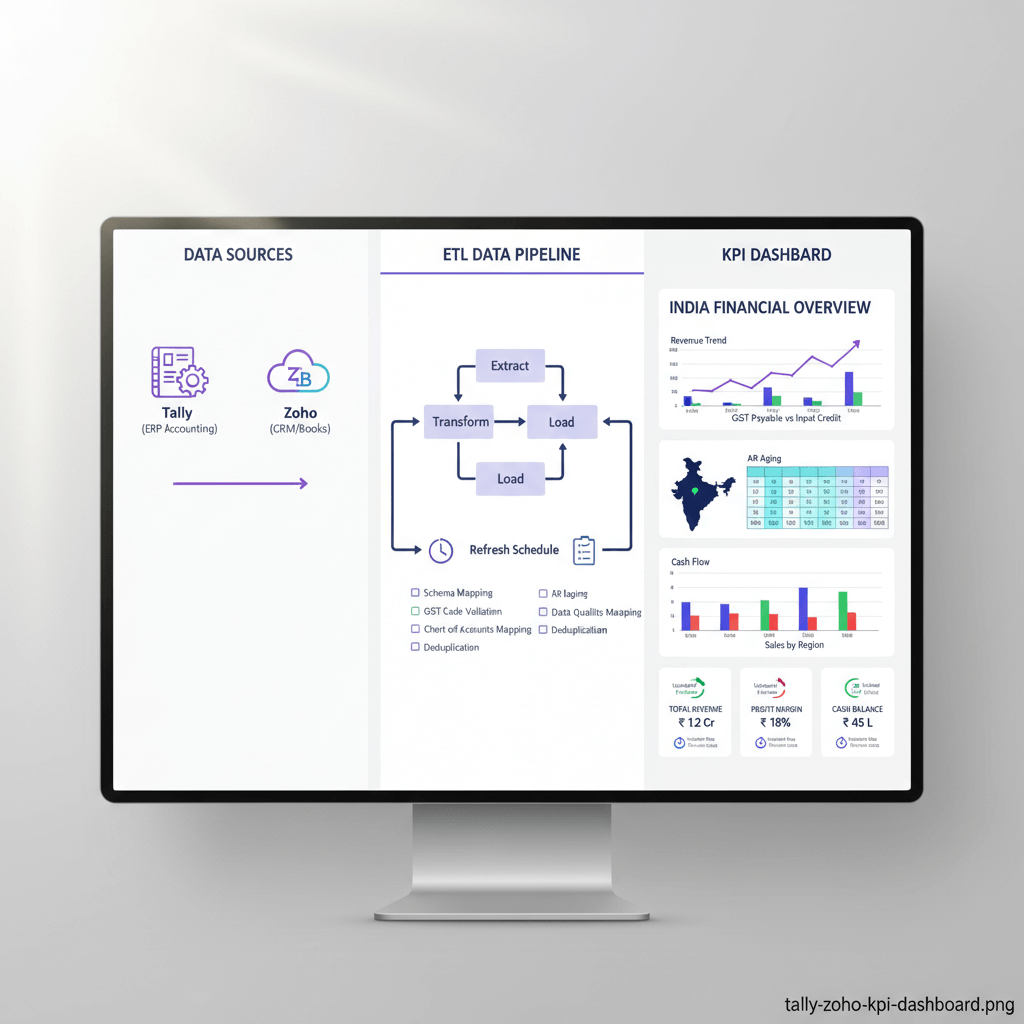
Your finance data pipeline architecture flows predictably. Sources feed staging, staging moves to transformation, transformations load into a warehouse, BI tools consume, orchestration and controls keep everything healthy.
- Sources: Tally and accounting platforms, bank statements, GST returns, invoices and bills (vendor invoices included), payroll systems if needed.
- Staging: raw dumps with metadata and change logs. Keep the audit trail intact.
- Transformation: standardize chart of accounts, apply GST and TDS logic, compute KPIs on normalized data.
- Warehouse: PostgreSQL for small teams, BigQuery or Snowflake for scale.
- Serving: Power BI, Tableau, Looker Studio, or Google Sheets for simpler consumption.
- Orchestration: cron for basics, Apache Airflow for complex workflows, automated tests, alerts, and retries.
Why ELT? You retain raw data, push transformations into the warehouse where compute is cheaper, and maintain versioned logic. This matters especially when you need to recalculate KPI thresholds retroactively or reprocess after a GST rate change notification from CBIC.
Extract from Tally and Accounting Systems: Getting Your Raw Data Out
The extract from Tally and accounting systems phase must be reliable and incremental. Pull vouchers, journals, ledger masters, customer and vendor masters, tax tables, invoices, bills, payments, and credit notes. Focus on deltas not full dumps. Keep source load low and pipeline fast.
Tally extraction options
TDL scripts and ODBC connections enable live access. XML or JSON exports suit batch transfers. For offline installations, deploy on premise agents to export voucher masters periodically. Schedule during low usage hours to avoid locking.
Agent based syncs have matured significantly. In 2026, these agents handle change data capture natively, pushing only modified ledger entries and vouchers rather than full dumps. This reduces extraction time from hours to minutes for large books.
Zoho Books extraction methods
Zoho Books offers clean REST APIs for journals, invoices, bills, and payments. Add webhooks for real time change capture. Explore the Zoho Books API and app ecosystem for integration options.
India specific extraction challenges
Handle multiple entities and GSTINs, branch segmentation for retail, back dated postings, and FX rate capture at transaction time.
Bank statements need UTR, IFSC, and narration parsing across many formats. Narration fields from Indian banks are notoriously inconsistent. SBI may include the UTR in one position, HDFC in another, and ICICI may abbreviate IFSC codes differently. Your extraction layer must normalize these before they reach transformation.
To reduce errors upstream, validate GSTIN at document level during extraction. Cross check against the GST portal's GSTIN search to catch invalid or cancelled registrations early.
Transform for KPIs: Making Raw Data Business Ready
The transform for KPIs stage is where raw extracts turn into analytical gold. Build a star schema: transaction facts, date, entity, ledger, vendor, and tax dimensions. Then compute tax aware metrics.
Standardization across entities
Map chart of accounts consistently. The same expense often appears under different names across entities. Use a master mapping and automate it where possible. Deduplicate vendors and customers using GSTIN, PAN, and state codes. Apply fuzzy matching to collapse near duplicates into golden records.
Tax logic implementation
Split taxable amounts and GST components correctly. Map HSN and SAC codes. Handle reverse charge. Calculate TDS deductions and net amounts. Differentiate intra state versus inter state for CGST, SGST, and IGST.
With new e invoicing thresholds pulling more SMEs into compliance, your transformation layer must validate that every invoice above the applicable turnover limit carries a valid IRN. Missing IRNs should be flagged as exceptions, not silently passed through.
Core KPI calculations and thresholds
The real value of a pipeline is not just computing KPIs. It is knowing when a KPI has crossed a threshold that demands attention. Here are the core metrics with actionable threshold guidance:
- Revenue and expenses: compute on GST exclusive amounts, derive gross margin cleanly. Set a threshold for margin variance (e.g., flag if gross margin drops more than 3 percentage points month on month).
- Cash flow: combine book entries with bank reconciliation, match UTR numbers so you know what truly hit the bank. Alert when projected cash runway falls below 60 days.
- AR and AP aging: standard buckets with GST advances where relevant. Track DSO and DPO. A useful threshold: flag when more than 15% of receivables cross 90 days.
- GST liability: match GSTR 1 to sales books, compare GSTR 2B to purchases, apply place of supply rules and adjustments. Threshold: any mismatch above ₹500 per invoice triggers review.
- Book to bank reconciliation coverage: tag exceptions, rounding differences, and TDS edge cases explicitly. Target 95% or higher. Below that, your close is unreliable.
Use SQL for base models, Python for complex logic, and DBT for version controlled pipelines. Visualize thresholds as color coded zones in your dashboards: green for healthy, amber for watch, red for act now.
Load to BI Tools: Serving Insights to Stakeholders
The load to BI tools phase delivers insights to end users. Pick tools matching skills and budget: Power BI, Tableau, Looker Studio, or Sheets for quick wins.
BI tool selection
For accounting specific needs, evaluate tools that handle Indian compliance natively. AI Accountant automates the entire pipeline with one click Tally sync, Indian bank formats, compliance ready dashboards, and GST aware KPIs. QuickBooks and Xero have strengths, but Indian GST and Tally integration can be limiting. FreshBooks suits simple setups. Sage is powerful and customizable but heavy. Zoho Analytics works well for integrated stacks.
Loading patterns and performance
Favor direct warehouse queries for fresher dashboards. Implement incremental monthly partitions to manage growth. Pre aggregate KPIs for speed. Design semantic layers enabling drill downs from summary to transaction.
When building pie charts in analytics tools for reconciliation coverage or expense breakdowns, ensure your data model supports the drill down from chart segment to underlying transactions. A pie chart showing 5% unmatched is useful only if clicking that slice reveals the actual exceptions.
For documentation and pipelines, review Zoho Analytics pipeline docs and Zoho Analytics data pipelines for practical scheduling and refresh patterns.
Schedule Refresh: Keeping Data Current
Your schedule refresh plan sets expectations for KPI freshness.
Refresh cadence planning
- Daily incremental loads: vouchers, transactions, and ledger entries.
- Hourly cash position: if treasury operations need it.
- Weekly full refresh: catch stragglers and schema drift.
- Month end runs: reconciliation complete, tie outs done, stakeholder sign off.
Scheduling tools and automation
Start with cron or Windows Task Scheduler. Graduate to Apache Airflow or Prefect for SLAs, and DBT for transform orchestration. Robotic process automation (RPA) tools can supplement for legacy system extractions where APIs are unavailable.
Zoho pipelines can automate end to end for integrated stacks. See Zoho Analytics pipeline docs and the ETL guide for patterns.
Alert configuration
Alert on failed pulls, zero row extracts, KPI drift beyond thresholds, and Tally locking or fiscal rollover anomalies. Build retries that respect source constraints.
Good alerts are specific and owned. Route extraction failures to ops, KPI threshold breaches to analysts, and cash position alerts to the CFO. Add suppression windows during planned maintenance so your team does not learn to ignore notifications. Include retry metadata so responders see context quickly.
Data Quality Checks: Ensuring Accuracy
Your data quality checks are the guardrails that keep your CFO's dashboard honest.
Structural validation
- Detect schema drift when sources change. Validate mandatory fields: GSTIN, dates, amounts.
- Ensure dates fall within April to March bounds. Flag anomalies early.
- Check for null or malformed UTR numbers in bank data before they reach reconciliation.
Business logic validation
- Trial balance must tie. Debits equal credits, zero tolerance.
- No orphan transactions. Enforce ledger mapping for every entry.
- GST rates and HSN codes must be valid per masters. Cross reference against the CBIC HSN notification for current rates.
- Book to bank reconciliation coverage above 95%. Exceptions must be auditable.
- GSTR 2B versus purchase book gaps quantified and classified (missing, mismatch, timing).
Monitoring and remediation
Track freshness with timestamps. Watch row counts for spikes or drops. Detect outliers statistically. Quarantine bad rows. Open tickets and fix upstream issues.
India specific checks include duplicate master detection by GSTIN, GSTR 2B versus purchase book gaps, TDS section validation, and place of supply compliance. AI powered anomaly detection now flags unusual patterns (sudden spikes in credit notes, unexpected reverse charge entries) before they compound downstream.
Security, Compliance, and Auditability
Financial data demands strong controls. Implement least privilege access by entity and user. Encrypt PAN and GSTIN fields at rest and in transit. Maintain immutable audit logs for every transformation step.
Apply user to entity mapping rigorously for row level security in dashboards. This ensures branch managers see only their data, while the CFO gets the consolidated view.
Use certified tools where possible. ISO 27001 and SOC 2 Type II provide assurance of controls. These certifications matter especially when client data from multiple CA firm engagements flows through the same pipeline.
Create retention policies that align to Indian tax laws. The Income Tax Act requires eight year record retention. Archive older data to reduce active database size, and maintain robust backup and disaster recovery procedures.
Build versus Buy: Making the Right Choice
When to build
Build if you have engineering capacity, highly customized KPIs, on premise Tally constraints, or proprietary systems that need deep integration. Expect ongoing maintenance and at least one dedicated engineer for production stability. Teams using Airflow and DBT with AI integrations (such as RAG for document extraction) can create powerful custom pipelines, but the setup cost is real.
When to buy
Buy if you need speed to value, standard KPIs suffice, prefer operating expense to capital, or lack expertise in Indian tax and compliance nuances. Prebuilt tools handle Tally syncs and India specific tax logic out of the box. AI Accountant exemplifies the buy path: one click Tally sync, trained on Indian bank formats, automatic ledger mapping and GST calculations, compliance ready dashboards, plus enterprise security.
Pilot results from Indian CA firms show the buy path delivering 75% faster month ends and 90% fewer reconciliation errors within three months. The trade off is less customization. If your KPIs are truly unique or your systems are proprietary, building may justify the investment.
Implementation Checklist and Timeline
- Scope sources and entities: list companies and GSTINs, document systems and history needs.
- Set up extraction from Tally, accounting platforms, and banks. Test connectivity and pull historicals.
- Design schema and mappings: chart of accounts mapping, GST and tax logic, vendor and customer masters.
- Build transformations for KPIs: tax calculations, aging buckets, reconciliation rules, and threshold definitions.
- Define data quality checks and thresholds: variance limits, exception reports, remediation workflow.
- Load to BI with semantic layers: base reports, interactive dashboards, drill downs from pie charts to transaction detail.
- Schedule refresh and alerts: test incremental loads, verify triggers, document recovery.
- User acceptance testing for close: compare pipeline output to manual, finance sign off, operational runbooks.
Pilot one entity in two to three weeks. Multi entity rollout in four to eight weeks. Budget extra time for GST complexities and bank integrations.
Common Pitfalls and Solutions
Booking date versus value date confusion
Problem: value date used for revenue recognition distorts timing.
Solution: use posting date for KPIs, track value date separately for cash flow.
Back dated entry handling
Problem: back dated entries break deltas.
Solution: implement change data capture, run periodic full refreshes for stragglers.
Missing incremental logic
Problem: full reloads stress sources and take hours.
Solution: build proper delta mechanisms using modified timestamps or change logs.
Weak deduplication
Problem: same vendor appears multiple times with small name variations.
Solution: fuzzy match on GSTIN and PAN, build golden records. This is especially important when computing AP aging thresholds, since duplicate vendors split balances and mask overdue concentrations.
GST and TDS edge cases
Problem: credit notes and advances break standard logic.
Solution: test with real scenarios and handle refunds and adjustments explicitly. Validate TDS sections against the Income Tax Act provisions to ensure correct deduction rates.
Threshold fatigue from noisy alerts
Problem: too many alerts with low thresholds train teams to ignore them.
Solution: start with fewer, higher confidence thresholds. A 95% reconciliation coverage alert is more actionable than alerting on every ₹10 mismatch. Tune thresholds quarterly based on exception patterns.
Essential KPIs for Your First Dashboard
- Cash runway: months of operation plotted, include receivable collections for optimistic scenarios. Threshold: alert when runway drops below 90 days.
- AR and AP aging: heatmaps of old dues concentration, identify priority customers and vendors. Threshold: flag when more than 15% of total receivables exceed 90 days.
- Revenue and expense trends: bar charts month on month and year on year, breakdown by category or unit. Threshold: investigate when any category deviates more than 10% from the trailing three month average.
- GST payable and receivable bridge: reconcile books to returns, show timing differences clearly. Threshold: any invoice level mismatch above ₹500 needs review before filing.
- Reconciliation coverage: pie chart of matched versus unmatched, monitor improvements over time. Threshold: below 95% matched is a red flag.
Add filters for entity, period, and department. Enable drill downs from summary charts to individual transactions. Export packs for auditors and management reviews.
Moving Forward with Your Finance Data Pipeline
Build trust in your data step by step. Start with one entity and a handful of KPIs, then expand. Prioritize data quality over quantity initially. Five accurate KPIs beat fifty questionable ones.
Keep documentation tight and review with finance regularly. Tax rules evolve (GST council meets quarterly, TDS provisions update annually) and your pipeline must adapt. Subscribe to GST Council updates so your team catches rule changes before they hit filing deadlines.
If you need a faster path, explore AI Accountant: from Tally syncs to bank reconciliation, GST calculations, and aging dashboards, it handles India first complexities so your team can focus on decisions, not data plumbing.
The goal is not moving data from A to B. It is to deliver trustworthy insights that drive better business decisions. With the right data pipeline finance India infrastructure, finance transforms from data processors to strategic advisors.
FAQ
How do I connect an offline Tally server to a cloud data pipeline without breaking user sessions?
Deploy a lightweight on premise agent that reads vouchers and masters during low usage windows, then pushes deltas to staging with audit logs for change data capture. In 2026, agent based syncs handle change data capture natively, reducing extraction time from hours to minutes for large books (2026 update). Schedule gateway refreshes during non peak hours so staff experience remains smooth.
What is the recommended approach to handle back dated vouchers in incremental loads for Indian entities?
Use a hybrid strategy: daily deltas by modified timestamps, and a weekly back fill that scans a sliding window to catch back dated postings. Combine with versioned transformations so recalculations are deterministic and auditable. This approach is especially important during March when back dated entries spike for year end adjustments.
How should I set KPI thresholds in analytics dashboards so they trigger action, not noise?
Start with fewer, high confidence thresholds tied to business impact: 95% book to bank reconciliation coverage, ₹500 per invoice GST mismatch limit, and 90 day cash runway floor. Review and tune thresholds quarterly based on exception volumes and false positive rates. Color code zones (green, amber, red) in your pie charts and dashboards so stakeholders can scan status at a glance.
What checks ensure GST and TDS logic remains correct across AR and AP aging reports?
Split taxable base and tax components at the transformation layer. Validate HSN, SAC, and rates against current masters. Enforce place of supply for CGST, SGST, and IGST, and confirm TDS sections on invoices and credit notes. Add exception reports for mismatches and drift, then lock corrections with immutable audit trails.
Which BI refresh strategy avoids long downtime at month end for large Indian books?
Partition by month, push incremental fact loads, pre aggregate common KPIs, and cap concurrency on gateway refreshes. For large books processing millions of transactions, micro batch hourly refreshes for cash position alongside daily full KPI refreshes strikes the right balance between freshness and performance.
When should a CA firm or CFO choose build versus buy for a finance data pipeline in India?
Buy when speed, standard KPIs, and lower maintenance matter, which covers roughly 75% of use cases. Pilot results show buy path solutions delivering 75% faster month ends within three months (2026 update). Build only when KPIs are truly unique, systems are proprietary, or strict on premise constraints apply. Expect at least one dedicated engineer for ongoing production stability if you build.
Can I use threshold based alerts in analytics tools to monitor GST reconciliation gaps automatically?
Yes. Configure alerts on GSTR 2B versus purchase book mismatch counts, invoice level variance above ₹500, and reconciliation coverage dropping below 95%. Route GST specific alerts to the tax team, not general finance. Suppress during filing windows when temporary mismatches are expected, and include context (invoice numbers, vendor GSTINs) so responders can act immediately.

Rohan Sinha is a fintech and growth leader building aiaccountant.com, focused on simplifying accounting and compliance for Indian businesses through automation. An IIT BHU alumnus, he brings hands-on experience across 0 to 1 product building, growth, and strategy in B2B SaaS and fintech.