-01%201.svg)
Key takeaways
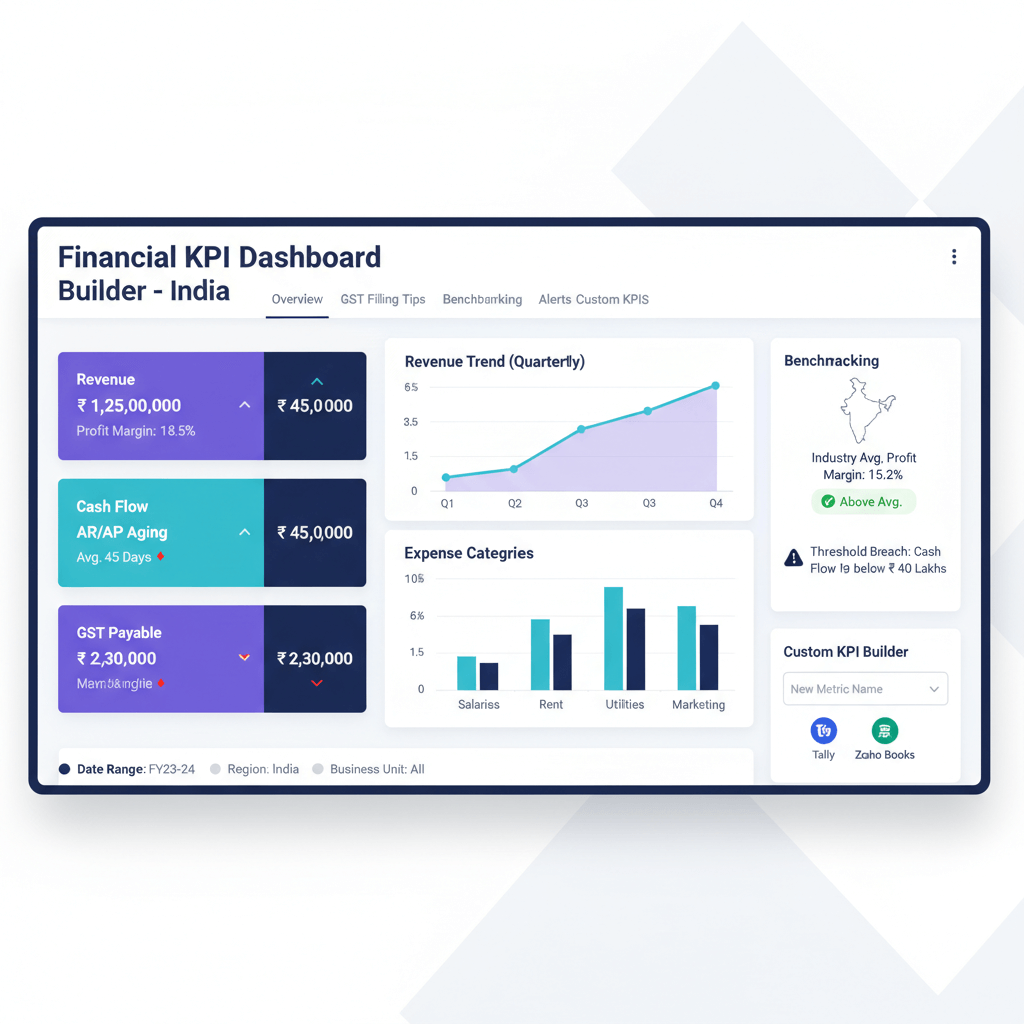
- A financial KPI dashboard builder for India automates data ingestion from Tally and bank statements, delivers near real time synchronization, and tracks GST compliance metrics without manual effort.
- The features that drive daily value for CA firms and SMEs are custom metric creation flexibility, automated refresh cycles, threshold based alerting, and multi organization benchmarking with strict data segregation.
- Critical KPIs to prioritize: cash runway (alert below six months), DSO and DPO, GST input credit utilization, GSTR 2B match rates, reconciliation completion, and spend analytics by category, vendor, and department.
- Teams using finance automation reduce data gathering effort by roughly 80 percent, compress month end close from 15 days to three, and shift from reactive reporting to proactive decision making.
- If your team spends more time collecting data than analyzing it, start with a pilot: AI Accountant's MIS reporting connects to Tally, normalizes transactions, and surfaces pre built dashboards within days.
Financial KPI Dashboards for India: What's New in 2026
Until March 2025, the GST e-invoicing mandate applied to businesses with turnover above ₹5 crore. From April 2025, the threshold dropped to ₹1 crore, pulling a significantly larger pool of SMEs into the e-invoicing net. This means more transaction level data flowing into GSTR returns, and more reconciliation points your dashboard must track automatically. Firms that still rely on manual matching now face a higher volume of ITC mismatches and potential compliance flags (see GST portal notification on e-invoicing thresholds).
The operational shift is concrete. Every invoice above the new threshold generates an IRN, which must reconcile against your GSTR 2B. CA firms managing 20 or more clients now handle thousands of additional line items monthly. Without automated ingestion and matching, the risk of blocked ITC claims, interest under Section 50, and late filing penalties (₹50 per day for GSTR 1, ₹20 per day for nil returns) compounds quickly.
Who does this hit hardest? SMEs in the ₹1 crore to ₹5 crore band that previously operated below the e-invoicing radar. Many still run on Tally without automated GST reconciliation workflows. CA firms servicing this segment face volume spikes in reconciliation work.
What to do now:
- Audit which clients now fall under the ₹1 crore e-invoicing mandate and confirm IRN generation is active.
- Set up automated GSTR 2B ingestion so ITC matching happens continuously, not at filing deadlines.
- Configure threshold alerts for ITC mismatches exceeding 5 percent, these are early warning signs of blocked credits.
Platforms offering automated GST reconciliation handle this volume shift without adding headcount, keeping match rates above 90 percent even as transaction counts climb.
The Real Problems Indian Finance Teams Face Daily
Indian finance teams and CA firms grapple with fragmented data. Transactions reside in Tally, bank statements arrive in many formats, GST data sits in government portals, and purchase registers live in Excel.
Teams spend nearly 80 percent of time gathering and organizing data. Dashboards in spreadsheets become outdated immediately. Alerts on overdue payments or cash shortfalls arrive too late. Benchmarking across periods or peers is painful.
The result is late month end closes, ad hoc reporting scrambles, and missed strategic opportunities. AI Accountant addresses these pain points with automated dashboards and seamless integrations, connecting to Tally for near real time visibility without manual work.
Bottom line, if your team spends more time collecting data than analyzing it, you are operating reactively rather than proactively.
Understanding India Specific Dashboard Requirements
Effective dashboards in India must support Tally, multiple bank statement formats, GSTR 2B files, and purchase registers. Compliance KPIs matter enormously:
- Track GST input credit utilization
- Reconcile between books and GSTR filings
- Manage payables and receivables aging
- Maintain cash position across multiple bank accounts
CA firms need multi organization management. Each client requires separate dashboards with role based access. Partners want consolidated views while maintaining strict data segregation. The ICAI guidance on GST annual returns reinforces the importance of maintaining reconciliation discipline throughout the year, not just at filing time.
Essential Features Your Dashboard Builder Must Have
Custom metric creation capabilities
Your custom metric creation determines dashboard flexibility. Look for formula builders that reference any ledger or period, support derived fields, and aggregations without code.
Power BI offers DAX for complex calculations. Other platforms provide visual builders with pre built functions. Aim for a balance of power and usability, so both CAs and non technical founders can build what they need.
Real time KPI tracking systems
Real time KPI tracking means automated refresh as data arrives. In practice, hourly or daily updates are typical for most Indian businesses on Tally.
Your system should handle incremental syncs, backdated entries, and automated schedules so teams always see current information. The goal is fresh data without manual intervention, not millisecond latency that adds server load without business value.
Alert configuration dashboard setup
An alert configuration dashboard turns passive reporting into proactive monitoring. Set thresholds for minimum cash balance, anomaly detection for unusual spends, and overdue payment triggers routed to email or chat.
Escalation paths for critical issues ensure the right person acts quickly. For example, a cash balance alert can trigger a payment hold workflow, preventing problems rather than just informing about them.
KPI benchmarking tools
KPI benchmarking tools enable comparisons across time, business units, and industry standards. CA firms need multi organization support to compare clients and identify best practices.
Internal benchmarks (this month versus last, this quarter versus same quarter last year) are most actionable. External benchmarks using anonymized aggregates provide directional guidance without exposing client specifics.
Integration requirements
Native Tally integrations save setup time. Statement ingestion should cover varied bank formats (PDF, CSV, Excel). GST dataset compatibility, especially GSTR 2B, is essential for ITC reconciliation.
Learn how to design a robust data pipeline from books to dashboards. Breadth is helpful, but depth is critical. Shallow Tally connections will not meet complex reporting needs where you need ledger level detail.
Usability and access controls
No code builders democratize creation. Templates accelerate setup. Role based views focus attention.
Security should include certifications, audit trails, and data lineage. Implement row level security for finance dashboards to control visibility across teams and clients.
Comparing Dashboard Builder Categories
Top financial dashboard platforms
- AI Accountant, purpose built for Indian businesses with native Tally integration, automated GST reconciliation, ML powered transaction mapping, and pre configured financial dashboards.
- Power BI, strong Excel integration with DAX for complex modeling.
- Tableau, enterprise visualization with powerful data modeling.
- Klipfolio, cloud dashboards with many connectors.
- Zoho Analytics, native integration with the Zoho ecosystem.
- Abacum, finance automation with multi entity support.
Accounting native solutions
Zoho Analytics and Tally dashboards offer quick starts with native connections and immediate visuals. Limitations appear in advanced custom metric creation, alerting, and multi organization views.
Pricing is attractive, yet hidden costs arise when external tools are needed for GST reconciliation or cross entity benchmarking.
Business intelligence platforms
Power BI, Tableau, and Klipfolio excel at custom metric creation and expansive visualization, with hundreds of connectors. Downsides include setup complexity, data modeling needs, engineering maintenance, and add ons for alerting.
Pricing varies. Power BI is entry level, Tableau is premium, Klipfolio suits small teams. For most Indian CA firms, the total cost of ownership includes consultant fees, connector maintenance, and ongoing data pipeline management, which often exceeds the license cost.
Finance automation platforms
Specialized tools like AI Accountant and Abacum understand accounting structures. They ship pre modeled datasets, GST workflows, and multi organization support out of the box.
Synchronization stays current. Cash, AR, and AP views require minimal configuration. These platforms bridge the gap between simple accounting dashboards and complex BI stacks, offering depth without the engineering overhead.
Critical KPIs for Indian Finance Teams
Cash and runway metrics
Track consolidated cash across accounts, monthly net burn, and burn multiple for efficiency. Runway alerts below six months prompt early action for startups.
Example: configure an alert when runway dips under six months with a notification to the CFO and finance lead.
Receivables management
Use aging buckets and DSO (Days Sales Outstanding) to measure collection efficiency. Track dispute rates and problem customers. Act before bad debts accumulate.
A DSO trending upward over three consecutive months signals collection process issues that need immediate attention.
Payables optimization
Balance DPO (Days Payable Outstanding) with vendor relationships. Track early payment discounts captured versus missed. Monitor vendor concentration.
Ensure GST input credit utilization by watching unmatched invoices that delay ITC claims. As per CBIC circulars on ITC eligibility, credits for mismatched invoices can be blocked during assessment, making real time matching essential.
Operational efficiency
Measure month end close time, auto categorization rates, and reconciliation completion. The faster your close, the sharper your decisions.
Top performing teams close within three to five days. If you are still at 10 or more days, automated transaction mapping and categorization are the highest impact interventions.
Compliance tracking
Monitor GSTR 2B match rate and ITC mismatches. File on time to avoid penalties. Early detection prevents filing surprises.
With the e-invoicing threshold now at ₹1 crore, more transactions generate IRNs that must reconcile. Dashboard alerts on mismatch percentages catch issues before the filing deadline.
Spend analytics
Analyze category trends, vendor consolidation opportunities, and department or project allocations to support budgeting.
Spend visibility by vendor reveals concentration risk. If your top three vendors account for more than 60 percent of payables, diversification planning should start immediately.
Mastering Custom Metric Creation
Custom metric creation turns dashboards into decision engines. Build formulas referencing ledgers, vendors, and customers. Add time logic for trailing twelve months, month to date, and year over year comparisons.
Examples of high value custom metrics:
- DSO: average accounts receivable divided by credit sales times number of days
- GST ITC percentage: claimed versus eligible input tax credit
- Vendor concentration: top five vendors as a percentage of total spend
- Working capital ratio: current assets divided by current liabilities, tracked monthly
Watch for master data issues. Inconsistent vendor names break aggregations. Missing account mappings distort totals. Prioritize data cleaning and mapping automation before building complex metrics.
Power BI DAX handles time intelligence elegantly, yet visual no code builders often suffice for standard financial KPIs.
Implementing Real Time KPI Tracking
Real time KPI tracking is usually near real time. Hourly or daily cycles meet most needs. True millisecond updates add server load without business value for accounting data.
Normalize data across sources. Standardize bank narrations, debit and credit formats, and date formats. Without normalization, your dashboard shows garbage regardless of refresh speed.
Configure per source cadence: daily for bank feeds, hourly for accounting system syncs. AI Accountant keeps Tally masters synchronized continuously, so transactions flow into dashboards without manual refresh or CSV uploads.
Building Your Alert Configuration Dashboard
Your alert configuration dashboard needs four types of alerts:
- Threshold alerts: cash minimums, credit limit breaches
- Event alerts: overdue invoices, failed reconciliations
- Anomaly detection: spending spikes, drops in collections
- Compliance alerts: GSTR deadlines, TDS payment due dates
Calibrate thresholds per organization. A ₹50 lakh minimum cash alert makes sense for one client but not another. Define escalation paths and route through multiple channels for redundancy.
Pro tip: instrument alerts that prevent rather than just inform. A cash balance alert that triggers a payment hold workflow stops problems before they become crises.
Leveraging KPI Benchmarking Tools
KPI benchmarking tools provide context. Compare this month to last, this quarter to the same quarter last year, and across business units.
CA firms value multi organization benchmarking to identify best practices and improvement opportunities across their client portfolio. Which clients have the best DSO? Which ones are leaving ITC on the table?
External benchmarks are useful directionally. Use anonymized aggregates and respect privacy. Tools like Abacum and AI Accountant support cohorts by industry, size, and geography.
Step by Step Implementation with AI Accountant
Connect your organizations and sync masters from Tally. Ingest bank and card statements. The platform normalizes formats into consistent transactions automatically.
Machine learning maps and categorizes transactions, links payments to bills and receipts to invoices, and handles transfers or splits. This eliminates the tedious manual matching that consumes hours each week.
Push cleaned data back to your books. Activate pre built dashboards for cash, receivables, and payables. Build custom metrics, configure alerts, set role based access, and enable audit trails.
Typical implementation completes within days, not weeks. Your team gains visibility quickly, without waiting for a BI consultant to build data models.
Comprehensive Vendor Evaluation Framework
Use a scorecard. Weight criteria by importance and rate vendors on:
- India data coverage (Tally depth, GSTR 2B handling, bank format support)
- Custom metric strength (formula flexibility, time intelligence)
- Data cadence (refresh frequency, incremental sync capability)
- Alert completeness (threshold, event, anomaly, compliance)
- Benchmarking ability (multi org, cohort comparisons)
- Security (ISO 27001, SOC 2 Type II, audit trails, RLS)
- Scalability (transaction volume handling, multi entity support)
- Pricing predictability (no hidden engineering or connector costs)
Validate GST and TDS handling specifically. Ask for a demo with real GSTR 2B data. Test Tally integration depth by pulling ledger level detail, not just summary balances. The ICAI technical guide on GST reconciliation outlines the level of detail required for proper compliance, your vendor should match this standard.
Real World Success Story
A typical Indian SME moved from manual Excel to AI Accountant. Month end close dropped from 15 days to three. GSTR 2B matching reached 90 percent accuracy. The team shifted from data gathering to analysis.
Threshold alerts now warn on low cash. Overdue receivables trigger notifications. Unusual spends get flagged early.
The finance team reclaimed roughly 12 hours per week previously spent on data collection and formatting. That time now goes into vendor negotiations, cash flow planning, and advisory conversations with management.
Understanding Costs and Return on Investment
BI tools seem affordable per user. Yet hidden costs include data engineering, consultants, connector maintenance, and ongoing pipeline management. For a five person team, these hidden costs often double or triple the license fee.
Finance automation platforms reduce these costs through pre modeled data, automated mapping, and built in compliance features.
Calculate ROI by quantifying:
- Time saved: teams often reduce data gathering by 80 percent
- Close acceleration: three to five days faster
- Error reduction: fewer rework cycles from mismatched entries
- Opportunity costs: manual reporting displaces analysis, delays mean missed optimization, late alerts create preventable cash crunches
For most Indian SMEs and CA firms, finance automation delivers better total value than raw BI tools because it eliminates the engineering layer entirely.
Taking the Next Steps
Choosing the right financial KPI dashboard builder India means balancing custom metric creation flexibility, real time KPI tracking cadence, an alert configuration dashboard that prevents surprises, and KPI benchmarking tools to drive improvement.
Favor solutions that understand Indian requirements: native Tally integrations, GST reconciliation, multi organization support, and compliance aware alerting.
Start with a pilot. Connect a subset of data to AI Accountant, test your KPIs, validate data freshness, and configure a few critical alerts. You will move from reactive reporting to proactive decisions, spending less time gathering data and more time using insights to drive growth.
Frequently Asked Questions
What exactly counts as real time for financial KPIs in an Indian accounting context?
Near real time, meaning hourly or daily automated refresh cycles from Tally and bank feeds, meets most Indian business needs. True millisecond updates add server load without practical benefit for accounting data. Configure per source cadence: daily for bank statements, hourly for Tally syncs, so dashboards stay fresh for decisions without unnecessary infrastructure costs. For India specific implementation details, see the explainer on real time accounting sync in India.
Can my CA practice create custom metrics without coding, for example DSO or GST ITC utilization?
Yes, modern platforms provide visual no code builders and templates for common financial KPIs. You can define DSO, DPO, working capital ratios, and GST ITC percentage without writing any code. Start with pre built templates, then adapt filters and date logic. Ensure master data is clean (consistent vendor names, proper account mappings) to avoid calculation errors.
How should a CA firm configure alerts for multiple client entities with different thresholds?
Use an alert configuration dashboard that supports entity specific rules. Set cash minimums per client size, overdue invoice thresholds by industry norms, and escalation paths to assigned managers. Multi tenant setups with role based notification routing ensure each client gets relevant alerts without cross contamination of data.
What are the must have integrations for an Indian finance KPI dashboard?
Native Tally connectors, bank statement ingestion across formats (PDF, CSV, Excel), and GST datasets including GSTR 2B for ITC reconciliation are non negotiable. With the e-invoicing threshold now at ₹1 crore (2026 update), IRN data reconciliation capability has become essential for a much larger pool of businesses. Build a resilient data pipeline from books to dashboards so refreshes stay dependable.
How do KPI benchmarking tools work for multi organization CA portfolios while safeguarding client confidentiality?
Benchmark internally with strict role based access and row level security. Compare cohorts by industry, size, and geography without exposing individual client data. External benchmarks rely on anonymized aggregates, never revealing client specifics. Implement row level security for finance dashboards and verify platform certifications (ISO 27001, SOC 2 Type II) before onboarding client data.
What KPIs should an Indian SME prioritize for cash flow and working capital management?
Start with cash across accounts, net burn, and runway (alert below six months). Then track DSO with aging buckets, DPO with early payment discounts captured, vendor concentration, GST ITC utilization, reconciliation completion rates, and spend by category. Configure immediate alerts for runway risk and overdue receivables to catch problems before they compound.
Is a BI tool like Power BI enough, or should we adopt a finance automation platform first?
Finance automation platforms deliver faster time to value for Indian accounting workflows because they ship with native Tally integration, GST reconciliation, and pre modeled datasets. BI tools excel at custom visualization but require data engineering, connectors, and alert add ons that increase total cost. Many CA firms start with automation for operations, then layer BI for specialized analytics only where needed.

Rohan Sinha is a fintech and growth leader building aiaccountant.com, focused on simplifying accounting and compliance for Indian businesses through automation. An IIT BHU alumnus, he brings hands-on experience across 0 to 1 product building, growth, and strategy in B2B SaaS and fintech.