-01%201.svg)
Key takeaways
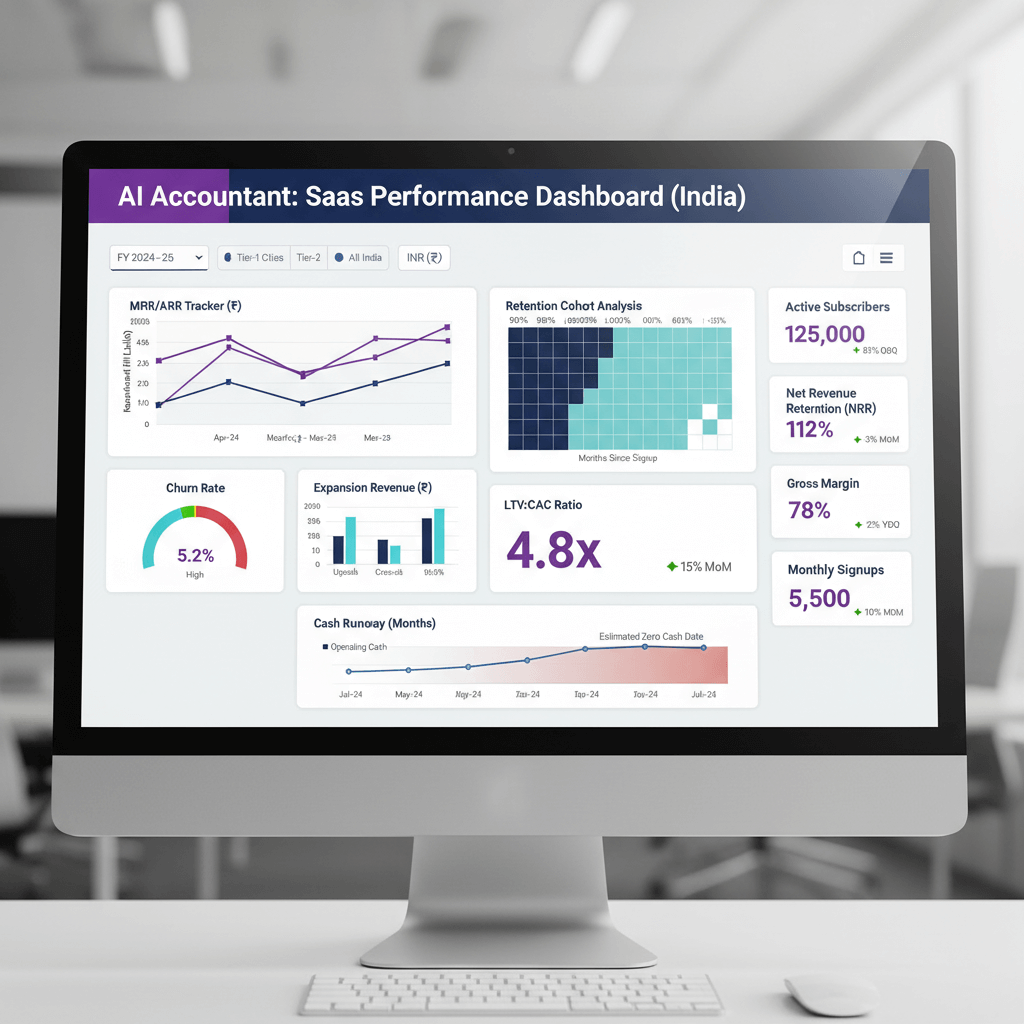
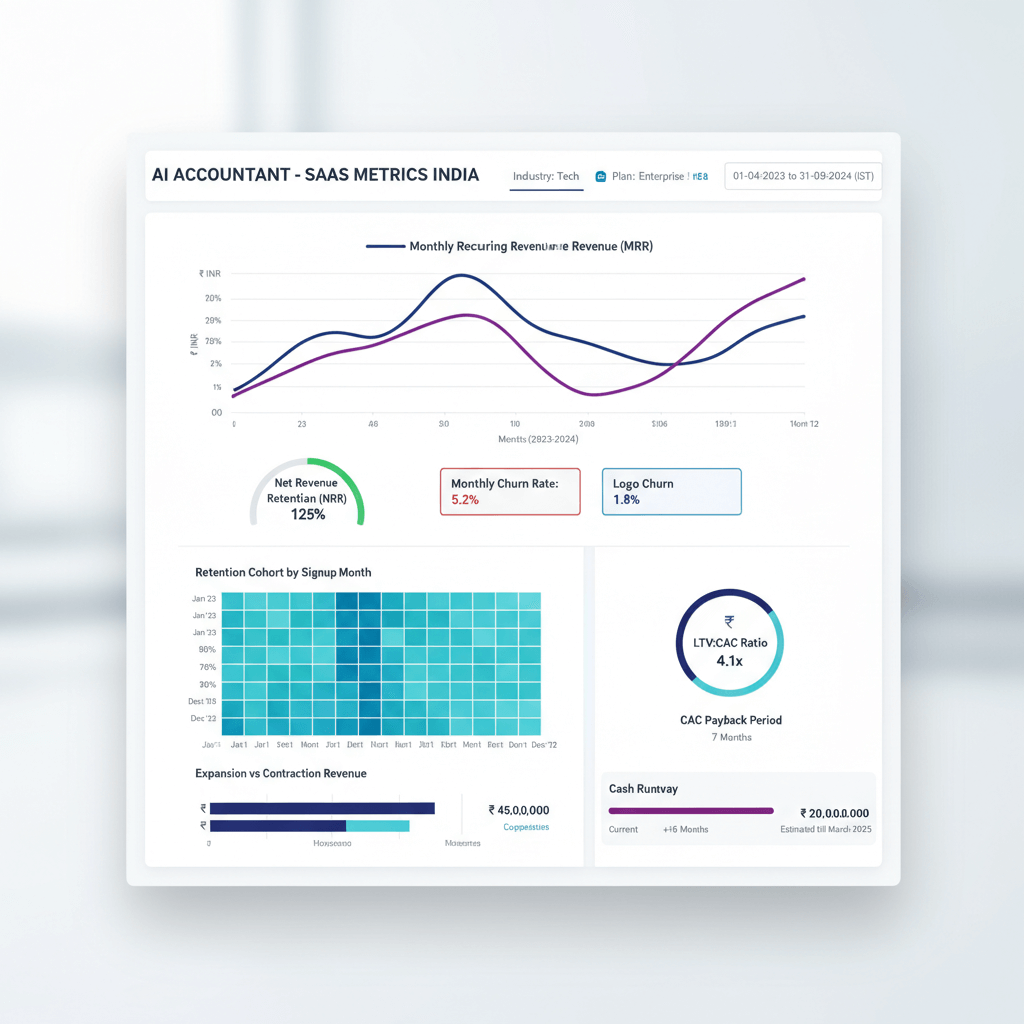
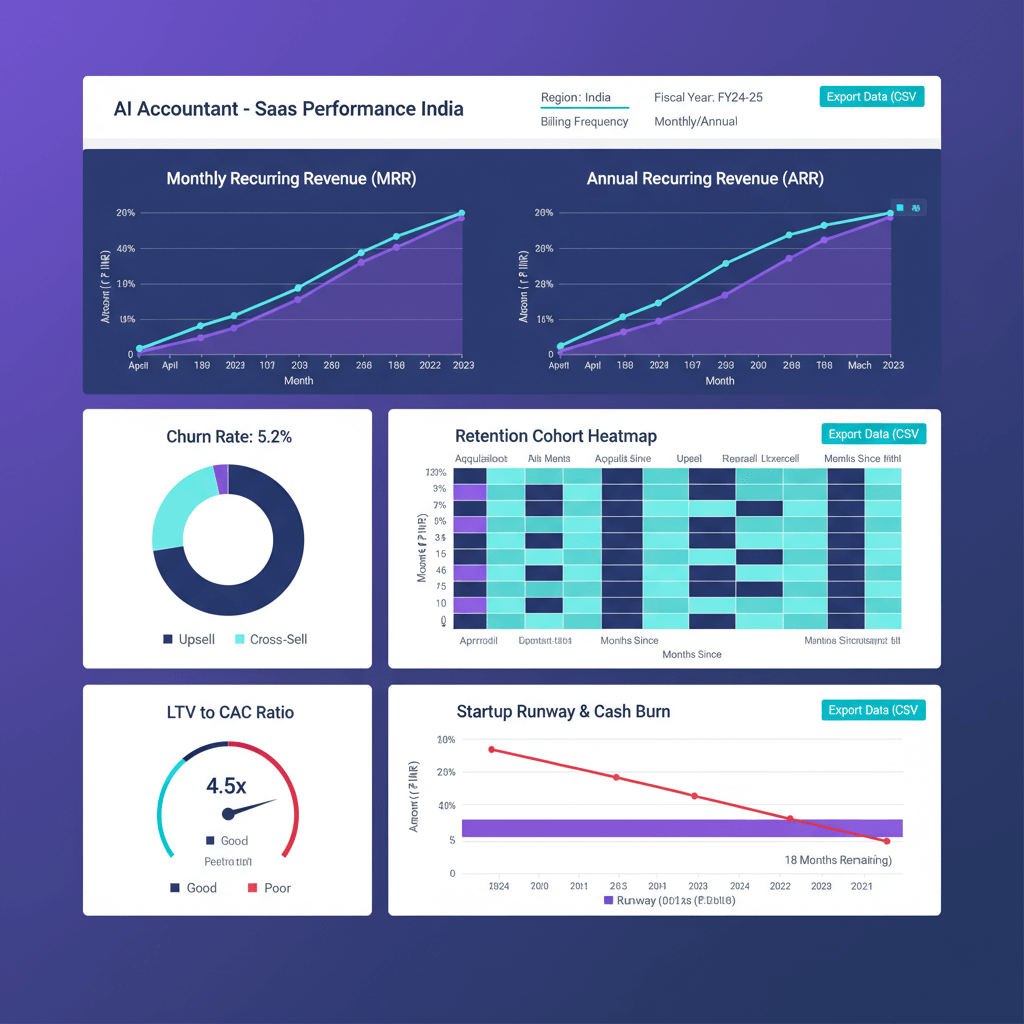
- A founder-friendly SaaS metrics dashboard in India unifies MRR, ARR, churn, cohorts, expansion revenue, LTV to CAC, and a runway overlay, creating a single source of truth for teams and boards.
- Exclude GST from all subscription revenue metrics, normalize annual contracts monthly per Ind-AS 115, and standardize FX conversion to avoid noisy, misleading numbers.
- Segment MRR into new, expansion, contraction, and churn, then reconcile billed versus collected amounts for clarity on true performance and cash health.
- Track cohorts for both logo and MRR retention, distinguish voluntary churn from UPI soft failures, and treat pauses separately to avoid false churn signals.
- Compute LTV with margin adjustments, compute fully loaded CAC by channel, and monitor payback periods monthly to safeguard unit economics.
- Overlay runway on growth trends to connect strategy with cash reality, then use scenario toggles to answer board level what if questions in minutes.
- Codify a definitions document, run a monthly close for metrics, and align board packs with consistent visuals and reconciliations.
- If data plumbing slows you down, connect AI Accountant to Zoho Books or Tally to automate GST cleanup, collections mapping, and burn calculations.
Why Indian SaaS Founders Need a Unified Metrics Dashboard
Indian SaaS operators juggle GST, UPI behaviors, and multi-currency collections, so getting a clean read on business health can feel messy. A unified SaaS metrics dashboard India consolidates MRR, ARR, churn, retention cohorts, expansion revenue, LTV to CAC, and runway into one control center. Investors see clean, auditable KPIs, boards receive consistent reports, and founders connect growth decisions to cash realities.
Bottom line, when GST on invoices, annual prepayments, and FX noise get normalized at the source, everyone operates on the same numbers.
Finance, growth, and product align fastest when the company runs on one truth, not a patchwork of spreadsheets.
What Good Looks Like, Core Components
MRR and ARR Tracker is your foundation, with revenue segmented by plan, channel, and geography, excluding taxes and one time fees.
Churn and Retention Cohorts highlight behavior patterns, separating gross churn from net churn with clear retention curves.
Expansion Revenue tags upsells, cross sells, and seat changes, enabling precise NRR computation.
LTV to CAC Analysis validates unit economics with margin adjusted LTV and fully loaded CAC.
Runway Overlay connects growth to burn so leaders make decisions with cash context.
India Specific Nuances to Get Right Upfront
GST and Tax Handling
Exclude GST from subscription revenue, always. A customer paying ₹11,800 including 18% GST contributes ₹10,000 to MRR, not ₹11,800. Handle credit notes and refunds separately, and set up your data pipeline to strip GST before any metric calculation happens.
Ind-AS 115 Revenue Recognition vs. Cash Collections
Recognize annual prepayments monthly per Ind-AS 115. Billing tools often show cash upfront, accounting spreads revenue over the term. Normalize everything to monthly values before MRR calculations so renewals do not create artificial spikes.
Multi Currency and FX Conversion
Choose one FX method, month end spot rates, monthly averages, or fixed quarterly rates, and document it. Apply consistently so ARR movements reflect business change, not currency noise.
UPI and Indian Payment Rails
Separate UPI soft failures from voluntary churn. Tag retries as transient payment issues and track this queue independently, so temporary bank limit issues do not inflate churn.
Source System Stack
Map billing IDs to accounting customer masters carefully. Maintain a master mapping table across billing, accounting, CRM, and payment gateways to prevent double counting or orphaned records.
Data Model and Sources, Foundation for Accuracy
Connect subscription billing, payment gateways, CRM, product analytics, and accounting. Normalize to a single reporting currency, remove GST upstream, and keep reconciliation fields for auditability.
Essential Entities and Fields
Customer, Unique ID, name, plan tier, channel, geography, start date, status.
Subscription, Subscription ID, customer ID, plan details, MRR at start and end, discount percentage, discount reason.
Invoice, Invoice ID, subscription ID, amount excluding GST, GST amount, issue date, due date, payment status.
Payment, Payment ID, invoice ID, amount, method, date, status.
Credit Note, Credit ID, invoice ID, reason, amount, date.
Data Hygiene Rules
- Use subscription IDs, never emails or names, as primary keys.
- Handle proration by effective change date, not invoice date.
- Mark pauses separately, zero the MRR contribution without counting as churn unless fully canceled.
- Treat reactivations as new business unless your board tracks win backs as a distinct cohort.
Step by Step, Build Each Metric Properly
MRR and ARR Tracker
Definition, MRR is normalized monthly recurring revenue excluding taxes and one time fees, ARR is MRR times twelve.
Include, monthly subscriptions at face value, annual subscriptions normalized monthly, recurring add ons and upgrades.
Exclude, one time implementation or setup fees, GST, professional services, trial revenue.
Segmentation, split MRR into new, expansion, contraction, churn, then analyze by cohort, plan, and channel.
Reconciliation, link billed to collected amounts, publish a monthly note with billed MRR, collected MRR, and aging difference.
Churn and Retention Cohorts
Build signup month cohorts and track both logo and MRR retention over time.
Gross churn, MRR lost to cancellations and full downgrades as a percentage of starting MRR.
Net churn, gross churn minus expansion MRR from the same cohort, negative net churn implies NRR above 100 percent.
Edge cases, downgrades are contraction, not churn, pauses under three months are excluded from churn, partial churn reduces MRR but keeps the customer active.
Visualization, cohort heatmaps by month since signup, retention curves to month twelve, and survival tables for board precision.
Expansion Revenue
Track upsells, cross sells, add ons, and seat increases separately. Do not include reactivations or one time purchases.
NRR formula, (Starting MRR + Expansion − Contraction − Churn) divided by Starting MRR, multiplied by 100. Best in class lands at 120 to 130 percent.
Views, NRR waterfalls and expansion rate trends over six to twelve months.
LTV to CAC, Standardized Definitions
LTV, ARPA times gross margin percent times average lifetime in months, where lifetime equals one divided by monthly churn, or compute directly from cohort cash flows for precision.
CAC, fully loaded sales and marketing costs divided by new paid customers, include salaries, commissions, partners, onboarding, and ads.
Margin adjustment, use gross margin to account for COGS like payments, hosting, and support.
Benchmarks, LTV to CAC above 3 to 1, payback under twelve months, under six is excellent.
Visuals, feature the LTV:CAC ratio prominently, show payback trends, and compare channels side by side.
Runway Overlay
Calculate runway as current cash divided by net monthly burn, exclude equity or debt inflows from burn.
Visuals, overlay runway months on MRR and NRR trends, add scenario toggles for hiring or pricing changes, and show sustainability views with cash lines and burn bars.
Visualization Patterns and Dashboard Design
Top Metric Tiles
Feature MRR, ARR, NRR, LTV to CAC, and runway months as tiles with period change and sparklines, so leaders grasp health in seconds.
Chart Configurations
- MRR waterfalls to show new, expansion, contraction, churn drivers.
- Cohort heatmaps for retention patterns with consistent color scales.
- Expansion breakdowns by type with an overlay expansion rate line.
- Time series with annotations for launches, pricing, or GTM shifts.
Update Cadence
Refresh collections and cash near real time, run cohorts, LTV, and FX standardized reports daily, and set alerts for churn spikes, runway below six months, or payback drift.
Common Pitfalls and How to Avoid Them
Counting Billed Amounts Including GST as Revenue
Remove GST at the invoice line before any metric, store excluding GST as your primary amount.
Double Counting Reactivations or Misclassifying Downgrades
Classify win backs distinctly if you track them, treat downgrades as contraction within cohorts, not churn unless fully canceled.
Ignoring Proration and Annual Contracts
Normalize annual contracts to monthly, automate proration on the effective change date for accuracy.
Blending Cash and Accrual Metrics Without Labels
Publish both billed and collected MRR with clear labels, reconcile monthly, and explain gaps in board notes.
Misattributing CAC
Allocate all channel costs, include partners and commissions, and divide only by closed won paid customers.
Operating Cadence and Governance
Update Frequency Schedule
- Daily, collections, cash, burn run rate.
- Weekly, pipeline deltas, churn alerts, payback shifts.
- Monthly close, final MRR, ARR, cohorts, LTV to CAC, runway.
Definitions Document
Publish a metrics dictionary for MRR, ARR, churn types, cohorts, and activations, version control it, and include worked examples.
Ownership and Cross Functional Reviews
Assign finance ops or FP&A as owner, run monthly reviews with sales for CAC, and with product for usage driven risk signals.
Board Pack Alignment
Use consistent visuals, show month over month and year over year views, and annotate anomalies with concrete explanations.
How to Implement Your Dashboard with the Right Tools
- AI Accountant, automates financial data prep with Zoho Books and Tally syncs, GST reconciliation, collections mapping, and burn datasets, ideal for Indian SaaS with multi currency and GST complexity.
- QuickBooks, accounting, invoicing, expenses, and reporting with strong integrations.
- Xero, cloud accounting with robust APIs and revenue workflows.
- FreshBooks, simple accounting for early stage MRR tracking.
- Chargebee, subscription billing with proration and subscription analytics.
- Stripe, payments with subscriptions and detailed revenue reporting.
AI Accountant unifies invoices, payments, and ledgers, automates burn by ingesting bank statements and expenses, and maps payments to invoices for billed versus collected clarity. GST reconciliation flags mismatches and credit note errors before they pollute revenue. Multi org support lets CA firms oversee multiple SaaS clients from one dashboard. The result is finance ready datasets that plug straight into your metrics stack.
Spend time on analysis, not on data wrangling.
Practical Checklist to Ship v1
Week 1, Foundation
- [ ] Identify systems and establish unique ID mapping across billing, accounting, CRM
- [ ] Create a metrics dictionary for MRR, ARR, churn, expansion, CAC
- [ ] Document include and exclude rules for every metric
Week 2 to 3, Core Metrics
- [ ] Build MRR and ARR tracker with monthly normalization
- [ ] Validate against accounting records and post adjustments
- [ ] Reconcile billed versus collected amounts
- [ ] Set up churn and retention cohorts for the last twelve months
- [ ] Choose gross versus net churn as the baseline KPI
Week 4, Advanced Metrics
- [ ] Track expansion by type, upsell, cross sell, seats
- [ ] Calculate NRR and publish a monthly waterfall
- [ ] Compute margin adjusted LTV and fully loaded CAC
- [ ] Compare LTV to CAC ratios to benchmarks
Week 5, Integration
- [ ] Add a runway overlay with cash and burn
- [ ] Build scenario toggles for hiring and growth plans
- [ ] Ship tiles, waterfalls, heatmaps
- [ ] Schedule automated refreshes
Week 6, Operationalization
- [ ] Assign dashboard owner and governance
- [ ] Schedule monthly stakeholder reviews
- [ ] Configure alert thresholds for key metrics
- [ ] Document SOPs and change logs
- [ ] Gather feedback and plan version two
Closing Thoughts
A robust SaaS metrics dashboard India becomes your operating system for discipline and investor trust. Normalize for GST, align with Ind-AS 115, separate UPI soft failures from churn, and reconcile billed versus collected revenue. Start with MRR and ARR, add cohorts and expansion, then layer on LTV to CAC and a runway overlay.
If data integration is the bottleneck, connect AI Accountant to Zoho Books or Tally, then plug those clean datasets into your dashboard and ship in weeks, not quarters.
FAQ
Which dataset should I prioritize for MRR in an Indian SaaS context, billing or accounting?
Lead with billing to capture contracted MRR normalized monthly, then reconcile to accounting recognized revenue per Ind-AS 115. By month end, the two should be within five to ten percent, gaps usually point to unposted credit notes, GST treatment errors, or timing misalignments that finance must resolve.
How should a CA treat GST on subscription invoices when computing MRR and ARR?
Exclude GST entirely. Store gross and tax fields separately, report only the net subscription value as MRR, and post credit notes against the correct periods. Tools like AI Accountant can flag invoice lines where GST was not split correctly before metrics roll up.
What is the correct approach to annual prepayments under Ind-AS 115 for SaaS?
Recognize revenue monthly over the service period. If ₹120,000 is invoiced in January for a year, recognize ₹10,000 per month. Keep a clean deferred revenue schedule, and reconcile billing cash to accounting recognition to avoid MRR spikes around renewals.
How do I separate involuntary churn from UPI payment failures in dashboards?
Create a payment retry bucket and tag UPI soft failures distinctly. Keep these customers out of voluntary churn counts for seven days, then reclassify only if retries fail. This preserves true churn rates and improves collections playbooks.
What are the minimum fields a CA should enforce across billing and accounting masters?
Customer ID, subscription ID, plan tier, start date, status, invoice amount excluding GST, GST amount, payment method, and credit note linkage. This supports proration, GST exclusion, and collections reconciliation. AI Accountant synchronizes these fields across Zoho Books and Tally automatically.
How do I compute LTV to CAC correctly for Indian SaaS, with examples?
Use LTV equals ARPA times gross margin percent times average lifetime, where lifetime is one over monthly churn. CAC equals fully loaded sales and marketing divided by new paid customers. For example, if ARPA is ₹8,000, margin 80 percent, churn 4 percent, LTV is ₹160,000. If CAC is ₹40,000, LTV to CAC is 4 to 1, and you should target payback under twelve months. AI Accountant can feed margin adjusted ARPA and closed won counts to your model.
How should FX be standardized when ARR is reported in INR but billing is in USD?
Pick one approach, monthly average, month end, or fixed quarterly, document it, and apply consistently across all datasets. Recompute historical series after definition changes only through a controlled restatement process with board sign off.
What is the right way to treat downgrades, pauses, and reactivations in cohort analysis?
Downgrades are contraction within the cohort, not churn. Pauses under three months should zero MRR but stay out of churn. Reactivations typically count as new business unless your policy defines a win back cohort. Maintain these rules in your definitions document and audit monthly.
How do I reconcile billed MRR to collected MRR for board reporting?
Publish a reconciliation table, opening AR, plus invoiced, minus collections, minus credit notes, equals closing AR. Show billed versus collected MRR tiles, then explain aging shifts. AI Accountant maps bank statement lines to invoices and highlights unmatched items for faster month end closes.
What benchmarks should a CA use for NRR, LTV to CAC, and payback in India?
NRR above 100 percent is healthy, 120 to 130 percent is best in class. LTV to CAC above 3 to 1 is the goal, payback under twelve months acceptable, under six months excellent. Early stage companies may be below these thresholds, focus on improving month over month trends.
How do I estimate runway when burn and collections are volatile across months?
Use a rolling three month average for burn, incorporate a conservative collections factor, for example eighty percent of forecast, and update weekly. Present base and conservative scenarios with sensitivity to hiring and pricing moves. AI Accountant automates burn from bank feeds and expense ledgers, enabling faster scenario refreshes.
What governance should a CA put in place to keep the dashboard audit ready?
Version controlled definitions, monthly metric close with reconciliations, exception logs for reclassifications, and change control for FX and allocation methods. Schedule a monthly cross functional review, finance, sales, product, to validate CAC, churn drivers, and any outliers before board packs go out.

Rohan Sinha is a fintech and growth leader building aiaccountant.com, focused on simplifying accounting and compliance for Indian businesses through automation. An IIT BHU alumnus, he brings hands-on experience across 0 to 1 product building, growth, and strategy in B2B SaaS and fintech.