-01%201.svg)
Key takeaways
- Build a single source of truth for Indian SaaS realities, exclude GST from revenue metrics, track gateway-level payment outcomes, and normalize FX consistently.
- Prioritize MRR and ARR, churn and retention cohorts, expansion revenue, LTV to CAC, and a dynamic runway overlay with scenario toggles.
- Adopt a phased architecture, start with data foundations, metric modeling, dashboard design, then automation and alerting, reference the SaaS metrics dashboard India edition for patterns.
- Avoid common pitfalls, do not mix bookings, billings, and recognized revenue, keep taxes and fees out of MRR, segment CAC by channel, and amortize annual contracts.
- Use AI Accountant for automated ingestion, GST reconciliation, and clean metric refreshes with Zoho Books and Tally, reduce manual errors and month-end stress.
Why a SaaS metrics dashboard matters in India
Indian SaaS teams juggle GST, RBI e-mandate constraints, UPI autopay failures, and FX movements, so generic dashboards lead to misinterpretation, broken trust, and wasted time. You need a control room that speaks the Indian SaaS language, one that aligns finance, product, and growth around reliable numbers.
Without an India-focused setup, your MRR is noisy, churn is understated, and FX changes masquerade as growth. With a purpose-built stack and definitions, you convert confusion into clarity, and investors, board members, and teams operate on shared facts.
Bottom line: A resilient SaaS metrics dashboard India turns compliance quirks, payment behavior, and FX reality into actionable intelligence.
For structure and examples, explore the SaaS metrics dashboard India edition.
Core widgets every dashboard should include
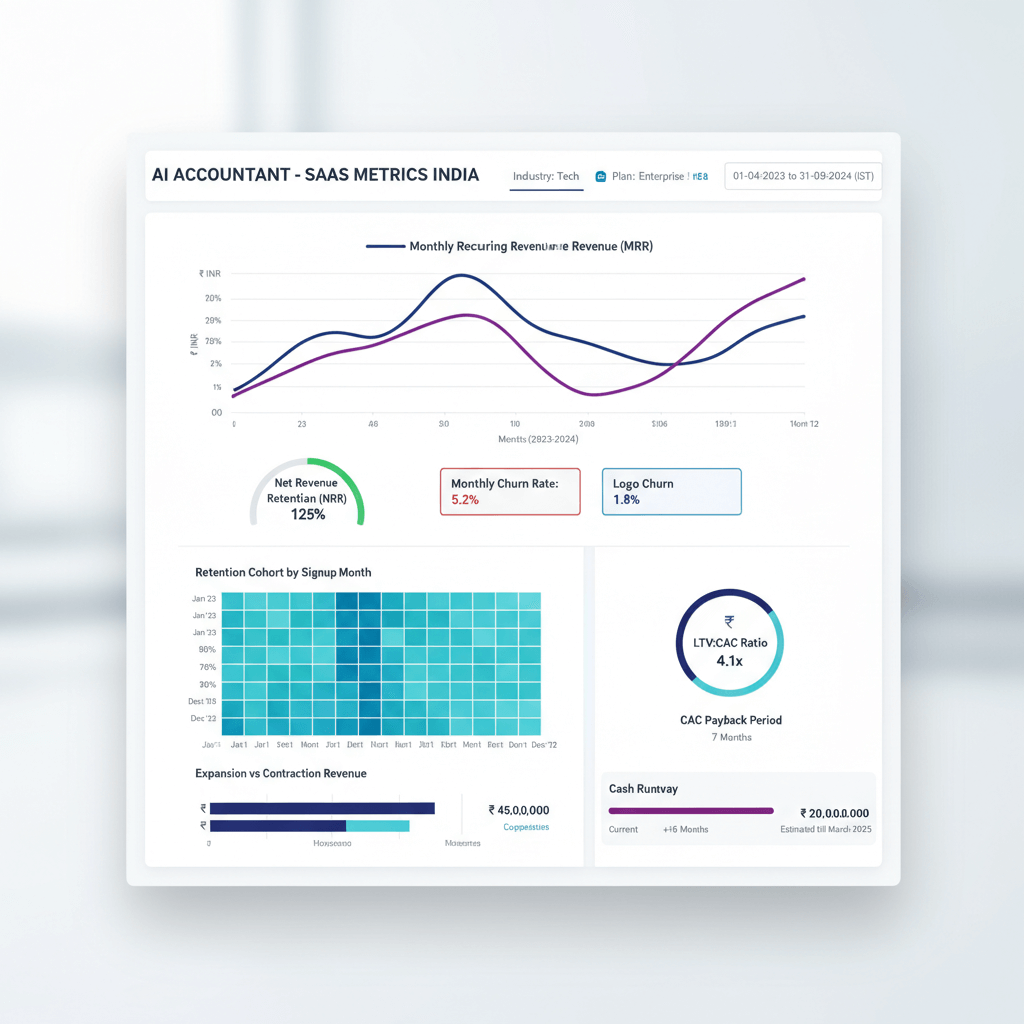
MRR and ARR tracker
Show gross and net MRR with bridges for new, expansion, contraction, churn, and reactivation. Display ARR with monthly trends, add sparklines for quick context, and keep taxes and payment fees out of the numerator.
Churn and retention analysis
Build cohorts by first paid month, pricing plan, and geography, track logo churn and revenue churn separately, add survival curves to visualize retention, and link findings to expansion behavior.
Expansion revenue
Split upsell, cross-sell, and seat growth. Calculate net expansion rate, isolate FX effects, and segment by customer size and product line to reveal durable growth pockets.
Unit economics
The LTV to CAC ratio anchors your efficiency story, show cohort LTV, CAC components, and payback periods, flag when ratios dip below healthy thresholds.
Cash runway
Layer growth rate and burn rate in a runway overlay, offer base, optimistic, and conservative scenarios to plan hiring and infra investments.
For an end-to-end widget list and visuals, see the SaaS metrics dashboard India edition and the external take on a startup SaaS metrics dashboard.
Definitions, formulas, and caveats for each metric
MRR: Exclude GST and gateway fees, handle discounts, credits, and refunds correctly, amortize annual prepayments over twelve months, and normalize FX using a consistent policy.
Net MRR: New MRR, plus Expansion MRR, minus Churned MRR, minus Contraction MRR, plus Reactivation MRR, keep a tight audit trail for each component.
Revenue churn: Lost MRR divided by prior month MRR, multiplied by 100, distinguish involuntary churn due to payment failures or RBI rules from voluntary churn, apply grace periods before classifying as churned.
Cohorts: Define membership by first paid month, not trial start, measure both revenue and logo retention, segment by billing cycle, plan, and geography.
Expansion: Count true upsell or cross-sell events, exclude FX inflation and price indexation, attribute wins to product-led or sales-led motion.
LTV: ARPU times Gross Margin times the inverse of churn rate, CAC: include sales salaries, marketing spend, commissions, and partners, Payback: CAC divided by (ARPU minus variable costs), avoid blended CAC, track by channel.
Runway: Available cash divided by monthly burn, include net cash after collections, payouts, and tax obligations, tie scenarios to hiring and infra scale plans.
For more examples, refer to the SaaS metrics dashboard India edition and the external perspective on a startup SaaS metrics dashboard.
Data sources and stack for Indian SaaS
Billing: Chargebee, Razorpay Subscriptions, or Stripe Billing, each handles GST and Indian payment flows differently, reconcile webhooks, invoices, and dunning outcomes.
Payments: Razorpay and Stripe for cards, UPI Autopay for domestic subscriptions, reconcile failures, settlements, and refunds across gateways.
CRM and CAC: HubSpot or Salesforce for acquisition costs, link deals to campaigns and activities, calculate CAC by channel with clean mapping.
Accounting: Zoho Books and Tally for revenue recognition, GST, and cash positions, keep consistent identifiers across systems.
Data hygiene: Normalize customer IDs, map plan codes and invoice IDs, keep bank statements and FX records for reconciliation.
Reference implementation notes in the SaaS metrics dashboard India edition.
Architecture: how to build the dashboard
Phase 1, Data foundation: Audit sources, write a data dictionary, and establish pipelines, learn from data pipeline, books to dashboards.
Phase 2, Metric calculation: Model events, invoices, and payments, design revenue recognition and cohort tracking, ensure reproducibility.
Phase 3, Dashboard design: Put top KPIs up front, provide role-specific views for executives, finance, and product, add filters for time, segments, and product lines.
Phase 4, Automation and alerting: Schedule refreshes, add threshold alerts for MRR drops, churn spikes, and CAC deterioration.
Ingestion: Start with CSVs, then upgrade to APIs and webhooks, store amounts in native currency and INR, define an FX policy and stick to it.
Tools: Sheets and Looker Studio at early stage, Power BI or Metabase as you grow, data warehouses like BigQuery or Snowflake at scale.
Governance is non-negotiable: maintain a metric dictionary, run weekly validations, enforce role-based access, and document changes with rationale.
Cross-check designs with the SaaS metrics dashboard India edition and external ideas from startup SaaS metrics dashboard.
India-specific compliance and accounting considerations
GST: Exclude from MRR, reconcile against GSTR-1 and GSTR-2B monthly, track place of supply for domestic sales versus exports.
Fees and withholdings: Payment gateway fees, TCS, and TDS are expenses, not netted against revenue, keep them out of margin metrics unless explicitly modeled as costs.
RBI regulations: Tokenization and stricter autopay rules increased involuntary churn, annotate cohort periods impacted by regulatory changes, track UPI failures separately from card declines.
Payment behavior: Expect annual payments during tax-saving season and plan shifts based on cash flow, ensure your models amortize and classify correctly.
Fiscal calendars: Support both April to March and calendar-year views for stakeholders, ensure FX and tax logic remain consistent across reporting frames.
Compliance nuances are captured in the SaaS metrics dashboard India edition.
Common mistakes and how to avoid them
- Mixing bookings, billings, and revenue, instead, track separately to preserve signal.
- Including taxes or fees in MRR, strip GST and processing charges to avoid distorted comparisons.
- Ignoring failed payments when calculating churn, define grace periods and retry logic clearly.
- Letting FX mask growth, show constant currency alongside reported figures.
- Using blended CAC, compute CAC by channel, then campaign, for efficient allocation.
- Not amortizing annual contracts, spread across twelve months for accurate MRR.
Explore guardrails and templates in the SaaS metrics dashboard India edition and external guidance on a startup SaaS metrics dashboard.
Tools and software recommendations
Financial automation and accounting
- AI Accountant, automates transaction categorization, GST reconciliation, and syncs with Zoho Books or Tally for clean MRR.
- Zoho Books, strong GST capabilities and Indian workflows.
- Tally Prime, widely used for compliance and statutory reporting.
- QuickBooks, helpful for teams with international operations.
- FreshBooks, simple interface for small teams.
Dashboard and visualization
- Looker Studio, free and friendly for Google ecosystems.
- Power BI, robust with Excel connectivity.
- Metabase, open source and flexible.
- Tableau, enterprise-grade depth.
- Grafana, SQL-friendly for technical teams.
Billing and subscriptions
- Chargebee, built for SaaS, supports Indian payment methods.
- Razorpay Subscriptions, native Indian platform with UPI autopay.
- Stripe Billing, strong for international customers.
- Recurly, capable dunning features.
- Zuora, complex enterprise billing.
Choose tools that integrate, respect GST, handle multiple payment methods, and support currency conversions.
How AI Accountant helps
AI Accountant bridges raw financial data and clean metrics for your SaaS metrics dashboard India. It ingests bank and card statements, normalizes formats, and classifies transactions as customer inflows, vendor payments, or transfers. These feed MRR, cash flow, and working capital views.
By syncing with Zoho Books and Tally, AI Accountant reconciles revenue and GST baselines, automatically excludes tax from MRR, and reduces reconciliation effort. Multi-org support enables consolidated views across entities or client accounts.
The result is reliable MRR, ARR, churn, expansion, LTV to CAC, and runway overlay that refresh without spreadsheet drudgery.
See implementation examples in the SaaS metrics dashboard India edition.
Visual layout suggestions
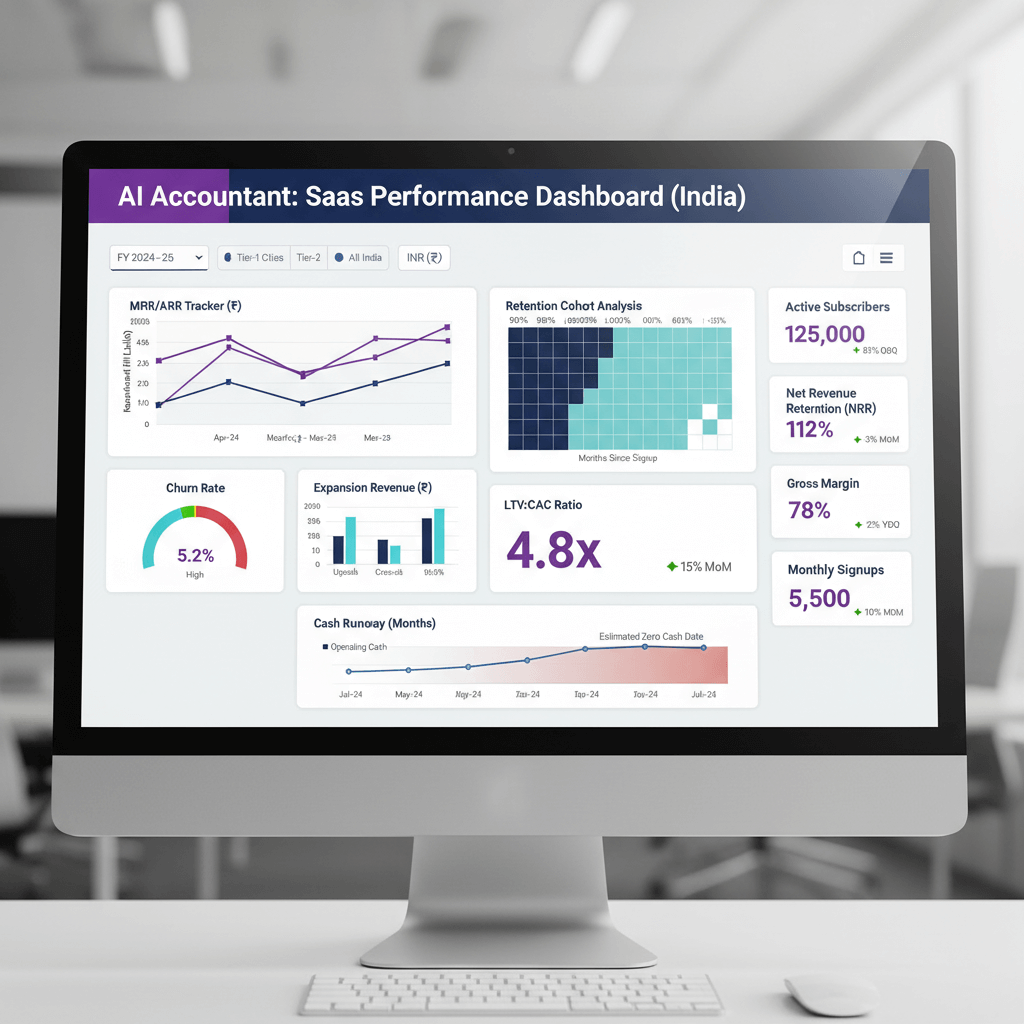
Place an MRR and ARR tracker in the top row, include a net new MRR bridge, show bold current values with subtle trend indicators.
In the middle, add churn and retention cohorts on the left, expansion tiles on the right, use heat maps to spot retention issues quickly.
On the sidebar, highlight the LTV to CAC ratio and payback trends, include clear thresholds for healthy, watch list, and at-risk zones.
Anchor the bottom with cash position and a runway overlay, include alert badges for churn spikes or extended payback periods.
For more visualization ideas, review the SaaS metrics dashboard India edition and external guidance on custom SaaS dashboards for effective KPI visualization.
Update cadence and operating rhythm
Weekly: Focus on payment recovery and involuntary churn, track RBI and UPI outcomes separately, monitor retry logic performance.
Monthly: Reconcile dashboard metrics with the accounting close, update GST impacts and FX rates, refresh cohorts, and review CAC by channel.
Quarterly: Analyze cohorts over longer arcs, evaluate pricing experiments, re-compute LTV to CAC with updated retention data, and plan the next quarter’s initiatives.
Add automated alerts, such as daily MRR drop greater than 10 percent, churn rate breaches, or CAC payback beyond limits, and run review meetings at weekly, monthly, and quarterly intervals with clear metric ownership.
Reference cadence patterns in the SaaS metrics dashboard India edition and the external overview of a startup SaaS metrics dashboard.
Quick-start checklist
- Create a metric dictionary, define MRR and ARR, churn types, expansion categories, LTV to CAC, and runway assumptions, secure stakeholder alignment.
- Map data sources and join keys, document customer and invoice identifiers, set FX rate policy and source.
- Build revenue recognition logic, cohort tracking, CAC by channel, and cash flow projections from bank and accounting data.
- Implement validations, compare dashboard MRR to accounting revenue minus taxes, verify churn against cancellations, check expansion against invoice lines, and reconcile CAC to spend.
- Publish a minimal viable dashboard with access controls, add depth as accuracy is validated, schedule reviews.
- Connect AI Accountant to Zoho Books or Tally for ingestion and cleanup, eliminate manual prep and refresh metrics automatically.
- Backfill historical data, test narratives for last quarter, and resolve discrepancies before going live.
Find templates in the SaaS metrics dashboard India edition.
Conclusion
A reliable SaaS metrics dashboard India is more than charts and formulas, it is an operating system for decisions. With GST excluded, payment failures tracked, FX normalized, and multi-entity consolidation, stakeholders trust the numbers and act faster.
Start simple, iterate steadily, automate wherever you can, and institutionalize reviews. If you use Zoho Books or Tally, AI Accountant can automate the plumbing behind your MRR and ARR tracker, churn cohorts, expansion metrics, LTV to CAC, and runway overlay, keeping your dashboard fresh with clean, reconciled data.
In a fast-growing Indian SaaS ecosystem, operational excellence in metrics is a competitive advantage. Build the dashboard right, and you will spot risks early, amplify wins, and steer confidently toward your targets, backed by numbers your whole company understands.
Explore deeper examples in the SaaS metrics dashboard India edition.
FAQ
How should a CA exclude GST from MRR under Ind AS while keeping gateway fees separate?
Compute MRR using invoice line items net of GST, exclude IGST, CGST, and SGST, then treat gateway fees, TCS, and TDS as operating expenses, not deductions from revenue. AI Accountant syncs with Zoho Books or Tally to fetch tax components and automatically strips GST before MRR aggregation.
What is the correct Net MRR formula when discounts, credits, and refunds exist in Indian SaaS?
Net MRR equals New plus Expansion minus Churn minus Contraction plus Reactivation, discounts lower New or Expansion depending on context, credits and refunds reduce current-period revenue, ensure the events table maps each adjustment to its category, AI Accountant’s mapping engine keeps this classification consistent.
How does a CA reconcile Chargebee or Razorpay with Zoho Books for revenue recognition?
Use invoice IDs and customer IDs as join keys, tie subscription events to accounting entries, amortize annual prepayments over twelve months, and reconcile totals to books after excluding GST. AI Accountant pulls both billing and accounting data, flags mismatches, and posts reconciliation summaries.
How to separate involuntary churn due to RBI e-mandate failures from voluntary cancellations?
Classify payment failure events as involuntary churn only after a defined grace period and final dunning outcome, voluntary churn requires explicit cancellation, UPI and card declines should be tracked by gateway and reason code. AI Accountant surfaces failure cohorts and recovery rates by gateway.
What is the recommended approach to FX normalization for USD invoices reported in INR?
Choose a consistent FX policy, mid-market daily rate, monthly average, or accounting rate, store amounts in both native currency and INR, report constant currency growth beside reported metrics. AI Accountant supports dual-currency storage and policy-driven FX normalization.
How to compute LTV and CAC at cohort level for board reporting in India?
For each cohort, LTV equals ARPU times Gross Margin times the inverse of churn, CAC includes salaries, marketing, commissions, partners, and tooling, payback is CAC divided by contribution margin. AI Accountant tags customers by acquisition channel, generating cohort LTV, CAC, and payback views automatically.
How should annual contracts be amortized for accurate monthly MRR in GST contexts?
Recognize revenue evenly across the service period, typically twelve months, exclude GST from the amortized amounts, and align recognition with the start date on the contract. AI Accountant reads the billing schedule and posts monthly revenue entries net of GST.
How can a CA validate dashboard MRR against accounting revenue quickly?
Run a reconciliation where Dashboard MRR multiplied by twelve approximates ARR, then compare accounting revenue after removing GST and non-recurring items, investigate variances by plan code or invoice line. AI Accountant provides a reconciliation report with variance buckets and drill-down.
What controls should be set for access, change logs, and metric governance?
Maintain a metric dictionary, enforce role-based access, implement weekly validation checks, and record every formula change with rationale and effective date. AI Accountant includes audit trails and role-level permissions for metric calculations.
How to track CAC by channel without falling into the blended CAC trap?
Tag leads and opportunities to their acquisition source, allocate spend to channels and campaigns, compute CAC per channel and compare payback periods, deprecate blended CAC in management reporting. AI Accountant integrates CRM and marketing spend to produce channel-level CAC and payback dashboards.
How should a CA present runway scenarios to the board with collections and tax obligations?
Compute net cash position after collections, payouts, and taxes, divide by monthly burn, then show base, optimistic, and conservative scenarios with hiring and infra toggles. AI Accountant’s runway overlay uses bank feeds and books data to update scenario months automatically.
What cadence should be instituted for metric refreshes and audit checks?
Weekly for payments and involuntary churn, monthly for accounting close, GST, FX, cohorts, and CAC by channel, quarterly for pricing and retention strategy. AI Accountant schedules refreshes aligned with source updates and sends threshold alerts when metrics breach targets.

Rohan Sinha is a fintech and growth leader building aiaccountant.com, focused on simplifying accounting and compliance for Indian businesses through automation. An IIT BHU alumnus, he brings hands-on experience across 0 to 1 product building, growth, and strategy in B2B SaaS and fintech.