-01%201.svg)
Key takeaways
- The true cost of manual invoice entry in India typically lands between ₹40 and ₹120 per invoice once you include labor, rework, overheads, compliance leakage, and missed opportunities.
- Small errors cascade into big problems, think wrong HSN codes, GSTIN typos, duplicate submissions, and late approvals, each one chips away at margin and trust.
- Missed ITC due to GSTR-2B mismatches and delayed payments quietly drain cash, while audit scrambles consume senior time.
- Automation reduces human touch time to under 5 minutes, lowers error rates below 1 percent, and centralizes approvals and audit trails.
- Most CA firms and SMEs see a 6 to 9 month payback period, and first year ROI comfortably above 150 percent when discounts, ITC capture, and labor savings are counted.
What manual invoice entry looks like in India today
Walk into any accounts department at 5 PM on the 10th and you will likely see invoice PDFs open, spreadsheets loaded, WhatsApp pings for approvals, and last minute postings to Tally or Zoho Books. Each invoice needs GSTIN checks, HSN and SAC coding, PO matching, and ledger postings, then payment processing and GST filing. Multiply by hundreds or thousands each month.
The pain points are familiar, non standard PDF formats, vendor name mismatches, missing POs, duplicate uploads, and late approvals. A 1 to 3 percent error rate is common, and every mistake triggers rework or worse, compliance notices and ITC losses. Delays beyond 45 days also inflame MSME obligations, damaging relationships and credibility. See supporting analyses from Clear and Chronexa.
Bottom line: manual AP works, but it works expensively, slowly, and unpredictably, especially at month end when everything spikes.
Breaking down the real cost of manual invoice entry India
Direct labor costs
Manual processing typically takes 8 to 15 minutes per invoice. With a loaded hourly rate of ₹150 to ₹250, 12 minutes at ₹200 per hour equals about ₹40 in direct labor alone.
Indirect and overhead costs
Supervisor time, IT systems, storage, and office overheads usually add ₹5 to ₹10 per invoice.
Error and rework costs
With a 1 to 3 percent error rate, each thousand invoices means 10 to 30 fixes, often 20 to 30 minutes each. Spread across the base, that adds roughly ₹10 to ₹30 per invoice.
Compliance and GST penalties
Mismatches and late filings reduce ITC and attract penalties. Expect another ₹5 to ₹20 per invoice lost to compliance leakage.
Opportunity costs
Missing a 2 percent early payment discount on a ₹50,000 invoice costs ₹1,000, while delays distort cash planning and credit limits. These are real, recurring losses.
The complete cost formula
Cost per invoice = (Time in minutes × Loaded cost per minute) + (Error rate × Rework cost) + Overhead allocation + Compliance leakage + Opportunity costs
Example, for 2,000 invoices monthly:
- Direct labor, 12 minutes × ₹3 per minute = ₹36
- Error rework, 2 percent × ₹20 = ₹0.40
- Overhead and compliance, ₹10
- Total ≈ ₹46.40 per invoice
| Invoice volume per month | Cost per invoice ₹ | Monthly total ₹ | Annual total ₹ |
|---|---|---|---|
| 500 | 50 to 80 | 25,000 to 40,000 | 3 to 4.8 lakhs |
| 2,000 | 40 to 70 | 80,000 to 1.4 lakhs | 9.6 to 16.8 lakhs |
| 5,000 | 35 to 60 | 1.75 to 3 lakhs | 21 to 36 lakhs |
Benchmarks and ranges are supported by Chronexa, Invoice Data Extraction, and WRP Solution.
The hidden cost accounts payable you are not tracking
Missed discounts vs late fees
On ₹50 lakh monthly spend, missing 1 to 2 percent early payment discounts burns ₹50,000 to ₹1 lakh, while late fees and tightened credit terms quietly inflate working capital costs.
Vendor relationship damage
Disputes and delays lead to advance payment asks, deprioritized deliveries, and weaker negotiating power, costs that never show up in a ledger line.
Month end audit overhead
Ten to twenty hours a month disappear into chasing documents and clarifying mismatches. That is leadership time you could redeploy to analysis, planning, and pricing.
Fraud and duplicate payments
Weak three way matching exposes you to duplicates and fake vendor entries. One incident can erase months of margin. See discussions on systemic risks from Symtrax and Cevious.
Team burnout and attrition
Repetitive entry consumes 60 to 70 percent of AP time, disengagement rises, errors follow, and replacement training resets the cycle.
Peak period chaos
Month end and year end compress timelines, overtime spikes, and exception rates climb just when accuracy matters most. See an overview from Clear.
Manual vs automated AP India, the real differences
Manual AP workflow
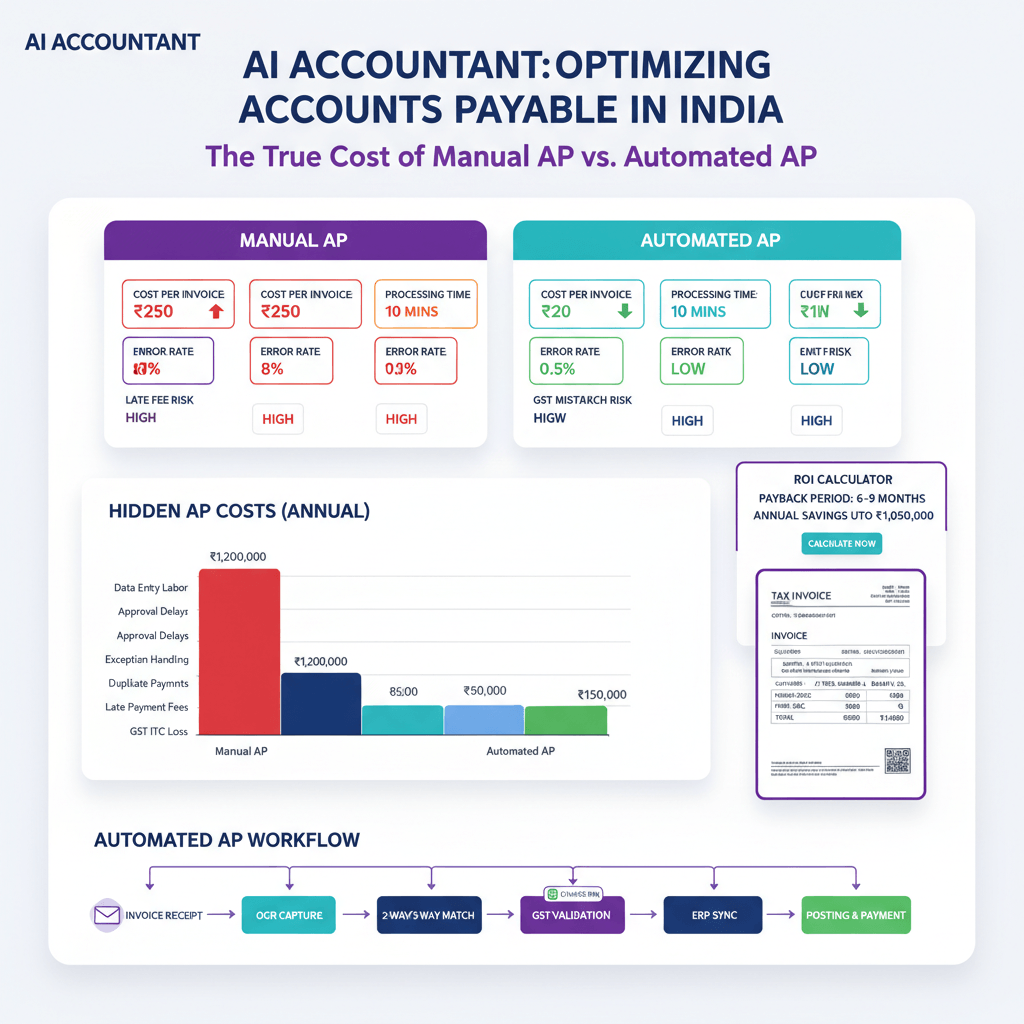
Receive invoice by email or WhatsApp, download and open, key vendor details, line items, taxes, route through emails and reminders, post to ledger, process payment, reconcile and file GST. Ten to twenty five minutes per invoice, 1 to 3 percent error rates, and a fragmented audit trail.
Automated AP workflow
Invoices auto ingest from forwarding or upload, OCR technology extracts data, GSTIN and HSN validations run instantly, rules route approvals, entries sync to Zoho Books or Tally, payments integrate, and GSTR 2B reconciliation runs in the background. Human touch time falls under 5 minutes, and errors drop below 1 percent.
Key differences that matter
- Cycle time improves by 80 percent or more, with mobile approvals and smart reminders.
- Data quality rises, GSTIN mismatches, duplicates, and PO variances are caught at entry.
- Your team shifts from typing to exception handling, vendor care, and spend analysis.
Independent guides on impact and benchmarks are available from Chronexa and Invoice Data Extraction.
Calculating ROI AP automation CA India
The ROI framework
ROI = (Annual savings − Annual cost) ÷ Annual cost
Savings include labor reduction, fewer errors, captured discounts, avoided penalties, and better cash control. Costs include subscription, implementation, training, and support. Payback period equals implementation cost divided by monthly savings. Many Indian businesses see 6 to 9 months.
SME example, 2,000 invoices monthly
Current: ₹45 per invoice, ₹90,000 monthly, ₹10.8 lakhs annually, 2 percent error rate, ₹50,000 discounts missed annually.
After automation: ₹10 per invoice, ₹20,000 monthly, ₹2.4 lakhs annually, 0.5 percent error rate, ₹5 lakhs discounts captured.
ROI: Annual savings of ₹13.4 lakhs versus ₹3 to ₹5 lakhs implementation, 168 to 347 percent first year ROI, 3 to 5 month payback.
CA firm example, 15 clients, 5,000 invoices
Standardization across clients compresses closings from two weeks to 48 hours, creates 1 to 2 FTE capacity, and materially improves margins through scale.
Key performance metrics to track
- Cost per invoice, cycle time from receipt to payment
- First time match rate, target above 95 percent
- Exception rate, target below 5 percent
- ITC capture rate and early payment discount capture
- Days to close books
Case studies and checklists are summarized by Clear and WRP Solution.
Building your business case for AP automation
Baseline your current state
For one month, measure invoice volumes, touch time on a 50 invoice sample, error and rework minutes, late fees, missed discounts, and month end overtime. Turn this into a per invoice baseline and a monthly total.
Quantify hidden costs
Capture escalations, senior time on disputes, audit prep hours, vendor churn risk, and discount leakage. Convert each to rupees using conservative assumptions.
Identify key stakeholders
- CFO: ROI, working capital, compliance risk.
- AP lead: less drudge work, more ownership of value tasks.
- IT head: integration, security, uptime.
- Compliance officer: GST accuracy, audit trail depth.
Design a low risk pilot
Pick 2 to 3 high volume vendors for a 30 to 45 day pilot, run in parallel, measure before and after on time, errors, costs, and satisfaction.
How to choose an AP automation solution for India
Must have features for Indian businesses
- Accurate OCR on PDFs, scans, and phone photos, automated GSTIN and HSN validations, and two way sync to Zoho Books or Tally.
- GSTR 2B reconciliation that flags mismatches early, plus bank and card reconciliation to close the loop.
- Complete audit trails, role based access, and India data residency if required.
Evaluation checklist
- Run 50 of your invoices, look for above 95 percent extraction on standard formats.
- Confirm GSTIN checks, HSN mapping, duplicate detection, and three way matching.
- Security posture, ISO 27001 and SOC 2, encryption in transit and at rest.
- Implementation under 30 days, clear pricing per invoice or subscription, and responsive support.
Top AP automation tools for Indian businesses
- AI Accountant (https://www.aiaccountant.com) purpose built for India with native Zoho Books and Tally sync, GSTR 2B reconciliation, and multi entity support suited to CA firms
- QuickBooks Online solid scan and basic automation, GST capabilities may require configuration
- Zoho Books strong GST compliance and growing automation features
- FreshBooks cloud based capture and approvals for services centric teams
- Xero international platform with expanding India specific workflows
- SAP Concur enterprise grade for complex approvals and global controls
Integration and training requirements
Prefer direct APIs with two way sync, master data from ERP, transactions back post approval. Plan enablement for exception handling and reporting, and ensure vendor led hypercare during the first month.
Where AI Accountant fits in your automation journey
AI Accountant streamlines bulk ingestion with robust OCR, validates GSTIN at the point of capture, and learns your ledger mappings from history so postings are accurate. It syncs directly to Zoho Books and Tally, and tracks GSTR 2B continuously to flag mismatches for action before filing.
For CA firms, multi organization access lets teams switch clients in seconds, each entity retains its own learning and controls, and cash dashboards provide instant visibility across portfolios. Security aligns to enterprise expectations with ISO 27001 and SOC 2 Type II coverage.
Typical onboarding: 2 to 4 weeks, start with high volume vendors, train for exceptions, then scale to full coverage.
Common objections and practical answers
Will this replace our AP team
No, it elevates them. The team moves from keying invoices to managing exceptions, vendor relationships, spend analytics, and process improvement. The work becomes higher value and less error prone.
Our invoices are too complex
Modern OCR handles multi page layouts, tables, and mixed languages. Edge cases route to a review queue, the system learns from your corrections, and even 80 percent touchless flow unlocks major savings.
Is it GST compliant
Quality solutions validate GSTIN in real time, maintain immutable audit trails, and generate GST ready reports, improving compliance compared to email and spreadsheet sprawl.
How do approvals work
Your matrix is mirrored in the tool, with amount bands, departments, and multi levels. Mobile and email approval actions shrink cycle times without sacrificing control.
What about data security
Vendors with ISO 27001 and SOC 2 demonstrate mature controls, with encryption, access governance, and monitoring that usually surpass manual, email heavy processes.
How do we start without disrupting month end
Run a pilot on select vendors outside the close window, process in parallel for one cycle, compare metrics, fix gaps, then switch over in phases.
Taking the next steps to reduce your cost of manual invoice entry India
Week 1, baseline your current state
Measure volumes, touch time, error rate, late fees, missed discounts, and overtime. Build a simple spreadsheet from your own numbers.
Week 2, build your business case
Compute cost per invoice using the formula above, model 50 percent efficiency gains, map stakeholder concerns, and align success metrics.
Week 3, evaluate solutions
Pilot two or three platforms with your invoices, validate accuracy, integrations, and India specific needs, and demand clear outcome targets.
Week 4, design your pilot
Pick high volume, standard vendors, run 30 to 45 days, track cycle time, exceptions, and discount capture, then scale with confidence.
To speed your math, download a cost calculator template. Test your invoice samples with providers, and quantify the gain before you commit. Every week you wait costs real money that could fund growth, not paperwork.
Further reading and benchmarks, Chronexa, Invoice Data Extraction, Clear, and WRP Solution.
FAQ
What is the fully loaded cost per invoice for a CA firm in India when I include rework and compliance leakage
Across Indian CA firms and SMEs, a realistic all in range is ₹40 to ₹120 per invoice, which includes direct labor, supervisor time, error correction, GST related leakage, and missed early payment discounts. A practical midpoint for steady teams is ₹50 to ₹70. Tools like AI Accountant typically compress this to ₹10 to ₹20 while lifting accuracy and auditability.
How should a CA quantify the impact of GSTR 2B mismatches on ITC during month end close
Start with monthly ITC denied or deferred due to mismatches, add the cost of notices and interest if applicable, then include the labor minutes spent on reconciliation and vendor follow ups. With AI Accountant’s automated GSTR 2B tracking, most mismatches surface before filing, so ITC capture improves and rework minutes fall substantially.
What cycle time targets are reasonable for invoice processing after implementing AP automation
Receipt to approval within 24 to 48 hours is realistic for most Indian businesses, with human touch time under 5 minutes per invoice and a first time match rate above 95 percent. AI Accountant users often see same day approvals for standard vendors due to mobile reminders and rules based routing.
How do I compute ROI on AP automation for a multi client CA practice
Aggregate invoice volumes across clients, apply current cost per invoice, then model savings from labor cuts, error reduction, and discount capture. Add revenue upside from faster closings and capacity to onboard more clients without adding staff. CA firms using AI Accountant commonly see payback in 3 to 6 months due to scale effects.
Does automation really reduce GST related notices, or does it just speed up data entry
Quality automation reduces notices by validating GSTIN and tax logic at ingestion, enforcing three way matching, and maintaining complete audit trails. Speed is a byproduct, compliance outcomes are the core win. AI Accountant’s real time checks and GSTR 2B reconciliation materially lower notice frequency.
What exception rate should a CA target post automation, and how is it managed
Aim for under 5 percent exceptions. Use queues that classify issues by type, GSTIN mismatch, PO variance, duplicate suspicion, or missing fields. With AI Accountant, exception dashboards and learning from corrections steadily shrink this rate over time.
How do I factor early payment discounts into the AP automation business case
List vendors offering 1 to 2 percent within 10 day terms, estimate realistic capture based on improved cycle time, then apply to monthly spend. Even a 0.5 percent net improvement on ₹50 lakh monthly purchases adds ₹25,000 per month, which alone can fund a tool like AI Accountant.
What is the best pilot design for a CA firm to prove value without disrupting client operations
Select two high volume, standard format vendors per client, run 30 to 45 days in parallel, and measure cycle time, exception rate, and discount capture before and after. AI Accountant’s parallel run mode and two way sync to Zoho Books or Tally make pilots low risk and data rich.
Can automation handle non standard invoices and WhatsApp photos that many Indian vendors send
Yes, as long as the OCR engine is robust and there is a review queue for low confidence extractions. AI Accountant accepts email forwards and uploads, processes scans and photos, and routes ambiguous fields for human confirmation, then learns from your edits.
How should a CA evaluate security and data residency when shortlisting AP tools
Look for ISO 27001 and SOC 2, encryption in transit and at rest, role based access, detailed audit logs, and India data residency options if your clients require it. AI Accountant aligns to these standards, giving CAs and clients a defensible security posture.
What KPIs should a CA present to clients to demonstrate continuous improvement after automation
Report monthly on cost per invoice, cycle time, first time match rate, exception breakdown by cause, ITC capture improvements, and early payment discount realization. AI Accountant provides dashboards and exports so these KPIs are simple to share in client reviews.
Will AP automation integrate cleanly with Zoho Books and Tally without breaking existing processes
With native integrations and two way sync, your chart of accounts, vendors, and tax configurations remain authoritative. AI Accountant posts approved transactions back in the right format, preserving your existing reporting, compliance, and audit practices while eliminating manual keying.