-01%201.svg)
Key takeaways
- Manual Excel reconciliation leaks ITC and time, while dedicated GSTR 2B reconciliation tools deliver higher match accuracy, automated vendor nudges, and predictable month-end closure.
- Non‑negotiables for 2025: intelligent fuzzy matching, ITC claim optimisation with what‑if scenarios, vendor follow up automation, drill‑down dashboards, robust ERP sync, and enterprise security.
- Expect measurable ROI: 60% time reduction, 3–5% higher ITC capture, lower interest and penalty exposure, plus stronger audit readiness.
- Run a proof of concept on your own data, validate quarterly filer handling, B2BA chains, credit note linking, GSTIN mismatch suggestions, and IRN checks.
- For scale and reliability, full‑featured platforms such as AI Accountant justify subscription cost through faster closure, better recovery, and fewer notices.
Why GSTR 2B reconciliation needs a modern upgrade
If you are still reconciling with brittle VLOOKUPs and manual filters, you are absorbing write‑offs and compliance risk that modern automation avoids. Purpose‑built GSTR 2B reconciliation tools match purchase registers against GSTR‑2B JSON at scale, surface root causes for breaks, and orchestrate vendor follow ups so your team reviews exceptions rather than building spreadsheets.
Good reconciliation is not just matching numbers, it is a system that prevents ITC leakage before it becomes interest and penalties.
Real‑world data is messy, think “ABC Enterprises” versus “ABC Enterprises Pvt Ltd,” extra spaces in invoice numbers, quarterly filer timing gaps. Intelligent engines normalize and fuzzy match, catching what exact searches miss. Add in ITC claim optimisation, automated chase‑ups, and audit trails, and month end turns from scramble to routine.
For deeper context and illustrations, see this extended overview and deep dive: part one, part two.
What good GSTR 2B reconciliation looks like
Best‑in‑class outcomes combine accuracy with governance:
- Normalized data ingestion from ERP and portal, including credit and debit notes.
- Fuzzy and exact matching with clear buckets: matched, probable, duplicates, and missing on either side.
- Root‑cause tags: vendor non‑filing, GSTIN mismatch, timing differences, pending credit notes, B2BA amendments.
- ITC optimisation that respects Section 17(5), models RCM scenarios, and simulates claim timing.
- Automated vendor follow ups with audit‑ready logs.
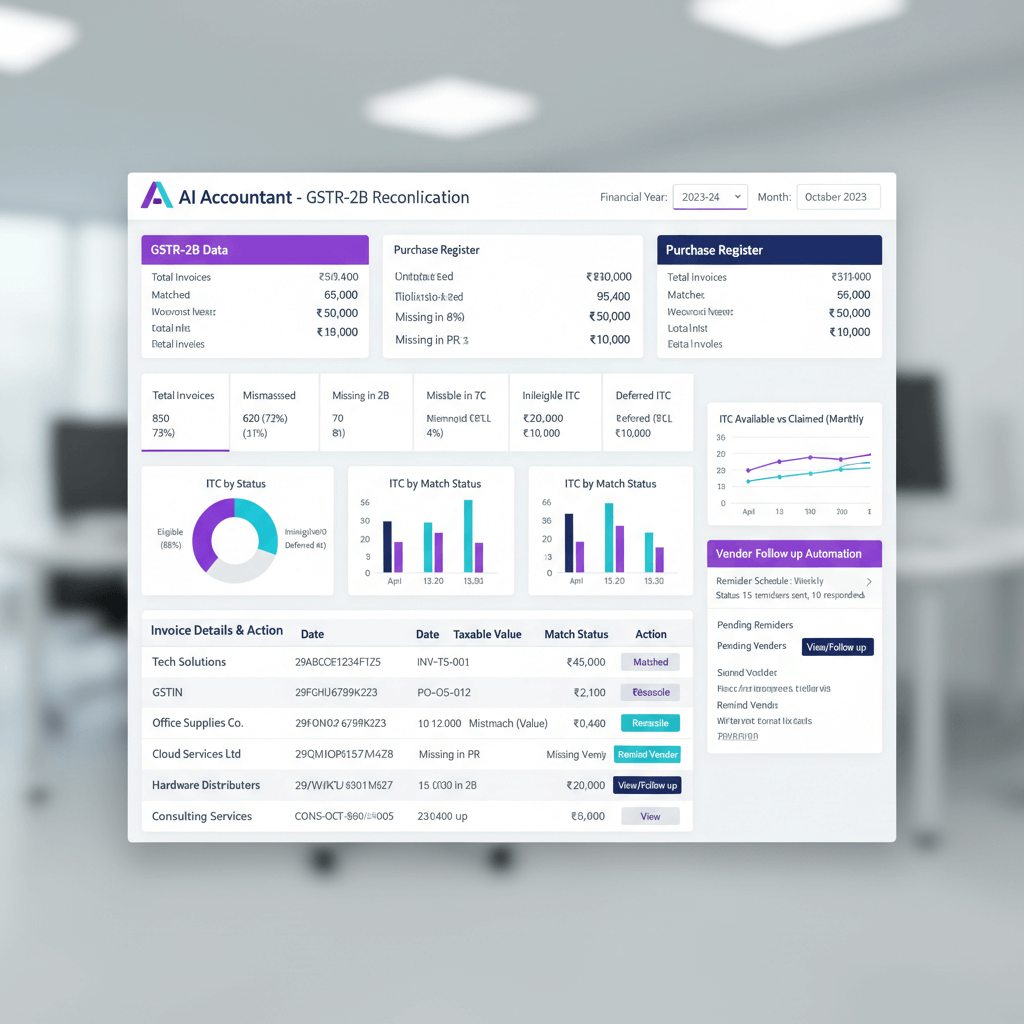
- Real‑time dashboards for variance trends, aging, vendor compliance, and drill‑downs.
Must‑have features in modern reconciliation tools
Data ingestion and validation
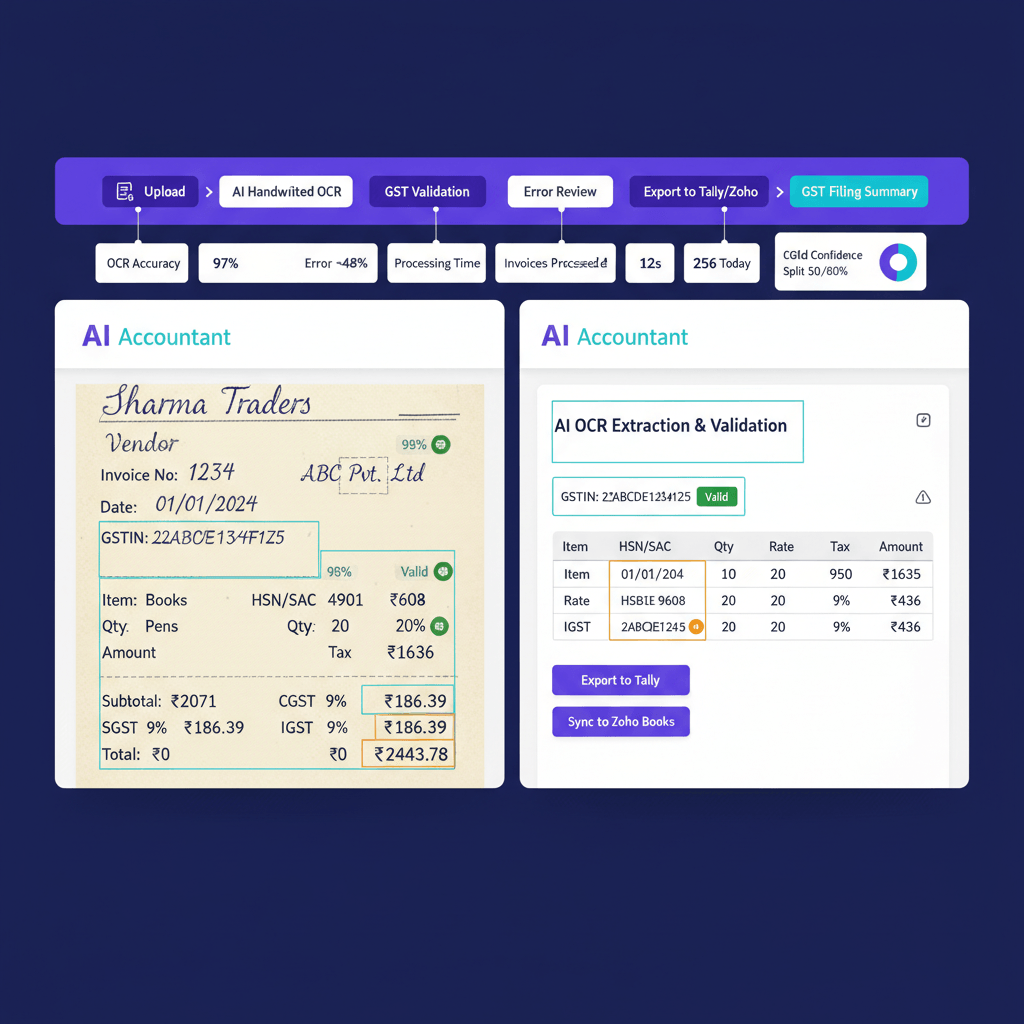
Bulk import for multi‑GSTIN entities, with GSTR‑2B JSON and Excel, plus purchase register pulls from ERP. Automatic normalization of invoice numbers, dates, and GSTINs reduces false breaks. Converting “01‑Apr‑2024” and “01/04/2024” to the same standard, for example, prevents noise during matching.
Intelligent matching engine
Exact matches for perfect hits, fuzzy matches for near hits, and confidence scores to prioritize review. Bucketing should distinguish B2B from B2BA, flag duplicates before double‑claiming, and call out suspected vendor or master‑data issues.
ITC claim optimisation engine
Automatic eligibility tagging, blocked credit checks under Section 17(5), RCM treatment, and timing cut‑offs. What‑if scenarios answer, “Claim now or defer?” and reveal GSTR‑3B impact, turning guesswork into measurable choices.
Vendor follow up automation
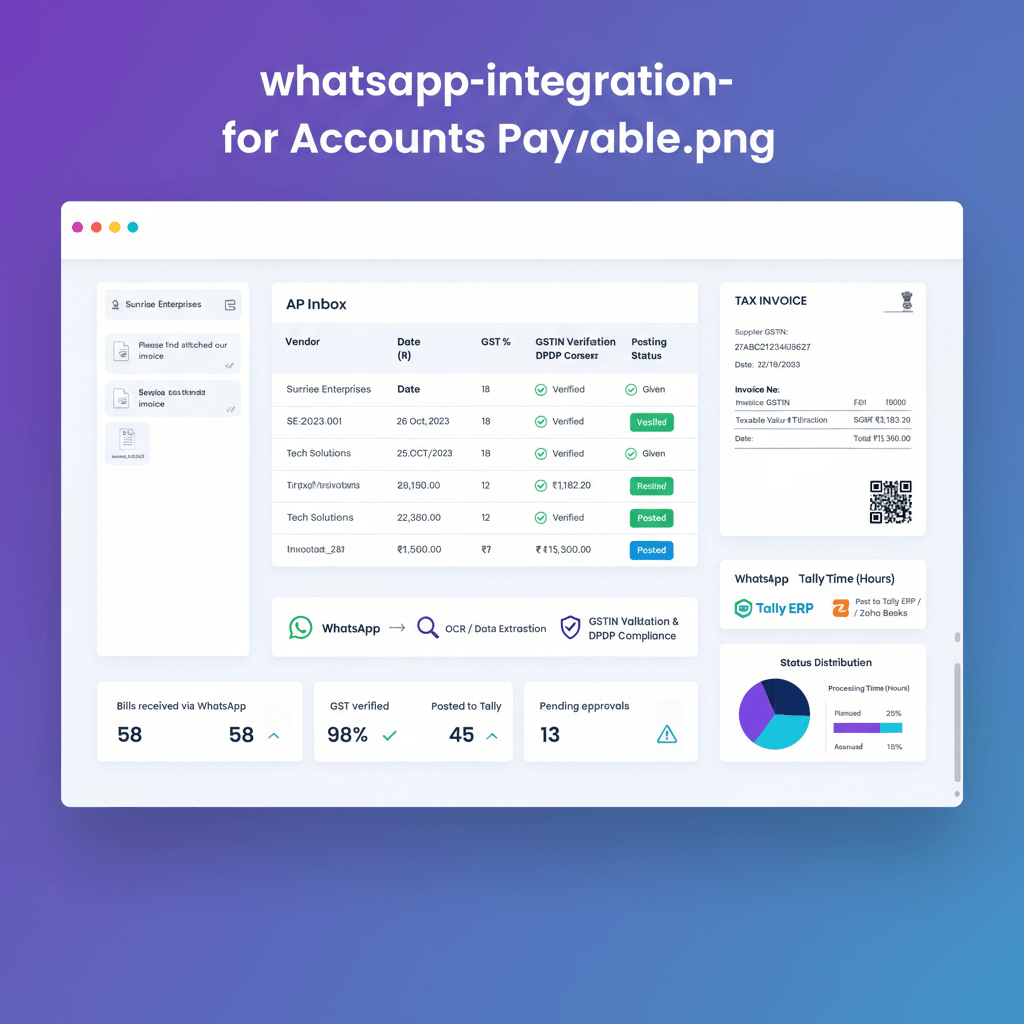
Email and WhatsApp reminders at scale, but still personalized. Escalation ladders and SLA timers separate momentary delays from chronic non‑filers. Response tracking and audit trails protect you during assessments.
Review workflows and audit trails
Status tags such as Matched, Under Review, Deferred, and Assigned distribute work cleanly. Every decision is logged, with approvals on high‑value mismatches to balance speed and control.
Monthly dashboard and reporting
At a glance, see ITC variance, unresolved aging, vendor compliance trends, and drill to document level, without exporting. On‑demand reports support internal reviews and external audits.
ERP integration and posting
Native sync with Zoho Books and Tally moves data both ways, posts reconciliation outcomes, and prepares GSTR‑3B exports. Robust error handling and rollbacks keep books clean.
Enterprise security and scale
Role‑based access, encryption in transit and at rest, ISO 27001 and SOC‑2, and proven performance on 100,000+ lines a month. Data residency options keep data within India when required.
Further reading: overview and expanded notes, plus the Taxilla GSTR‑2B matching tool and this Zoho guide to reconciling GSTR‑2B.
Comparing different reconciliation approaches
Excel and DIY
Low entry cost and full control, but brittle on messy data, weak on fuzzy matching, no automated follow ups, and limited dashboards. As volume grows, maintenance overhead swallows any savings.
Lightweight web tools
Quick to start and better than spreadsheets, yet often shallow on vendor automation, scenario modelling, and drill‑down analytics. Adequate for a few hundred invoices, but stressed at scale.
Full‑featured platforms
- AI Accountant — predictive fuzzy matching that learns your patterns, comprehensive vendor automation, deep Zoho/Tally integration, and enterprise security at scale.
- Octa GST — strong core matching and GSTIN validation, reasonable reports.
- ClearTax GST — broad compliance suite with portal integrations and reconciliation tools.
- Zoho GST — seamless for Zoho Books users with unified compliance.
- TaxiVaahan — bulk processing and automation focus with vendor management features.
Across mature deployments, users report about 60% time reduction and higher ITC capture, which quickly offsets subscription fees. See summaries here: snapshot, comparison notes.
The ideal end to end reconciliation workflow
Step 1: Import and match
Load GSTR‑2B and the purchase register. Let exact and fuzzy logic auto‑clear most lines, then resolve probable matches using confidence scores. Deduplication protects against double‑claims.
Step 2: Surface missing and root causes
Separate “missing in 2B” from “missing in PR,” and tag causes such as non‑filing, GSTIN error, timing gaps, or pending credit notes. This turns chaos into targeted actions.
Step 3: Optimise ITC claims
Apply rules for eligibility, Section 17(5), and RCM, then run simulations for deferrals and reversals. Pick the path that balances cash flow and compliance.
Step 4: Trigger vendor follow ups
Fire batch reminders with templated messages. Track acknowledgments, route escalations, and measure SLA adherence to raise compliance over time.
Step 5: Review dashboard and post to ERP
Scan trends, investigate outliers, and clear exceptions. Post results back into Zoho Books or Tally, generate GSTR‑3B data, and archive reports for audits.
Calculating ROI and building your business case
Time savings
Manual work often takes 2–3 minutes per invoice. At 500 invoices, that is roughly 25 hours. Automation reduces it to 5–8 hours, even lower as models learn your data.
ITC recovery
Capturing an extra 3–5% ITC across crores in purchases means lakhs recovered annually. Add reduced interest at 18% on late credits and avoided penalties, and benefits compound.
Net ROI
(Hours saved × hourly rate) + (extra ITC) + (penalties avoided) − (subscription) = Net benefit.
Example at 1,000 invoices a month: 20 hours saved valued at ₹40,000, plus ₹50,000 higher ITC, plus ₹10,000 penalty avoidance, minus ₹15,000 subscription, equals ₹85,000 monthly benefit. Intangibles, including cleaner audits and calmer month end, add further upside.
Due diligence checklist for 2025 buyers
Matching accuracy
Insist on a proof of concept using your data. Measure match rate, false positives, and fuzzy performance on your vendor name variants. Test volume limits and response times.
ITC optimisation depth
Validate Section 17(5) blocked credits, Rule 42/43 proportionality, RCM handling, and timing logic. Review what‑if outputs and their impact on GSTR‑3B.
Vendor management
Look for customizable templates, bulk sends that still personalize, escalation trees, and end‑to‑end communication logs for audit defense.
Dashboard quality
KPIs must be actionable, not cosmetic. Demand click‑through from summary to document, flexible exports, and performance under full data loads.
Integration depth
For Zoho Books and Tally, confirm two‑way sync, master pulls, error handling, and safe rollbacks. Validate GSTR‑3B export format against current portal norms.
Security and compliance
Check certifications, encryption, access controls, data residency, and cadence of security audits. Ask about breach response policies and uptime SLAs.
Scalability and support
Test on peak‑month volumes. Evaluate support during trial, including resolution time and product knowledge for advanced queries. Training content matters.
Pricing clarity
Understand whether pricing is per invoice, per GSTIN, or flat, and whether users or modules add cost. Negotiate a 15–30 day trial with your live data.
Common pitfalls and edge cases to test
Quarterly filer timing
Invoices show up late in 2B. The tool should maintain provisional matches and auto‑reconcile on arrival without creating duplicates or false breaks.
B2BA amendment chains
Ensure originals and amendments are linked, history is visible, and duplicate ITC is prevented.
Credit note linking
Link credit notes to the right originals, manage partials, and automate reversals to keep 3B correct.
Duplicate detection
Catch duplicates across vendor codes, with minor variations in numbers or dates.
GSTIN mismatches
Propose likely corrections, preserve change history, and prevent recurring errors by updating masters.
Month‑end cut‑offs
Allow custom cut‑off logic so invoices on the cusp of month end reconcile accurately.
Missing IRN
For applicable taxpayers, flag missing IRN (Invoice Reference Numbers) early, reconcile IRN data with 2B, and prevent ineligible claims.
How AI Accountant addresses these requirements
AI Accountant applies predictive matching trained on millions of Indian invoices, improving accuracy as it learns your patterns. It goes beyond “matched or not,” with root‑cause tags and recommended actions for breaks. ITC optimisation simulates multiple strategies with real‑time cash‑flow and 3B impact. Vendor follow up automation covers templates, bulk sends, and smart escalations, with complete audit trails. Dashboards provide executive summaries and click‑through to documents. Deep Zoho Books and Tally integrations keep systems in sync, protected by robust error handling. With 300M+ transactions processed and ISO 27001 and SOC‑2 certifications, the platform supports enterprises and CA firms reliably.
Explore more context and examples: primer, expanded overview.
Real‑world implementation snapshot
A CA firm with 12 GSTINs and 3,000+ monthly invoices spent five days reconciling, with missed ITC and filing stress. After adopting a comprehensive platform, they cut effort by 60% in month one, boosted match accuracy from 75% to 95%, and improved vendor compliance by 25% through automated reminders. Within two months they recovered lakhs in missed credits, gained real‑time visibility through dashboards, and handled 40% more clients without adding staff. Audit readiness also improved thanks to detailed logs and document trails.
Moving forward with GSTR 2B reconciliation tools
In 2025, reconciliation at scale demands automation. Prioritize engines that handle real‑world data, optimise ITC with clarity, automate vendor chase‑ups, and deliver insightful dashboards. Prove value with a pilot on your data, track time saved, ITC uplift, and error reduction, then expand. Choose vendors investing in AI, integrations, and security, so your process stays robust as rules and volumes evolve. For firms and SMEs alike, the question is not whether to automate, but which platform fits your books and your cadence.
Further reads and comparisons: quick guide, buyers’ notes.
FAQ
As a CA, how do I justify the move from Excel to a GSTR‑2B tool when partners question cost?
Quantify hours per invoice, interest on delayed ITC, and penalties avoided, then compare with subscription. A typical firm saves 60% time and recovers 3–5% more ITC. Demonstrate with a two‑week proof of concept using one GSTIN. Tools like AI Accountant make this easy with guided pilots and audit‑ready reports.
What evidence trail will an AO expect during a GST audit of our reconciliation process?
Expect to show versioned purchase registers, portal 2B snapshots, matching logs, exception resolutions, vendor communications, ITC eligibility rationale, and 3B tie‑outs. An AI Accountant deployment stores these artifacts, mapping every summary variance to document‑level proof.
How should we treat credits not appearing in 2B due to vendor late filing, and can a tool bucket these correctly?
Best practice is to bucket prior‑period ITC separately, initiate vendor follow ups, and claim once reflected in 2B unless a policy allows provisional credit within risk limits. AI Accountant automatically tags late‑filing scenarios and shows cash‑flow impact of claim timing.
Does a good tool handle quarterly filers without flooding exceptions every month‑end?
Yes, quarterly filer logic should provisionally park invoices, then auto‑reconcile on appearance in 2B. Dashboards should show expected arrivals to prevent false breaks. Validate this behavior in your pilot with actual quarterly vendor samples.
How are B2BA amendments linked so that we do not double claim or miss reversals?
The engine must chain originals to amendments, maintain chronology, and display net ITC effect. In AI Accountant, amendment histories are visible at line level, and reversal impacts roll into 3B simulations.
What is the standard approach to blocked credits under Section 17(5) and Rule 42/43 proportionality?
Automate tagging of ineligible categories, separate tracking of common credits, and apply Rule 42/43 for proportionate reversals, with clear month‑over‑month carry. Scenario runs should show how choices change 3B liabilities.
How do we treat RCM cases within reconciliation, and can the tool verify tax payment before ITC claim?
RCM documents should be isolated with proof of cash ledger payment before ITC recognition. AI Accountant applies RCM scenarios automatically and alerts if payment proof is missing.
What duplicate patterns should we configure, and can detection work across vendor codes?
Set rules on invoice number similarity, date proximity, GSTIN equality, and amount thresholds. Detection should span vendor code variants and minor number formatting changes. Review confidence scores before final suppression.
Can dashboards actually support audit queries, or will I still export to Excel?
Audit‑ready dashboards must drill from KPI to source document and export evidence bundles. AI Accountant links each metric to transactions, communications, and notes, keeping Excel exports optional rather than necessary.
What integration checks should I run for Zoho Books or Tally before go‑live?
Test two‑way sync on masters and transactions, simulate a reconciliation post and a rollback, and verify GSTR‑3B export structure. Intentionally trigger a sync error to confirm safe failure behavior and clear recovery steps.
How do we manage cut‑off dates so invoices around month end do not distort 2B matching?
Use configurable cut‑off rules, a transition bucket, and auto‑reconciliation logic once the next period’s 2B arrives. The dashboard should show temporary variances separately from true breaks.
Is there a simple way to explain GSTR‑2A versus GSTR‑2B to clients who keep mixing them up?
2B is a static snapshot for the month, generated mid‑month, and is the gold standard for ITC claims. 2A is dynamic and changes as suppliers file or amend. For a refresher, share this primer on maximizing ITC through accurate 2A/2B processes: Maximizing Input Tax Credit through accurate reconciliation. Tools like AI Accountant anchor claims to 2B while still watching 2A for early warnings.

Rohan Sinha is a fintech and growth leader building aiaccountant.com, focused on simplifying accounting and compliance for Indian businesses through automation. An IIT BHU alumnus, he brings hands-on experience across 0 to 1 product building, growth, and strategy in B2B SaaS and fintech.