-01%201.svg)
Key takeaways
- GSTR-2B reconciliation tools automate purchase register matching, find missing invoices instantly, and raise ITC accuracy with audit ready logs.
- GSTR-2B is static for the period, if suppliers file late your ITC is deferred, which inflates working capital and invites penalties.
- Deep exception handling, ITC claim optimisation, vendor follow up automation, and a reliable monthly dashboard separate great tools from the rest.
- Specialized tools cut reconciliation time by 80 to 90 percent, recover 2 to 3 percent more ITC, and shorten month end close by several days.
- A disciplined four week rollout, with maker checker controls and vendor escalations, delivers fast time to value for CA firms and SMEs.
Why GSTR-2B reconciliation matters in 2026
Under the 2B regime your ITC is limited to what appears in the static monthly statement that arrives around the twelfth. Unlike 2A, it does not refresh for late supplier filings. When vendors delay GSTR-1, you cannot claim that ITC in GSTR-3B for the month, cash stays locked, interest rises, and risk of assessment increases.
Manual Excel work creates more leakage. VLOOKUP mismatches on partial invoice numbers, date formats that do not align, and confusion around credit notes or debit notes, all add up to denied or deferred ITC.
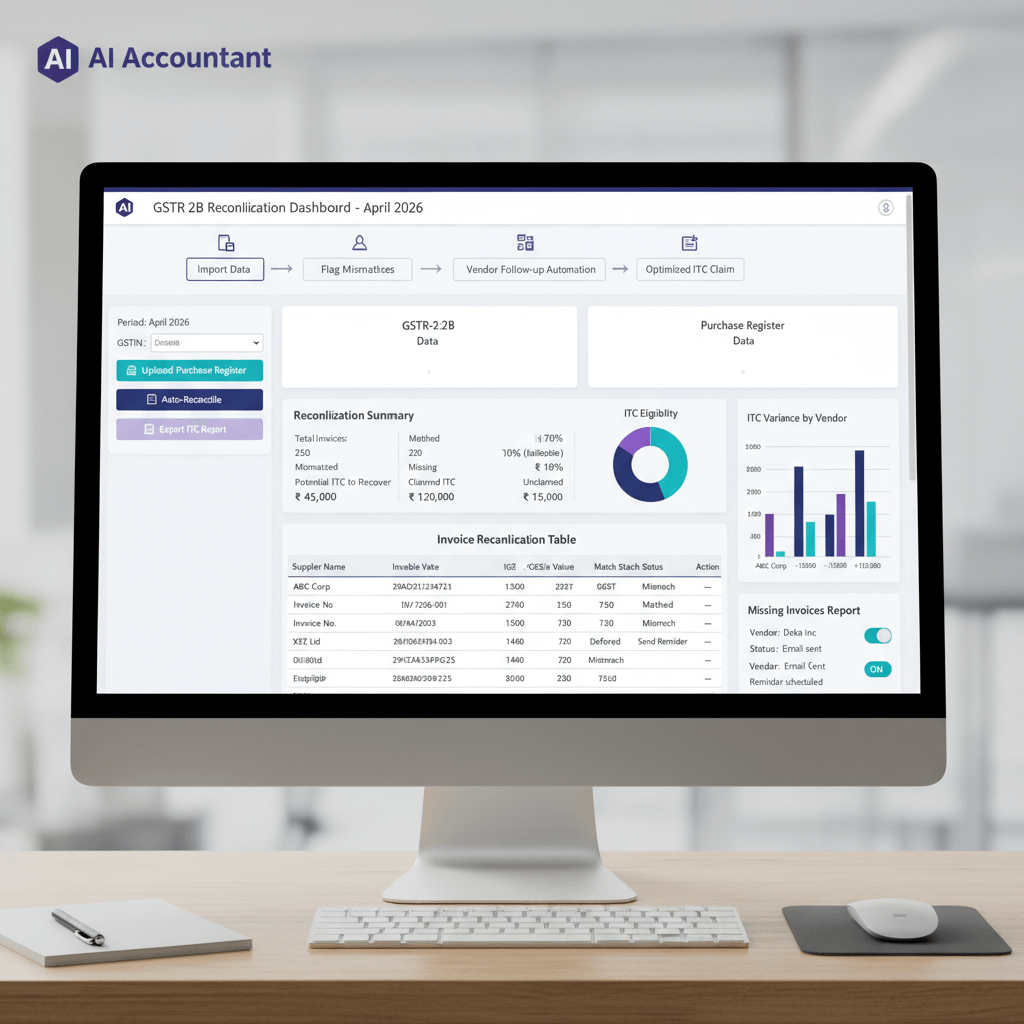
GSTR-2B reconciliation tools fix this with automated matching, intelligent exception buckets, vendor nudges, and rule driven ITC claim optimisation. You also gain a live monthly dashboard to see eligible, claimed, and deferred credits in one place.
Quick refresher, common pitfalls you must control
- Static 2B compiles eligible and ineligible ITC from suppliers’ GSTR-1, GSTR-5, GSTR-6, and ICEGATE imports.
- Typical mismatches, GSTIN transpositions, truncated invoice numbers, date formats, rounding differences, and amount variances within a few rupees.
- Complex areas, amendments, credit notes, debit notes, RCM, imports, IGST splits, and vendor filing delays.
Every rupee of ITC you can evidence and book early reduces working capital strain and boosts free cash flow.
How GSTR-2B reconciliation tools work, end to end
Step 1, Data inputs
Upload purchase registers, JVs, credit notes, debit notes, and the 2B JSON or Excel.
Step 2, Core matching engine
Apply exact and fuzzy rules with configurable tolerances for GSTIN, invoice number, date, and taxable value to match purchase register lines to 2B even with partial or formatted differences.
Step 3, Exception buckets
Auto classify missing invoices, duplicates, partial matches, amendments, and ineligible credits under Section 16 or 17. Surface root cause hints to cut investigation time.
Step 4, Status tagging
Mark items as eligible, deferred, action needed, or ineligible with complete audit trails and maker checker approval.
Step 5, Outputs and posting
Create posting ready exports, and push reconciled entries to Zoho Books or Tally with two way sync.
Evaluation checklist for GSTR-2B reconciliation tools
- Matching depth and accuracy, Custom keys, fuzzy logic, tolerances, and duplicate detection that reduce manual touch.
- Exception handling, Clear buckets for missing invoices and duplicates, with reasons and guided actions.
- ITC claim optimisation, Section 16 and 17 rule engine, deferrals for late filings, and GSTR-3B previews.
- Vendor follow up automation, Bulk email and WhatsApp reminders, escalations, and vendor scorecards.
- Monthly dashboard and reporting, Eligible versus claimed versus deferred, aging, vendor compliance, trends, and drill downs.
- Integrations, Two way sync with Zoho Books or Tally, APIs for scale.
- Scale and performance, Multi organization handling, large volume performance, role based access.
- Accuracy controls, Audit logs, maker checker workflows, and authorized overrides.
- Data security, Encryption, ISO 27001 or SOC 2 certifications, and data residency options.
- Usability, Bulk import validation, row level error reporting, filters, and quick edits.
- Support and pricing, SLAs, onboarding, training, and a transparent total cost model.
Manual versus specialized GSTR-2B reconciliation
Manual Excel
Processing ten thousand lines can take days, partial matches and duplicates slip through, and there is little visibility into patterns. Hidden cost, two to five percent ITC gets deferred or lost.
Generic utilities
Time drops to hours, error risk remains medium, and only basic visibility exists. Deadlines can still be missed.
Specialized tools
Solutions like ClearTax, GSTZen, Zoho Books, and LogiTax complete the same volume in minutes, fuzzy matches cut errors near zero, the monthly dashboard clarifies exposure, and vendor follow up automation sustains compliance.
AI powered solutions
Platforms such as GSTrobo drive sub minute processing for thousands of lines, reveal optimization patterns, and automate vendor scorecards, the tools effectively fund themselves through recovered ITC.
Top GSTR-2B reconciliation tools in 2026, quick picks
- AI Accountant, End to end GST reconciliation with AI matching, automated vendor follow ups, and seamless Zoho Books or Tally sync. Handles very high volumes with ISO 27001 certification, ideal for CA firms with multi client books.
- Zoho Books, Built in 2B to purchase register matching with credit note handling, dashboards, multi GSTIN, and audit trails.
- LogiTax, Strong PR versus 2B matching and ITC controls, customizable dashboards, and proactive alerts.
- LEDGERS, Focused PR and invoice matching with sharp error identification and rapid updates.
- GSTrobo, Very fast PR versus 2B or 2A comparison with high accuracy and low manual effort.
- MYGST Refund, Automated PR 2B matching with clear exception flags and ITC workflows.
These options reliably match the purchase register, identify missing invoices quickly, and drive configurable ITC claim optimisation.
Implementation guide, a four week fast start
Week 0, Setup
Connect Zoho Books or Tally, upload two to three months of PR and 2B data to set a baseline.
Week 1, Pilot
Start with one GSTIN, tune tolerances, and enable rules for ITC claim optimisation.
Week 2, Automation
Turn on vendor follow up automation for top vendors by purchase value, review your first monthly dashboard, train staff on exceptions.
Week 3, Process refinement
Adjust matching rules, add escalations, and publish standard operating procedures.
Week 4, Steady state
Load the 2B each month before GSTR-3B, run reconciliations, and execute vendor cycles on a fixed calendar.
India specific tips
- Account for QRMP and IFF timing differences when deferring ITC.
- Separate RCM and import entries for clear tracking.
- Define credit note and debit note posting practices to prevent double reversals.
- Use maker checker for every override to stay audit ready.
Metrics and ROI you can defend
Baseline
Teams spend four to eight hours per thousand lines, with five to ten percent error rates that defer ITC. Mid sized businesses often lock ₹50,000 or more in monthly working capital.
After implementation
Time falls by 80 to 90 percent, ITC recovery rises by two to three percent through early identification of missing invoices and vendor follow up automation, month end closes accelerate by three to five days.
Sample ROI
With ₹10 crore in annual purchases, two percent more ITC yields ₹2 to 3 lakhs in cash flow, add five hundred hours saved worth about ₹5 lakhs, the total benefit crosses ₹7 to 8 lakhs a year, with payback in two to three months.
Mini case, SME finance team transformation
Before
Excel driven matching, frequent missing invoices, long closes, and heavy vendor chasing. Audit weeks triggered disruption and stress.
After
Automated matching of the purchase register to 2B completed in hours, vendor follow up automation cut exceptions by seventy percent, the monthly dashboard exposed patterns, and ITC recovery improved by three percent, freeing cash and time.
What made it work
- Leadership sponsorship and a clear owner.
- Focused pilot, then phased rollout.
- Weekly reviews on exceptions, vendors, and overrides.
Looking ahead
AI models will keep improving match accuracy, predictive analytics will forecast vendor compliance, real time reconciliation will reduce batch spikes, and e invoicing data will shrink manual entry. For now, the right tool that can match the purchase register reliably, identify missing invoices quickly, and sustain ITC claim optimisation is your competitive edge.
Every percentage of ITC recovered goes straight to profit, every hour saved can be redeployed to advisory and growth.
FAQ
How can I reconcile GSTR-2B with a large purchase register across multiple GSTINs without losing control?
Adopt a tool that supports multi organization workspaces, configurable match keys for GSTIN plus invoice number plus date or value, and fuzzy rules with tolerances. For example, AI Accountant lets you set field level weights, apply date windows, and auto bucket misses by vendor, so a single run handles multiple GSTINs while maker checker approvals preserve control.
What is the practical workflow to handle deferred ITC when suppliers file late under QRMP?
Use a deferral rule that tags lines as deferred when the supplier’s GSTR-1 falls after your 2B cut. Post a carry forward schedule, preview the impact on GSTR-3B, and roll the ITC into the next eligible period. AI Accountant provides a period shift preview so you can see cash flow impact before posting.
How should I treat credit notes and debit notes during 2B versus purchase register reconciliation?
Match notes to the original invoice using supplier GSTIN and reference numbers, then adjust taxable value and tax amounts accordingly. If the note is missing in 2B, park it in a deferred or ineligible bucket with narrative. AI Accountant auto links notes to base invoices and prevents double reversals in 3B.
What tolerance settings are audit safe for value and tax differences?
Keep a tight band, for example up to ₹1 or 0.5 percent for rounding, and document it in policy. Ensure the tool logs each override with user, timestamp, and reason. During audits, provide the exception report, the tolerance policy, and the specific audit trail. AI Accountant exports a single PDF pack with these artifacts.
How do I reconcile import IGST from ICEGATE with 2B so ITC is not stranded?
Load the BE wise ICEGATE file, map it to 2B import rows, and tie to the purchase register via BE number and port code. Post unmatched imports to a watchlist with vendor or CHA follow ups. AI Accountant has a dedicated import matcher that aligns BE data to 2B in one pass.
Can I push reconciled results straight into Tally or Zoho Books without rekeying?
Yes, use two way sync. After approval, the tool posts JV adjustments, credit note links, and ITC buckets back to Tally or Zoho Books. AI Accountant provides connectors that preserve voucher numbers and attach the reconciliation PDF for reference.
What is the best way to automate vendor follow ups without spamming suppliers?
Segment vendors by materiality, send personalized reminders with the exact invoice list, and escalate only on the second or third cycle. Combine email for audit trail with WhatsApp for quick action. AI Accountant supports templated campaigns with vendor scorecards so chronic late filers are escalated to procurement.
How should RCM entries be handled during 2B reconciliation?
Exclude self assessed RCM from supplier match logic, maintain a separate register for RCM liabilities and ITC eligibility, and ensure correct 3B box mapping. AI Accountant auto segregates RCM lines and validates tax head mapping to avoid mispostings.
Why do duplicate invoices pass basic Excel checks and how can I eliminate them?
Duplicates often vary in spacing, case, or suffixes, for example INV 123 versus INV-123, and Excel exact match fails. Use normalized keys, remove spaces and special characters, and rely on fuzzy match thresholds. AI Accountant applies normalization and duplicate clustering so duplicates are flagged before posting.
How do I quantify ROI for a reconciliation tool to convince management or clients?
Measure hours per thousand lines before and after, the percentage of deferred ITC recovered, and the close time reduction. Attach interest savings from earlier ITC claim and penalty avoidance. AI Accountant’s dashboard shows time saved and ITC unlocked, which feeds a client wise ROI report for CA firms.
Will auditors accept AI assisted matching, what evidence do I need?
Auditors focus on traceability and policy compliance. Provide the matching rules, tolerance policy, exception logs, and maker checker approvals. Ensure every override has a reason. AI Accountant maintains immutable audit logs and generates a reconciliation packet acceptable in statutory and internal audits.
What security assurances are essential when sharing PR and 2B data with a SaaS tool?
Insist on ISO 27001 or SOC 2, encryption in transit and at rest, role based access, and data residency disclosures. Ask for third party pen test reports and an incident response policy. AI Accountant is ISO 27001 certified and offers client wise access controls suited for CA firms.

Rohan Sinha is a fintech and growth leader building aiaccountant.com, focused on simplifying accounting and compliance for Indian businesses through automation. An IIT BHU alumnus, he brings hands-on experience across 0 to 1 product building, growth, and strategy in B2B SaaS and fintech.