-01%201.svg)
Key takeaways
- Real Time Financial Analytics gives live visibility into cash, burn, runway, and compliance, so leaders act today, not after month end.
- Indian startups and SMBs gain sharper control of GST, TDS, and ROC, while improving cash collection and forecast accuracy.
- Dashboards that focus on cash, working capital, compliance, and growth, turn numbers into clear next actions.
- Clean data ingestion and fast reconciliation are the backbone, without them, any live view is a guess.
- Alerts, governance, and audit trails convert data into safe decisions, and support investor diligence.
- A CA led model like AI Accountant blends automation and oversight, reducing errors and speeding filings.
- A practical seven step implementation roadmap keeps the rollout fast, safe, and focused on outcomes.
What is Real Time Financial Analytics
Real Time Financial Analytics means your key finance numbers update as transactions happen. Bank feeds pull entries, gateways send payment activity, and your dashboard refreshes in near real time. You can spot a cash dip before it becomes a crunch, and you can track receivables and payables as invoices move. This live view is your command center for money and compliance, not a static report that arrives late. Sources: Lucid, MyPulse, Moody’s.
Traditional reporting makes you wait for month end, consolidation, and reconciliation, then you read a static report. By then, risks are already live and chances are missed. Live dashboards shift you from reactive to ready.
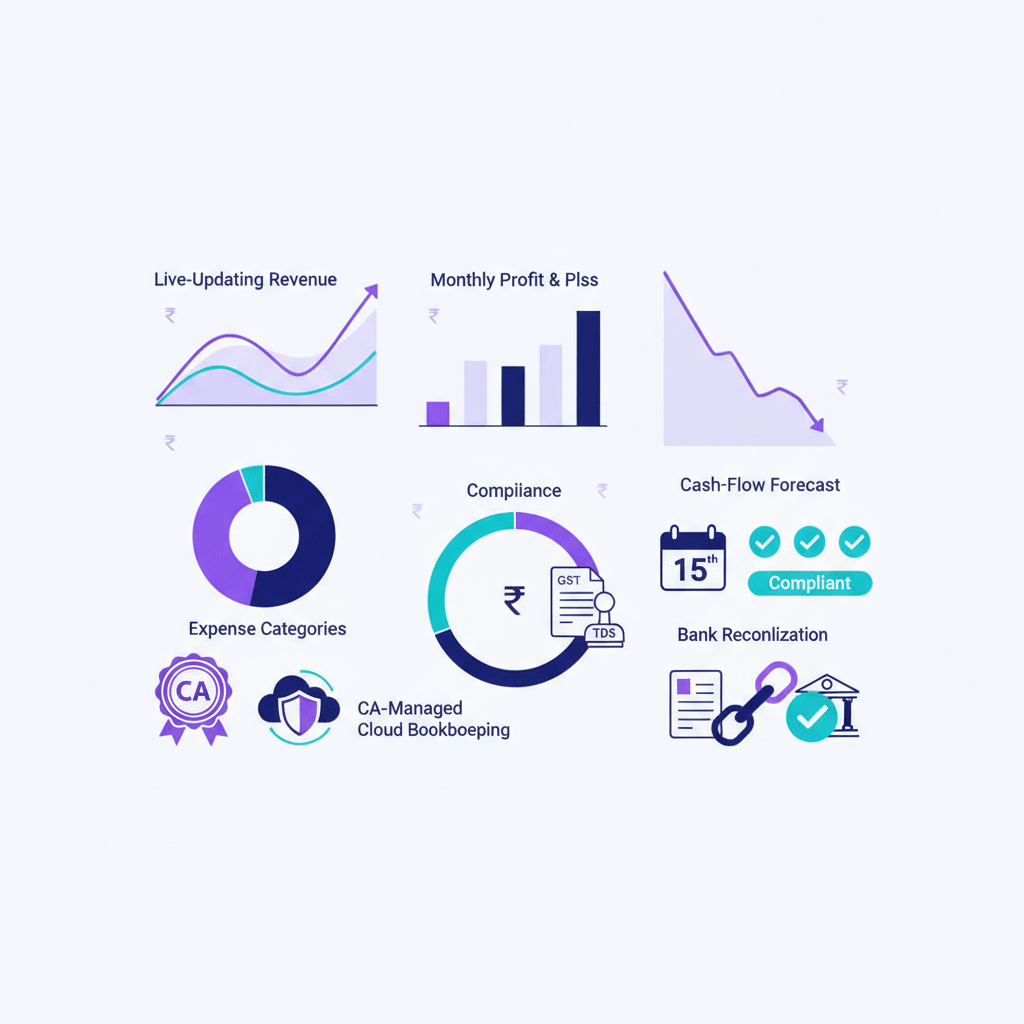
Think of it as a living P&L and compliance panel, where cash, burn, runway, DSO, DPO, margins, and variance alerts update as the business moves.
Why Real Time Financial Analytics matters for Indian startups and SMBs
Founders in India juggle cash planning alongside GST and TDS. Waiting for books to close is risky. A live dashboard shows your runway now, so you can cut burn or speed collections this week. Search and industry data show teams that use real time data report about 70 percent better cash control and around 65 percent better forecasting, and many reduce DSO by 20 to 30 percent with focused AR tracking. Add live GST, TDS, and ROC status, and you avoid penalties while improving cash. Sources: AI Accountant, Lucid, MyPulse.
Core metrics and dashboards that matter
Cash and liquidity metrics
- Cash balance across banks, a single number that leaders can trust.
- Burn rate, average monthly cash outflow, keep it simple, spend per month.
- Runway, months of cash left at current burn, cash divided by burn.
- Cash conversion cycle, time to turn cash out into cash in, links inventory, receivables, and payables.
Working capital metrics
- AR aging, unpaid invoices by bucket, for example 0 to 30, 31 to 60, 61 to 90, and over 90 days.
- DSO, average days to collect, a joint focus for sales and finance.
- AP aging, bills due by bucket, plan vendor payments with cash.
- DPO, average days to pay vendors.
Compliance metrics for India
- GST status, GSTR 1, GSTR 3B due and filed, GSTR 9 and 9C at year end.
- TDS status, monthly challans, quarterly returns 24Q, 26Q, 27Q filed.
- Income tax, advance tax and ITR status.
- ROC panel, MGT 7, AOC 4, DIR 3 KYC status.
Growth and profitability metrics
- Revenue trend, monthly and year to date.
- Gross and net margin, track drift quickly.
- MRR and ARR, if subscription revenue matters.
- Unit economics, contribution margin per unit.
Tie widgets to actions, if DSO rises by five days, show a collection playbook, if burn jumps, show top cost drivers, if GSTR 3B is due in five days, nudge a review of input tax credit. Source: Lucid.
How Real Time Financial Analytics works, data ingestion and reconciliation
- Bank feeds, connect each bank for daily or intraday pulls.
- Payments and gateways, connect Razorpay, Stripe, PayU, PhonePe, and others.
- Invoicing and billing, connect ERP or billing tools.
- Expenses and cards, connect corporate cards and expense apps.
- Payroll, bring in salaries, TDS, and PF summaries.
Reconciliation is the backbone, match bank lines to ledger entries, gateway payouts to orders and refunds, vendor bills to POs, get trust in your numbers. Sources: AI Accountant, Sigma Computing, Moody’s.
Dashboards compute metrics and trends, alerts catch spikes and gaps, audit trails log who did what, so you get speed without losing control. Source: Lucid.
Implementation roadmap, a seven step path
- Standardize the chart of accounts, map revenue streams, cost centers, taxes, and banks, keep names clean.
- Integrate data sources, connect banks, gateways, invoicing, and expenses, set daily sync as baseline, intraday if volume is high.
- Set reconciliation cadence, daily for banks and gateways, weekly for AR and AP aging, monthly for fixed assets and inventory.
- Configure dashboards by goal, founders want cash, burn, runway, and AR, finance wants DSO, DPO, accruals, and variance, tax teams want GST, TDS, and ROC panels.
- Set alerts and thresholds, use simple rules, runway below six months, DSO rises by five days, budget variance breaches.
- Establish governance and audit trails, role based access, approvals, and logs in one place.
- Create a review loop, weekly cash and AR in ten minutes, monthly MIS in one hour, update thresholds as you learn.
References: Moody’s, Sigma Computing, MyPulse.
Alerts, governance, and audit trails that protect finance teams
- Cash alert, projected balance in the next fourteen days drops below a set floor.
- DSO alert, cohort crosses a bucket or a top customer payment is overdue.
- Expense alert, category jumps more than a set percent week over week.
- GST alert, GSTR 1 or GSTR 3B due in seven days and support documents missing.
- TDS alert, challan not paid by the tenth of the month.
Governance keeps you safe, role based access locks sensitive data, audit trails show who changed what and when, valuable for investor diligence and internal audits. Source: AI Accountant.
Common pitfalls and how to avoid them
- Garbage in, garbage out, wrong categorizations or tax mappings break reports, add periodic CA reviews.
- Over automation without oversight, keep human review on exceptions.
- Reconciliation delays, unreconciled banks make live views unreliable, keep daily matching tight.
- Weak access control, define roles, log actions, review quarterly.
- No documentation, write a one page runbook, do not let knowledge live in one head.
References: Lucid, Sigma Computing.
India specific compliance lens for GST, TDS, and ROC
GST essentials
- 2A and 2B reconciliation for input tax credit, match vendor invoices to GSTR 2B before filing GSTR 3B.
- Place of supply, HSN, and SAC mapping for correct tax rates.
- Reverse charge checks on import of services, rent, and other triggers.
- E invoice readiness, track threshold, IRN and QR code on invoices.
TDS and Income tax
- Monthly challan schedule and payment tracker, prevent interest and late fees.
- Quarterly returns 24Q, 26Q, 27Q, and distribution of Form 16 and 16A.
- Advance tax planner for smooth payments.
ROC for small companies
- MGT 7 and AOC 4 status and due dates.
- DIR 3 KYC and DIN changes.
- Board and AGM document checklist.
A real time compliance panel shows status, next dates, and blockers, so taxes and filings stay under control.
Case vignette, the ninety day shift
A growth stage SaaS startup had a twelve month runway and was missing GST credits due to poor invoice capture, with DSO at 72 days. After a CA led real time setup with weekly AR reviews, GST 2B reconciliation, and alerts, the shift was fast.
- DSO dropped to 54 days, a 25 percent improvement, cash in hand rose by one month of expenses.
- GST filing delays fell by three weeks, automated reminders and a document hub avoided about two lakh in potential late fees across the year.
- Forecast accuracy improved, budget variance was caught within a week, better pricing and hiring calls followed.
This matches broader findings, teams using real time data report around 70 percent better cash control and about 65 percent better forecasts. Sources: Lucid, MyPulse.
Data quality, tax mapping, and reconciliation details
- Chart of accounts, separate GST input and output ledgers, HSN and SAC aware item codes.
- Master data, store GSTIN, place of supply, and default tax codes per party.
- Invoice rules, correct document numbers, dates, GST breakup, and e invoice QR and IRN captured.
- Reconciliation rules, map gateway fees, TCS or TDS on sales, and partial settlements correctly, match payouts to orders net of fees.
- Approval workflow, monthly checks for rate changes, new RCM cases, new place of supply cases.
References: Sigma Computing, Moody’s.
Review cadence that turns data into decisions
Weekly quick review, ten to fifteen minutes
- Cash balance, two week cash forecast, and runway.
- AR aging shifts, top five overdue invoices.
- New alerts and filings due this week.
Monthly MIS review, forty five to sixty minutes
- P&L trends and budget variance.
- DSO and DPO movement, cash conversion cycle.
- Tax positions, GST credit health, filing status.
- Action items and owners.
Quarterly strategy review
- Forecast update and scenarios.
- Hiring and spend plan changes.
- Funding or credit needs.
Source: Lucid.
Security, access, and scope clarifications
Finance data is sensitive, set role based access so people see only what they need, keep encryption in transit and at rest, maintain audit logs for every change, and review access quarterly. Real time dashboards and MIS support management, they do not replace statutory audits. Sources: Moody’s, Sigma Computing.
Fundraising and lending readiness
Investors and lenders prefer live, accurate data over month old decks. A real time setup lets you share current cash, AR, burn, runway, governance, and compliance health on demand, which builds trust and speeds diligence. Sources: MyPulse, Lucid.
Best tools to consider for real time analytics
- AI Accountant, CA led managed service with a proprietary dashboard for India specific GST, TDS, and ROC, plus end to end virtual accounting.
- QuickBooks Online, strong bank feeds and basic dashboards for small businesses.
- Xero, clean bank rules and reconciliation, good for multi currency and growing teams.
- Zoho Books, built for India GST and e invoice support, tight automation across the suite.
- Tally Prime, widely used in India, offline strength and GST modules, add ons for live dashboards.
- FreshBooks, simple invoicing and expenses for service firms and freelancers.
- Sage Intacct, mid market cloud ERP with deep reporting and approvals.
How AI Accountant fits into your real time model
AI Accountant is a CA led managed accounting and compliance service with a live dashboard. The team runs bookkeeping, GST, TDS, income tax, and ROC, while the dashboard shows cash flow, AR and AP, reconciliation status, and filings in one place. This blend of automation and professional oversight avoids the garbage in trap, replaces email and spreadsheet loops, and gives you a single source of truth.
You can chat with your CA team inside the system, and you can see documents and audit trails as work happens.
Practical tips to get started this week
- Pick three metrics to start, cash on hand, runway, and DSO.
- Connect your main bank and your main gateway first, add more after you prove the flow.
- Adopt a daily five minute reconciliation habit, clear yesterday’s unmatched lines today.
- Set one alert, for example runway below six months, tune later.
- Keep a one page runbook for categorization, reconciliation, and reviews.
Conclusion
Real Time Financial Analytics gives you a living picture of money and filings, so you can plan cash, speed collections, and avoid penalties. Burn rate, runway, DSO, and compliance status live in one place, which leads to better cash control, sharper forecasts, and faster decisions. With the right data pipes, tight reconciliation, and strong governance, real time becomes a daily habit. Add a CA led service like AI Accountant for expert oversight on tax mapping and compliance, and you make real time simple, safe, and powerful.
FAQ
What counts as real time for a finance stack in India
Daily sync is the baseline, intraday for banks and gateways is ideal. Numbers become management ready when reconciled, then you can trust cash, AR, AP, and GST or TDS panels for decisions.
How do we ensure reconciliation discipline without slowing down
Set daily matching for bank and gateway lines, weekly for AR and AP aging, and monthly for full close. Use rules for common cases, route exceptions to a CA reviewer. An AI enabled service like AI Accountant keeps this cadence steady.
Will a real time dashboard replace our statutory audit or tax assessments
No. Real time MIS supports management and investors, statutory audits and assessments remain separate. The benefit is a cleaner audit since reconciliations, logs, and documents are always current.
Can one dashboard track GST 1, GSTR 3B, GSTR 9, TDS 24Q 26Q 27Q, and ROC items
Yes. With the right data model and compliance connectors you can show due dates, filing status, ITC readiness, challans, and ROC forms in one panel. AI Accountant offers an India specific compliance view that does this.
What DSO target should a SaaS or services business aim for, and how does real time help
Many teams target DSO under 45 to 55 days depending on terms. Live AR aging, cohort alerts, and promise to pay notes in the dashboard pull collections forward and can reduce DSO by 20 to 30 percent.
How do we set cash runway alerts that are useful, not noisy
Start with a floor, for example six months of runway, add a second alert for sudden burn spikes, for example spend jumps by 15 percent week on week. Review thresholds monthly based on plan changes.
What is the cleanest way to structure the chart of accounts for GST and revenue streams
Use separate GST input and output ledgers, map HSN and SAC at the item level, and keep revenue accounts by product or channel. This supports ITC reconciliation and clear margin analysis.
How do we connect multiple banks and gateways without duplicate entries
Use unique source identifiers and reconciliation rules that match gateway settlements to orders net of fees. Lock down manual imports and rely on a single connector per source. A managed setup like AI Accountant enforces these controls.
What governance and audit evidence do investors expect during diligence
Role based access logs, reconciliation histories, variance notes, and a clear close calendar. They also expect compliance proofs, for example GSTR filings, TDS challans, and ROC acknowledgments stored against the period.
How does an AI enabled virtual accounting service like AI Accountant work with our in house team
The service runs bookkeeping, reconciliations, and filings, while your team focuses on approvals, budgets, and collections. You get a shared dashboard, in product chat, and audit trails, so work stays visible.
What is a realistic timeline and cost to go live for a 50 to 200 employee company
With clean masters and connectors, expect two to four weeks for integration, mapping, and first reconciliations. Costs vary by scale and complexity, savings often show up as faster collections and fewer penalties.
How do we handle e invoice and reverse charge cases in a live flow
Encode thresholds and place of supply rules, validate IRN and QR on invoices, and flag RCM on import of services and other triggers. Review new edge cases monthly with your CA.
How safe is our data when using bank feeds and third party connectors
Use encrypted connections, least privilege access, and segregated duties. Review access quarterly, and keep audit logs on by default. Ask vendors for their compliance attestations.
What KPIs belong on the CEO view versus the finance controller view
CEO view, cash, burn, runway, revenue, margin, top customers, and big risks. Controller view, DSO, DPO, AR and AP aging, budget variance, reconciliations, and compliance status. Both see alerts, with different thresholds.