-01%201.svg)
Key takeaways
- Duplicate vendor bills in India often hide as near-duplicates, created by formatting differences, OCR mistakes, vendor resubmissions, and weak import checks in Tally, leading to cash leakage, GST ITC mismatches, and audit issues.
- Robust detection depends on composite matching of GSTIN, normalized invoice number, date, amount, and IRN where applicable, supported by PO and GRN matching.
- Tally controls, when properly configured, block many duplicates at source, while AI systems scale detection with fuzzy matching, cross-branch visibility, and real-time alerts.
- Track detection rate, prevented value, resolution time, post-payment incidents, GST mismatch rate, and vendor duplicate rates to prove ROI and strengthen controls.
- A five-week roadmap helps you clean masters, run historical sweeps, pilot AI, roll out new workflows, and embed continuous improvement.
Understanding Duplicate Invoices in the Indian AP Context
Not all duplicates look identical, and that is why many slip through month-end rushes. In Indian accounts payable, duplicates emerge in several forms.
- Exact duplicates share the same GSTIN, invoice number, date, and amount. These are easiest to spot, yet they still pass during bulk uploads.
- Near-duplicates arise from formatting variations and OCR mistakes, for example INV-001 versus INV/1, or O versus 0. Vendor names also vary, for example ABC Traders versus ABC Traders Pvt Ltd.
- Partial duplicates appear when the same invoice amount is split across two entries, or the same invoice is recorded in two branch GSTINs.
- Document variants include revised invoices, credit notes, and re-scanned copies, which get treated as new bills without proper linking.
Tip: Normalize invoice numbers, group by GSTIN or vendor code, and compare dates and amounts with small tolerances to expose lookalikes.
Why Duplicate Vendor Bills Keep Happening
Manual entry is the biggest driver. When teams key in bills from spreadsheets without validation, or process scanned documents that suffer from OCR errors, duplicates multiply. Poor quality scans from WhatsApp forwards and email attachments add more noise that basic automation fails to interpret correctly.
Vendor-side behaviors compound risk, such as multiple vendor masters for the same supplier, incorrect GSTIN entries, and multi-channel submission. Vendors resubmit invoices when payments delay, unaware that the original is already in the queue.
System limitations in Tally or Zoho Books add to the problem, as out-of-the-box duplicate checks are limited. PO re-issues and amendments often produce duplicates if not governed by matching controls.
India-specific complexities persist, for example non-e-invoice vendors without IRNs, a mix of GST-registered and unregistered suppliers, and composition dealers with inconsistent formats, all of which hinder unique identification.
Business Risks and GST Compliance Impact
Cash leakage from duplicate payments blocks working capital, and recoveries can take weeks, sometimes months. Meanwhile, vendor relationships strain when you request refunds.
GST compliance takes a hit. Double ITC claims surface during GSTR-2B reconciliation, triggering notices, increasing reconciliation time, and delaying filings. Audit findings escalate when control weaknesses are evident, and documentation for reversals consumes bandwidth.
Remember: Faster detection, same-day resolution, and clean audit trails reduce compliance exposure and improve stakeholder confidence.
Essential Fields and Matching Rules for Robust Duplicate Invoice Detection India
- Primary identifiers: Group by GSTIN, PAN, or vendor code. Use bank account or IFSC as secondary validators where available.
- Invoice number normalization: Strip slashes, dashes, and leading zeros before comparison. Use fuzzy matching to catch typos, with similarity thresholds near 85 to 90 percent.
- Date and amount tolerances: Allow a small date window, for example plus or minus 3 days, recognizing entry delays. Consider variations in CGST, SGST, and IGST splits when matching totals.
- E-invoicing integration: Use IRN and QR data as unique keys when available, which are particularly reliable for compliant vendors.
- Supporting data: Reinforce checks with PO and GRN through 2-way or 3-way validation. Place of supply codes and TDS rates improve context, distinguishing legitimate lookalikes from true duplicates.
Manual Methods to Find Duplicate Vendor Bills India
Excel and Google Sheets Techniques
Build a composite key, for example GSTIN + normalized invoice number + taxable value. Use COUNTIFS to flag repeats, and pivot tables grouped by vendor and invoice number to surface patterns. For near-matches, use Power Query or fuzzy matching add-ins to catch small variations.
GST Reconciliation Approach
Compare your Purchase Register against GSTR-2B, then flag cases where multiple entries map to a single IRN. Export both datasets, and apply VLOOKUP or INDEX-MATCH to isolate mismatches that signal duplicates.
Zoho Books Built-in Features
Enable per-vendor duplicate checking for bill numbers. Use Bills reports with vendor and date filters, sort by invoice number, and scan quickly for repeats.
Document Management Hygiene
Stamp invoices as Processed, or use digital labels, and compute file hashes to detect exact re-submissions. Maintain an intake log with timestamps and processor names for quick audit reference.
Tally-Specific Controls to Prevent Duplicate Payment Tally
Voucher Reference Configuration
- Enable Bill-wise Details to enforce unique references per vendor.
- Lock voucher numbering, and prefer auto-numbering with vendor-based prefixes for traceability.
Import Validations and Exception Handling
- Configure imports to reject vouchers with duplicate Reference Nos for the same vendor.
- Scan Day Book and Exception Reports for anomalous patterns.
- Export monthly vouchers to XML or Excel, then sweep with composite key checks such as GSTIN + invoice number + amount.
Payment Controls
- Restrict payments to Bill Outstanding only, preventing ad-hoc disbursements.
- Validate bank details against vendor records, and enforce maker-checker approvals above thresholds.
Recovery Procedures
Document SOPs for discovered duplicates, including credit note creation, set-offs, and refunds. Maintain standardized vendor communication templates, and track recoveries with aging until closure.
Building Long-Term Process Controls
- Centralized intake: Funnel invoices to a single AP portal or mailbox to avoid duplicate entry points.
- Vendor master governance: Use approval workflows, validate GSTIN through APIs, and curb duplicate supplier codes.
- Matching protocols: Enforce 2-way or 3-way matching above thresholds, and mandate IRN verification for applicable vendors.
- Period controls: Establish monthly closings, with exception logs tracking duplicates and resolutions.
- Vendor education: Share submission guidelines, required fields, and preferred formats to reduce rework.
Where AI Duplicate Detection AP India Transforms the Process
Advanced Matching Techniques
AI handles fuzzy matching at scale, finding typos, formatting differences, and OCR noise. Vendor name resolution and GSTIN validation align inconsistent records. OCR normalization improves extracted data before comparison, while IRN and hash checks add certainty. Cross-organization scanning exposes duplicates across branches and client entities, a key advantage for CA firms.
Handling Edge Cases
AI detects split invoices that share references or line items, links revised invoices to originals, and normalizes multi-currency amounts using date-appropriate rates. Pattern analysis flags suspicious behavior and potential fraud attempts, reducing downstream risk.
Measurable Outcomes
Real-time alerts block processing, detection accuracy improves continually, GST reconciliation is cleaner, and cycle times drop so teams can focus on high-value work.
How AI Accountant Solves Duplicate Detection at Scale
Intelligent Ingestion and Extraction
Bulk upload PDFs, images, and spreadsheets in one flow. Advanced extraction reads low-quality scans from messaging apps accurately, while vendor mismatch detection flags incorrect GSTINs or names before they cause duplicates.
Sophisticated Detection Capabilities
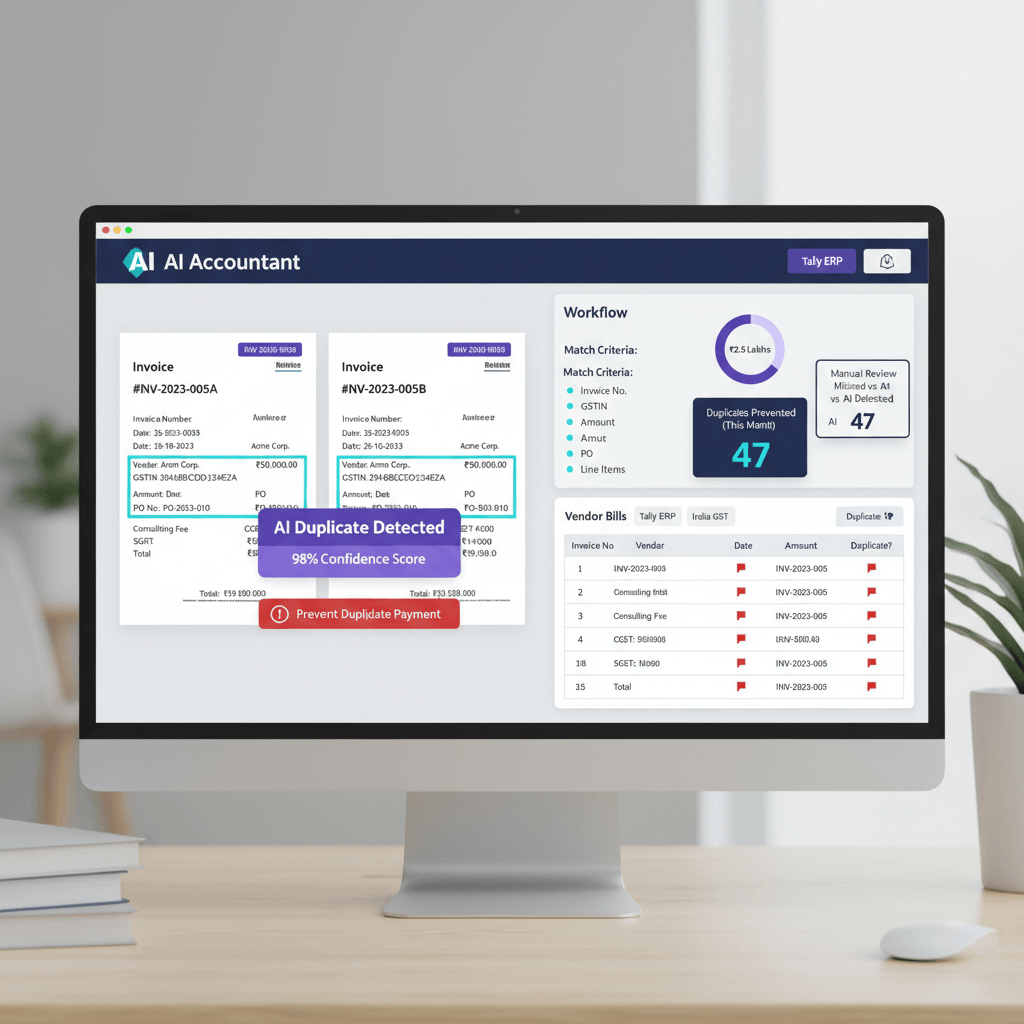
Fuzzy matching over GSTIN, IRN, invoice numbers, dates, and amounts yields confidence scores with explainability. Weighted similarity across fields catches near-duplicates that exact rules miss.
Streamlined Review Workflow
Bulk triage lets reviewers confirm or dismiss many alerts at once, one-click merges preserve audit trails, and direct integrations with Tally and Zoho Books prevent duplicate posting at source.
Prevention and Monitoring
Bank statement reconciliation surfaces paid duplicates for recovery, GSTR-2B alignment keeps ITC clean, and multi-entity dashboards help CA firms monitor duplicate trends, while prevented value metrics quantify ROI.
Key Metrics to Track Success
- Detection rate: Percent of duplicates blocked before payment, target 95 percent or more.
- Prevented value: Rupees of duplicate payments avoided monthly, the clearest ROI signal.
- Resolution time: Average hours from flag to resolution, aim for same-day closure.
- Post-payment incidents: Duplicates caught after payment, a lagging indicator of control gaps.
- GST mismatch rate: ITC issues from duplicates, trending downward signals cleaner compliance.
- Vendor duplicate rate: Suppliers with frequent resubmissions, enabling targeted education.
Implementation Roadmap: Your 5-Week Action Plan
Week 1: Foundation Setting
Clean vendor masters with GSTIN validation, enable duplicate checks in Tally or Zoho Books, map current workflows, and baseline duplicate incidents and resolution time.
Week 2: Historical Cleanup
Export two quarters of purchase data, run Excel-based composite key checks, analyze patterns, and estimate prevented value potential.
Week 3: AI Implementation
Pilot AI Accountant with your context, connect Tally or Zoho Books, tune similarity thresholds, and test with known duplicates.
Week 4: Process Rollout
Deploy detection checklists, formalize review workflows, publish dashboards, and set escalation paths for complex cases.
Week 5 and Beyond: Continuous Improvement
Schedule monthly sweeps, refine thresholds, engage vendors on submission quality, and update SOPs as metrics evolve.
Small, consistent improvements compound into strong controls and fewer audit surprises.
Taking Action on Duplicate Detection
Duplicate detection is part technology, part discipline. Start with vendor master cleanup and Tally configuration, then layer advanced detection for scale and speed. For CA firms and SMEs handling hundreds of bills, manual checks plateau quickly, while AI raises detection from about 70 percent to 95 percent, often higher.
Scale your duplicate invoice detection India program with AI Accountant, purpose-built for Indian GST, integrated with Tally and Zoho Books, and designed for real-time prevention. The cost of undetected duplicates, in cash leakage, compliance risk, and audit findings, far exceeds the investment in proper detection. Every prevented duplicate payment improves cash flow, strengthens vendor relationships, and boosts audit confidence.
Bottom line: Treat duplicate detection as a journey, invest in controls and AI, and let metrics guide continuous improvement.
FAQ
How do I configure Tally Prime to block duplicate vendor bills at voucher entry level?
Enable Bill-wise Details for purchase vouchers, lock voucher numbering to prevent manual overrides, and enforce unique Reference Nos per vendor. Add a monthly export to Excel or XML for a composite key sweep, GSTIN + normalized invoice number + amount, to catch anything that slips through. Tools like AI Accountant integrate with Tally to stop duplicates at source and provide explainable flags.
What matching rules should a CA recommend for cross-branch duplicate detection under a shared services model?
Standardize a composite key across entities, GSTIN or vendor code + normalized invoice number + taxable value, add date window of plus or minus 3 days, and incorporate IRN where available. For cross-branch, include branch code and place of supply as context fields. AI Accountant supports cross-organization scanning so duplicates across multiple GSTINs are flagged in one view.
How do I handle revised invoices and credit notes without triggering double payment or double ITC?
Always link revised invoices and credit notes to the original document and reason code, maintain a revision register, and ensure credit notes are processed as adjustments, not as new payable documents. In AI workflows, train the model to pair revisions with originals so review screens present a single thread, not two separate liabilities.
What is the best way to normalize invoice numbers for fuzzy matching in Indian AP?
Strip spaces, slashes, dashes, and leading zeros, convert letters to uppercase, and normalize common prefixes, for example INV, BILL, TAX. Run a similarity check around 85 to 90 percent to catch O versus 0 or INV-001 versus INV/1. AI Accountant applies normalization and weighted matching across number, date, amount, and GSTIN.
How can a CA quantify ROI from duplicate detection controls for a client?
Track detection rate, prevented value per month, resolution time, post-payment incidents, and GST mismatch rate. Compare baseline to post-implementation metrics. AI Accountant dashboards aggregate prevented value and show trend lines by vendor, branch, and processor, which helps justify investments to management and auditors.
What controls work for unregistered vendors where GSTIN is not available?
Use PAN, vendor code, bank account, and IFSC as primary identifiers, require PO references for all bills, and match address or phone as secondary checks. Apply tighter date and amount tolerances. AI Accountant can weight non-tax identifiers more heavily for unregistered suppliers to preserve accuracy.
How should Tally imports be validated to avoid duplicates from bulk uploads?
Before import, pre-validate against an index of composite keys already posted, block any entry where GSTIN or vendor code plus normalized invoice number collides, and present a review list for near-matches. Post-import, run Day Book and Exception Reports, then a monthly Excel sweep for assurance. AI Accountant automates pre-ingest dedupe and near-duplicate flags.
Does e-invoicing and IRN eliminate duplicate invoices in practice?
IRN reduces risk but does not eliminate it, since not all vendors fall under e-invoicing, and scanned copies or near-duplicates can still occur. The IRN should be a unique key in your matching logic, supported by date, amount, and vendor checks. AI Accountant uses IRN where available and falls back to fuzzy logic elsewhere.
What recovery workflow should finance follow once a duplicate payment is identified?
Document evidence, notify the vendor immediately, request refund or agree on set-off through a credit note, update a recovery register with aging, and escalate overdue recoveries. In AI Accountant, tag incidents as Paid Duplicate, attach proof, and track recovery status to closure for audit readiness.
How do we detect duplicates originating from poor quality scans or WhatsApp PDFs?
Use OCR normalization and fuzzy matching to overcome extraction noise, compare by multiple fields, and calculate hashes on cleaned text. Maintain a low threshold for manual review when image quality drops. AI Accountant is tuned for Indian invoice formats and low-resolution uploads, reducing misses from noisy sources.
What thresholds balance false positives versus misses for near-duplicate detection?
Start around 85 to 90 percent similarity for invoice numbers, allow date variance of plus or minus 3 days, and require tight amount matching on taxable value while permitting small tax breakup differences. Tune these based on your historical patterns. AI Accountant provides confidence scores and learns from reviewer feedback.
Can CA firms run cross-client duplicate detection without exposing confidential data?
Yes, by using a centralized detection platform that logically separates client entities while enabling cross-entity analytics. Pseudonymize or tokenize sensitive fields where policy requires. AI Accountant supports multi-organization workspaces with role-based access, enabling cross-client insights without compromising confidentiality.
How do we prevent ad-hoc payments in Tally that bypass duplicate checks?
Restrict payments to Bill Outstanding entries, mandate maker-checker approvals over thresholds, and reconcile bank statements weekly to spot anomalies early. AI Accountant’s bank reconciliation and real-time alerts help catch exceptions before funds leave the account.
What reports should auditors request to validate duplicate detection effectiveness?
Provide monthly exception logs, prevented value reports, post-payment incident summaries, vendor duplicate rate trends, and resolution time SLAs. Include Tally export snapshots, composite key sweeps, and AI review audit trails. AI Accountant retains explainability for each flag, which simplifies audit sampling and verification.
How can we educate vendors to reduce duplicate submissions without damaging relationships?
Issue concise guidelines on required fields, consistent invoice numbering, and a single submission channel, share examples of acceptable formats, and confirm receipt automatically. Track vendors with high duplicate rates, then schedule short check-ins. AI Accountant’s dashboards highlight high-risk vendors, making vendor education targeted and data-driven.