-01%201.svg)
Key takeaways
- Use a precise, entity-wise checklist for GST registration, most rejections stem from small document mismatches, unclear scans, or incomplete address proofs.
- For rented or shared premises, submit the complete trio, rent or service agreement, recent utility bill, and owner or provider NOC, a single document is not enough.
- Aadhaar authentication accelerates approval to roughly 7 working days, skipping it often triggers physical or video verification.
- Companies and LLPs must use a Class 3 DSC, other entities can use Aadhaar OTP or EVC for submission.
- Bank details can be added within 30 days, providing them upfront reduces follow-up notices and speeds go-live.
- Name and address consistency across PAN, bank proof, and premises proof is critical, tiny inconsistencies invite REG-03 queries.
- If you want a first-attempt approval, consider done-for-you support from Virtual Accounting by AI Accountant, including review, filing, and follow-through.
2026 GST registration documents, the complete guide
If you are tired of guesswork, this 2026-ready checklist breaks down documents by entity type, highlights common pitfalls, and shares insider tips that save weeks of back-and-forth. Keep this open while you assemble your files, and you will likely clear on the first attempt.
Quick win: Always prepare premises proof as a complete set based on your situation, owned, rented, or shared. This single step prevents most REG-03 notices.
Do you actually need GST registration?
Run this 30-second test before collecting papers.
- Goods, typical threshold ₹40 lakh turnover, some states ₹20 lakh.
- Services, typical threshold ₹20 lakh, some special category states ₹10 lakh.
- Mandatory if you make inter-state supplies, sell via e-commerce, fall under reverse charge, act as a casual or non-resident taxable person, or must deduct TDS or collect TCS.
- Voluntary registration helps you claim input tax credit, work with larger buyers, and list on marketplaces.
Still unsure? A short call with your CA, or with Virtual Accounting, can clarify eligibility in minutes.
Master checklist, documents most businesses need
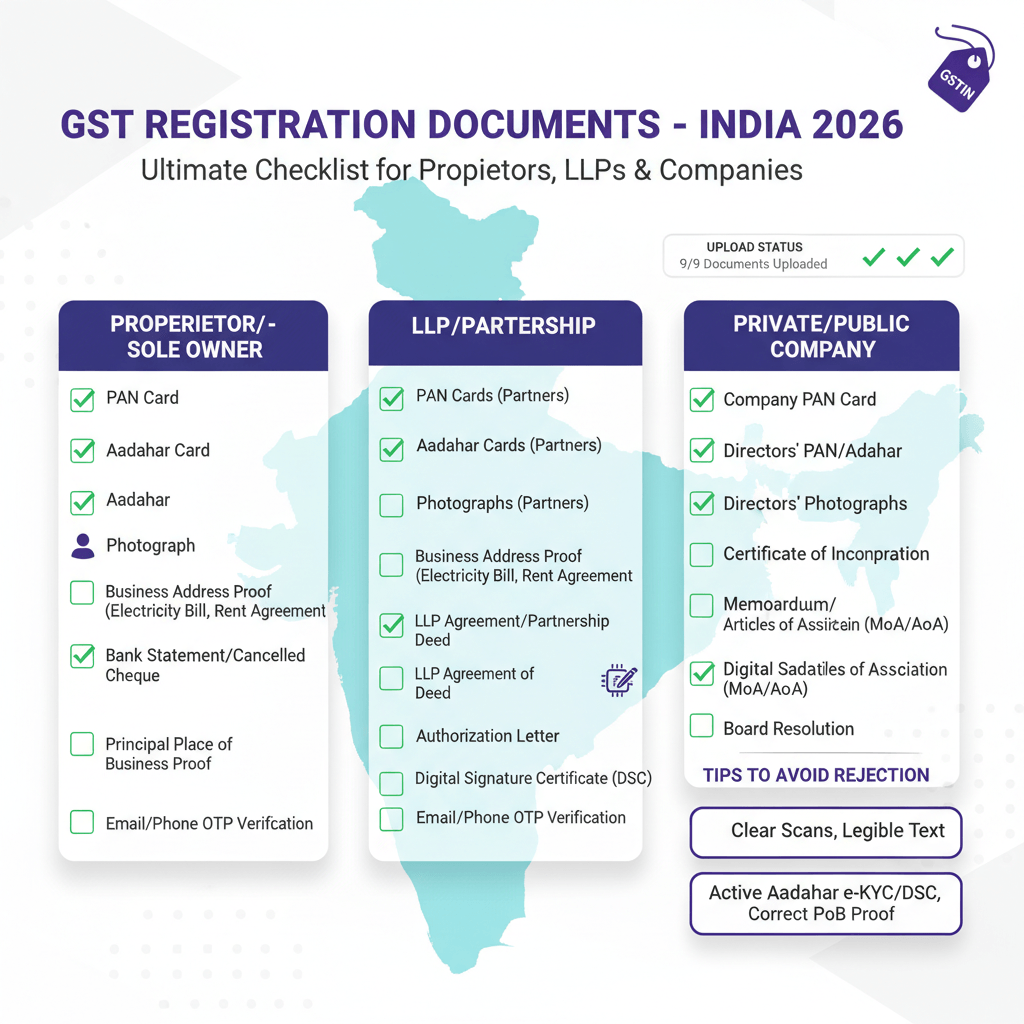
Identity and tax
- PAN of the entity, for proprietorships, the proprietor’s PAN is used.
- Aadhaar of promoters, partners, directors, and the authorized signatory for e-KYC, keep the Aadhaar-linked mobile handy for OTP.
Photographs
- Proprietor, one passport-size photo.
- Partnerships, LLPs, companies, photos of all partners or directors and the authorized signatory.
- Trusts and societies, photos of key office bearers and the authorized signatory.
Principal place of business proof
- Owned: Property tax receipt or municipal khata or sale deed, plus a recent electricity bill.
- Rented: Rent or lease agreement, recent utility bill of the premises, owner NOC.
- Shared or co-working: Provider NOC, provider’s ownership or utility proof, your service agreement or invoice.
Match the address in documents exactly with what you enter on the portal, even small variations invite queries.
Bank details
- Cancelled cheque with pre-printed name, or
- First page of passbook, or
- Recent bank statement showing name, account number, and IFSC.
Authorization
- Partnerships, authorization letter or partner resolution.
- LLPs and companies, board or partner resolution appointing the authorized signatory.
- Trusts and societies, committee resolution or trustee authorization.
Digital signature and contact
- Class 3 DSC is mandatory for companies and LLPs, optional for others.
- Active mobile and email for OTPs and notices.
Optional but useful, Shops and Establishments licence, Udyam Registration, professional tax registration.
Documents by business type
Proprietorship
- PAN and Aadhaar of proprietor.
- One photograph.
- Premises proof per owned, rented, or shared rules, home address works with bills and NOC if needed.
- Bank proof, personal or current account used for business.
- DSC not required, Aadhaar OTP is fine.
Partnership firm
- Firm PAN, partnership deed.
- PAN and Aadhaar of partners, at least the authorized signatory.
- Photos of partners and authorized signatory.
- Premises and bank proof in firm’s name.
- Authorization letter appointing the authorized signatory.
- DSC optional, but helpful if you plan scale, check the GST portal for current authentication options.
LLP
- LLP PAN, LLP Agreement, Certificate of Incorporation from MCA.
- PAN and Aadhaar of designated partners and the authorized signatory, photographs.
- Resolution appointing authorized signatory on LLP letterhead.
- Premises and bank proof in LLP name.
- Class 3 DSC of the authorized signatory is mandatory.
Private limited company
- Company PAN, Certificate of Incorporation, MOA and AOA.
- PAN and Aadhaar of directors and authorized signatory, photographs.
- Board resolution specifying powers for GST matters.
- Registered office proof, bank proof in company name.
- Class 3 DSC of the authorized signatory is mandatory.
HUF
- HUF PAN, Karta’s PAN and Aadhaar, Karta’s photograph.
- HUF deed or declaration if available.
- Premises proof, bank proof in HUF name.
- If someone else signs, authorization by Karta.
Trusts, societies, NGOs
- Trust deed or society registration certificate, entity PAN.
- PAN and Aadhaar of trustees or office bearers, photographs.
- Resolution appointing authorized signatory.
- Registered office proof, bank proof in entity name.
- Section 8 companies follow company DSC rules.
Casual and non-resident taxable persons
- Casual taxable persons, PAN and Aadhaar if resident, event or exhibition allotment letter as address proof, advance tax challan based on estimated liability.
- Non-resident taxable persons, passport, home country incorporation or tax ID proofs, Indian authorized signatory with PAN and Aadhaar, temporary Indian address proof, advance tax challans.
Special situations, what to prepare
Home-based businesses
You can use your residence as the principal place of business. Provide a recent electricity bill or property tax receipt, ownership proof, and if not in your name, an NOC from the owner along with their ownership document.
Co-working spaces
Have three items ready, provider NOC, provider’s utility or ownership proof, and your service agreement or monthly invoice. Some officers ask for cabin or desk details, keep a brief description and a photo ready, just in case.
Multiple locations
Declare principal and additional places of business in the application. Each location must have its own proof per owned, rented, or shared rules. You can add more addresses later via amendment.
E-commerce sellers
Registration is usually mandatory regardless of turnover when selling on marketplaces. Standard documents suffice, the crucial part is principal place of business documentation, often your home office or warehouse.
Composition scheme
No extra documents are needed at registration. Ensure you meet turnover and activity conditions, remember that inter-state supplies and input tax credit claims are not allowed under composition.
Aadhaar authentication, the fast track
Why it matters
Successful Aadhaar e-KYC often cuts processing to about 7 working days, reduces the odds of physical verification, and lowers the chance of REG-03 queries.
What to ensure
- Authorized signatory and key persons should have Aadhaar with active mobile numbers.
- Names on PAN and Aadhaar should align, significant differences may need an affidavit.
If it fails
Expect physical or video checks and longer timelines. Fix mismatches on Aadhaar if needed and reattempt e-KYC.
File formats and upload tips
- Use color scans when possible, ensure text is crisp and fully readable.
- PDF for multi-page documents, JPEG for photos or single pages, keep within portal size limits.
- Use clear names like PAN_ABC_LLP.pdf, RentAgreement_MainOffice.pdf to avoid mix-ups.
- Utility bills from the last 2 to 3 months work best, cancelled cheques must have pre-printed names.
For a quick refresher on typical lists, see documents for GST registration for a reference perspective.
GST registration process, what happens step by step
Understanding the flow reduces anxiety and errors. For an expanded walkthrough, explore GST registration in India.
Generate your TRN
Start on the GST portal, choose Services, Registration, New Registration, then verify OTPs to get your TRN. Save it for later sessions.
Complete the application
Log in with TRN, fill Part B of REG-01, add addresses, promoters, and bank details, upload all documents in the asked format, and recheck every field.
Authentication and submission
Finish Aadhaar e-KYC for signatories, apply DSC for companies and LLPs, or use EVC or OTP for others, then submit to generate your ARN.
Track and respond
Monitor status daily and watch for REG-03. If a notice arrives, respond within 7 days with clear, complete documents. Missing the deadline means starting over.
Approval and go-live
Download REG-06 once approved, update your invoices and displays with the GSTIN immediately, and issue GST-compliant invoices from the effective date.
Common rejection reasons, and how to avoid them
- Name or address mismatches: Keep PAN, bank proof, and premises proof perfectly aligned. If variations are unavoidable, attach an affidavit or name change evidence.
- Incomplete address proof: For rented or shared offices, always submit the complete set, agreement, recent utility bill, and NOC.
- Poor scans or outdated papers: Re-scan, use recent utility bills and bank statements, upload all pages of deeds and agreements.
- Missing authorization: If the signatory is not the proprietor or Karta, include a proper resolution or authorization letter that explicitly mentions GST matters.
- Skipping Aadhaar e-KYC: Expect delays and extra checks if you skip it, finish e-KYC to accelerate approval.
- Ignoring REG-03: Notices have tight timelines, respond fast and fully.
If you want a concise external refresher, you can reference documents for GST registration, then return to this checklist to prepare your exact set.
After registration, your first 30 days and beyond
Immediate actions
- Add or confirm bank details within 30 days if not already provided.
- Display GSTIN at all business locations and update invoices, letterheads, and websites.
Systems and tools
- Set up HSN or SAC codes in your billing tool, enable e-invoicing if your turnover is within the current mandate, and configure e-way bills for eligible goods movement.
Return calendar
- Mark your calendar for GSTR-1 deadlines for outward supplies.
- Set reminders for GSTR-3B, your summary return and tax payment.
- Prepare for annual return GSTR-9 if you cross the prescribed turnover.
Record keeping
- Maintain digital purchase invoices for ITC, keep sales ledgers tidy, reconcile with bank statements, and store export paperwork carefully for refunds.
How Virtual Accounting by AI Accountant makes it effortless
Smart document prep
Virtual Accounting by AI Accountant builds a customized entity-wise checklist, reviews every proof for consistency, and ensures the right combination of premises documents, owned, rented, or shared, so you avoid preventable queries.
End-to-end submission
We handle TRN creation, REG-01 completion, uploads, Aadhaar e-KYC handholding, and DSC setup for companies and LLPs, then track and respond to queries until approval.
Ongoing compliance
Post-approval, we automate GSTR-1 and GSTR-3B, manage e-invoicing and e-way bills, and keep you updated with a real-time dashboard. Pricing starts at ₹4,000 per month for up to 200 transactions, fully transparent. Get started with Virtual Accounting by AI Accountant, and request a free document checklist review.
FAQ
What exact documents do I need for GST registration as a first-time founder?
Start with entity PAN, Aadhaar for the authorized signatory, photographs, principal place of business proof based on owned, rented, or shared rules, bank proof, and authorization letters or resolutions where applicable. Companies and LLPs also need a Class 3 DSC. If you want a tailored list and a pre-check to avoid REG-03, Virtual Accounting by AI Accountant can prepare and validate your pack end to end.
Can I use my home as my principal place of business without issues?
Yes, provide a recent electricity or property tax bill, ownership proof, and an NOC if the property is not in your name. Many startups begin from home and clear on the first attempt when the address documents match the portal entry exactly.
Do I need bank details at the time of applying, or can I add them later?
You can add bank details within 30 days of registration or before your first return, but adding them upfront reduces notices and speeds activation. A cancelled cheque with pre-printed name, the first page of the passbook, or a recent statement works.
Is a DSC compulsory for proprietors or partnerships?
No, DSC is mandatory for companies and LLPs only. Proprietors, partnerships, HUFs, trusts, and societies can use Aadhaar OTP or EVC. If you expect frequent filings and authorizations, a DSC can still be convenient.
How recent should my utility bill be for address proof?
Within the last 2 to 3 months. Older bills often trigger REG-03 requests for newer proof of possession. Always combine the bill with the right agreement and NOC when the premises are rented or shared.
What if my rent agreement is not registered, will my application get rejected?
Unregistered agreements are usually accepted if paired with the latest utility bill of the premises and a clear owner NOC. A registered agreement reduces queries, but is not an absolute requirement in most cases.
Do all partners or directors need Aadhaar for Aadhaar authentication?
At minimum, the authorized signatory must complete Aadhaar e-KYC. Having Aadhaar for all partners or directors helps speed verification, reduces queries, and avoids physical checks.
I sell on marketplaces, are there extra documents for e-commerce GST?
No special documents beyond the standard set. Ensure your principal place of business proof is strong, your GSTIN will be required for marketplace onboarding after approval.
How long does approval take in 2026 if I do everything right?
With successful Aadhaar e-KYC and clear documents, about 7 working days is common. Without Aadhaar authentication, or if you receive a REG-03, expect 15 to 30 days. Submitting complete, legible, and consistent proofs is the fastest path.
I received a REG-03 notice, how should I respond to avoid rejection?
Log in immediately, read the query carefully, and upload the exact documents requested, not substitutes. Respond within 7 days. If you need help interpreting the officer’s note or assembling the right combination, Virtual Accounting by AI Accountant can draft and upload the response for you.
Can a foreign company get GST registration without Indian Aadhaar?
Yes, non-resident taxable persons use passports and home country incorporation or tax documents, and must appoint an Indian authorized signatory with PAN and Aadhaar to complete e-KYC. You will also need a temporary Indian address proof and advance tax deposit challans.
Is there any government fee for GST registration on the official portal?
No, government registration on the official portal is free. Professional fees apply only if you engage service providers to help prepare and file your application.
What is the most common reason startups get rejected on the first attempt?
Address proof gaps, especially for rented or shared spaces, are the top reason. Officers look for the specific trio, agreement, recent utility bill, and owner or provider NOC. Submitting only a rent agreement is not enough. A pre-submission review by Virtual Accounting by AI Accountant eliminates these gaps.
Do I need to upload bank proof if my current account is not yet opened?
You can submit the application and add bank details within 30 days, but it is best to open the account and upload proof before filing your first return. This avoids additional notices and speeds operational onboarding with customers and marketplaces.
What if my PAN and Aadhaar names do not match exactly?
Minor variations often pass, but significant differences may cause Aadhaar e-KYC failures and delays. Update Aadhaar or prepare an affidavit and supporting evidence for name changes. Getting this right upfront saves weeks.

Rohan Sinha is a fintech and growth leader building aiaccountant.com, focused on simplifying accounting and compliance for Indian businesses through automation. An IIT BHU alumnus, he brings hands-on experience across 0 to 1 product building, growth, and strategy in B2B SaaS and fintech.