-01%201.svg)
Key takeaways
- Miss a GST due date and three costs can arise, late fee for delayed filing, interest for delayed tax payment, and possible penalties through notices, act within 24 to 72 hours to cap exposure.
- Penalty vs late fee vs interest: penalty is a notice driven fine for errors, late fee is a fixed daily charge for filing late even with nil tax, interest is a percentage on unpaid tax.
- Current late fee framework: daily charges apply with turnover based caps per return, repeated months mean repeated caps.
- Interest is typically 18% per annum on net cash liability, 24% for wrong ITC, pay via cash ledger before filing to stop the meter.
- Notices matter: GSTR-3A gives 15 days to file pending returns, ASMT-13 is best judgment, filing on time can withdraw assessment.
- Catch-up plan: reconcile, compute late fee and interest, pay through DRC-03 where needed, file oldest first, reply to notices, verify restoration of facilities.
- Special cases: nil returns have lower fees and no interest, QRMP needs monthly PMT-06 payments, watch for amnesty notifications.
- Prevention wins, build a compliance calendar, weekly reconciliations, and automation, or use Virtual Accounting for hands off compliance.
Missed GST deadline India penalty, the fast path to damage control
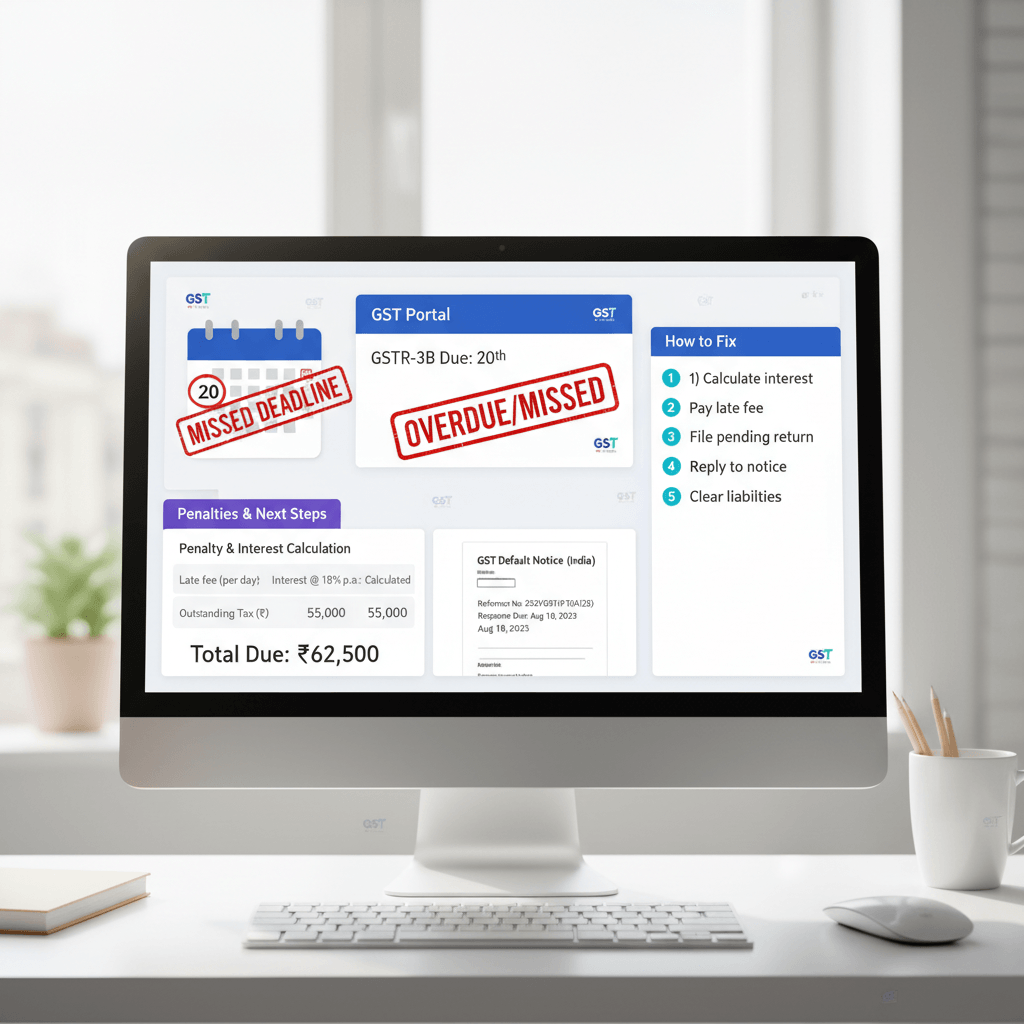
Missed a missed GST deadline India penalty? Take a breath. Late fees start the day after the due date, interest accrues on unpaid tax, and notices may follow, but prompt action keeps costs contained. This guide explains the penalty for late GST filing India, the GST late fee India, interest math, notices, and a precise catch up plan so you know exactly what to do next.
Pro tip: File the oldest pending return first, credit your cash ledger before filing to stop interest, and never ignore a notice.
What counts as a missed GST deadline in India?
A missed deadline means filing or paying after the portal due date. Key returns include:
- GSTR-3B, monthly or QRMP, summary of liabilities and payment, monthly due on the 20th, 22nd, or 24th depending on state, quarterly under QRMP by the end of the month following the quarter.
- GSTR-1, outward supplies, monthly for large taxpayers by the 11th or 13th, quarterly for QRMP.
- GSTR-9 and GSTR-9C, annual return and reconciliation, usually due December 31st.
- Others, GSTR-7 for TDS, GSTR-8 for TCS, GSTR-4 and CMP-08 for composition dealers, ITC-04 for job work.
If you are under QRMP with turnover below ₹5 crores, you still need to make monthly payments via PMT-06. Any delay starts the late fee clock, payment delay adds interest.
Penalty vs late fee vs interest, plain English differences
- Penalty for late GST filing India: demand based fines under Sections 73 or 74 for errors or misstatements, can go up to 100% of tax or ₹10,000, whichever is higher.
- GST late fee India: fixed daily charge under Section 47 for filing late, even with nil tax, subject to caps per return.
- Interest: percentage on unpaid tax under Section 50, applies only if tax is due.
Late fee punishes delay in paperwork, interest punishes delay in money, penalty punishes incorrect reporting. Nil returns attract late fee at a lower rate, but no interest if no tax is due. For a deeper dive, see the Handbook on Interest, Late Fee, and Penalties Under GST.
GST late fee India, current framework and caps for FY 2024-25
Section 47 late fees vary by turnover slab and return type:
- GSTR-3B and GSTR-1
- Turnover below ₹1.5 crores, ₹50 CGST plus ₹50 SGST per day for normal returns, ₹20 CGST plus ₹20 SGST for nil returns, capped at ₹1,000 each for CGST and SGST per return.
- Turnover ₹1.5 to 5 crores, same daily rates, cap increases to ₹2,500 each for CGST and SGST.
- Turnover above ₹5 crores, same daily rates, cap up to ₹5,000 each for CGST and SGST. - GSTR-9 and GSTR-9C, ₹200 per day split between CGST and SGST, maximum ₹5,000 total.
- GSTR-4 and CMP-08 for composition dealers, ₹50 per day, capped at ₹500.
These apply per return. Miss three months of GSTR-3B, you accrue three separate late fees. Always verify the latest caps and rates on official notifications.
Interest on delayed tax payment, simple formula and quick examples
Standard interest is 18% per annum on net cash liability after ITC set off. For wrong ITC availment or reversal, 24% applies. A quick formula:
Interest = (Tax due minus minimum ECL balance during delay period) × rate × days ÷ 365
Example, tax due ₹50,000, minimum ECL balance ₹10,000, delay 20 days. Interest base ₹40,000, interest ₹40,000 × 0.18 × 20 ÷ 365 ≈ ₹396. With nil liability, only late fee applies, no interest. Try the online GST late fee and interest calculator for quick estimates.
GST default notice India, what it is and why ignoring is costly
Getting a GST notice is serious but manageable if you act fast.
- GSTR-3A under Section 46, non filing intimation, 15 days to file pending returns.
- ASMT-13 under Section 62, best judgment assessment for continued non compliance, 30 days to file and withdraw the assessment.
Ignoring notices can block e way bill generation after two consecutive missed returns, risk registration cancellation, block ITC, impact your buyers, and trigger recovery under Section 79. File and respond immediately.
Missed GST return India what to do, a step by step catch up guide
- Reconcile comprehensively, match sales, purchase, ITC, and RCM with books and e invoices.
- Compute late fee and interest, apply turnover based caps, and segregate interest payable via DRC-03.
- Pay first, credit your cash ledger and use DRC-03 for interest to stop further accrual.
- File oldest first, clear GSTR-3B before GSTR-1 where both are pending.
- Handle notices, reply through the portal or DRC-06, filing often withdraws best judgment orders.
- Verify restoration, ensure e way bill unblocked, offsets correct, and keep documentation for audit.
Sequence matters, paying and filing the oldest period first reduces compounding interest and clears systemic blocks faster.
Special cases and reliefs to know
- Nil returns, lower late fee of ₹20 to ₹40 per day, no interest since no tax due, file promptly to avoid notices.
- Composition dealers, GSTR-4 or CMP-08 late fee ₹50 per day, capped at ₹500.
- Amnesty schemes, occasional waivers reduce accumulated fees, keep an eye on portal notifications.
- QRMP taxpayers, pay monthly via PMT-06 interest free if paid on time, late fee applies to quarterly return filing delays.
Common reasons businesses miss deadlines, and the quick fixes
- Cash crunch, make part payments via PMT-06 to limit interest, file quickly.
- CA or staff bandwidth, set internal cutoffs three days before portal due dates with automated reminders.
- Portal glitches, keep a two day buffer, never wait for the last evening.
- Slow data from vendors, standardize monthly closings with hard data submission deadlines.
Prevention toolkit to never miss again
- Create a compliance calendar with reminders five days and two days before every deadline.
- Do weekly reconciliations, sales, ITC, and bank matching every Friday.
- Use dashboards with task ownership and escalations, measure before due dates, not after.
- Make GST compliance a board level KPI, treat it as a cost saver, not a cost center.
How Virtual Accounting helps you avoid penalties, permanently
Virtual Accounting delivers end to end compliance for SMEs on one dashboard, bookkeeping, GST, TDS, ITR, payroll. Live due date tracking, AI alerts, auto reconciliations, and direct CA chat mean fewer mistakes and faster fixes.
- Up to 200 monthly transactions, ₹4,000 per month, includes bookkeeping, GST filing, TDS, and payroll.
- Above 200 monthly transactions, ₹6,000 per month with enhanced bookkeeping and filings.
- Annual compliance, Private Limited at ₹5,000, ROC at ₹18,000, ITR at ₹2,500.
Onboarding in 24 hours, predictable billing, no blocked e way bills, no missed GST deadline India penalty. Explore accounting and bookkeeping services to lock in compliance.
Compliance references you can trust
- Official updates, visit the CBIC GST Portal regularly.
- Deep dive reading, the Handbook on Interest, Late Fee, and Penalties Under GST.
- Quick math, try a GST late fee and interest calculator for estimates.
Take action today
Missing a deadline is not fatal, letting it snowball is. The missed GST deadline India penalty framework rewards fast correction. Calculate your dues, pay through the cash ledger, file from oldest to newest, respond to notices, and install systems that prevent repeats. Prefer a done for you route, book a 15 minute demo of Virtual Accounting and see how automation keeps you penalty free.
FAQ
I missed GSTR-3B by a few days, what costs hit me first?
Late fee starts the day after the due date and is capped by your turnover slab per return, interest applies only if tax is due and accrues daily at 18% on net cash liability, pay into your cash ledger before filing to stop interest. If this feels tight, consider shifting monthly compliance to Virtual Accounting by AI Accountant so due date tracking is automated.
What is the exact difference between penalty, late fee, and interest in practice?
Penalty is a notice based fine for inaccuracies or suppression under Sections 73 or 74, late fee is a fixed per day charge for filing a return late even with nil liability, interest is a percentage on unpaid tax for the period of delay. Late fee and interest can both apply together, penalty is separate and typically follows an investigation or notice.
How do I quickly stop interest on overdue tax if I’m cash strapped?
Credit whatever you can into the cash ledger immediately, even partial payment reduces the interest base, then file in sequence starting with the oldest period, if cash flow is the constraint, use PMT-06 to make staggered payments while you finalize books. A managed plan via Virtual Accounting by AI Accountant can prioritize payments to minimize daily interest.
Can I file GSTR-1 if GSTR-3B is pending for the same period?
Yes, GSTR-1 filing is allowed, but if tax is due your interest keeps accruing until GSTR-3B and payment are completed, operationally, clear GSTR-3B first to align liability and ITC flows for you and your buyers.
What happens if I ignore a GSTR-3A or ASMT-13 notice?
Ignoring GSTR-3A can escalate to ASMT-13 best judgment within 30 days, non compliance can block e way bill generation, trigger registration cancellation, ITC blocking, and recovery actions under Section 79. File the pending returns and respond on the portal quickly to withdraw best judgment orders.
Are there caps on late fee for small businesses under ₹1.5 crores turnover?
Yes, for GSTR-3B and GSTR-1 late fees are charged per day but capped per return as per the small business slab, nil returns have reduced per day fees, confirm the latest caps on the portal before paying.
I had no sales and no purchases this month, do I still need to file?
Yes, file a nil return to avoid notices and keep your e way bill facility active, late fee is lower for nil returns, no interest applies since there is no tax due.
What is the best filing order if I missed multiple periods?
Reconcile all periods, compute late fees and interest, pay into the cash ledger, then file from the oldest pending return forward, clearing GSTR-3B first for each period before GSTR-1 to align liabilities.
Can late fees or interest be waived under amnesty?
Occasionally, amnesty schemes waive or cap accumulated late fees for specified periods, monitor official notifications and the portal, if a scheme opens, calculate your net savings and act before the window closes.
How does QRMP change my late fee and interest exposure?
Under QRMP, you file quarterly but must pay monthly via PMT-06, if you delay the quarterly return you incur late fee for that return, if you delay monthly payments you incur interest on unpaid tax for the delay days, set reminders around both monthly payment dates and quarterly filing dates.
Should I use DRC-03 for interest and voluntary payments?
Yes, DRC-03 is the recommended route for paying interest or making voluntary payments, it keeps audit trail clean and helps during best judgment withdrawal if applicable.
What’s the smartest way to ensure I never miss again?
Set a compliance calendar with two staggered reminders, reconcile weekly, and move to a dashboard based system that flags gaps early. If you want a turnkey solution, adopt Virtual Accounting by AI Accountant for automated reminders, reconciliations, and CA oversight so deadlines are consistently met.