-01%201.svg)
Key takeaways
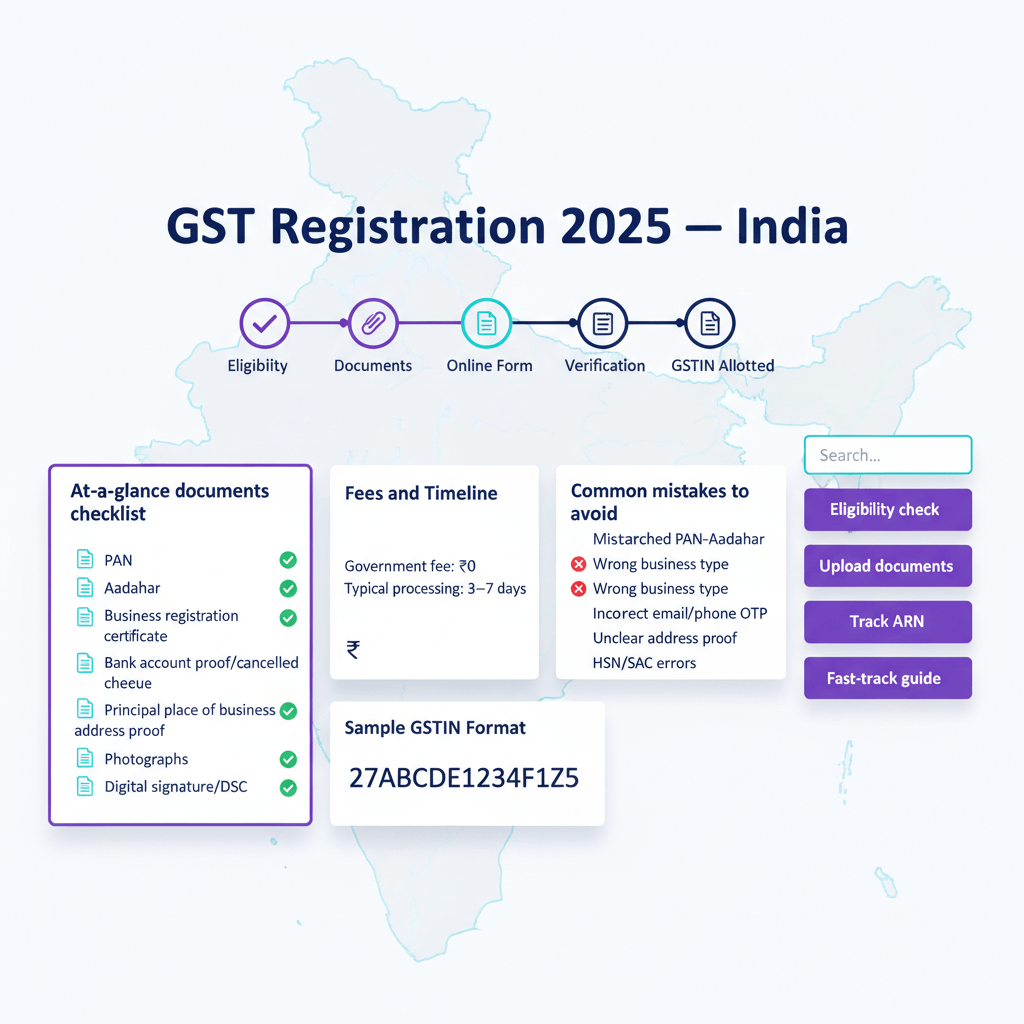
- GST registration is mandatory when turnover crosses the threshold, for goods it is ₹40 lakh in most states, for services it is ₹20 lakh, lower limits apply in special category states, inter-state sales and e-commerce require GST from day one.
- Choose the right type of registration, regular, composition, casual or non-resident, ISD, or TDS/TCS, understand switching rules before you commit.
- Keep documents ready by business type, use Aadhaar authentication to speed up approval, DSC or EVC works if Aadhaar is not feasible.
- The online process is simple, get TRN, complete Part B, verify, track with ARN, approvals typically take 3 to 7 working days.
- No government fee for registration, penalties for non-registration and late filing are significant, interest applies for delays.
- First 30 days after GSTIN matter, update invoices and portals, enable e-way bill, plan for e-invoicing above ₹5 crore, consider QRMP if eligible.
- Avoid common mistakes, name or state mismatches, skipping Aadhaar, choosing the wrong scheme, forgetting NIL returns.
- For help, consider Virtual Accounting by AI Accountant for end-to-end assistance and ongoing compliance.
GST Registration in India 2025, what founders and freelancers should know
Getting your GST registration done might look like a long climb, yet once you know the turns, it becomes a short, clear walk. Whether you are a startup founder, a D2C seller, or a freelancer scaling up, GST registration is your gateway to legal operations, input tax credits, and selling on marketplaces. The process is fully online, free, and usually done in 3 to 7 days.
Think of GST registration as your business passport, it lets you travel across states, sell on platforms, and claim credits that protect your margins.
Who needs GST registration, thresholds and must-register scenarios
The turnover thresholds depend on what you sell and where you operate. For most states, goods cross ₹40 lakh, services cross ₹20 lakh. In special category states, thresholds are lower, commonly ₹10 lakh for services and ₹20 lakh for goods, with Assam following ₹40 lakh for goods.
- Mandatory from day one if you sell across state lines, or sell on e-commerce like Amazon or Flipkart.
- Required for casual taxable persons, non-resident taxable persons, and cases under reverse charge.
- Voluntary registration is smart for B2B credibility and input tax credits, even if you are below limits.
- Separate registration is needed for each state where you have a fixed place of business.
Non-registration when required is costly, expect ₹10,000 or 100% of tax due, whichever is higher, plus 18% annual interest. Marketplaces can restrict your account, and your buyers cannot claim credits.
Types of GST registration, pick the right path
Regular taxpayer (normal scheme)
The default for most businesses, you charge applicable GST, claim full input tax credits, and file GSTR-1 and GSTR-3B. Ideal for inter-state operations and B2B invoicing.
Composition scheme
For small businesses within turnover limits, commonly up to ₹1.5 crore in most states, ₹75 lakh in special category states. You pay a flat rate on turnover, compliance is simpler with quarterly CMP-08 and annual GSTR-4, but you cannot make inter-state taxable supplies and you cannot claim input tax credits.
Casual and non-resident taxable persons
Temporary registration for exhibitions or short-term projects, typically valid for 3 to 6 months, with advance tax payment required.
ISD and TDS or TCS registration
Input Service Distributor is for allocating credits to branches, TDS or TCS registration applies to notified deductors and e-commerce operators.
Switching from composition to regular is allowed at the start of a financial year, switching back has stricter conditions, plan ahead.
Documents required, your practical checklist
Prepare your files before you start the application. Clear scans, consistent names, and matching proofs mean faster approvals.
Sole proprietorship
- PAN, Aadhaar for authentication
- Passport-size photograph
- Business address proof, rent agreement and NOC or utility bill
- Bank proof, cancelled cheque or first page of passbook
Partnership or LLP
- Firm PAN, partners’ PAN and Aadhaar
- Partnership deed or LLP agreement
- Authorization letter for authorized signatory
- Address and bank proofs
Company (Private Limited or OPC)
- Company PAN, Certificate of Incorporation
- MOA and AOA
- Board resolution authorizing signatory
- Directors’ PAN, Aadhaar, and photographs
- Registered address and bank proofs
Multiple locations require separate proofs per place of business, rent agreement, NOC from owner, and a utility bill. Aadhaar authentication via OTP or biometric accelerates approval, you can alternatively use DSC or EVC for signing. Non-residents can use a passport or foreign ID.
GST registration online, a step-by-step walkthrough
The process is straightforward when you know the sequence. Let us walk through it together.
- Go to the GST portal at gst.gov.in, open Services, Registration, then New Registration.
- Complete Part A with PAN and contact details, verify OTP on mobile and email to receive your TRN.
- Log in with TRN, complete Part B, add trade name, constitution, date of liability, HSN or SAC codes, principal and additional places, promoter or partner details, and bank account details.
- Upload documents, ensure names match PAN and proofs, unclear scans cause delays.
- Complete Aadhaar authentication for faster processing, otherwise use DSC or EVC.
- Submit and note your ARN, track status on the portal and respond to any queries within 7 days.
Once approved, you receive your 15 digit GSTIN. Download the GST certificate and store it safely.
Pro tip, skipping Aadhaar might save minutes now, but it can add days later, opt for Aadhaar authentication where possible.
Fees and timelines, what to really expect
Government fee for GST registration is zero. If you hire help, typical professional fees range from ₹500 to ₹2,000 depending on complexity.
Timelines vary, with Aadhaar authentication and clean documents, 3 to 7 working days is common, without Aadhaar or with physical verification, 15 to 30 days is possible. Casual taxable persons should apply at least 5 days before commencing business.
Officer reviews run in business hours, applications submitted on weekends queue for the next working day, expect minor delays during peak return periods.
After you get GSTIN, your first 30 days action plan
- Update invoices, quotations, and signage with your GSTIN, inform vendors, customers, and marketplaces.
- Enable e-way bills for consignments above ₹50,000, especially for inter-state movement.
- Assess e-invoicing, mandatory above ₹5 crore aggregate turnover, understand the IRP and IRN flow early.
- Evaluate QRMP if turnover is up to ₹1.5 crore, quarterly GSTR-1 with monthly tax payment balances effort and cash flow.
- Map HSN and SAC codes in your accounting, separate input tax credits, and set a compliance calendar for GSTR-1, GSTR-3B, and annual returns like GSTR-9.
Small habit, big payoff, file on time even when there are zero transactions, NIL returns prevent penalties and notices.
Common mistakes that derail applications and how to avoid them
- PAN and legal name mismatches, even tiny character differences can trigger rejection, match exactly with PAN records.
- Wrong state selection, register in the state of your fixed place of business, wrong state means cancellation and reapplication.
- Skipping Aadhaar authentication, slower scrutiny and potential physical verification add weeks.
- Choosing composition without understanding limits, it forbids inter-state taxable sales and blocks input credits, not suitable for most B2B businesses.
- Ignoring additional places of business, warehouses and branches must be declared upfront.
- Assuming no activity means no filing, NIL returns are mandatory, penalties apply otherwise.
Penalties and compliance risks, what non-compliance really costs
The penalty structure for GST non-compliance is designed to bite. Not registering when required can cost ₹10,000 or 100% of tax due, whichever is higher, plus 18% annual interest. Your buyers lose input credits, damaging relationships and future orders.
Late filing penalties accumulate quickly, GSTR-1 delays invite per day fees, GSTR-3B delays do the same, and interest applies to unpaid tax. Incorrect claims or under-reporting can lead to heavy penalties and even prosecution for significant evasion.
Minor amendments like email or mobile are instant, core changes like name or address need documents and approval, constitution changes often require a new registration. If you close or drop below thresholds, apply for cancellation within 30 days and clear pending dues.
Getting professional help, when to DIY and when to delegate
DIY works for straightforward cases, but professional help pays off for multi state registrations, complex structures, marketplace sales, or if you want a hands off setup.
- Virtual Accounting by AI Accountant, end to end GST registration, real time dashboard, dedicated CA support, e invoicing and filing setup included.
- Traditional CA firms, good for complex matters, may have limited tech enablement.
- Online platforms with expert assist, suitable for tech savvy founders who want guided DIY.
- Local consultants and freelancers, budget friendly, quality varies, check references.
Choose based on complexity, comfort with technology, and ongoing compliance needs, the cheapest option is not the most cost effective if it leads to penalties later.
FAQ
Do I need separate GST registration for every state where I have operations?
Yes, if you have a fixed place of business in more than one state, you must obtain separate GST registration for each state. For example, a warehousing unit in Maharashtra and a store in Karnataka requires two registrations under the same PAN.
Is the GST registration process actually free or are there hidden charges?
The government charges nothing for registration, it is fully free on the portal. You only pay if you hire a professional. If you want a done for you option, consider Virtual Accounting by AI Accountant for transparent pricing and tracking.
How fast can I realistically get my GSTIN if I submit everything today?
With Aadhaar authentication and clean documents, 3 to 7 working days is typical. If you skip Aadhaar or a physical verification is triggered, it can extend to 15 to 30 days. Respond quickly to any queries to avoid rejection.
I sell services from home, should I register voluntarily even if I am below ₹20 lakh?
Voluntary registration can help you claim input tax credits and appear compliant for B2B clients. If you raise tax invoices to GST registered customers, they often prefer vendors with GSTIN. Evaluate your client base and credit requirements before deciding.
We are launching pan India on marketplaces, do we need GST from day one?
Yes, e-commerce supplies require GST registration from day one, regardless of turnover. Marketplaces will ask for your GSTIN during onboarding and will not allow live listings without it.
What is the difference between regular and composition for a small D2C brand?
Regular registration allows input tax credits and inter-state sales, with standard return filing. Composition offers lower compliance but no credits and no inter-state taxable supplies. If you plan to sell across states or to businesses, regular is safer.
Is e-invoicing relevant if my turnover is under ₹5 crore today?
Not mandatory yet, but the threshold has reduced over time. Understanding how IRN generation works prepares you for growth and avoids last minute changes when you cross the limit.
What are the most common reasons GST applications get rejected?
Exact name mismatch with PAN records, incorrect state selection, unclear address proofs, and skipping Aadhaar authentication are top reasons. Double check that your legal name and PAN align perfectly and upload clear, current proofs.
How do I amend my registration if I add a warehouse or move offices?
Use the Amendment section on the portal to add additional places of business or update the principal place. Keep rent agreements, NOC, and a recent utility bill ready. Core field amendments require approval by the officer.
What happens if I miss filing NIL returns for a couple of months?
You will still be liable for late fees and may receive notices. File NIL returns on time to keep your compliance score clean. A compliance partner like Virtual Accounting by AI Accountant can automate these filings so you never miss deadlines.
Can I switch from composition to regular mid year if I start inter state sales?
Switching to regular is typically done from the start of the next financial year. If your supplies make you ineligible for composition, you must switch as per rules and begin charging tax under the regular scheme from the effective date. Plan your sales channels accordingly.
We are a startup with multiple founders, who should be the authorized signatory?
Choose a director or partner who can reliably handle OTPs, Aadhaar e KYC, and portal access. A board resolution or authorization letter will be required depending on your entity type. If you want to delegate fully, onboard a practitioner via Virtual Accounting by AI Accountant and authorize them appropriately.