-01%201.svg)
Key takeaways
- Accounting software integration connects your sales, banking, payroll, ecommerce, and tax systems to your ledger, enabling near real time finance and smoother GST and TDS compliance.
- Use native connectors first for cost and reliability, consider iPaaS for flexibility, reserve custom APIs and webhooks for scale, control, and complex logic.
- Clean master data, standard tax codes, and clear mappings are the foundation for stable syncs, fast closes, and audit ready trails.
- India specific flows, e invoicing, GSTR 1 and 3B, 2B matching, and TDS 26Q and 24Q depend on correct HSN or SAC, place of supply, reverse charge, and section level mapping.
- Set controls from day one, maker checker, immutable logs, and idempotency, to avoid duplicates, tax errors, and compliance risk.
- Track ROI with close time, manual journal count, sync success rates, reconciliation variance, and penalty avoidance, then iterate.
- A CA led managed service like AI Accountant blends integrations, monthly books, reconciliations, and filings with a live dashboard, giving founders and finance heads confidence and speed.
Introduction to accounting software integration
Accounting software integration links your source systems to your ledger and reporting layer so data flows on its own, not through manual entries. Sales, payouts, fees, payroll, and taxes move through defined pipelines into books and filings. Done right, your numbers are current every day, your team focuses on cash, customers, and growth, and audits get simpler.
Real time finance is not a tool, it is a design, clean data in, reliable syncs, clear exceptions, and disciplined reviews.
Founders and finance managers often feel tool sprawl, manual journals, delayed closes, and mismatched GST or TDS. Integration addresses this with a single source of truth and automated controls.
Useful overviews on software choices and integrations are available from Brex, K38 Consulting, and FuelFinance.
Foundations and connection options
How the flow fits together
Data moves from CRM, ecommerce, gateways, banks, and payroll into an integration layer, then into your ledger, then into MIS, analytics, and tax filings. You define mappings once, keep masters clean, monitor exceptions, and iterate.
Common connection methods
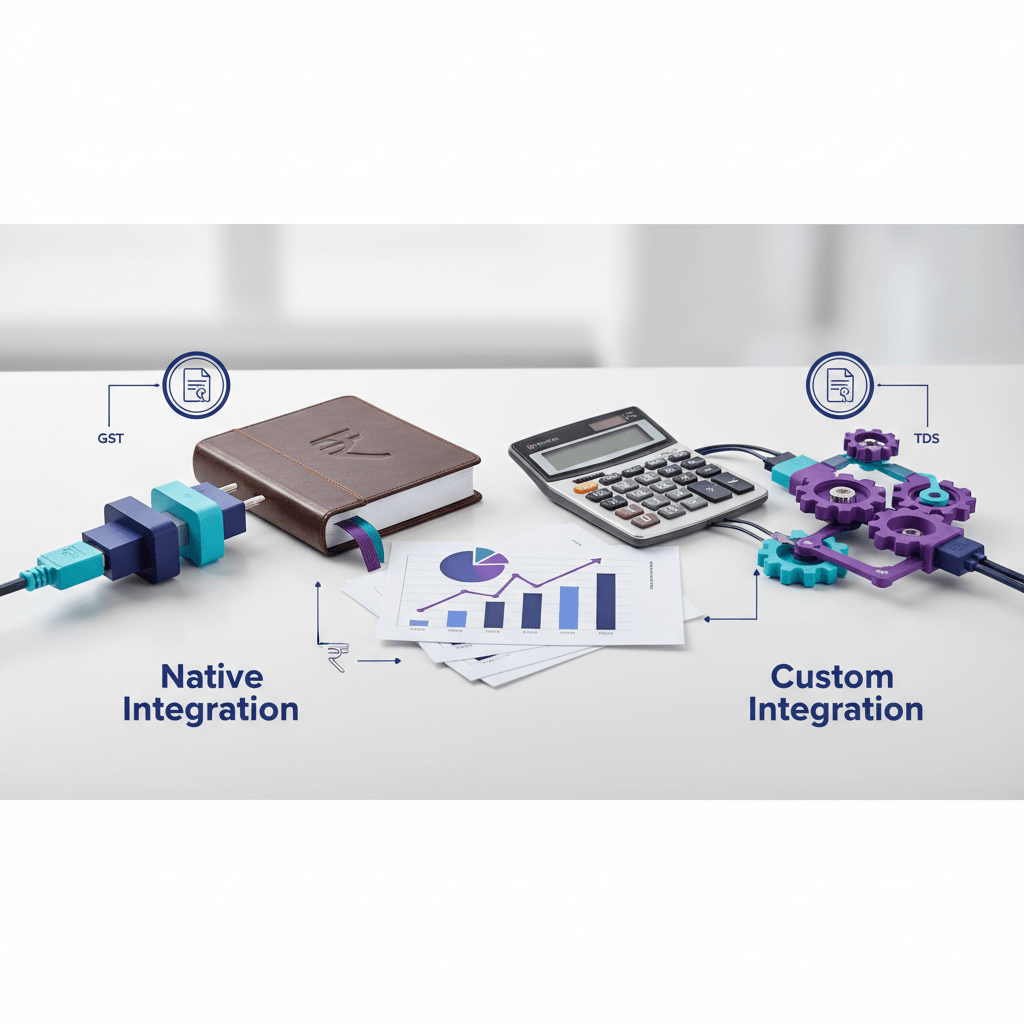
- Native connectors, quick to deploy, maintained by vendors, good for standard use cases, for example Shopify to QuickBooks or Zoho Books.
- iPaaS or no code automation, flexible without code, suits moderate volume or bespoke field mapping.
- Custom APIs and webhooks, real time, high control, better for scale, complex tax logic, and robust idempotency. RPA can bridge legacy systems with no APIs.
In a managed model like AI Accountant Virtual Accounting, integrations sit inside a larger service, the CA team builds mappings, validates GST and TDS, monitors exceptions, and keeps SLAs on sync health.
Why integration matters for Indian startups and SMBs
- One source of truth, every sale, fee, and tax appears once in the ledger, with clear provenance, reducing double counts and manual slips.
- Faster closes, P and L, cash flow, burn, and runway are visible any day, enabling proactive decisions.
- Smoother compliance, GSTR 1 and 3B and e invoicing draw from clean ledgers, TDS returns pull right sections and challans, penalties drop.
- Scales with growth, volume increases do not break your month end or audits, because audit trails and validations are built in.
- Clear ROI, high auto reconciliation rates for bank and gateways, fewer manual journals, and better decision making with current data. Guides from FinOptimal and Mercury offer helpful benchmarks.
Core integration patterns, India focused examples
Sales and e invoicing
Pull orders from Shopify or WooCommerce into the ledger with HSN or SAC, place of supply, and e invoice flags so GSTR 1 needs minimal edits. Validate GSTIN format and customer state codes before posting.
Payment gateways and settlements
Ingest payouts, fees, and GST on charges from gateways like Razorpay, PayU, or Cashfree, attach settlement IDs end to end, and split fees and taxes into proper accounts. See the explainer on payment gateway accounting here, AI Accountant payment gateway integration.
Bank feeds and reconciliation
Daily bank feeds with rules for recurring items, exception queues for unknowns, and variance thresholds enable rapid reconciliation. Deep dive here, AI Accountant bank reconciliation.
Payroll and TDS
Post monthly salaries, deductions, and TDS liabilities to keep 24Q and books aligned, minimizing month end scramble.
Inventory and COGS
Sync stock movements from POS or WMS to update COGS, credit notes, and write offs, keeping margins accurate.
GST and input tax credit
Outward supplies flow to GSTR 1, inward supplies match with 2B for ITC, and exceptions surface for missing or mismatched vendors. TDS mappings push to 26Q or 24Q with correct sections. For small companies, year end financials map to AOC 4 and MGT 7.
For broader perspectives, see ProfitBooks and Afino.
Choosing your accounting stack, and approach
- Platform criteria, robust APIs, webhooks, idempotency, GST features like HSN, reverse charge, place of supply, multi entity and multi currency if relevant.
- Connector first, native or supported integrations usually mean lower cost and fewer maintenance surprises, custom builds only for unique logic.
- Fit for MIS, ensure projects or cost centers flow end to end, from source to reports.
- Change management, roles, runbooks, documentation, and exception handling training smooth adoption.
Common, integration friendly choices include AI Accountant, QuickBooks Online, Zoho Books, Tally, Xero, and FreshBooks. Comparison notes from Brex, K38 Consulting, and Mercury can help you shortlist.
Implementation framework, step by step
- Discovery, inventory systems touching finance, map GST, TDS, and tax calendars, assign data owners and approvers.
- Data hygiene, standard chart of accounts, GST and TDS codes, clean HSN or SAC, master data sanity for customers, vendors, and SKUs.
- Design, detailed field mappings, error handling, retry with backoff, deduplication rules, idempotency keys.
- Build, establish API or OAuth credentials, AI Accountant API basics, use webhooks for real time, batch with checkpoints for volume, version endpoints, log every sync.
- Test, UAT with edge cases, reverse charge, export with LUT, multi currency, rounding, bank rec checklists, GSTR 1 and 2B matching.
- Go live and monitor, runbooks, alerts for sync failures, latency and success rate tracking, daily then weekly exception reviews, SLAs for owners.
Tip, start with one or two high volume flows, bank and gateway, prove auto reconciliation above ninety percent, then expand.
Controls, compliance, and audit readiness
- GST controls, enforce place of supply, HSN or SAC, reverse charge logic, link e invoice IRN to ledger invoices, keep tax masters updated.
- TDS controls, section wise mappings, PAN checks, challan linking for 26Q, 24Q, and 27Q, rate validations to prevent short deductions.
- Governance, maker checker on key changes, immutable logs on syncs and edits, retention policies, and periodic health checks aligned to filing calendars.
Security and privacy essentials
- Use OAuth 2, rotate tokens, least privilege for apps and users, and enforce multi factor sign in.
- Encrypt in transit and at rest, use IP allowlists for sensitive endpoints, maintain vendor SLAs, and monitor uptime and incidents.
- Run periodic access reviews and maintain a break glass procedure with auditable approvals.
Security checklists from FuelFinance and Mercury provide useful context.
Common pitfalls, and how to avoid them
- Duplicates, always use idempotency keys or checksums, store external IDs for orders and invoices.
- Tax errors, validations on HSN, place of supply, reverse charge, and GSTIN format, escalate edge cases for CA review until stable.
- Gateway mismatches, carry settlement IDs end to end, split fees and GST correctly, set variance thresholds for auto rec.
- Entity leakage, segregate API keys, tag entities across flows, keep data walls simple and strict.
- API drift, pin to versions, keep staging, test before rollout, document fallbacks for temporary manual flows.
Practical mini case examples
D2C brand
A D2C brand runs Shopify and Razorpay, syncs to Zoho Books, posts HSN and place of supply on orders, sets e invoice flags where applicable, and syncs gateway fees and GST daily. Auto reconciliation touches ninety eight percent of payouts, GSTR 1 needs minimal edits, and the close drops from ten days to three.
Services startup
A services company links CRM, payroll, and TDS to QuickBooks or Tally, maps sections to 26Q accurately, keeps ledgers clean with fewer manual fixes, and achieves on time TDS returns with clean audit notes.
Metrics and ROI tracking
- Close time from month end to final MIS.
- Manual journal entries per month.
- Sync success rates for sales, gateways, banks, payroll.
- Reconciliation variance thresholds and exceptions.
- Tax error rates and penalties avoided.
- Data latency from event to ledger post.
- Audit adjustments after review.
Review monthly, celebrate gains, and prioritize fixes, a cadence recommended by FuelFinance.
How AI Accountant Virtual Accounting helps
AI Accountant delivers a CA led managed service with a central dashboard, combining expert execution with system visibility. You see revenue, expenses, P and L, bank analysis, cash flow trends, burn, runway, and compliance status for GST, TDS, income tax, and ROC. AI driven insights and alerts flag exceptions early.
The team handles monthly bookkeeping, ledgers, year end closing, fixed assets, inventory, receivables and payables, bank and gateway reconciliations, GST registrations and filings, e invoicing setup, GST health checks, TDS challans and 26Q or 24Q or 27Q, advance tax, and tax audit preparation without certification. Payroll TDS and salary structuring advice are included. For small companies, ROC filings like MGT 7 and AOC 4 are covered.
On integrations, the team builds mappings, connectors, and reconciliations across Tally, Zoho Books, QuickBooks, Razorpay, Shopify, and banks. The dashboard centralizes documents and conversations so you do not chase threads, with runbooks and alerts for smooth handovers. Learn more at AI Accountant or see background from Digits and ProfitBooks.
Readiness checklist
- [ ] Clean chart of accounts and tax codes, HSN and SAC standardized.
- [ ] Master data sanity for customers, vendors, and SKUs.
- [ ] APIs and credentials confirmed and secure.
- [ ] Reconciliation rules and exception owners defined.
- [ ] Compliance calendar baked into workflows.
- [ ] Security and access governance in place.
Conclusion and next steps
A well built integration gives real time finance, faster closes, and smooth GST and TDS. With clean data, clear mappings, and disciplined monitoring, the numbers stay trustworthy, compliance stays steady, and leadership gets the visibility to act with confidence.
If you want a partner to plan and run it, consider AI Accountant Virtual Accounting, a CA led service that handles the build, the books, and the filings, with a dashboard that shows everything in one place. Book a demo or request a free integration health check.
FAQ
What does end to end accounting integration look like for a funded startup in India?
It typically links ecommerce or CRM to invoicing with HSN or SAC and place of supply, connects gateways and banks for daily reconciliation, posts payroll and TDS liabilities monthly, and feeds GST and TDS filings directly from the ledger. A managed setup like AI Accountant layers CA review, automated validations, and an exceptions queue to keep sync health above ninety five percent.
How quickly can we reach real time GST and TDS compliance after implementation?
For a focused scope, sales, gateways, and bank rec can stabilize within four to six weeks, with GSTR 1 and 3B drawing from the ledger by the first filing cycle, and TDS 26Q or 24Q aligned by the second cycle. Complex multi entity setups can take longer, but aggressive parallel UAT plus clean masters compress timelines.
Which ledger is better for multi entity operations across India, and possibly overseas?
Choose a ledger that supports entity tags, separate books per entity, intercompany entries, and multi currency if required. Zoho Books, QuickBooks, and Xero are common picks, Tally remains strong for tax and audit familiarity. AI Accountant helps evaluate trade offs, reporting needs, and connector availability before you decide.
Can we keep Tally and still get modern integrations?
Yes, through bridge connectors, iPaaS, or API enabled middle layers that push clean vouchers into Tally. You will still need idempotency keys, external IDs, and reconciliation rules. AI Accountant frequently runs hybrid stacks, Tally for statutory comfort, cloud tools for automation and dashboards.
How do we reconcile Razorpay or PayU or Cashfree, Shopify, and the bank at scale?
Carry unique settlement IDs from gateway reports into the ledger, split fees and GST on charges, and auto match bank credits against settlement batches. Use variance thresholds in paise, maintain a fees and tax mapping table, and review exceptions daily. AI Accountant targets ninety eight percent auto rec on mature flows.
What GST validations should be automated before filing?
Validate GSTIN format and status, place of supply versus customer state, HSN or SAC presence, reverse charge flags, e invoice eligibility and IRN link, tax rate conformity, and rounding rules. Add a pre filing checklist that reconciles GSTR 1 to the sales register and 2B to purchase registers for ITC.
How do TDS sections map in practice, for example 194J versus 194C?
Maintain a vendor and expense category matrix that maps to sections and rates, for professional fees 194J, for contracts 194C, and enforce PAN checks. The ledger should carry section tags per voucher, while challans and returns pull directly from tagged entries. AI Accountant templates include common vendor and section mappings to reduce setup time.
How do auditors get evidence, without slowing the close?
Provide read only access to the document repository, immutable sync logs, and maker checker approvals. Auto generated audit trails for each voucher, with source event IDs and timestamps, speed testing. AI Accountant packages a period bound audit kit, trial balance tie outs, GST and TDS ledgers, and reconciliation reports.
What ROI should a CFO expect, and how is it measured?
Most teams see close times drop by fifty percent or more, manual journals reduce by thirty to sixty percent, and auto reconciliation above ninety percent for banks and gateways within two to three cycles. Track close time, journal count, sync success, rec variance, tax penalties avoided, and audit adjustments. AI Accountant reports these monthly in the dashboard.
Who owns upkeep when APIs change, and what SLA is reasonable?
With AI Accountant, the managed team monitors vendor changelogs, pins versions, tests in staging, and deploys with runbooks. A typical SLA is one to three business days for non breaking changes, same day for critical sync failures, with temporary manual fallbacks documented.
Is Excel acceptable early on, and how do we harden later?
Yes, CSV imports and controlled templates can bridge early gaps, provided you enforce validation rules and audit trails. Over time, move to APIs and webhooks, add idempotency keys, and restrict manual uploads to exception only. AI Accountant transitions teams from CSV to API in phases, reducing risk while maintaining momentum.
How does AI Accountant differ from hiring an in house accountant plus a tool stack?
AI Accountant combines CA led execution, integrations, and a live dashboard in one service, so you get books, reconciliations, and filings with monitored pipelines and SLAs. In house teams often juggle multiple vendors without a single accountability line. The managed model accelerates implementation, reduces context switching, and standardizes controls from day one.