-01%201.svg)
Key takeaways
- Bank reconciliation software gives Indian SMEs and startups clean, real time cash visibility across banks, UPI, gateways, and marketplaces.
- Automation normalizes data, applies matching rules, manages exceptions, and preserves audit trails, so your bank and books stay in sync.
- Measure impact with auto match rate, exception aging, cycle time, and reduced write offs, then iterate rules weekly.
- Choose tools that cover Indian banks, Razorpay, PayU, Amazon, and Flipkart, support FX, and integrate with Tally, Zoho Books, QuickBooks, Xero, and NetSuite.
- Go live with a practical roadmap, start strict, pilot with real data, and enforce maker checker with period locks.
- Decide build versus buy versus outsource, for many, a CA managed model like AI Accountant delivers outcomes with less overhead.
- AI Accountant combines Virtual Accounting, CA oversight, and an operations dashboard, so you get daily reconciliations and audit ready logs without running the tool yourself.
Introduction, why this guide matters
If you move money through banks, UPI, payment gateways, or marketplaces, you need bank reconciliation software. It is the quiet engine that keeps your cash accurate. It matches your bank statement to your books, flags errors early, and gives you real time cash visibility. For a quick primer on statement level diagnostics, see bank statement analysis here: https://www.aiaccountant.com/blog/bank-statement-analysis-accounting. For Indian SMEs and startups juggling multiple accounts, Razorpay or PayU, Amazon or Flipkart, and even foreign currency, this tool can be a lifesaver. AI Accountant works with founders and finance teams every day, so this guide is simple, direct, and built for busy operators.
Bottom line, daily reconciliations de risk close, expose fraud early, and make GST, TDS, and tax audit smoother.
Further reading: https://www.floqast.com/blog/bank-reconciliation-software, https://www.equilityhq.com/blog/modern-bank-reconciliation-software-features-benefits, https://ramp.com/blog/automated-bank-reconciliation
What is bank reconciliation software
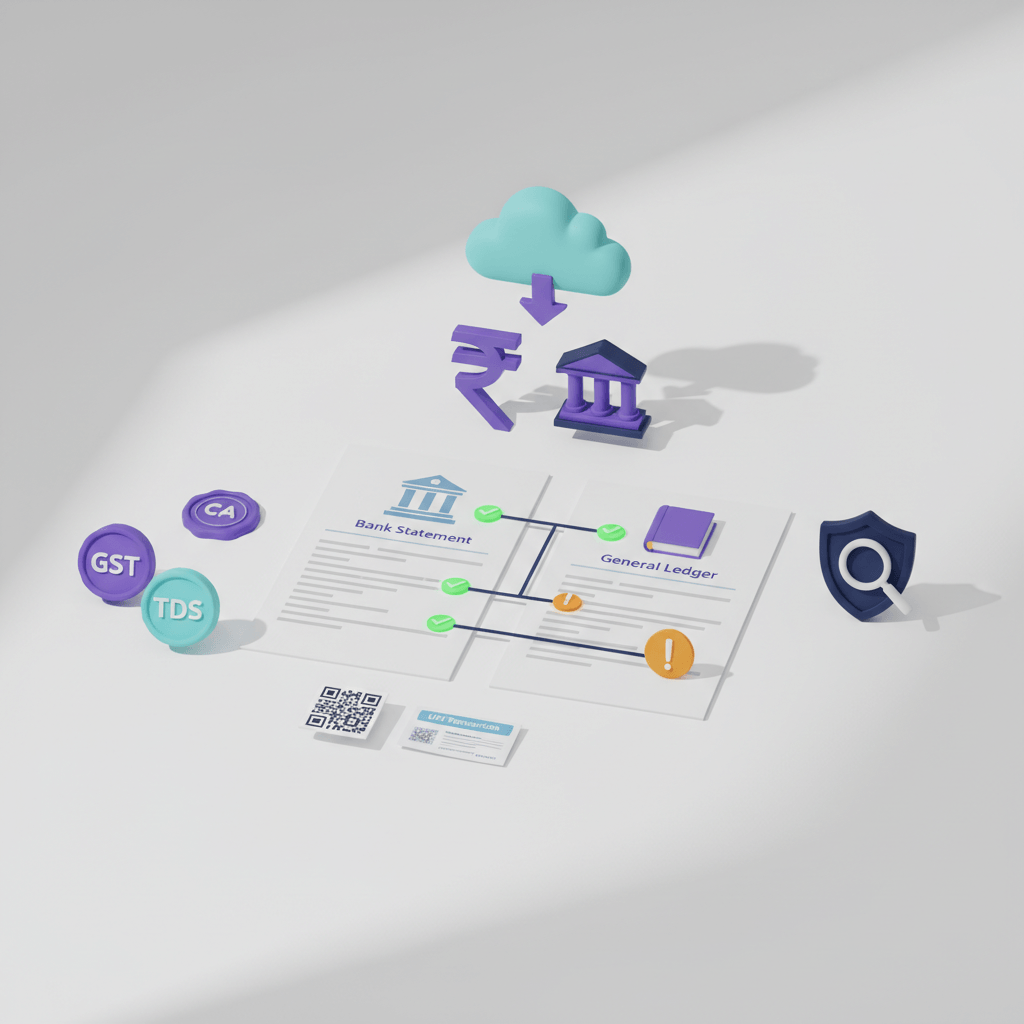
Bank reconciliation software automates the matching of bank transactions with your general ledger entries, keeping cash accurate and verified. A quick overview of automated reconciliation services in India is here: https://www.aiaccountant.com/blog/automated-reconciliation-services-india. The software connects to your bank feeds or takes uploads, normalizes data, applies matching rules, queues unmatched items, then locks results and preserves an audit trail, so your bank and your books stay in sync.
Core components
- Bank data ingestion. Pull via direct feeds, Open Banking, or upload CSV, MT940, or PDF extracts.
- Matching engine. Use exact and partial matches, support one to many and many to one, catch duplicates and timing gaps.
- Rules and AI assistance. Configure tolerances and fee templates, let AI learn vendors and narrations.
- Exceptions workflow. Route unmatched items, add notes and attachments, set due dates, track aging.
- Reporting and controls. Reconciliation status, logs, approvals, and period locks.
It sits between banks and your ledger, more reliable than manual spreadsheets, and often smarter than basic matching inside entry level accounting modules.
Useful primers: https://www.kosh.ai/blog/what-is-reconciliation-software-benefits-use-cases-and-best-tools, https://www.mysoftwaresolutions.com/news/what-is-bank-reconciliation-and-how-software-tools-can-help
Why bank reconciliation matters for accuracy and cash visibility
Cash is king. Without clean reconciliations, cash numbers drift, errors creep in, and fraud can hide in plain sight. With software, you get real time visibility, you see burn and runway with confidence, you close faster because matching happens daily, and you make tax work easier, since clean cash schedules support GST and TDS filings and prepare you for tax audit.
India specific reality, UPI spikes small payments, gateways create fees and net settlements, and FX adds exchange differences. Good software handles this complexity and reduces manual tracing.
Benefits at a glance
- Higher accuracy, fewer human errors
- Faster close, less month end stress
- Earlier fraud and error detection
- Better compliance and audit readiness
References: https://www.floqast.com/blog/bank-reconciliation-software, https://www.equilityhq.com/blog/modern-bank-reconciliation-software-features-benefits, https://www.mysoftwaresolutions.com/news/what-is-bank-reconciliation-and-how-software-tools-can-help
How bank reconciliation software works, step by step
Think of it like a pipeline that runs each day.
- Data capture. Connect to banks through approved feeds or Open Banking, or upload CSV, MT940, or PDF. Pull gateway exports from Razorpay, PayU, Cashfree, Stripe, and wallets. Learn more: https://www.aiaccountant.com/blog/payment-gateway-integration-for-accounting.
- Normalization and enrichment. Parse narrations and payees, tag UTRs and virtual accounts, apply exchange rates, split bank charges and gateway fees.
- Matching logic. Try exact first, then partial or fuzzy with tolerances, support splits and merges, detect duplicates and timing differences.
- Rules engine and AI assistance. Configure recurring rules, let AI pattern recognition improve match rates and auto split net settlements.
- Exceptions handling. Unmatched items flow to a queue, assign owners, add notes and evidence, track aging and SLAs.
- Posting and controls. Post entries or mark reconciled, enforce maker checker, lock periods, preserve immutable logs.
Additional reads: https://www.equilityhq.com/blog/modern-bank-reconciliation-software-features-benefits, https://ramp.com/blog/automated-bank-reconciliation, https://www.paystand.com/blog/bank-reconciliation-automation, https://www.mysoftwaresolutions.com/news/what-is-bank-reconciliation-and-how-software-tools-can-help
Benefits you can measure
Time savings. Automation matches most items, your team reviews exceptions, daily runs reduce month end spikes, hours are saved each week, close speed improves.
Higher accuracy. Consistent rules reduce mispostings and write offs, fewer manual touch points means fewer mistakes.
Real time cash visibility. With daily reconciliations, you see true balances, you track burn, runway, and collections in near real time, cash forecasting improves.
Fraud and error detection. The system flags odd patterns early, like duplicate charges or unknown vendors, controls get stronger.
Audit readiness and compliance. Logs, evidence, approvals, and exportable schedules support GST, TDS, and tax audit, back and forth with auditors reduces.
Scalability. High volumes from UPI, wallets, and gateways are handled, FX and fees are supported, the process stays stable as you grow.
Benchmarks and ideas: https://www.floqast.com/blog/bank-reconciliation-software, https://www.paystand.com/blog/bank-reconciliation-automation, https://ramp.com/blog/automated-bank-reconciliation, https://www.equilityhq.com/blog/modern-bank-reconciliation-software-features-benefits, https://www.netsuite.com/portal/resource/articles/accounting/automated-reconciliation.shtml
Must have features to evaluate in bank reconciliation tools
Bank connectivity
- Coverage of major Indian banks, current and overdraft accounts
- Reliable feeds with CSV fallback when feeds are down
- UPI and wallet transaction support
Gateway and marketplace coverage
- Razorpay, PayU, Cashfree, Stripe, Paytm
- Amazon, Flipkart, and Shopify payout files
- Parsing of net settlements, chargebacks, refunds
Multi entity and multi currency
- FX revaluation support
- GST logic for bank fees and gateway charges
- Separate books for subsidiaries or branches with consolidation
Matching sophistication
- Exact, partial, and fuzzy matches with clear tolerances
- Splits and merges for many to one and one to many
- Rule priority and duplicate detection
- Templates for recurring fees or payouts
Exceptions management
- Workflows with owners, SLAs, and due dates
- Notes and attachments for traceability
- Aging reports and dashboards for breaks
Integrations
- Tally, Zoho Books, QuickBooks, Xero, and NetSuite
- Post entries or mark reconciled in the ERP
- APIs or flat file options when needed
Security and compliance
- Role based access and single sign on
- Encryption at rest and in transit
- SOC 2 or ISO 27001 certifications
- Data residency options
Reporting and analytics
- Unmatched aging, variance analysis, and status
- Cash insights and drill downs
- Audit logs and exportable evidence
Ease of use and pricing
- Simple interface and clear templates
- Sandbox to test rules
- Pricing aligned to volume and accounts
Test with your real data, include net settlements with fees, splits of large deposits, and foreign currency charges, check auto match rate and how fast exceptions clear. Deep dives: https://www.equilityhq.com/blog/modern-bank-reconciliation-software-features-benefits, https://ramp.com/blog/automated-bank-reconciliation, https://www.kosh.ai/blog/what-is-reconciliation-software-benefits-use-cases-and-best-tools
Industry specific considerations for reconciliation
Ecommerce
- Cash on delivery, returns, refunds, chargebacks
- Marketplace fees, holds, rolling reserves from Amazon and Flipkart
- Daily net settlements with multiple fees and taxes
SaaS and subscriptions
- Proration, discounts, trial conversions
- Failed retries and delayed payouts from gateways
- Timing gaps between invoices, collections, payouts
Services and consulting
- Retainers, milestones, advances
- TDS on receipts and split settlements
- Project level reconciliation views
NGOs and non profits
- Donor fund tracking and restricted funds
- Multiple collection channels and grant reporting
Retail and offline sales
- POS settlements from many acquirers and wallets
- Wallet cashback and promotions
- Daily cash deposits and shortage or overage handling
Context: https://ramp.com/blog/automated-bank-reconciliation, https://www.equilityhq.com/blog/modern-bank-reconciliation-software-features-benefits, https://www.touchnet.com/trends/blog/2022/11/15/7-benefits-of-reconciliation-software
Implementation roadmap for bank reconciliation software
- Assess pain points and define KPIs. Targets for auto match percent and cycle time.
- Clean data. Map all bank accounts, standardize narrations, clean masters, fix duplicates.
- Connect feeds and gateways. Set up feeds, import history, connect marketplaces, pull months of data.
- Configure rules and tolerances. Vendors, customers, payouts, fees, and GST on bank charges.
- Pilot one or two accounts. Pick a high volume and a simple account, tune rules.
- Train the team and set controls. Maker checker, locks, owners for exceptions.
- Go live and iterate. Weekly reviews, add rules as patterns emerge, track KPIs.
References: https://www.equilityhq.com/blog/modern-bank-reconciliation-software-features-benefits, https://ramp.com/blog/automated-bank-reconciliation
KPIs and ROI tracking for reconciliation success
- Reconciliation cycle time in days, move from monthly to daily
- Auto matched percentage, target steady rise as rules improve
- Exception rate and aging, clear old breaks first
- Cash accuracy, fewer surprises and adjustments
- Fraud or error flags caught early
- Write offs reduced over time
- Hours saved per month and payback period
- Coverage of gateway fees and refunds inside reconciliations
Set up a simple dashboard, show unmatched aging, auto match percent, and cycle time trend, then review weekly with the finance lead. More ideas: https://www.equilityhq.com/blog/modern-bank-reconciliation-software-features-benefits, https://www.kosh.ai/blog/what-is-reconciliation-software-benefits-use-cases-and-best-tools, https://www.mysoftwaresolutions.com/news/what-is-bank-reconciliation-and-how-software-tools-can-help
Common pitfalls and how to avoid them
- Loose rules causing false matches, start strict, test on real data, tighten approvals
- Ignoring gateways and wallets, cover banks plus gateways and marketplaces
- Mishandling foreign currency, use auto revaluation and clear FX variance rules
- Dirty vendor and customer masters, clean and standardize before launch
- No approvals or locks, enforce maker checker and period locks
- Poor change management, assign an owner, train users, set SLAs for exceptions
Good reads: https://www.equilityhq.com/blog/modern-bank-reconciliation-software-features-benefits, https://ramp.com/blog/automated-bank-reconciliation
Security controls and audit readiness
Choose software with strong controls, role segregation, maker checker approvals, and immutable logs. Attachments on exceptions add traceability, period locks protect closed books, and you pass Indian tax audits that expect cash and bank schedules, matched statements, exception logs, and approval evidence.
Ask vendors about SOC 2 or ISO 27001, confirm encryption and access control, and avoid risky screen scraping for bank data, use certified, secure feeds. More here: https://www.equilityhq.com/blog/modern-bank-reconciliation-software-features-benefits, https://www.netsuite.com/portal/resource/articles/accounting/automated-reconciliation.shtml
Build versus buy versus outsource
Build your own
- Pros, full control and perfect fit
- Cons, high setup and maintenance, needs developers, formats change
Buy software
- Pros, fast automation, proven scale, vendor support
- Cons, licensing cost and a learning curve, still need governance
Outsource the process
- Pros, a CA led team runs reconciliations end to end, covers banks, gateways, GST, TDS, income tax, and ROC
- Cons, less hands on control, need clear SLAs and reporting
For most SMEs and startups, outsourcing or buying is practical, you focus on operations while securing reliable cash control. References: https://www.equilityhq.com/blog/modern-bank-reconciliation-software-features-benefits, https://ramp.com/blog/automated-bank-reconciliation
How AI Accountant helps with bank reconciliation and compliance
AI Accountant offers Virtual Accounting as a managed service, a dedicated CA team handles accounting and compliance end to end, including monthly bookkeeping, bank and payment gateway reconciliations, ledger cleanup, and year end close. The AI Accountant dashboard shows bank statement analysis, recent transactions, cash flow trends, and reconciliation status with AI insights, you get continuous visibility without running the tool yourself.
What this means for you
- Daily or weekly reconciliations across UPI, Razorpay, PayU, Cashfree, Stripe, Amazon, Flipkart, and Shopify
- Maker checker approvals and audit ready logs
- Cash and bank schedules ready for GST, TDS, and tax audit support
- Integration with Tally, Zoho Books, QuickBooks, Xero, or NetSuite
- Full compliance on GST filings, TDS returns, income tax returns, and ROC for small companies
- MIS and management reporting to track burn and runway
More context: https://www.equilityhq.com/blog/modern-bank-reconciliation-software-features-benefits
Vendor landscape snapshot and tool recommendations
Shortlist based on your stack, your bank and gateway coverage, and your industry flows, then test on real data.
Suggested tools to evaluate
- AI Accountant, https://aiaccountant.com
- QuickBooks Online
- Xero
- Zoho Books
- Tally with add ons
- NetSuite
- FreshBooks
- SAP Business One add ons
Notes, native modules in Zoho Books, QuickBooks, Xero, and Tally add ons work well for simpler flows and lower volumes, mid market stacks often pair NetSuite or SAP Business One with dedicated reconciliation add ons, India focused tools exist for Razorpay, PayU, Paytm, Amazon, and Flipkart, ensure these are supported as standard. Landscape read: https://ramp.com/blog/automated-bank-reconciliation
Practical tips to get more from your reconciliation process
- Create a rule library, review monthly, retire low value rules, add new ones as patterns emerge
- Set SLAs for exceptions, clear all breaks older than seven days first
- Use RPA ideas, auto attach gateway fee files to exceptions
- Sync with collections, use recon insights to target overdue invoices or payout holds
- Tie to cash forecasting, use daily reconciled balances for short term plans
- Document your SOP with screenshots, onboard new teammates quickly
More tips: https://www.equilityhq.com/blog/modern-bank-reconciliation-software-features-benefits, https://www.kosh.ai/blog/what-is-reconciliation-software-benefits-use-cases-and-best-tools
A simple mental model for reconciliation
Feed, normalize, match, exceptions, approve, post. Your goal is a smooth flow with minimal friction, rules push more items through matching, governance keeps approvals tight, ownership empties the exceptions queue fast, dashboards reveal bottlenecks you can fix.
Helpful reads: https://ramp.com/blog/automated-bank-reconciliation, https://www.mysoftwaresolutions.com/news/what-is-bank-reconciliation-and-how-software-tools-can-help
Closing thoughts and next steps
Bank reconciliation software gives you accuracy, speed, and peace of mind. For Indian SMEs and startups, it reduces the mess of UPI, gateways, and marketplaces into a simple, reliable process. Whether you buy a tool, or outsource to a CA led team like AI Accountant, the key is to move from monthly to daily, from manual to automated, and from best effort to audit ready.
If you want results without tool overhead, AI Accountant can run reconciliations, show live status on the dashboard, and handle GST, TDS, income tax, and ROC while you focus on growth. If you prefer in house control, use the feature checklist here, test on your own data, and track KPIs from week one.
Additional reading: https://www.floqast.com/blog/bank-reconciliation-software, https://www.equilityhq.com/blog/modern-bank-reconciliation-software-features-benefits, https://ramp.com/blog/automated-bank-reconciliation
FAQ
How do CAs evaluate whether bank reconciliation should be in house or outsourced to a CA managed service
Start with volume, number of bank accounts and gateways, control requirements, and audit posture. If you need rapid time to value and strict controls, a CA managed model like AI Accountant delivers daily reconciliations, maker checker, and audit logs without you maintaining tooling, while in house works if you have a stable team, engineering support for integrations, and capacity to manage rules and exceptions.
What auto match rate should a finance head target during the first quarter of rollout
A practical target is 70 to 85 percent in month one, then 85 to 95 percent by end of quarter as rules mature. Include net settlements, fees, and FX cases in your training set, and track unmatched aging weekly to eliminate recurring breaks.
Can AI enabled Virtual Accounting like AI Accountant reconcile gateways end to end including fees, refunds, and chargebacks
Yes, the operating model ingests gateway files from Razorpay, PayU, Cashfree, Stripe, and marketplaces like Amazon and Flipkart, splits net settlements into gross, fees, GST on fees, refunds, and chargebacks, then matches payouts to orders or invoices, creating a clean trail for audit.
How do we configure tolerances without risking false positives during audit
Begin strict on amount and date, for example zero amount tolerance and plus or minus one day on dates, then selectively relax for known cases like weekend postings or FX card fees. Enforce maker checker on tolerance changes, and maintain a change log as part of your audit evidence.
What reconciliation evidence do Indian tax auditors usually request
Auditors expect matched bank statements, exception logs with notes and attachments, approval records, aging of unmatched items, and cash and bank schedules tying to the trial balance. A service like AI Accountant packages these in a standard audit binder to cut review time.
Can we keep Tally as the system of record while using an external reconciliation layer
Yes, many teams keep Tally, Zoho Books, QuickBooks, or Xero as the ledger, while the reconciliation layer posts journals or simply marks entries as reconciled. Ensure the tool supports flat file or API posting, and that period locks in the ledger prevent backdated edits.
How should founders treat UPI and wallet volumes that explode during promotions
Schedule daily feeds during campaigns, pre configure rules for common narrations and cashback, and allocate temporary reviewers for exceptions. Track auto match percent daily, and after the surge, harvest new rules that emerged to improve the baseline.
What is the recommended approach for foreign currency and FX revaluation in reconciliations
Normalize bank entries using the bank rate for realization, post FX variance to a dedicated account, and run month end revaluation for receivables and payables. The tool should match realized amounts while keeping a clear trail of FX gains or losses for audit.
How does AI improve reconciliation quality beyond rules based matching
AI learns vendor patterns, narrations, and settlement structures, boosting match rates on messy descriptions and recurring fees. For example, AI Accountant uses pattern recognition to auto tag net settlements and recurring bank charges, reducing manual touch points and exceptions.
What KPIs should a CFO review weekly to manage reconciliation health
Focus on auto match percent, exception count and aging buckets, cycle time from bank post to recon complete, duplicate detection alerts, and number of tolerance overrides. Add cash accuracy variances and write offs to track quality over time.
How long does a typical SME take to go live on a new reconciliation process
With clean masters and prepared bank files, a focused pilot can go live in two to four weeks, including connecting feeds, configuring core rules, and training reviewers. Full rollout across all accounts and gateways often completes in six to eight weeks with weekly iterations.
What is the ROI case for buy or outsource versus building an in house tool
When you include developer time, maintenance, bank and gateway format drift, and audit requirements, payback for buy or outsource typically lands within three to six months from hours saved, faster close, reduced write offs, and lower audit effort. AI Accountant adds CA oversight and standardized evidence, which further compresses audit time.
Can reconciliation insights feed cash forecasting and collections prioritization
Yes, daily reconciled balances inform short term cash plans, while exception reasons reveal stalled payouts or customer behaviors. Push these insights to collections to chase high impact invoices, and to treasury to schedule payouts with confidence.
How does maker checker work in a CA managed model like AI Accountant
Preparers clear matches and document exceptions with attachments, checkers review and approve reconciliations, and period locks prevent edits after close. Immutable logs record who did what and when, which satisfies governance and audit requirements.