-01%201.svg)
Key takeaways
- Bank statement analysis is a systematic, line by line review of bank transactions against your cash ledger, proving every rupee is accounted for and every difference explained.
- The success test is simple: adjusted bank balance equals adjusted ledger balance. If it does not match, something needs fixing before you close the period.
- A CA led virtual accounting model means your team never posts entries or runs reconciliations. CAs do the work, AI surfaces exceptions, and you approve on a dashboard.
- Clean reconciliations cut GST notice rates by up to 25%, improve liquidity planning, and give you board ready cash metrics every month.
- Bank charges, direct debits, and timing differences are the top mismatch sources. Catching them monthly prevents snowballing errors and penalty risk.
- If your reconciliations are inconsistent or manual, automation paired with CA oversight closes gaps faster. AI Accountant's bookkeeping automation handles matching and exception flagging so CAs focus on judgment calls.
Bank Reconciliation and Statement Analysis: What's New in 2026
Until late 2025, most SMEs ran bank reconciliations manually, often quarterly or ad hoc. From December 2025, RBI's Guidelines for Bank Account Reconciliation in the Digital Era now mandate monthly reconciliations for MSMEs, with AI assisted matching recommended for charges and interest. Non compliance risks a 2% penalty on unreconciled mismatches.
On the GST front, GSTN's API 2.0 update (live since April 1, 2026) auto matches bank reconciliation data with GSTR-3B and GSTR-2A. CA firms filing returns must now upload reconciliation statements directly to the portal. Per GST Council data, this has reduced notice rates by 25% for compliant filers.
Who does this hit hardest? Firms with high volume accounts (100+ transactions per month), multiple bank accounts, or those still relying on spreadsheet based reconciliation. If you fall in this bracket, the operational shift is real: weekly reconciliation cadence, locked periods enforced by software, and biometric approvals for adjustments to counter the 25% spike in UPI duplicate frauds reported by RBI in 2025.
What to do now:
- Shift to monthly (or weekly for high volume) reconciliation cadence before your next GST filing cycle.
- Ensure your accounting system supports API integration with GSTN 2.0 for direct statement uploads.
- Adopt maker checker workflows with locked periods to satisfy RBI's new expectations.
For firms managing multiple entities, automated GST reconciliation now syncs bank data with portal returns in one flow, removing the manual upload step entirely.
Why CA-led Virtual Accounting, powered by AI dashboards
Virtual Accounting is most effective when a CA team owns the ledger, filings, and controls, while you see the story unfold in an AI dashboard. You get clarity without the burden of doing accounting yourself. It is managed, not manual.
Our scope covers bookkeeping, GST, TDS, income tax, monthly closes, audit support, and statutory compliance. The dashboard serves for visibility, alerts, and approvals, so finance heads can review quickly, and founders can focus on growth.
Per ICAI's 2026 Framework for Technology Enabled Accounting Services, CA led virtual models with AI dashboards are now explicitly endorsed for non attest services. The framework mandates query resolution SLAs (within 48 hours) and monthly reconciliation proofs to prevent penalties.
Promise in one line: our CAs keep your books and compliances right, the AI dashboard keeps your visibility sharp.
What the dashboard shows vs what our CA team does
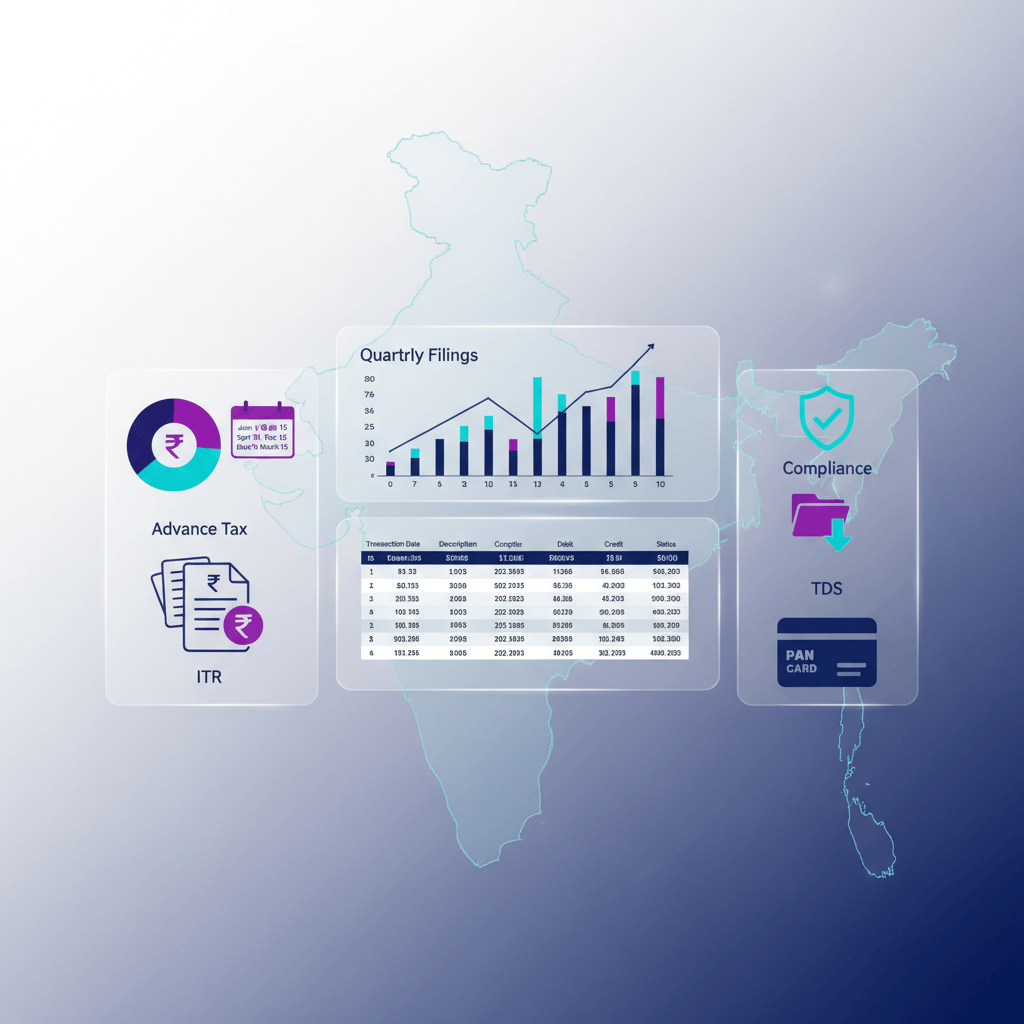
- Dashboard shows: cash by bank, cash flow and liquidity runway, receivables and payables aging, GST and TDS calendars, reconciliation status, and exception alerts.
- CA team does: voucher posting, reconciliations, GST and TDS returns, income tax computations, ledgers review, month end close, schedules, and audit support.
Result, you approve decisions with confidence, while we execute the ledgers and filings with discipline.
Bank statement analysis accounting, what it is and why it matters
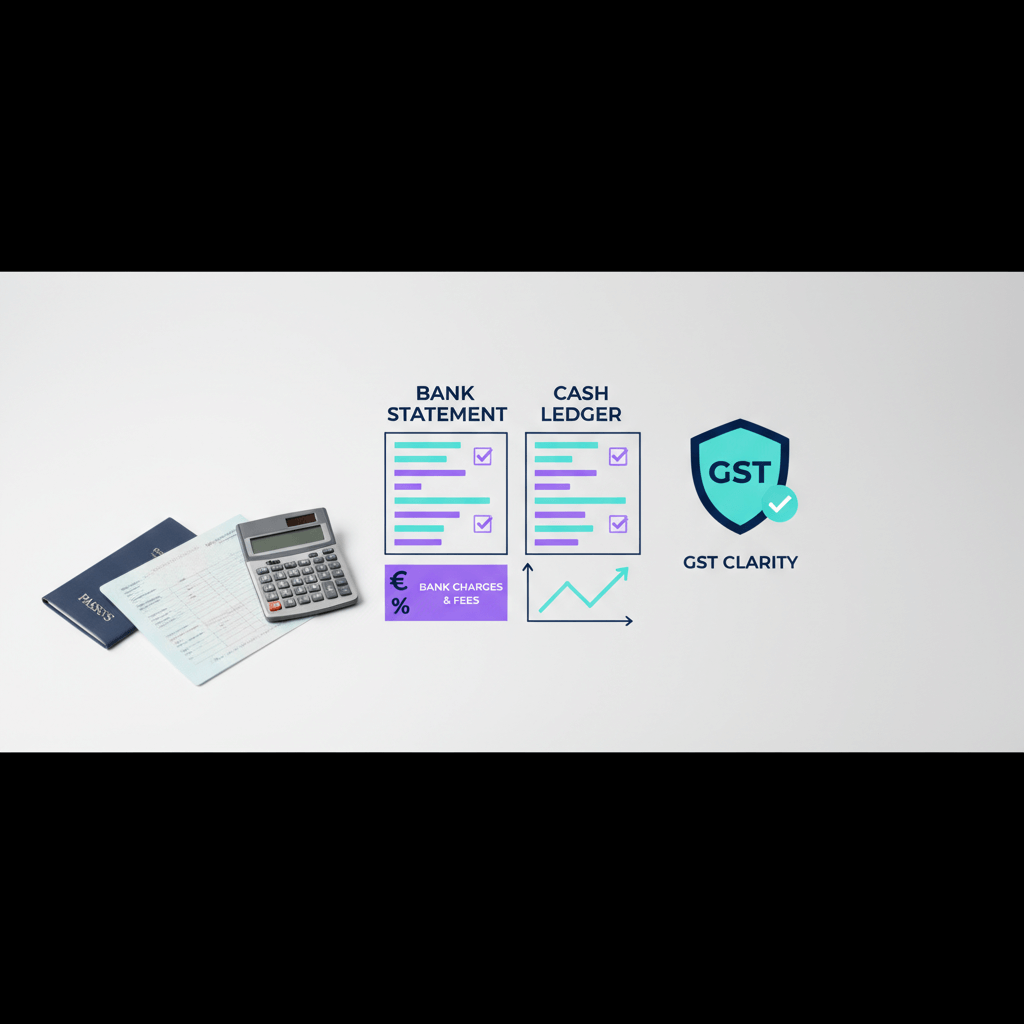
Bank statement analysis is a systematic review of bank transactions to prove your cash ledger is correct. The aim is alignment between bank and books, with every difference explained.
When done right it protects liquidity, highlights errors and fraud early, and improves decision making. Per bank statement purpose and examples, a reconciled statement is the foundation of reliable financial reporting.
Success test: your bank reconciliation shows the adjusted bank balance equals the adjusted ledger balance for the period.
Our AI dashboard flags exceptions, but the reconciliation is done by CAs, ensuring controls are applied correctly, consistently.
Know your inputs, mapping bank statements to your ledger
A bank statement gives you the signals needed to match with your ledger. Key elements include opening and closing balances, dates and descriptions, cheque or UTR references, debits and credits, fees and interest.
- Balances anchor the period in your cash book.
- Dates and descriptions trace to vouchers or receipts.
- References tie to UTR, cheque number, or payment proofs.
- Debits and credits mirror your ledger entries by amount and near date.
- Charges and interest often exist on the statement first, post them to tie the books.
Tip, bank charges and interest are commonly missing from books. Post them with clear narrations and references. Per PwC India's April 2026 Accounting Alert, bank charges account for 35% of reconciliation mismatches.
Preparation checklist before analysis
Good inputs avoid wasted time and repeated mismatches:
- Fix the exact period, usually month wise by statement dates.
- Gather the cash ledger for the period, prior reconciliation, and supporting documents like invoices, advices, and receipts.
- Use official bank PDFs or printed statements. Avoid altered or screenshot versions.
- Confirm the opening balance ties to last month's reconciled closing balance.
Step by step reconciliation workflow
Our CA team runs a simple, strict flow for every bank account, every month:
- Verify opening balance, ensure it equals the prior period reconciled closing balance. Fix prior gaps first.
- Match line by line, by date, amount, description, and reference. Tag cleared items.
- List unmatched items, missing entries, duplicates, wrong amounts or dates, wrong accounts.
- Prove closing balance, adjust for items in books not in bank and vice versa. The adjusted totals must match.
With GSTN API 2.0 now requiring reconciliation uploads, this workflow feeds directly into your GST compliance pipeline.
Handling reconciling items and timing differences
Common reconciling items that create temporary mismatches:
- Deposits in transit, in books not yet in bank. Add to bank side.
- Outstanding payments, in books not yet cleared. Deduct from bank side.
- Direct debits or credits, ECS, EMI, taxes, interest. Post them with clear narrations.
- Timing differences, track until cleared in the next cycle.
- Errors, if bank error, raise with UTR or cheque reference. If book error, pass correction with approval.
The key discipline: timing differences are not ignored. They are tracked on a schedule and cleared in the following period.
Bank charges analysis, identify, verify, and post
Fees and interest are frequent sources of mismatch. Here is how to handle them systematically:
- Identify types, service charges, NEFT or RTGS or wire fees, minimum balance penalties, SMS or cash handling fees, overdraft interest or penalties, interest income on current or sweep accounts.
- Verify, check tariff plans and usual patterns. Query outliers with the bank.
- Classify and post, expense to Bank Charges, credit interest to Interest Income. Use the statement date.
- Audit trail, note date, amount, and reference in narrations.
Per the treasurer's guide to account analysis statements, reconciling bank fees monthly prevents year end surprises and penalty risk.
Record adjustments and correct the books
Your reconciliation will not tie until you post all findings:
- Post bank charges, taxes, and credit interest.
- Record direct debits and credits missing in books.
- Enter unrecorded customer receipts or vendor payments that appear in bank.
- Fix book errors (wrong amount, date, party, or account) with approvals.
- Reference the statement line in each journal, with date, amount, and UTR or cheque reference.
Every adjustment needs a clear narration. This is what makes your audit trail bulletproof.
Prepare the bank reconciliation statement
Build a simple proof for the period, step by step:
- Start with statement closing balance (or ledger closing balance).
- List adjustments to bank balance: add deposits in transit, deduct outstanding payments, include any bank errors.
- Arrive at adjusted bank balance.
- Ensure adjusted bank balance equals adjusted ledger balance after postings. If not, investigate.
This reconciliation statement is now a compliance requirement under RBI's December 2025 guidelines and must be retained as part of your monthly close documentation.
Investigate anomalies and fraud red flags
Stay alert to patterns that do not fit your business:
- Round number transfers without purpose, duplicate transactions, irregular spikes or drops.
- Repeated fees that do not match tariff, unauthorized transactions, unknown beneficiaries.
- UPI duplicates (up 25% in 2025 per RBI data), particularly in high volume accounts.
Follow up with UTR checks, internal approvals, and control reviews. Our AI dashboard flags these anomalies automatically, but a CA investigates each one before escalation.
For credit assessment scenarios, bank statement analysis for credit decisions follows a similar pattern of anomaly detection and verification.
Documentation and audit trail
A strong audit trail cuts rework and speeds audits:
- Tick marks for matched items in statement and ledger. Separate mark for queries.
- Attach reconciliation statement, schedules for deposits in transit and outstanding payments, and copies of key vouchers and approvals.
- Retain records seven to ten years for audits and regulatory reviews (aligned with RBI and Income Tax Act requirements).
With monthly reconciliations now mandatory under RBI's digital reconciliation guidelines, maintaining this documentation is not optional.
Cadence and controls that keep cash clean
Set a steady rhythm and review system:
- Frequency, monthly at minimum, weekly for high volume or high risk accounts.
- Cut off discipline, close each month by a fixed day, then lock after review.
- Second level review, senior accountant review for quality assurance and compliance sign off.
- Locked periods, once reviewed and signed off, no entries can be posted to the closed period without escalation.
With this cadence, mismatches do not snowball, cash stays reliable, and surprises fade.
What founders and finance heads get
- Compliance handled, GST, TDS, income tax, payroll, and filings, done by CAs.
- Cash clarity, reconciled accounts, early alerts, and a living cash flow and liquidity view.
- Control comfort, maker checker workflows, audit trail, and evidence backed reconciliations.
- Board ready metrics, revenue, burn, runway, DSO and DPO, and exception logs.
- Faster audits, monthly close discipline means audit packs are ready in days, not weeks.
Getting started and onboarding steps
- Scope confirmation, books, entities, GST registrations, payroll, and timelines.
- Data access, bank statements, accounting system, prior reconciliations, and returns.
- Health check, opening balance review, and one time clean up plan if needed.
- Dashboard setup, approvals, alerts, and reporting cadence.
- Go live, weekly hygiene, monthly close, and quarterly reviews.
Typical onboarding takes seven to ten days, with the first clean reconciliation delivered in your first month close cycle.
Bottom line: we do the accounting, you keep real time visibility, and the bank reconciliation never falls behind.
FAQ
Is Virtual Accounting truly managed by CAs, or will my team have to do the accounting work?
It is fully managed by our CA team. You and your finance head review and approve on the dashboard, you do not have to post entries or run reconciliations. ICAI's 2026 Framework for Technology Enabled Accounting Services explicitly endorses this model, with mandatory 48 hour query resolution SLAs (2026 update).
What exactly will I see on the AI dashboard, and what remains in the CA workflow?
You see cash by bank, reconciliation status, receivables and payables aging, GST and TDS calendars, filings status, and exceptions. Our CAs handle bookkeeping, reconciliations, GST, TDS, and income tax, plus period end close and audit support. The dashboard is for visibility and approvals, not DIY accounting.
How do you prove that my cash ledger equals my bank, every month?
We produce a reconciliation statement where adjusted bank balance equals adjusted ledger balance. This is reviewed by a senior accountant before the period is locked. Under RBI's December 2025 guidelines, monthly reconciliation is now mandatory for MSMEs, with a 2% penalty risk on unreconciled mismatches (2026 update).
Can you detect fraud or suspicious activity from bank patterns?
Yes. Our dashboard flags anomalies like round figures, duplicates, tariff mismatched fees, and unknown beneficiaries. A CA investigates using UTR, approvals, and vouchers. With UPI duplicate frauds up 25% (per RBI 2025 data), biometric approvals for adjustments are now part of our control framework (2026 update).
Will you handle GST, TDS, and income tax end to end, including notices?
Yes. We compute and file GST and TDS returns, reconcile books to returns via GSTN API 2.0 (live since April 2026), and prepare income tax workings. If a notice arrives, we prepare responses based on ledgers, reconciliations, and documentary evidence. You approve submissions, we execute.
How quickly can you onboard and produce the first clean reconciliation?
Typical onboarding is seven to ten days, depending on access to prior data, bank statements, and volume. First clean reconciliation lands in the first month close. Where gaps exist, we schedule a one time clean up, then switch to steady monthly cadence.
What does CA-led virtual accounting cost compared to traditional outsourcing?
Most firms see similar or lower cost versus traditional outsourced accounting, with stronger controls and live visibility included. Pricing depends on transaction volume, number of entities, and compliance scope. Because AI handles matching and exception flagging, CAs spend time on judgment, not data entry, making the model more efficient at scale.