-01%201.svg)
Key takeaways
- D2C accounting in India is uniquely complex because of multi-channel orders, payment gateway holds, returns, and GST TCS, traditional methods break under volume.
- Automation driven virtual accounting, matched with expert CA oversight, delivers daily reconciliations, accurate GST, and real-time SKU, channel, and cash flow visibility.
- Specialized services for online sellers capture missed credits, fix fee overcharges, and expose loss-making SKUs that hide behind high sales velocity.
- Outsourcing reduces costs by 40-60%, improves accuracy, and saves founders 15-20 hours monthly, freeing up focus for growth.
- Virtual Accounting by AI Accountant offers a D2C-first stack, instant marketplace and gateway integrations, and a dedicated CA team at transparent pricing.
Why D2C accounting in India demands a different playbook
D2C brands sell on Amazon, Flipkart, Shopify, Meesho, and more, each with its own fee logic, payout cycle, and reports. Add Razorpay, PayU, and COD to the mix, and reconciliation becomes a full time job. E-commerce TCS under Section 52 complicates GST credits, while high returns and RTO change true margins. Frequent discounting, paid ads, and multi-warehouse inventory add further layers. Traditional accountants know GST, they rarely master marketplace settlements, SKU margins, and channel P&L, which is why modern brands adopt virtual accounting for D2C brands India built for online sellers.
The problem is not data scarcity, it is fragmented data and delayed truth. The fix is automated reconciliation with CA-grade controls.
- Marketplace complexity, settlement disputes, and fee overcharges demand automated checks, see this overview of the top e-commerce accounting software.
- GST and TCS nuances require rigorous reconciliation, explore a live GST compliance case study for a D2C brand.
- Specialist e-commerce accountants like EcomCA highlight the need for domain specific workflows.
What the right accounting service for D2C brands must include
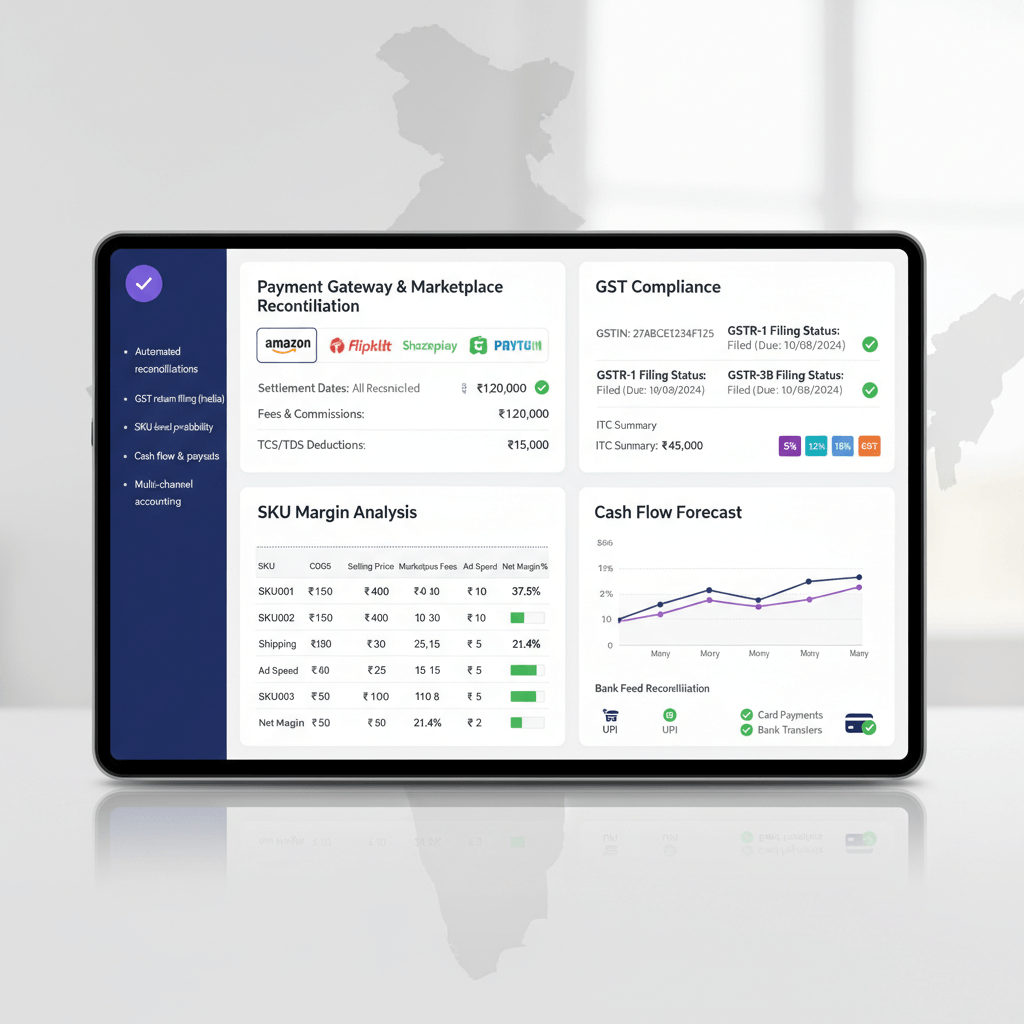
Automated marketplace and payment gateway reconciliations
Every order must match fees, TCS or TDS, and final bank settlement. Daily, API based pulls of Amazon, Flipkart, Shopify, Razorpay, and PayU data close gaps quickly and surface anomalies before they become cash leaks.
GST ready invoicing and compliance
Correct HSN or SAC mapping, e-invoicing where applicable, and automated GSTR-2B input reconciliation are non negotiable. The service should manage Section 194-O advisory and ensure credit optimization without risky tactics.
SKU level profitability and ROAS aware MIS
Landed cost, channel fees, returns, and attributed ad spend must roll into SKU margins. Channel wise P&L reveals where your unit economics actually work. Without this, pricing and promotions become guesswork.
Returns and RTO accounting that tells the truth
Track reasons, measure RTO hit, and separate discount or coupon effects using proper revenue recognition. This is where many “bestsellers” show their real cost.
Inventory valuation and cross channel reconciliation
Use FIFO or weighted average consistently, reconcile warehouses and FBA, and monitor stock aging to avoid dead inventory. Automated alerts prevent overselling and hidden carrying costs.
Cash flow and working capital visibility
Weekly forecasts guide purchase cycles, daily bank reconciliation catches discrepancies, and AR or AP workflows steady vendor and wholesale relationships.
Compliance calendar and audit readiness
Never miss GSTR-1, GSTR-3B, GSTR-9, ITR, TDS, or ROC. Proactive prep and clean documentation make audits routine rather than stressful.
Real time dashboards and alerts
Instant flags for overcharged marketplace fees, negative margin SKUs, and GST mismatches keep you in control between closings.
- Shortlist providers with purpose built tooling, start with the e-commerce accounting software landscape.
- Review specialist firms like EcomCA, and benchmark value against a virtual CFO case study for D2C and affordable virtual CFO service roundups.
- Evaluate outsourcing depth from global players like Outsource2india to local GST experts such as APCA LLP.
In-house versus D2C accounting outsourcing, the smart choice
The real cost of in-house
Full time accountant plus CA oversight can cross ₹12 lakhs annually after tools and overheads, and manual spreadsheets struggle during sale spikes. Errors in GST or settlements often wipe out perceived savings.
The outsourcing advantage
Specialist providers deliver predictable monthly fees, automation driven accuracy, and daily reconciliations. Review transparent options and benchmarks on virtual accounting pricing in India for context.
Bottom line impact
Outsourcing typically reduces accounting costs by 40-60%, founders reclaim 15-20 hours monthly, penalties drop, and SKU clarity lifts margins within a few cycles.
- Cross check market options, from affordable virtual CFO providers to D2C focused accountants.
- Keep a shortlist of software that integrates cleanly, see the top tools for e-commerce accounting.
Top D2C CA service India providers, your options
1. Virtual Accounting by AI Accountant
Virtual Accounting by AI Accountant is a D2C first CA-as-a-Service, with native integrations for Amazon, Flipkart, Shopify, Razorpay, and PayU, plus all major banks. Automated order, fee, and TCS reconciliation meets end to end GST and TDS, while SKU and channel P&L, RTO analytics, and inventory aging power decisions. Transparent pricing, rapid onboarding, and in app CA chat make it a founder friendly default.
2. Traditional CA firms with D2C offerings
Established firms bring compliance depth and audit pedigree, yet many still rely on manual workflows. Expect higher monthly retainers and slower turnarounds during peak seasons.
3. Specialist e-commerce accountants like EcomCA
Boutique teams that understand marketplace nuance, some with partial automation. Assess fit by platform expertise and SLAs, start with EcomCA as a reference point.
4. International virtual accounting platforms
Slick software and strong automation, but India specific GST and TDS can be gaps, and dollar pricing raises total cost.
5. DIY accounting software
Tools like Tally and Zoho Books keep subscriptions low, but you trade savings for time and risk. To compare capabilities, review the roundup of e-commerce accounting software.
Real world outcomes, quick D2C case snapshots
Brand A, Fashion on Shopify with Razorpay recovered ₹47,000 in gateway overcharges within two months after automated reconciliation, and GSTR mismatches dropped by 90%.
Brand B, Beauty on Amazon and Flipkart found 12% of SKUs were net loss makers after returns and fees, pausing them lifted blended margins by 3% immediately.
Brand C, Omnichannel Home Décor adopted weekly cash flow forecasts, eliminated vendor penalties, and improved working capital by 35% through disciplined closings and alerts.
- Browse practical tools and platforms in this software guide, and see a GST case study for a D2C seller for compliance wins.
Onboarding process and ongoing deliverables
Week 1, set the foundation
Connect marketplaces, gateways, and bank feeds, review opening balances, clean GST master data, align chart of accounts, and map SKUs for margin analytics.
Monthly rhythm
Close books by the 5th, file GSTR-1 and GSTR-3B on time, reconcile TDS, publish MIS with channel P&L, SKU margin ladders, and cash flow statements.
Quarterly and annual
Prepare GSTR-9 or 9C progressively, plan ITR to minimize liability, maintain ROC compliance, and keep audit trails clean for a stress free year end.
SLAs and the human layer
Expect 24 hour responses, dedicated CA reviews, and bank grade security with backups and access controls. Automation does the heavy lifting, the CA team guides strategy in plain language.
- For broader outsourcing context, consider virtual accounting service models, and benchmark e-commerce specialists like EcomCA or APCA LLP’s GST case study, alongside affordable virtual CFO roundups.
Decision checklist to choose your accounting partner
Before you commit, run this decision checklist and demand clear answers.
Technical capabilities
- Order level reconciliation of marketplaces, gateways, and bank statements.
- SKU and channel P&L with ad cost attribution, and automated GSTR-2B with TCS or RTO treatment.
Service delivery
- Monthly close within 5-7 days, experienced CA review, and fast query resolution via chat or phone.
Pricing and terms
- Transparent fees, no surprise filing charges, no lock in, and a trial or guarantee if possible.
References and scale
- Relevant D2C references, proven performance during festive spikes, and strong marketplace coverage.
Technology and security
- Direct integrations for your stack, clear data protection policies, and anytime data access.
Red flags
- Unrealistic tax promises, email or spreadsheet only operations, and too good to be true pricing.
Take action, transform your D2C finance today
Stop firefighting and start forecasting. Move from fragmented spreadsheets to automated reconciliations, accurate GST, and live profitability. Book a no obligation walkthrough of Virtual Accounting by AI Accountant, get a complimentary one month reconciliation diagnostic, or request a quick compliance risk review.
Compare plans on our transparent pricing page, and download the founder friendly D2C Accounting Checklist for India to benchmark your current setup. Your competitors are already upgrading their finance stack, the best time to catch up is now.
FAQ
What exactly does online seller accounting cover for marketplaces and Shopify?
End to end coverage includes order to cash reconciliation across Amazon, Flipkart, Shopify, and your payment gateways, automated GST and TCS computation and credits, inventory tracking across warehouses, and clear reporting on gross sales, collections, deductions, and true earnings after fees and taxes. A D2C focused stack like Virtual Accounting by AI Accountant makes this real time, not month end.
How do I handle GST TCS under Section 52 without leaving money on the table?
Marketplaces deduct 1% TCS on sales, which becomes a credit in your GSTR-2B. The key is automated matching between marketplace reports, GSTR-2B, and your books, so every eligible rupee is claimed and no double tax slips through. Specialist workflows in Virtual Accounting by AI Accountant reconcile these daily.
What is the right way to account for COD, returns, and RTO in a D2C setup?
Reconcile COD remittances against orders and logistics partner reports, tag returns with reason codes, and capitalize RTO costs into landed cost for accurate SKU margins. When this is automated, you quickly see which products are profitable after their return behavior, and which need pricing, creative, or ops fixes.
Is presumptive taxation under 44AD smart for my D2C brand or should I keep full books?
If turnover is under ₹2 crores, 44AD can be used, taxing presumed profit at 6% of digital receipts. It is useful when actual margins are comfortably above 6%. If your returns, RTO, and ad costs are heavy, detailed books usually reduce taxable income legitimately. A CA led service will compare both paths before filing.
How do I connect ad spend to sales so I get true SKU level margins?
Integrate Meta and Google Ads cost data, attribute spend to SKUs via campaign structure, and combine with marketplace fees, discounts, returns, and logistics. The result is a post advertising margin view per SKU and channel, refreshed in your MIS. This is standard in Virtual Accounting by AI Accountant.
What integrations and data do you need to get started, and how fast is onboarding?
Marketplace and gateway API credentials, bank feed access, and clean opening balances. Most D2C brands are live in 24-48 hours, with dashboards lighting up instantly, and the first close completed by the 5th of the next month.
Can virtual accountants manage audits and ROC while I scale channels?
Yes, if the provider is CA led, audit and ROC are part of the compliance calendar alongside GSTR-1, GSTR-3B, GSTR-9 or 9C, ITR, and TDS. The advantage is consistent documentation and reconciliations throughout the year, so audits become procedural rather than a scramble.
What SLAs should I expect for a high volume D2C brand?
Daily reconciliations, monthly close within 5-7 days, 24 hour query responses, and proactive alerts for GST mismatches, negative margin SKUs, and fee overcharges. During festive spikes, the service should scale without extra firefighting. This is where CA-as-a-Service models shine.
How do I switch accounting systems mid year without breaking compliance?
Cutover with a month end close, import opening balances, map SKUs and tax masters, and parallel run for one cycle if needed. Ensure GSTR-2B and marketplace settlements align on the switch date, then lock prior periods. A managed transition by Virtual Accounting by AI Accountant typically completes in days, not weeks.
What metrics should a founder see on a live finance dashboard?
Channel wise P&L, SKU margin ladder with ad attribution, return and RTO rates, cash position and weekly forecast, GST payable and credits, fee anomaly flags, and inventory aging. If a metric does not help you decide inventory, pricing, or marketing today, it belongs in a deeper report, not the dashboard.
Can outsourced D2C accounting actually reduce my costs, not just the headache?
Yes, cost drops come from lower headcount, fewer penalties, and recovered overcharges, with added upside from SKU rationalization. Many founders also value the time dividend, 15-20 hours monthly back to product and growth. Benchmark your numbers against this pricing and ROI guide.
We sell on Amazon, Flipkart, and our own site, will one team handle all three?
With a D2C focused stack, yes. The same reconciliation engine ingests marketplace data, payment gateway settlements, and bank feeds, then generates a unified view for operations and compliance. This eliminates channel silos and finger pointing, and it is exactly what Virtual Accounting by AI Accountant was built to do.

Rohan Sinha is a fintech and growth leader building aiaccountant.com, focused on simplifying accounting and compliance for Indian businesses through automation. An IIT BHU alumnus, he brings hands-on experience across 0 to 1 product building, growth, and strategy in B2B SaaS and fintech.