-01%201.svg)
Key takeaways
- E-commerce operators must collect TCS at 1% under Section 52 and file GSTR-8 by the 10th monthly, while sellers file regular GST returns with different deadlines based on turnover.
- Missing deadlines costs real money, ₹50 per day for GST delays as per CBIC notifications, 18% annual interest on unpaid tax, and ₹10,000 to ₹1 lakh for TDS violations.
- The compliance burden is significant, Indian SMEs spend 218 hours annually on tax compliance, often the equivalent of hiring a full time accountant in metros.
- Automation changes the economics, Virtual Accounting by AI Accountant handles filings for ₹4,000 to ₹6,000 monthly, with real time dashboards and a dedicated CA team to prevent penalties.
Body
You are running an e-commerce business in India, and the tax notifications keep coming, GST on every sale, TCS on marketplace transactions, TDS on vendor payments, and you are not even sure if you are collecting the right documents. One missed deadline can mean penalties that eat into already thin margins.
This guide breaks down exactly what tax compliance looks like for Indian e-commerce in 2025, from the GST returns due on the 11th of every month to the e-invoicing rules that apply above ₹5 crores turnover. You will know which forms matter for your business model, when each deadline hits, and what happens when things go wrong.
2025 at a glance: File GSTR-1 by the 11th, GSTR-3B by the 20th, collect 1% TCS and file GSTR-8 by the 10th if you operate a marketplace, deposit TDS by the 7th and file quarterly returns on time. Implement e-invoicing for B2B if aggregate turnover exceeds ₹5 crores, and follow RBI’s T+1 settlement expectations via payment aggregators. The typical SME spends 218 hours annually on tax compliance, so consider automation and expert support to protect margins and avoid penalties.
Understanding GST for e-commerce, the complete framework
GST for e-commerce operates on two distinct models, if you sell directly to customers, you follow standard GST rules with monthly or quarterly returns, but if you run a marketplace connecting buyers and sellers, you become an e-commerce operator with additional TCS obligations under Section 52.
For direct sellers, GST registration becomes mandatory once you cross ₹20 lakhs turnover, ₹10 lakhs for special category states, though sales via e-commerce eliminate the threshold, which means any online sale requires registration. You will file GSTR-1 for outward supplies by the 11th of each month, followed by GSTR-3B for tax payment by the 20th. Under QRMP, if your turnover stays below ₹5 crores, you can file quarterly with monthly payments.
The real complexity hits when you operate a marketplace. Under Section 52, you must collect TCS at 1% on the net value of taxable supplies, split as 0.5% CGST and 0.5% SGST. This is reported in GSTR-8 by the 10th of the following month, and the credit appears in your sellers’ electronic cash ledgers automatically.
What happens if I miss GST deadlines?
Missing GST deadlines triggers automatic penalties that compound quickly. Late fees for GSTR-1 run ₹50 per day, capped at ₹5,000, while nil returns attract ₹20 per day up to ₹2,000. The same structure applies to GSTR-3B, and you also face 18% annual interest on any unpaid tax from the due date.
Repeat delays can restrict GST portal access, block e-way bill generation, and jeopardize input tax credit eligibility for both you and your buyers, risking hard won customer relationships.
How does Input Tax Credit work for online sellers?
ITC lets you offset the GST paid on business purchases against GST collected on sales, with important restrictions. You cannot claim ITC on specific items as per the CGST Act, including goods for personal consumption, motor vehicles in most cases, and works contracts for immovable property.
Remember the 180 day payment rule, if you do not pay a supplier within 180 days of invoice date, the system reverses your ITC and you must pay that back with 18% interest, then reclaim after payment is made. For thin margin e-commerce businesses, this makes vendor payment discipline essential.
TDS and TCS requirements for digital transactions
E-commerce businesses face TDS on vendor and professional payments, advertising, and more, with deposits due by the 7th of each month and quarterly returns following strict timelines.
The most common scenario is 10% TDS on professional fees above ₹30,000 annually, 2% on contractor payments in many cases, and 2% on advertising services. Payment gateway fees, cloud hosting, and digital marketing may attract TDS depending on the service category and vendor residency.
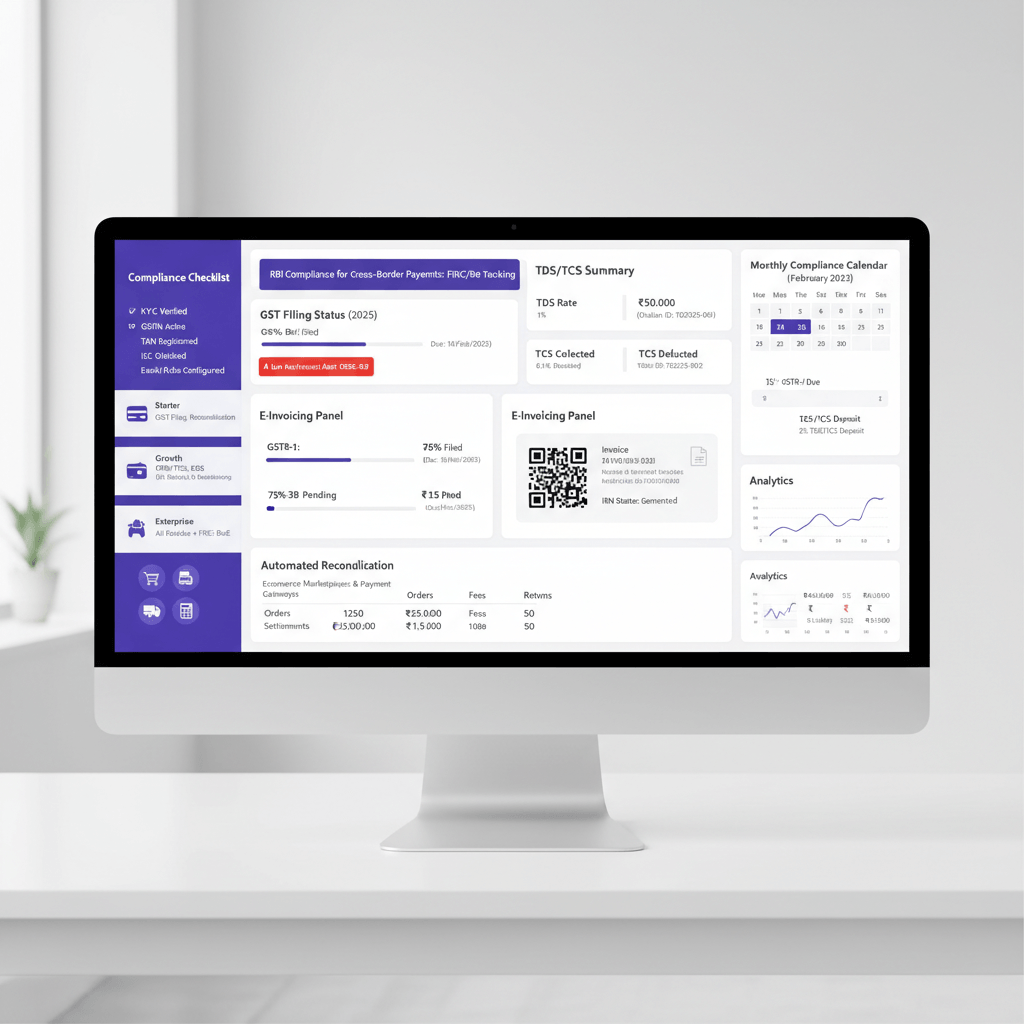
Virtual Accounting handles the maze end to end. One dashboard with auto reminders 7 days before due dates, a dedicated CA team that files GST, TDS, and TCS on time, manages Form 16A, and flags transactions that require TDS before you pay, preventing reversals and penalties. Watch this short video.
When do I need to file TDS returns?
TDS returns follow a quarterly cycle, Form 26Q for non salary deductions is due by July 31st, October 31st, January 31st, and May 31st. Vendors must receive Form 16A within 30 days of quarter end.
Missing TDS deadlines attracts ₹200 per day in late fees under Section 234E, plus 1.5% per month interest on late deposits. Persistent delays can invoke Section 271H penalties from ₹10,000 to ₹1 lakh.
What are the TCS obligations for marketplaces?
If you run a marketplace, 1% TCS applies on net value after returns and discounts, but you collect on the gross upfront and adjust later, per Section 52. GSTR-8 due on the 10th must reconcile perfectly, since sellers rely on the credited amounts to meet their GST liability.
E-invoicing and QR code implementation
E-invoicing became mandatory for businesses with turnover above ₹5 crores, requiring IRP authentication for every B2B invoice before it is valid for GST. For large B2C players, dynamic QR codes are required on invoices to facilitate instant payments.
Instead of sending invoices directly, you upload invoice data to IRP, receive an IRN and signed QR code, then issue the invoice. This applies to sales, debit notes, and credit notes for B2B transactions.
How do I integrate e-invoicing with my existing systems?
Choose direct IRP API integration for high volumes and real time flows, or a GSP for simpler bulk uploads. Update your ERP to capture schema fields, accurate HSN or SAC, place of supply, and invoice types. Validation failures block IRN generation, so data accuracy is non negotiable.
What if my turnover crosses ₹5 crores mid year?
Crossing the ₹5 crore threshold triggers e-invoicing from the first day of the next month as per CBIC notifications, with no grace period. Track aggregate turnover across all GSTINs and begin prep at least 60 days before you expect to cross the limit.
Payment gateway compliance and RBI regulations
Payment aggregators must settle merchant payments within T+1, maintain segregated nodal accounts, and complete daily reconciliations. This improves cash flow but demands meticulous reconciliation on your side, with chargeback liabilities and tight dispute windows.
Do I need separate compliance for international payments?
Yes, FEMA adds FIRC documentation, purpose codes, and 9 month realization tracking via EDPMS. Ensure your gateway segregates domestic versus cross border flows, provides export friendly reports, and maps GSTINs correctly for IGST refund claims.
What documentation do I need for payment gateway audits?
Maintain transaction logs, settlement reports, refund and chargeback registers for at least 8 years, plus signed gateway agreements, annual KYC, and security certifications. Any change to payment methods or terms should be documented and acknowledged by the gateway.
Where this gets easier: Virtual Accounting by AI Accountant reconciles daily settlements against sales, maintains FIRC and export trails, and integrates with major gateways to keep books accurate and audit ready, all in real time.
Annual compliance calendar for e-commerce
E-commerce businesses face a rolling calendar, monthly GST, TDS deposits, EPF or ESI for employers, quarterly TDS returns, and annual MCA requirements with AGMs by September 30th. GST annual returns are due by December 31st for the previous year, GSTR-9 for turnover above ₹2 crores and GSTR-9C reconciliation as applicable.
For companies, the MCA cycle peaks post AGM, AOC-4 by October 30th and MGT-7 by November 30th, with escalating additional fees for delays.
Which monthly compliances are absolutely critical?
Three monthly items can choke operations if missed repeatedly, GST returns, TDS or TCS deposits by the 7th, and EPF or ESI contributions by the 15th for employers. Professional tax varies by state, often due by the 20th. Marketplace operators must file GSTR-8 by the 10th to pass credits to sellers.
How do I manage multi state compliance?
Each state requires its own GSTIN for inventory locations, with separate GSTR-1 and GSTR-3B filings, state wise professional tax, and Shops and Establishments obligations. Track e-way bills for inter and intra state movements, and maintain state wise ledgers to avoid ITC mismatches.
Penalties and legal implications
Violations can escalate from civil penalties to prosecution, with GST evasion above ₹5 crores enabling arrests and TDS failures inviting prosecution under the Income Tax Act. Data analytics now match GSTR-1, GSTR-3B, e-way bills, and bank data, increasing the speed and certainty of detection.
What triggers a GST audit or investigation?
GST audits often trigger when ITC in GSTR-3B exceeds GSTR-2B significantly, when GSTR-1 does not match GSTR-3B, or when refund claims spike. GSTR-9C requirements also drive scrutiny, and intelligence based investigations can occur without prior notice.
Can I go to jail for tax mistakes?
Genuine mistakes attract interest and penalties, not jail. Willful evasion, fake invoices, or collecting tax without depositing it can lead to prosecution under Section 132 of the CGST Act. First time offenders demonstrating corrective action often secure compounding, but do not rely on leniency.
Automating compliance, tools and solutions
Indian SMEs spend 218 hours annually on tax compliance. Many operate 4 to 5 disconnected tools for GST, TDS, payroll, and reconciliation, which creates silos and errors. The goal is a single workflow from transaction to filing to reconciliation.
Ideal systems classify transactions in real time, generate e-invoices if required, post to returns, reconcile with payments, and track deadlines with audit proof trails. This reduces manual work and prevents inadvertent non compliance.
What should I look for in compliance automation?
Five essentials, accurate classification with HSN or SAC and TDS sections, return preparation with pre filing validations, payment integration for reconciliation, robust deadline tracking, and complete audit trails. Also assess the provider’s update cadence for regulatory changes.
How much does compliance automation cost versus manual filing?
Experienced e-commerce accountants in metros cost ₹6 to ₹12 lakhs annually, plus benefits. Comprehensive platforms range from ₹30,000 to ₹100,000 yearly. Virtual Accounting by AI Accountant, at ₹4,000 to ₹6,000 monthly, pairs software with a CA team to deliver coverage that beats hiring on both cost and reliability.
Choosing professional services versus in house teams
In house offers control and context but demands hiring and training, turnover management, and continuous upskilling. Services provide a multi person bench, systems, and regulatory monitoring, but vet their e-commerce expertise and responsiveness.
When should I hire dedicated accounting staff?
Consider in house once monthly transactions exceed 1,000, when you need daily reporting, or when operations, such as complex inventory or manufacturing, require deep embedded knowledge. Many firms between ₹5 and ₹25 crores revenue benefit most from modern tech enabled services, then add in house capacity as scale increases.
What questions should I ask potential service providers?
Probe their e-commerce client base and show me capacity, ask to see sample dashboards, confirm who will handle your account, test their deadline tracking and escalation, and ensure they integrate with your stack. Call references, especially peers of your size.
Conclusion
E-commerce tax compliance in India demands vigilance across GST, TCS, TDS, e-invoicing, RBI payment rules, and MCA and labor calendars. The penalties compound quickly, and the real cost is time diverted from growth. Automate what you can, bring in experts where it counts, and build systems that turn compliance into a strength, with predictable filings, clean reconciliations, and zero penalty operations.
FAQ
What happens if I miss the GST return deadline by just one day?
Missing your GST return deadline by even one day triggers automatic late fees of ₹50 per day, ₹25 CGST plus ₹25 SGST, per CBIC notifications, plus 18% annual interest on any tax liability from the original due date. For example, miss GSTR-3B due on March 20th and file on March 21st with ₹50,000 tax payable, you owe ₹50 in late fees and about ₹24.66 in interest. Virtual Accounting by AI Accountant prevents this with automated reminders and a dedicated CA team that prepares returns ahead of time.
Do I need to collect TCS if I run a small marketplace with GMV under ₹50 lakhs?
Yes, TCS collection under Section 52 is mandatory for all e-commerce operators regardless of turnover. Even at ₹10 lakhs GMV, you must collect 1% TCS and file GSTR-8 monthly.
Can I claim ITC on the GST paid for my e-commerce platform’s cloud hosting services?
Yes, cloud hosting is an eligible business expense, and it is not in the blocked credits list under Section 17(5) of the CGST Act. Ensure you have a valid tax invoice with your GSTIN, that the vendor reports the supply, and that you pay within 180 days to avoid reversal.
What is the penalty if I forgot to deduct TDS on freelance content creator payments?
You owe 1% per month simple interest from the date TDS should have been deducted until you actually deduct and deposit, per Income Tax guidelines. Section 271C may impose a penalty equal to the TDS amount. You also risk disallowance of the expense until TDS is paid. Virtual Accounting flags such payments before you process them to avoid this outcome.
How quickly must I implement e-invoicing if my turnover crosses ₹5 crores?
E-invoicing becomes mandatory from the first day of the month immediately after crossing the ₹5 crore aggregate turnover threshold, as per CBIC notifications. Begin implementation 60 days in advance, update ERP fields, and test IRP flows to avoid invoice rejections.
Do I need a separate GST registration for each state where I store inventory?
Yes, inventory presence creates a fixed establishment that requires state wise GST registration under the CGST Act. You must file returns for each GSTIN and maintain state wise books. Stock transfers need e-way bills and proper reporting.
What documentation do payment gateways require for selling internationally?
You need FIRC for inward remittances, export invoices with correct HSN, shipping bills or courier proofs, and purpose codes for transactions above $5,000, aligned with RBI guidelines. Ensure your gateway provides EDPMS compliant reports. Virtual Accounting maintains these records and reconciles export proceeds for you.
Can Virtual Accounting handle multi state GST compliance for my e-commerce business?
Yes, Virtual Accounting by AI Accountant manages registrations, monthly returns for each GSTIN, e-way bills, and state wise ledgers. It consolidates views while preserving statutory separation, and it costs ₹4,000 to ₹6,000 monthly, far less than hiring a single experienced accountant.
How does GST work if I sell on Amazon and my own website simultaneously?
Marketplace sales attract 1% TCS which appears as credit in your cash ledger via GSTR-8, while direct website sales do not. You file consolidated GSTR-1 and GSTR-3B across channels, adjust TCS credit, and keep channel wise registers for reconciliation.
What happens to my ITC if my vendor does not file their GST returns?
Your credit will not appear in GSTR-2B, and claiming it risks future reversal with interest. Under present rules, you can only claim up to 105% of eligible credit appearing in GSTR-2B. Virtual Accounting tracks vendor filing status and alerts you to chase missing credits before year end reconciliations.
Is TDS applicable on Google Ads and Facebook marketing spending?
Yes, payments for advertising services generally attract 2% TDS. If you pay an Indian reseller or agency, deduct TDS. For direct payments to overseas entities, maintain documentation and consult your CA for treaty or equalization levy implications. Virtual Accounting classifies these spends correctly and prepares compliant TDS returns.
How long do I need to preserve e-commerce transaction records for tax purposes?
Keep records for 8 years from the relevant assessment year per Income Tax record keeping guidance, and at least 6 years from GST annual return filing, which practically aligns with 8 years. Ensure payment gateway logs, settlement reports, and refund trails are archived and retrievable.
What is QRMP and should my e-commerce business opt for it?
QRMP lets businesses up to ₹5 crores turnover file GSTR-1 and GSTR-3B quarterly while paying monthly. It reduces filings, but high velocity B2C sellers may prefer monthly filing to keep ITC flows and reconciliations tight. Virtual Accounting can simulate both to recommend the better cash flow and workload profile.
Can I face criminal prosecution for incorrect HSN codes on invoices?
Incorrect HSN codes typically result in differential tax demands with interest, not prosecution, unless there is deliberate evasion under Section 132. Keep documentation on classification rationale to demonstrate good faith.
What changes when I convert from sole proprietorship to private limited?
You will need a new GSTIN, transfer eligible ITC as per Section 18, new TAN, EPF or ESI codes, and state professional tax registrations. ROC filings like AOC-4 and MGT-7 become mandatory per MCA rules. Update bank, gateways, and marketplace KYC. Expect a 45 to 60 day transition with overlapping compliances, which Virtual Accounting can plan and execute with minimal disruption.

Rohan Sinha is a fintech and growth leader building aiaccountant.com, focused on simplifying accounting and compliance for Indian businesses through automation. An IIT BHU alumnus, he brings hands-on experience across 0 to 1 product building, growth, and strategy in B2B SaaS and fintech.