-01%201.svg)
Key takeaways
- Manual vendor verification in India is slow, error prone, and risky for GST and TDS compliance.
- Automation validates GSTIN and PAN via APIs in seconds, improves accuracy, and creates audit ready trails.
- OCR extracts data from vendor documents, auto populates accounting systems, and eliminates transcription errors.
- Continuous monitoring alerts you when a GSTIN is cancelled or a PAN is deactivated, preventing blocked ITC and TDS errors.
- Seamless integration with Zoho Books, Tally, QuickBooks, and SAP enables bidirectional vendor master sync.
- Typical ROI arrives within 3 to 4 months, with annual savings often reaching lakhs for SMBs and crores for enterprises.
- Start with a pilot on new vendors, refine exception workflows, then scale to bulk re-verification of existing suppliers.
- Leading options include AI Accountant for end to end automation, and specialist API providers for enterprise scale checks.
Understanding Vendor Identity Verification in India
Vendor identity verification in India goes beyond collecting documents, it ensures every supplier is legitimate, tax compliant, and accurately recorded before the first payment leaves your bank.
Think about what happens when you onboard a vendor today. You collect PAN, GSTIN, bank details, and incorporation proofs, someone keys them into your accounting platform, then the team does a manual dance across government portals to validate details. Errors slip in, outdated documents remain, and mismatches surface during 2B reconciliation.
If it is not verified, it is not in the books should be the AP rule, because every mismatch today becomes tomorrow’s reconciliation crisis.
As GST and income tax rules tighten, getting vendor data right at the start is non negotiable. Manual checks do not scale, and they leave you exposed to blocked ITC, TDS mistakes, and audit friction.
The Challenges of Manual Vendor KYC Process
Manual KYC looks manageable on paper, but in practice it consumes time, introduces human error, and heightens compliance risk.
- Time sink, 20 to 30 minutes per vendor for document review, portal checks, and corrections.
- Error prone, transposed GSTIN digits, mistyped PAN letters, and address mismatches are common.
- Compliance gaps, inactive GSTINs stay active in your books, name changes go unnoticed, credits get blocked.
- No scalability, growing vendor volumes force costly hiring or risky shortcuts.
- Opportunity cost, CAs spend hours on clerical work instead of analysis, cash flow planning, and vendor strategy.
Benefits of Automated Vendor Identity Verification
Automation replaces repetitive checks with accurate, real time validation and clean vendor masters.
- Speed, GSTIN and PAN checks complete in seconds, onboarding same day, quicker POs and payments.
- Accuracy, OCR lifts data from documents, APIs confirm details, mismatches get flagged instantly.
- Compliance, continuous monitoring for GSTIN status changes and PAN deactivations keeps you audit ready.
- Cost reduction, fewer hours on verification, fewer errors to fix, fewer penalties to pay.
- Risk control, duplicate detection, blacklist screening, and identity checks reduce fraud exposure.
- Scalability, handle 10 or 10,000 vendors without linear team growth.
Key Features of Vendor Verification Automation Tools
Real time GSTIN validation
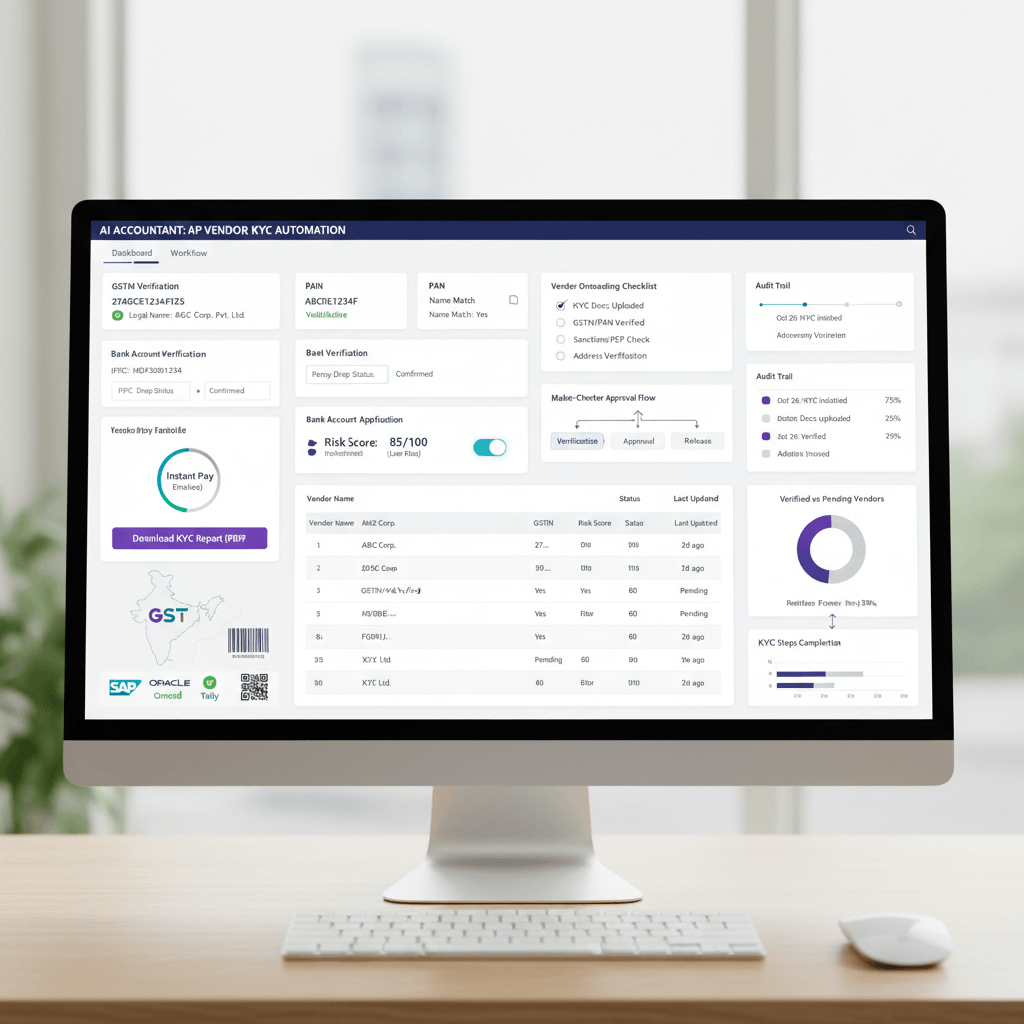
Direct API checks confirm registration status, legal name, trade name, constitution, and addresses, before a vendor record is created.
PAN authentication
Deeper than format checks, tools confirm authenticity, holder type, name match, and activation status, and cross link PAN to GSTIN.
Intelligent document parsing
OCR extracts fields from GST certificates, PAN cards, incorporation docs, and bank statements, eliminating manual keying.
Workflow automation
Structured onboarding, document collection, automated verification, exception routing, and approval trails, all in one flow.
Integrations
Connect with Zoho Books, Tally, QuickBooks, and SAP, push verified vendor masters automatically, and maintain a single source of truth.
Bulk verification
Upload Excel files, validate hundreds of vendors in parallel, and export results with clear status flags and error reasons.
How Automated Vendor Verification Works
Data extraction, vendors submit documents, OCR and intelligent parsing capture GSTIN, PAN, addresses, and bank details.
API checks, the system queries GST and income tax sources, confirms status and names, and validates bank accounts when enabled.
Reconciliation logic, extracted fields get compared to authoritative data, with discrepancies highlighted for action.
Exception handling, minor formatting issues auto correct, material mismatches trigger notifications, document resubmission, or manual review.
System sync, verified data creates or updates vendor records in your accounting system, including tax IDs, addresses, and terms.
Continuous monitoring, periodic rechecks catch GSTIN cancellations, suspensions, and PAN deactivations, so you act before credits get blocked.
Best Vendor Verification Automation Software in India
AI Accountant leads with end to end financial automation, extracting vendor details from bills, validating GSTIN and PAN in real time, and flagging mismatches before they hit your books. Native integrations with Zoho Books and Tally, plus intelligent duplicate detection, make it ideal for Indian SMBs and CA firms.
ClearTax provides dependable GST verification APIs, often embedded in onboarding workflows, and complements with e invoicing and GST compliance modules.
Zoho Books offers foundational checks for GSTIN and PAN structure during vendor creation, suitable for straightforward needs.
Tally Prime maintains vendor masters with format validations, while real time verification typically uses third party integrations.
Karza Technologies delivers enterprise grade APIs for GSTIN, PAN, Aadhaar, and bank validations, built for high volume use cases.
SignDesk streamlines digital onboarding, combining document collection, OCR extraction, and multi source verification with workflow automation.
Implementing Vendor Verification Automation
Prepare data, clean the vendor master, remove duplicates, standardize names, and assemble GSTINs and PANs for bulk checks.
Select tools, match needs to volumes and systems, for Zoho Books or Tally users, integrated platforms like AI Accountant are compelling.
Pilot first, start with 20 to 30 new vendors, validate extraction accuracy, exception paths, and approval steps.
Integrate, map fields, configure rules and tolerances, and test two way sync, including failure alerts and retries.
Train teams, clarify what is automated versus judgment based, provide quick guides for exceptions and document resubmissions.
Roll out in waves, apply to all new vendors, then re verify active suppliers in batches, archive inactives last.
Refine continuously, monitor failure patterns, tune rules, and optimize exception handling for speed and accuracy.
GST and PAN Verification Automation
GSTIN verification confirms format, registration status, legal and trade names, constitution, and addresses. The system also identifies registration type, regular or composition, captures registration dates, and retrieves multi state GSTINs where relevant.
PAN automation validates authenticity, holder type from the fourth character, name matching, and activation status. Cross checks ensure the PAN embedded in GSTIN matches the declared PAN.
Real time, always current validation prevents claiming ITC on invalid GSTINs and avoids TDS errors on inactive PANs.
Bulk mode, Excel uploads validate hundreds of GSTINs and PANs in parallel, returning clear pass or fail insights for cleanups and audits.
Integrating Vendor Verification with Accounting Software
Direct APIs, verification tools push verified vendors into Zoho Books or QuickBooks, and pull existing records for rechecks, keeping one source of truth.
Field mapping, align supplier names, GSTINs, PANs, and address components precisely to avoid data loss or corruption.
Workflow triggers, auto verify on PO creation, re verify on vendor detail changes, and block payments if status turns risky.
Platform specifics, Tally often relies on XML or Excel exchanges, Zoho Books supports real time APIs, QuickBooks may use middleware connectors when needed.
Error handling, log every sync, retry gracefully, alert on persistent failures, and never silently overwrite partially verified data.
Compliance and Regulatory Aspects
GST compliance, Rule 36(4) ties ITC claims to GSTR 2B, any GSTIN mismatch blocks credit. Automated verification and logs prove due diligence and support audits.
Income tax, Section 206AA mandates higher TDS for invalid PAN, automated PAN checks ensure correct rates and prevent compliance breaches.
KYC and vendor risk, businesses increasingly apply KYC principles, and vendor risk management automation strengthens identity, address, and legitimacy checks.
AML screening, high value or regulated sectors benefit from sanctions and PEP screening to reduce counterparty risk.
Data protection, tools should implement encryption, access controls, consent capture, and retention policies aligned with privacy requirements.
Regtech updates, service providers embed rule changes upstream, so you remain compliant without manual tracking.
ROI and Cost-Benefit Analysis
Time saved, 25 minutes per vendor manually drops to under 2 minutes of human time with automation, saving 20 hours a month at 50 new vendors.
Fewer errors, avoid 1 to 2 percent data mistakes that consume 30 to 45 minutes to fix, prevent costly GST mismatches that block ITC.
Penalty avoidance, prevent GST notices, interest, and professional fees that can run into tens of thousands per incident.
Scalable costs, handle growth without linear headcount, lowering per vendor verification cost as volumes rise.
Opportunity value, free CAs from clerical checks, let them optimize working capital, negotiate terms, and analyze vendor performance.
Faster cycle times, same day onboarding, quicker payments, and smoother month ends deliver operational gains beyond hard savings.
Common Challenges and Solutions
Change resistance, involve AP teams early, show how automation removes drudgery, and position them to manage exceptions and analytics.
Messy data, start with new vendors, then use bulk verification to fix legacy masters in waves, expect more flags at first, that means it is working.
Integration hurdles, lean on vendors who understand Indian stacks, start with file based sync if APIs are limited, add middleware for complex ERPs.
Vendor pushback, communicate benefits, faster payments and fewer clarifications, provide simple guides, and transition gradually to portals.
Budget concerns, model ROI with time, errors, and penalties, begin with entry plans or per verification pricing, then scale.
Edge cases, design exception paths for unregistered or foreign vendors, aim for 80 percent automation with smooth manual fallbacks.
Future of Vendor Verification in India
AI first, smarter extraction, anomaly detection, and risk scoring reduce manual reviews and improve precision.
Blockchain registries, shared, tamper evident identities could eliminate repeated verifications across customers.
Government rails, unified business registries and real time APIs will expand coverage and speed.
Predictive risk, behavior and compliance history will drive vendor risk scores, credit limits, and terms.
Integrated finance stacks, verification will live inside end to end AP suites, enabling clean data flow from onboarding to reconciliation.
Regtech by design, automatic rule updates will keep systems compliant without manual maintenance.
Conclusion
Automating vendor identity verification transforms onboarding from a manual slog into a fast, accurate, compliant flow. You shift from reactive fixes to proactive controls, from compliance anxiety to confidence, from data entry to data analysis. Start with new vendors, integrate with your accounting system, tune exception paths, and scale in batches. Every month without automation means more manual work, more errors, and more risk. Build your baseline of time spent, errors found, and notices received, evaluate tools against this reality, and move quickly toward a system where verification is solved, not struggled with.
FAQ
How can I automate GSTIN and PAN verification without disrupting my current Tally process?
Run a parallel pilot, use a verification tool that exports Tally compatible XML or Excel, validate new vendors in the tool, then import verified masters into Tally. AI Accountant supports this staged approach, so your team keeps its familiar flow while data quality improves.
What is the fastest way for a CA firm to bulk verify a client’s 2,000 vendor GSTINs before audit?
Export the vendor list to Excel with GSTIN and PAN columns, upload to a bulk verification module, and download results with pass or fail flags. With AI Accountant, firms complete thousands of checks in minutes and attach logs to audit workpapers.
How do I handle vendors whose GST registration is suspended mid month, can the system block invoices automatically?
Enable continuous monitoring and workflow rules, when status turns suspended, the tool flags the vendor, halts invoice posting or payment, and alerts AP and tax teams. Re verification on status change reopens processing once compliance returns.
Can I map verification status into Zoho Books so AP staff see it during bill creation?
Yes, integrate via API, write the verification status and timestamp to custom fields in the vendor master, and trigger re verification if key fields change. AI Accountant syncs this in real time, so AP sees a clear green or red state while entering bills.
What tolerance rules should I set for address mismatches between GST and vendor documents?
Use strict matching for PIN code and state, and lenient matching for street lines to accommodate abbreviations. Flag material differences for review, for example, different cities or states, while auto approving formatting variations.
How does automation reduce ITC blockage risk during GSTR 2B reconciliation?
By validating GSTIN and legal names at onboarding, and monitoring status changes continuously, invoices from invalid or cancelled GSTINs get stopped before posting. This prevents ineligible ITC from entering the returns workflow.
What exception paths do I need for unregistered vendors supplying below threshold?
Create a non GST vendor category, skip GSTIN checks, but still validate PAN and bank details. Apply reverse charge rules where applicable, and document exception approval in the workflow for audit readiness.
Can I verify bank accounts and match beneficiary names to vendors in the same flow?
Yes, many tools add penny drop or API based bank verification. AI Accountant supports account existence checks and name matching, reducing payment failures and beneficiary fraud.
How should I price vendor verification for multiple SME clients as a CA, per vendor or subscription?
For seasonal onboarding, per verification pricing is cost efficient, for steady volumes, a subscription with bundled checks lowers unit cost. AI Accountant offers both models, letting firms align costs with client needs.
What audit evidence will satisfy officers that I performed adequate vendor due diligence?
Provide system generated logs showing verification dates, sources queried, response snapshots, and exception resolutions. Attach these to the vendor record and your audit file to demonstrate consistent, policy driven KYC.
How do I integrate verification into my PO workflow so risky vendors cannot receive POs?
Set a rule that PO creation requires a green verification status, if a vendor is unverified or failed, the system routes to exception approval or blocks the PO. AI Accountant exposes this status via API for procurement checks.
What measurable ROI can I present to management for a verification project?
Quantify time saved per vendor, error correction hours avoided, historical penalties and interest prevented, and working capital gains from faster onboarding. Most CA led implementations recover costs within one quarter, and save ₹3 to ₹5 lakhs annually for SMB clients.