-01%201.svg)
Key takeaways
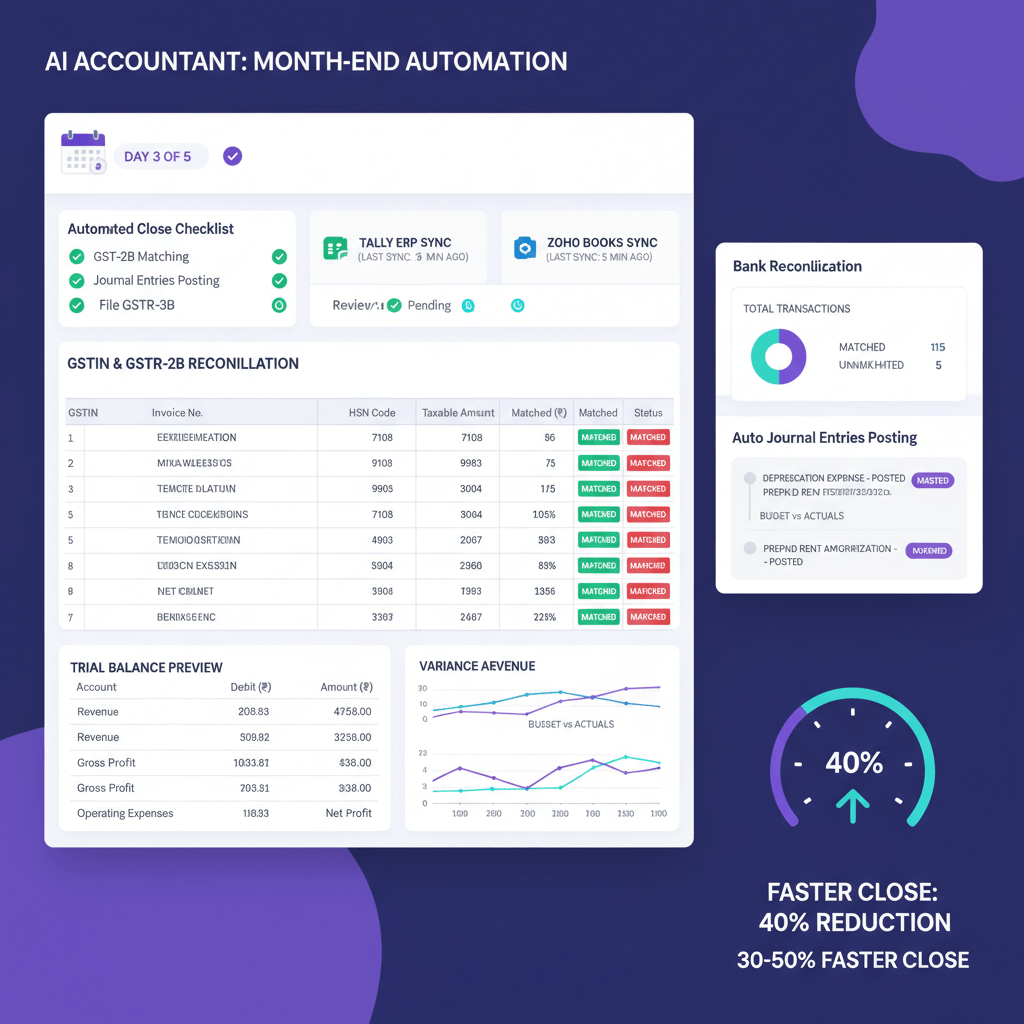
- Indian CA firms can reduce month end workload by 30 to 50 percent with seven targeted automations, from AP capture to GST reconciliation.
- Rolling closes, not end of month batching, are the backbone of faster, cleaner books, with fewer late discoveries and rework.
- Standardized intake, AI assisted mapping, and two way sync with Tally and Zoho Books remove duplicate masters and posting errors.
- Materiality thresholds and exception queues focus human effort where it matters, improving speed and audit readiness.
- Real time dashboards shift partners from reactive firefighting to proactive cash, AR, and AP management.
- A two week pilot across three to five clients is enough to prove time savings, accuracy gains, and team adoption.
- Tools like period end closing automation India guides show repeatable playbooks for success.
What Month End Close Looks Like for Indian CA Firms Today
Every month, bills stack up, bank statements arrive late, and GST mismatches surface during crunch time. Teams on Tally and Zoho Books juggle AP bill capture, bank and card ingestion, categorization, AR and AP linking, GSTR 2B reconciliation, and partner dashboard updates. Add master mismatches, messy WhatsApp PDFs, and delayed client inputs, and you get 10 to 15 days of overtime.
Result: seniors spend hours on repetitive data entry, juniors make avoidable errors, and partners lack cash visibility until it is too late.
For benchmarks and playbooks tailored to India, see the period end closing automation India guide and this perspective on using workflow automation to reduce month end close cycle in India.
Root Causes of Overload and Delays
- Unstructured inputs, PDFs, images, and Excel files with inconsistent headers demand manual cleanup.
- Duplicate masters and missing invoice fields drive vendor and GSTIN mismatches.
- End of month tagging creates backlogs, weekly rolling closes would prevent pileups.
- Tool fragmentation scatters data across emails, Excel, and accounting files, limiting single source truth.
- Late exception discovery causes cascading rework and people bottlenecks.
These are common across firms, as outlined in month end close automation research, alongside India specific nuances in the period end closing automation India guide and workflow automation close cycle best practices.
Framework to Cut Month End Close Time India
Standardize intake, mandate shared templates and bulk ingestion with validations, stop accepting random formats.
Shift left reconciliation, move to weekly rolling closes, catch and clear issues sooner.
Automate with AI and rules, let technology map and match, humans review exceptions only.
Materiality thresholds, auto approve immaterial items, route material breaks to queues.
Client SLAs, automate nudges and checklists so documents arrive on time.
Live dashboards, provide real time cash, AR, and AP visibility for proactive decisions.
Helpful primers include India centric closing frameworks, workflow automation close cycle insights, global process benchmarks, and a look at how AI agents automate month end close.
7 Practical Automations to Automate Month End CA Firm Work
1. AP and Bills Automation
Bulk ingest PDFs, images, Excel, and CSVs at once. India aware OCR extracts fields from even blurry scans. Automated vendor checks flag GSTIN or address mismatches for quick fix, with row level error reports.
Impact: up to 60 percent faster bill processing, roughly 40 hours saved per 500 monthly bills.
Explore detailed steps in the period end closing automation India guide and this overview of month end automation.
2. Bank and Credit Card Statement Ingestion
Indian banks use different formats, SBI, HDFC, ICICI, and more. Statement ingestion automation normalizes layouts, cleans dates and narrations, and structures debit and credit columns, ready for posting.
Impact: 2 to 3 hours saved per client monthly, a full work week regained across 20 clients.
Implementation guidance appears in India specific close playbooks and workflow automation close cycle notes.
3. Transaction Mapping, Matching and Cleanup
AI predicts ledgers, vendors, and types using historical patterns. Review, approve in bulk, and auto link payments to invoices, including splits and transfers without manual tedium.
Impact: a Bangalore firm cut categorization from 8 hours to 45 minutes per client.
See broader context in month end automation and how AI agents automate month end close.
4. Sync with Zoho Books and Tally
Two way sync keeps masters clean and prevents duplicates. Validated data posts back to your books without manual checks, reducing mismatch churn.
Impact: firms report 75 percent fewer discrepancies during audits.
Reference the India centric closing automation guide for checklists.
5. GST Reconciliation with GSTR 2B
GST reconciliation moves earlier in the month, not just at close. Standardize purchase registers, JVs, credit and debit notes, and GSTR 2B, then track statuses with clear tags to surface ITC risks in time.
Impact: a Mumbai firm reduced reconciliation from 2 days to 3 hours per client, catching 40 percent more ITC issues pre filing.
Learn more in the period end closing automation India guide and workflow automation close cycle playbook.
6. Real Time Dashboards
Partners get instant views of cash, AR and AP aging, and spend categories. Mid month blocker alerts drive timely action on collections and unusual outflows.
Impact: shifts the firm from reactive fixes to proactive working capital management.
Benchmarks available in India focused guides and automation research.
7. Multi Org Support
Manage many clients under one login with role based access. The AI adapts to each org, learning manufacturing versus services patterns for better predictions.
Impact: eliminates client by client workarounds, reduces context switching time.
Reference design considerations in the period end closing automation India guide.
Real World Success Story
A Pune based firm serving 25 clients implemented the seven automations. Within 60 days, close time fell 42 percent, bill processing touchpoints dropped 55 percent, and on time closes jumped from 7 to 21 clients. Juniors took on more, seniors shifted to advisory, partners finally had live visibility.
We expected resistance, instead the team embraced tools that removed repetitive work, said the senior partner.
See similar outcomes in the India case examples roundup.
Your 2 Week Pilot Plan for Measurable Wins
Pick three to five medium volume clients on Tally or Zoho Books, ones open to new workflows, and avoid your most complex accounts initially.
Week 1: Foundation Building
- Connect orgs, sync masters, and upload two months of bills and statements.
- Let the AI learn mappings, run the first reconciliation, and note exception patterns.
- Create exception queues, train the team, and document friction points.
Week 2: Optimization and Scaling
- Move to twice weekly rolling closes, refine AI suggestions via bulk edits, and push clean data back to books.
- Enable partner dashboards, track processing time and error rates, and gather feedback.
- Wrap with a data backed review of savings and accuracy improvements.
Pilot design references: workflow automation close cycle, period end closing automation India, and close automation benchmarks.
Measuring Success and ROI
- Close time per client, expect 30 to 50 percent reduction.
- Manual touches per bill or transaction, aim to halve them.
- Exceptions per 100 transactions, target below 10 percent for routine items.
- Rework percentage, drive below 5 percent as learning stabilizes.
- On time closing rate, reach 80 percent or higher.
- AR and AP aging, shorten cycles through faster processing.
Metric templates and industry context are outlined in India centric close guides and this review of month end automation.
Building the Internal Business Case
Time Savings That Scale
Quantify hours saved per 1,000 transactions or 100 bills, then show reinvestment into advisory. A 10 person firm can reclaim 120 to 150 hours monthly, equivalent to a senior hire, without salary cost.
Quality and Compliance Improvements
Fewer GST mismatches, fewer penalties, and stronger audits through standardized workflows and audit trails. Look for ISO 27001 and SOC 2 controls, with role based access and encryption.
Reference points: workflow automation close cycle benefits and India focused controls checklists.
Addressing Common Objections
AI will not be accurate enough
Modern AI, with human in the loop review, learns quickly, surpassing 95 percent accuracy after a short period.
Our clients send messy documents
That is exactly why you automate intake. OCR and validation rules catch errors before they enter your books.
We already have too many tools
Think of automation as a prep layer between sources and your accounting system, it cleans and structures data for Tally or Zoho Books.
What about data security
Choose platforms with bank grade encryption, ISO 27001, and SOC 2. Enforce least privilege access.
Deeper context: how AI agents automate month end close, workflow automation close cycle, and India implementation notes.
Quick Wins Checklist for Immediate Impact
- Standardize bank and card statement formats, enforce client templates.
- Adopt weekly rolling closes for your top five clients.
- Resolve your top 20 vendor master mismatches this week.
- Create 10 to 15 high volume mapping rules to seed AI accuracy.
- Move to daily exception review queues, not month end batches.
- Schedule a mid month GSTR 2B reconciliation with status tracking.
- Publish basic cash dashboards for partners and act on top five overdue receivables.
Recommended Accounting Automation Tools
- AI Accountant, purpose built for Indian CA firms, with native Tally and Zoho Books integrations, GSTR 2B reconciliation, and multi org support
- QuickBooks Online, cloud accounting with basic automation and a broad app ecosystem
- Xero, strong bank reconciliation and invoice automation, GST features may need Indian customization
- FreshBooks, suitable for smaller firms with simple automation and invoicing
- Sage Business Cloud, enterprise grade workflows and automation for larger practices
- Wave Accounting, free starter option, limited scalability for growing firms
Start Your Automation Journey Today
Begin with a 20 minute workflow audit, pick one painful process, then run a focused two week pilot. The sooner you start, the sooner overtime fades and accuracy rises.
For structured next steps, review period end closing automation India, compare with workflow automation close cycle practices, and validate against automation benchmarks.
FAQ
How can a CA firm reduce month end workload without disrupting client operations?
Start with standardized intake and rolling closes across three to five cooperative clients, then layer in AI assisted mapping and automated reconciliations. Tools like AI Accountant sit between your sources and Tally or Zoho Books, cleaning data without changing client behavior.
What is the fastest way to cut close time in India on Tally or Zoho Books?
Combine OCR based bank statement ingestion, two way master sync, and weekly rolling closes. As shown in the period end closing automation India guide, these three moves alone often deliver 40 to 50 percent time reduction.
Which month end processes should I automate first to show quick ROI?
Prioritize high volume, low judgment tasks, bill capture, bank and card statement normalization, transaction mapping, and basic payment matching. Many firms using AI Accountant report immediate cycle time drops in these areas.
How do I manage GST reconciliation with GSTR 2B proactively, not at the last minute?
Standardize purchase registers and GSTR 2B inputs, then run mid month reconciliations with status tags. This approach, detailed in workflow automation close cycle resources, flags ITC risks early so you can collect missing invoices on time.
What exception thresholds should a CA firm use for efficient reviews?
Set materiality based auto approvals for low value variances, for example up to a client agreed limit, and route only higher exceptions to queues. Over two to three cycles, tune thresholds as your exception rate falls below 10 percent.
How accurate is AI based transaction mapping for Indian ledgers and GST contexts?
With bulk review and learning from corrections, accuracy typically rises above 95 percent after the first cycle. Firms using AI Accountant often seed accuracy further with 10 to 15 mapping rules for their most common vendors and narrations.
Can automation handle multi org complexity across manufacturing, trading, and services clients?
Yes, choose platforms with multi org support and role based access. The AI should learn org specific patterns, for example recurring narratives from manufacturing ERPs versus service retainers, and propose context aware mappings.
How do partners get real time visibility without waiting for month end reports?
Enable live dashboards for cash, AR and AP aging, and spend categories. Mid month alerts on blockers and unusual outflows help partners intervene early, a best practice emphasized in month end automation benchmarks.
What are the security checkpoints I must validate before adopting an AI accounting tool?
Insist on encryption at rest and in transit, ISO 27001 certification, SOC 2 Type II, audit trails, and least privilege access. Document a data flow diagram and vendor responsibilities before onboarding a tool like AI Accountant.
How should a CA firm structure a two week pilot to prove value to partners?
Pick mid complexity clients, define baseline KPIs, close time per client, manual touches per document, and rework percentage, then run two rolling closes. End with a side by side metric review and a go, no go decision for expansion.
What KPIs best capture automation ROI for a CA practice in India?
Track close time, exceptions per 100 transactions, rework rate, on time close percentage, AR and AP aging shifts, and partner time reallocated to advisory. Templates are outlined in India centric close guides.
Does automation replace Tally or Zoho Books, or does it augment them?
It augments them. The automation layer ingests, validates, maps, and reconciles, then syncs clean transactions into Tally or Zoho Books. Firms using AI Accountant report fewer master mismatches and smoother audits, while continuing with their preferred books of record.