-01%201.svg)
Key takeaways
- GSTR-2B is a static monthly snapshot that drives what you can claim in GSTR-3B, so timely reconciliation is essential to avoid interest, penalties, and cash flow leakage.
- Modern tools automate matching between purchase registers and 2B using fuzzy logic, vendor wise buckets, and amendment handling, far outpacing manual spreadsheets.
- Elite platforms optimize ITC by classifying eligible, deferred, and ineligible credits, correctly netting credit notes and handling RCM transactions and ITC reversals.
- Vendor follow up automation, dashboards, and proactive alerts reduce missed invoices, improve vendor behavior, and speed up month end.
- Expect 80 to 90 percent time savings, higher match rates, and 5 to 10 percent more ITC realization with automation, especially at volume.
- Evaluate tools on accuracy, integrations, pricing, and security, then pilot with three months of real data before a full rollout.
Understanding GSTR-2B and why monthly reconciliation matters
Think of GSTR-2B as your monthly report card for input tax credit. It is a frozen snapshot compiled from supplier GSTR-1 filings, and it is the legal basis for what you can claim in GSTR-3B totals. Unlike GSTR-2A, which is dynamic, 2B is static, includes amendments and credit notes, and excludes provisional credits, so reconciling every month is non negotiable.
Without proper tools, manual VLOOKUPs crumble, invoice numbers misalign, GSTINs are inconsistent, and timing differences appear. The result is either short claiming ITC, or over claiming and inviting notices.
Pro tip: Ground your team in the difference between GSTR-2A and 2B, then explore the ICAI AI tool use case to see how practitioners operationalize monthly reconciliation at scale.
Key features every GSTR 2B reconciliation tool must have
Match purchase register capabilities
Your tool should auto import purchase registers from Tally, Zoho Books, or Excel, normalize formats, and use configurable fuzzy matching on GSTIN, invoice number, date, and value. It must handle amendments and bill to ship to flows accurately. For a detailed primer, study GSTR-2B vs purchase register reconciliation.
Identify missing invoices and duplicates
Powerful tools bucket data into PR only, 2B only, duplicates, and mismatches. They allow vendor, month, and rate wise drill downs, so you can spot late filers and systemic data entry issues, then export audit ready evidence. A practical walkthrough is here, GSTR-2B vs purchase register reconciliation, a step by step guide.
ITC claim optimisation features
Look for automated categorization of eligible, deferred, and ineligible credits, full coverage of Section 17(5), proper netting of credit notes and debit notes, and RCM logic aligned to law. Deep dives: reverse charge mechanism accounting in India, input tax credit reversal automation, and the broader GSTR-2B guide and reconciliation.
Vendor follow up automation
Great systems generate discrepancy packets and send vendor wise reminders via bulk email or WhatsApp, with templates, status tracking, and escalations, so you close gaps before the supplier GSTR-1 deadline. See the ICAI AI tool use case for a practitioner view.
Monthly dashboard and reporting
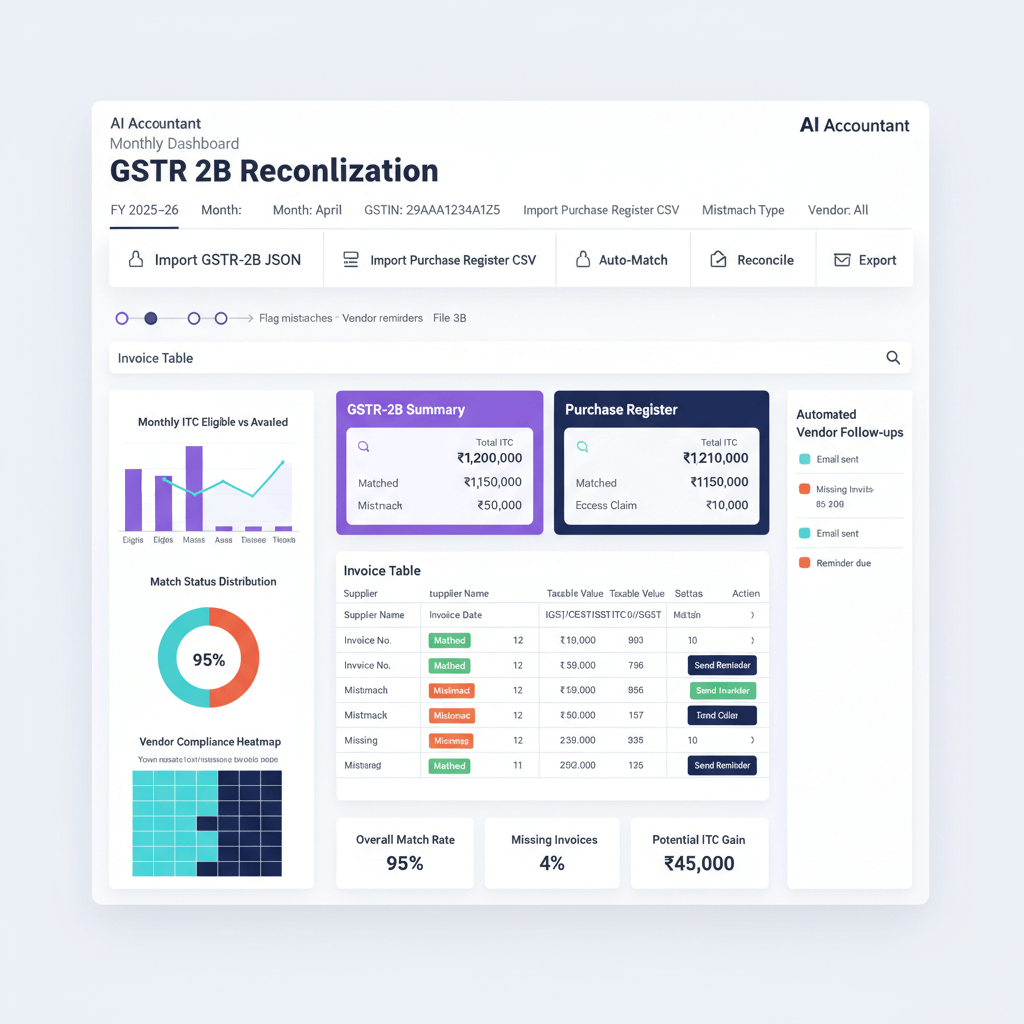
Dashboards should highlight ITC availed versus eligible, at risk amounts, top defaulting vendors, and month over month trends, with heat maps and aging analysis to prioritize action. For inspiration, review a GST health check dashboard.
Comparing GSTR 2B reconciliation tools in the market
Top software options for different business needs
- AI Accountant, AI powered matching, seamless Tally and Zoho integrations, and proven scale across hundreds of millions of transactions, ideal for CA firms and SMEs.
- ICAI AI Tool, an offline utility with multi file handling, comfortable for desktop focused workflows.
- GSTHero, strong fuzzy matching for businesses laser focused on GST compliance.
- ClearTax GST Software, capable reconciliation inside a broader GST suite, convenient for existing users.
- Zoho GST, native for Zoho Books, suitable for simple use cases.
- Tally Prime GST features, helpful for in product checks, though not as deep as dedicated tools.
Manual spreadsheets vs automated tools
Excel and VBA can feel familiar, yet they miss edge cases, struggle with scale, and plateau at around sixty percent matching. Automated tools consistently deliver eighty five percent or higher matches, and shrink hours of work to minutes. For an illustration, see this monthly automatic GSTR-2B vs books Excel tool, then compare capabilities with modern platforms.
Implementation guide for GSTR 2B reconciliation tools
Pre implementation checklist
- Clean purchase registers, validate GSTINs, and refresh vendor masters.
- Prepare opening balances and historical data for a quick migration.
- Document the current process and cycle time, so improvements are measurable.
Setting up your reconciliation workflow
- Connect APIs or importers for Tally or Zoho, and map fields carefully.
- Define user roles and approvals, restrict edits post reconciliation.
- Dry run three months of data, verify exports, and tune matching thresholds.
Best practices for monthly reconciliation
Adopt a weekly cadence, not a last week scramble, lock periods after sign off, standardize invoice entry formats, and train AP teams for clean data. Educate vendors on filing timelines, share vendor scorecards, and publish exception trends. A solid workflow guide is here, GSTR-2B vs purchase register reconciliation, a step by step guide.
ROI and business impact of reconciliation automation
Time and cost savings analysis
Automation typically saves eighty to ninety percent time. A CA firm with twenty clients might compress two to three days of manual work per client into two to three hours, freeing over forty days annually for higher value advisory.
ITC recovery and compliance benefits
Recover five to ten percent more ITC through better matching and vendor nudges. For purchases of ₹1 crore a month at eighteen percent GST, that is ₹90,000 to ₹1.8 lakh more ITC annually, besides avoiding eighteen percent interest and penalties on errors. The ICAI AI tool use case echoes this, with double digit ITC improvement and drastic cycle time reduction.
One distributor with three GSTINs lifted ITC realization by twelve percent, cut closing from seven days to two, and unlocked lakhs from long missed credits.
Choosing the right tool, an evaluation framework
Technical requirements assessment
Clarify must haves, Tally or Zoho integration, invoice volumes, multiple GSTINs, and special scenarios like imports and RCM. Seek at least eighty five percent automated matches, and insist on proof using your anonymized data.
Pricing models and total cost of ownership
Compare per GSTIN versus per transaction pricing, include onboarding, training, API, and support fees, and watch out for storage caps or historical processing charges. A helpful perspective on pricing and value can sharpen your TCO view.
Security and compliance considerations
Expect ISO 27001 certification and SOC 2 type II, robust access controls, audit logs, backups, disaster recovery, and strong SLAs. Month end downtime is costly, so verify commitments and monitoring.
Common challenges and solutions
Dealing with vendor non compliance
Publish vendor scorecards on GSTR-1 filings, link payment terms to compliance, and coordinate with procurement. Automated nudges, evidence packets, and escalations drive timely action.
Handling complex reconciliation scenarios
Bill to ship to, advances, and inter state operations demand precise configuration. Document scenarios, test with edge cases, and write SOPs for exceptions that need manual review.
Managing change resistance
Address concerns with a pilot, show quick wins, and appoint power users as internal champions. When teams see reconciliation finished before lunch, adoption accelerates.
Future of GSTR 2B reconciliation
AI and machine learning integration
AI learns from your past decisions, boosts match quality, and reduces manual work. NLP extracts data from semi structured documents, while vision models read scans reliably.
Real time reconciliation possibilities
As e invoicing spreads, near real time validations become practical, catching issues at creation rather than month end. Early adopters already match via APIs during invoice generation.
Integration with broader financial automation
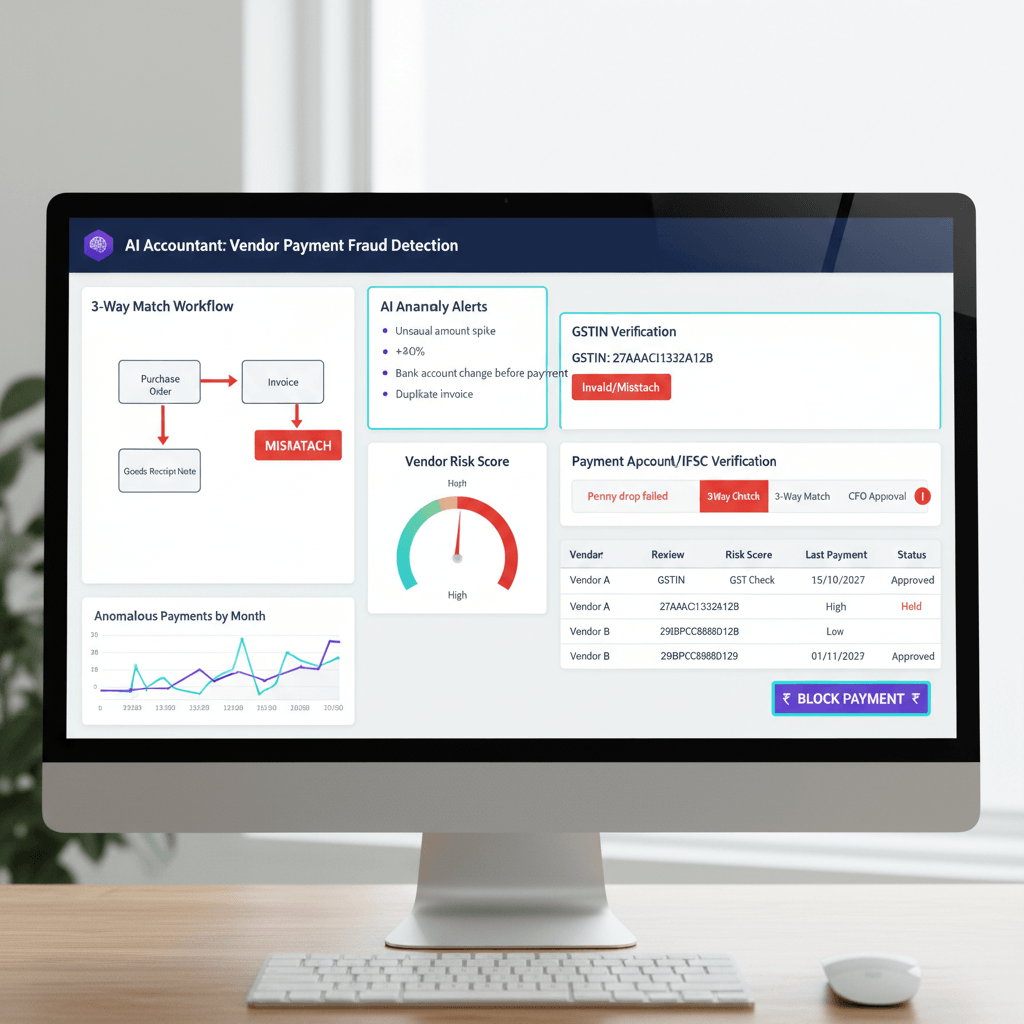
Reconciliation is converging with AP automation, onboarding, three way matching, and payments. This mirrors the evolution of modern GST reconciliation software and platforms like AI Accountant that unify bills, bank statements, and analytics for end to end visibility.
Vendor due diligence questions
- What matching accuracy do you achieve on amendments, back dated entries, and RCM, with evidence on my data set?
- How do you support multiple GSTINs and inter branch transfers, including consolidation and entity wise reporting?
- What is your SLA for adapting to GST law changes and portal updates, measured in days, not weeks?
- Which security certifications do you hold, what is your data residency, backup frequency, and log retention?
- What exactly is included in base price, what is add on, and how are API calls, users, and history billed?
- What is the typical implementation timeline, who leads onboarding, and what post go live support is guaranteed?
Conclusion, making your decision
Choosing the right GSTR 2B reconciliation tool turns month end chaos into a calm, reliable close. Automated matching, missing invoice detection, and ITC optimization pay back quickly, while dashboards and vendor automation build discipline across your supply chain.
Document pain points and desired outcomes, evaluate with real data, and favor usability and support alongside technical depth. A pilot de risks your rollout and builds internal confidence.
Modern reconciliation is not only compliance, it is financial control and visibility. With solutions like AI Accountant, you can unify reconciliation with broader finance automation, letting your team focus on analysis, not admin. Start your evaluation this week, and give your next close a stress free finish.
FAQ
How should a CA structure a step by step GSTR-2B vs purchase register reconciliation to maximize eligible ITC?
Start with clean vendor masters, then import 2B and purchase registers into an automated tool, run fuzzy matching on GSTIN, invoice number, date, and taxable value, bucket results into matched, PR only, 2B only, mismatches, and duplicates, apply rule based ITC classification for Section 17(5), RCM, imports, and credit notes, simulate GSTR-3B impact, and lock the month post approval. Tools like AI Accountant streamline this with guided workflows and approval checkpoints.
What matching logic thresholds should I configure for partial matches so I do not miss genuine credits?
Set confidence thresholds separately for invoice number similarity and value variance, for example, 85 percent for invoice text similarity, and ±1 to 2 percent for value where rounding or freight differences occur. Enable GSTIN exact match as a hard rule, and allow date tolerance of the return period plus one month for late filers. AI Accountant provides preset templates that you can tune per client volume and risk appetite.
How do RCM entries and Section 17(5) blocked credits flow through reconciliation and GSTR-3B reporting?
RCM liabilities sit outside supplier 2B, so the tool should auto identify RCM from purchase registers, compute tax payable in cash, and place ITC eligibility only after payment and booking of self invoice. Section 17(5) items like motor vehicles or personal consumption must be flagged ineligible at source. AI Accountant tags these via rule libraries and pushes the correct amounts into 3B tables for a clean audit trail.
What documentation should I share with clients before filing GSTR-3B to evidence ITC positions?
Provide a reconciliation pack, matched summary, PR only and 2B only lists, mismatch report with reasons, credit note netting proof, RCM computation sheet, and an ITC eligibility, deferred, and ineligible breakdown. Include a vendor wise scorecard and an attestation page. AI Accountant exports this as a single client ready bundle.
How do I treat supplier invoices that appear late in the next month’s 2B, can I still claim ITC?
If law permits claim in a later period subject to annual time limits, mark such credits as deferred, not lost. Your tool should carry forward deferred items automatically, and alert you when they surface in the next 2B. AI Accountant maintains a deferred queue and reconciles it the moment the invoice hits 2B.
What data hygiene practices materially improve auto match rates beyond ninety percent?
Standardize invoice number formats, enforce correct GSTINs at vendor onboarding, capture invoice date and taxable value exactly as per supplier document, and restrict free text fields. Run monthly vendor master scrubs and train AP to avoid abbreviations in invoice numbers. AI Accountant’s data standardizer corrects common errors before matching.
Can I reconcile offline for sensitive clients, then sync the results back to Tally or Zoho?
Yes, many tools support secure desktop import and export, followed by controlled sync. Export matched and exception CSVs, post journals back to Tally or Zoho via connectors, and retain audit logs. AI Accountant offers both API first sync and offline CSV pipelines for regulated environments.
How do I operationalize vendor follow ups and SLAs to minimize ITC leakage?
Segment vendors by volume and historical delay, set weekly reminders during the filing window, escalate to finance heads for chronic delays, and link payment terms to GSTR-1 filing proof. Automate discrepancy packets with invoice level evidence. AI Accountant runs scheduled WhatsApp and email nudges, tracks acknowledgments, and reports SLA breaches.
What is the right approach to reconcile bill to ship to transactions and ISD credits?
Ensure GSTIN mapping reflects the bill to entity that claims ITC, validate place of supply and tax type, and for ISD, reconcile against the ISD’s GSTR-6 and the recipient’s books with cross entity matching. AI Accountant supports bill to ship to logic and ISD allocation trails so you can evidence correct credit flow.
What audit trail elements are essential to handle GST scrutiny confidently?
Maintain immutable logs of imports, match decisions, manual overrides with user and timestamp, rule versions, and export references that map to each 3B line item. Archive vendor communications and acknowledgments. AI Accountant’s audit log and evidence pack meet these needs and simplify departmental queries.
How do I quantify ROI for moving from Excel reconciliation to an automated tool?
Add labor hours saved per month, incremental ITC realized from recovered invoices, avoided interest and penalties, and reduced auditor rework. Subtract license, onboarding, and minor process change costs. Many CA firms see payback inside one to two months. AI Accountant’s dashboard includes a benefits tracker to make this transparent.
What security controls must a cloud reconciliation platform provide for client GST data?
Expect encryption at rest and in transit, role based access, SSO, granular permissions, IP restriction, continuous monitoring, regular backups, disaster recovery, and audit certifications like ISO 27001 and SOC 2. AI Accountant aligns to these controls and shares security documentation under NDA for enterprise reviews.

Rohan Sinha is a fintech and growth leader building aiaccountant.com, focused on simplifying accounting and compliance for Indian businesses through automation. An IIT BHU alumnus, he brings hands-on experience across 0 to 1 product building, growth, and strategy in B2B SaaS and fintech.