-01%201.svg)
Key takeaways
- GSTR-2B is the static source for ITC eligibility, reconciliation against your purchase register is essential to avoid cash leaks, notices, and reversals.
- Dedicated reconciliation tools reduce effort from days to hours, improve accuracy, and create an auditable workflow, see this GSTR-2B reconciliation tools overview.
- Prioritize fuzzy matching, missing invoice detection, ITC optimization, vendor follow up automation, and dashboards that support multi GSTIN operations.
- Seamless Zoho Books and Tally sync, robust error handling, and security certifications like ISO 27001 and SOC 2 are non negotiable for scale.
- Well implemented tools typically deliver 80 percent time savings and faster ITC realization, most teams see payback within a quarter.
Why GSTR-2B reconciliation matters
GSTR-2B is the government’s static view of your inward supplies, it anchors monthly ITC eligibility. Your purchase register, however, often contains supplier delays, corrections, or entry level mistakes. Reconciliation closes that gap, it matches invoices, highlights ITC risks, and produces a clear audit trail. For practical context, review this GSTR-2B reconciliation tools overview and a broader GST reconciliation software roundup.
Missed or delayed reconciliation is not a cosmetic issue, it directly affects cash flow through blocked credits, interest, and penalties.
Understanding your tool options
Manual spreadsheet methods
Downloading 2B files, stitching VLOOKUPs, and filtering exceptions can work for small volumes, beyond 1000 invoices, accuracy and time costs escalate quickly, partial matches and amendments are easy to miss.
Accounting software add ons
Zoho Books and TallyPrime have native 2B reports and imports, they solve straightforward matching, but complex exception handling, automation, and vendor follow ups typically need more capability.
Dedicated reconciliation tools
Purpose built systems bring automation, predictive matching, and collaboration:
- AI Accountant, fuzzy matching, ITC optimization, vendor automation, Zoho and Tally sync, proven at scale.
- ClearTax, capable 2B versus PR matching with a free tier for basics.
- GSTZen and EasyGST, strong missing invoice detection and reminders.
- Giddh, reconciliation with trend views for larger operations.
- Taxilla, enterprise focused, AI driven exceptions.
- IRIS Sapphire, built for CA firms handling many clients.
For teams on Zoho or Tally, AI Accountant stands out for predictive matching and multi GSTIN learning, explore the GSTR-2B reconciliation tools guide and an in depth comparison.
Core features to evaluate
Match purchase register capabilities
Look for fuzzy matching across GSTIN variations, invoice number formats, dates, and tax rounding differences, with duplicate detection and learning from user corrections. Ask vendors about credit notes, journal vouchers, row level upload errors, and accuracy on your sample data.
Identify missing invoices
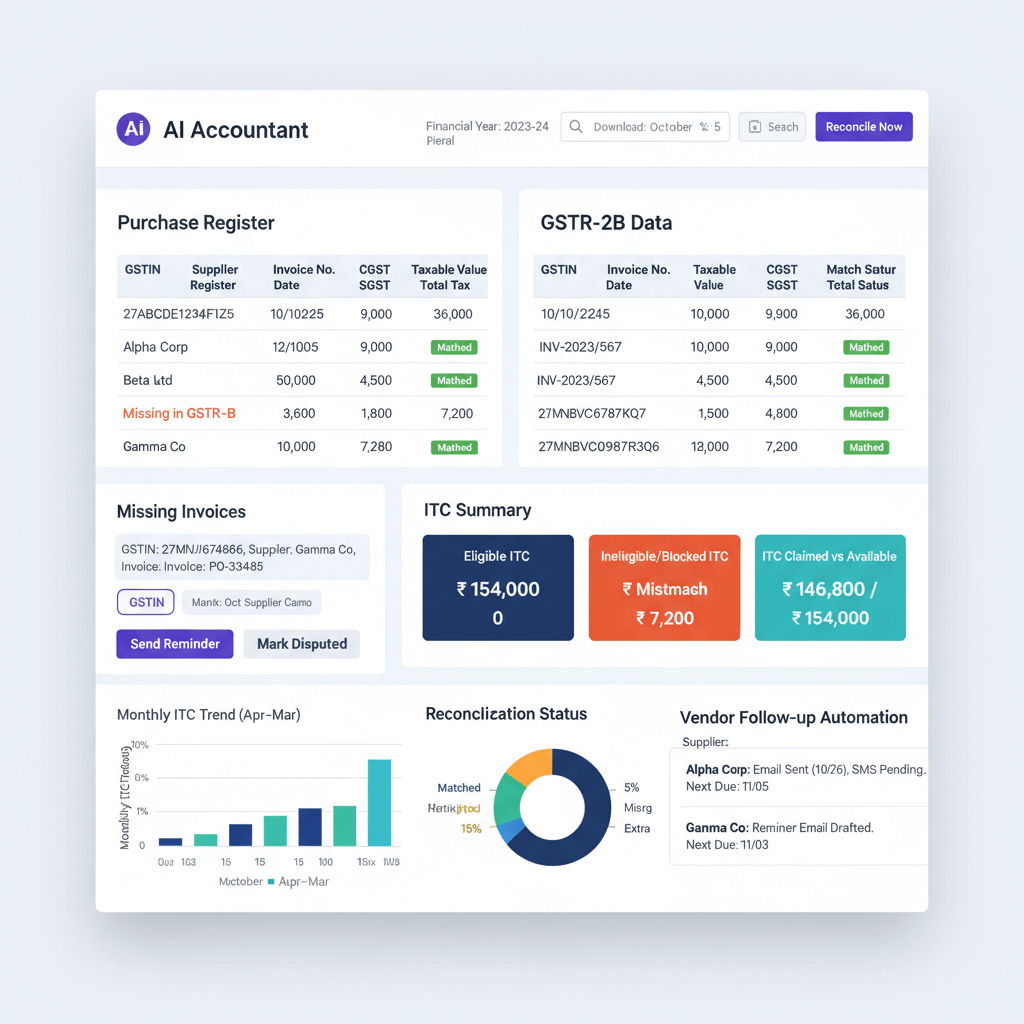
Strong tools categorize gaps into 2B only, PR only, and prior period amendments. Supplier wise lists and non filer flags make follow ups actionable. For context, see this deeper overview of 2B reconciliation.
ITC claim optimisation
Eligibility engines should apply Section 16 rules, handle RCM, blocked credits, and monitor the 180 day rule, review input tax credit reversal automation for best practices. Recommendation systems that suggest claim amounts with reasons help maximize compliant credits.
Vendor follow up automation
Templates for WhatsApp and email, escalation timelines, and communication logs reduce manual chasing. SLA views surface chronically late vendors, which informs payment terms.
Monthly dashboard and reporting
A concise monthly dashboard should summarize eligible, claimed, and blocked ITC, vendor heatmaps, and pending exceptions, with multi GSTIN consolidation and drill down to transactions.
Step by step reconciliation workflow
Step 1: Data import
Pull 2B via API or upload JSON or CSV, import your purchase register from Zoho or Tally in one click, validate masters and tax configurations.
Step 2: Automated matching
Run fuzzy logic on multiple parameters, surface exact, partial, and suggested matches, learn from your approvals to improve future runs.
Step 3: Exception management
Bucket unmatched records, tag PR only rows as vendor delays or non filing, flag 2B only rows for investigation, tie amendments and credit notes to original periods.
Step 4: ITC optimization
Apply eligibility rules, generate claim recommendations with reason codes, prep 3B mapping, document blocked or deferred credits.
Step 5: Vendor coordination
Send automated reminders with evidence logs, track acknowledgments, escalate based on timelines, export supplier wise lists for bulk outreach.
Step 6: Review and finalize
Validate summary, lock claims, push results back to Zoho or Tally, and generate management reports, a reference tool is the GSTR-2B purchase register matching tool.
Step 7: Archive and audit
Freeze the period, store version history and documents, maintain a clean trail for future reviews.
Accuracy, scale, and technical considerations
OCR accuracy on clean PDFs should exceed 95 percent. At scale, test 10,000 plus invoices for speed, error handling, and zero data loss. Deep integrations, open APIs, and webhooks enable real time workflows and custom extensions. Row level validation and clear error messages reduce rework.
Security, compliance, and multi organization support
Expect ISO 27001, SOC 2 Type II, encryption in transit and at rest, and regular penetration testing. For CA firms and multi GSTIN businesses, insist on entity segregation, role based access, consolidated dashboards, and organization specific learning. Automatic regulation updates, maker checker flows, and immutable audit trails are must haves.
ROI and cost benefit analysis
Time savings
Manual reconciliation often consumes 1 to 2 days per 1000 invoices, automated tools bring this down to a few hours, compounding savings across clients and months.
Cash flow impact
Earlier ITC claims and recovered credits improve working capital, avoiding reversals and interest protects cash.
Hidden costs to watch
Rigid data formats, training needs, and support responsiveness matter, tools that learn from your data reduce prep time.
Pricing models
Expect free tiers for basics, subscription or volume pricing for advanced automation, study an in depth comparison to benchmark value. A simple ROI model, time saved multiplied by team rates plus ITC recovered, compared with tool cost, usually pays back in two to three months.
Implementation timeline and change management
Week 1: Pilot setup
Onboard one GSTIN, load last month’s 2B and PR, set matching rules, and test vendor templates.
Week 2: Validation
Run parallel with your current method, reconcile differences, refine parameters, and train the core team.
Week 3: Go live
Migrate all entities, schedule auto syncs, finalize dashboards, and publish SOPs.
Prerequisites and change tips
Ensure GSTN credentials, clean masters, maker checker roles, and clear escalation paths. Start small, prove ROI, demo dashboards to win buy in, and celebrate early wins.
Common pitfalls and how to handle them
GSTIN and name mismatches
Vendor naming nuances are common, use fuzzy matching, and let the system learn from your confirmations for better future matches.
Amendments and partial invoices
Cross period linkages and partial matches require smart linking and splitting logic, maintain a visible amendment history.
RCM, CDNs, and rounding differences
Handle Reverse charge mechanism entries distinctly, link credit and debit notes to original invoices, set sensible tolerance levels for rounding.
Multi GSTIN complexity
Use entity segregation with consolidated oversight, for more nuances see this deeper overview.
Buyer’s checklist
Must have features
- Fuzzy matching for purchase register reconciliation
- Missing invoice identification with root causes
- ITC optimization rules engine
- Vendor follow up automation with templates
- Monthly dashboards with drill down capability
- Bulk processing for 1000 plus invoices
- Export functionality for reports
Nice to have features
- Real time GSTN data fetch
- OCR for scanned documents
- Multi GSTIN consolidated views
- Mobile access
- Custom workflow builders
- Advanced analytics and trends
Questions for vendors
- What is your matching accuracy on our sample data, and how do you measure it
- Can you demonstrate Zoho Books or Tally sync, both directions
- Do you have references from similar businesses, with similar volumes
- How do you handle amendments, RCM scenarios, and tolerance settings
- What happens to our data on cancellation, and how do we export it
- What support SLAs are included in your pricing
Real world success story
A Bangalore based CA firm managing 50 SME clients moved to AI Accountant. They cut reconciliation time from 5 days to 4 hours, achieved 95 percent auto matching, and recovered significant ITC via structured supplier nudges.
Result: Faster closures, cleaner audits, and a predictable, auditable process that clients trust.
They piloted with their five largest clients, proved ROI, then rolled out to all entities in eight weeks. Vendor automation alone saved double digit hours monthly.
Next steps and conclusion
Reconciliation can be a predictable process that protects cash, rather than a monthly scramble. Review the market overview, shortlist tools using the checklist above, then request a pilot using your own data. For structured evaluation, use this GSTR-2B reconciliation tools guide.
The best choice is the one that fits your workflow, integrates cleanly, and scales with your clients and GSTINs.
FAQ
How should a CA approach 2B versus purchase register reconciliation for month end closure, what checks are non negotiable
Start with automated matching, then bucket exceptions into PR only, 2B only, and amendments. Non negotiables include GSTIN validation, invoice number normalization, date tolerance checks, tax break up verification, and duplicate detection. A tool like AI Accountant provides reason codes and maker checker approval so your audit trail remains clean.
What matching rules work best for invoice number and date variations in 2B compared to PR
Use normalization rules for special characters, case insensitivity, and common prefixes or suffixes, along with date windows and tax amount tolerances. Fuzzy matching with confidence scores lets reviewers prioritize high probability pairs first. AI Accountant learns from your approvals, improving accuracy over time.
How do I treat ITC on RCM, and can the tool post the journal impact for GSTR 3B automatically
RCM ITC is claimed on self invoiced supplies subject to eligibility, separate it from forward charge flows and map to the correct 3B tables. Advanced tools generate or export the JV for your ERP and maintain a clear audit trail, AI Accountant supports automated mapping with review checkpoints.
How should I handle quarterly filing vendors under QRMP while reconciling monthly 2B
Flag QRMP suppliers, expect timing differences, and schedule follow ups aligned to their filing cycle. Maintain separate exception views for quarterly filers so your team does not chase invoices prematurely. Automated reminders can be timed for post filing windows.
What is the right tolerance for rounding differences, and how do I audit it
Set a per invoice absolute or percentage tolerance consistent with your policy, log every auto clearance within tolerance with before and after values, and include a monthly exception report for management. This gives your reviewers confidence without manual drudgery.
How do I map credit and debit notes to original invoices when suppliers amend past periods
Use reference numbers, GSTIN, and tax amounts with fuzzy linking where references are missing. A good tool threads the original invoice and all amendments, presents net ITC impact by period, and keeps a view for audit and GSTR 9C preparation.
What maker checker controls should I insist on before posting results back to books
Require role based access, preparer and approver separation, comment trails, and immutable timestamps. Approvals should be at exception and summary levels. Only approved items should sync back to Zoho or Tally with a reconciliation reference number.
What evidence should I collect to validate data security, ISO 27001 and SOC 2 claims
Request current ISO 27001 certificate, SOC 2 Type II report, data flow diagrams, encryption details, and results of recent penetration tests. Ensure vendor policies cover backups, retention, and incident response. AI Accountant maintains ISO 27001 and SOC 2 Type II with regular audits.
Can I push reconciled statuses back to Tally or Zoho without breaking ledgers
Yes, use native integrations that map vendor masters and tax ledgers correctly, restrict updates to reconciliation tags, references, and approved JVs only. Run a dry run in a sandbox, then schedule syncs during low traffic windows.
How do I configure 180 day rule monitoring, automated ITC reversal, and re claim in a practical workflow
Enable invoice age tracking with supplier wise views, trigger reversal entries at 181 days with reason codes, and auto re claim once payment clears. See principles in input tax credit reversal automation, AI Accountant automates reversal and re claim with maker checker control.
What is a realistic implementation plan for a 10 GSTIN group, including change management
Pilot one entity in week one, validate in week two, and roll out the rest by week three or four. Prepare SOPs, train champions in each entity, and track early wins in a dashboard to sustain adoption.
How does an AI driven tool like AI Accountant learn from my corrections, and can I export that learning
The system records approved matches and exception resolutions, then updates matching weights and patterns. Over time, confidence scores increase and review queues shrink. You can export rule snapshots and exception policies for audit or replication in new entities.
What reports do I keep ready for GSTR 9C or a departmental audit after reconciliation
Maintain period wise reconciliation summaries, exception logs with resolutions, supplier communication logs, amendment histories, and ITC eligibility reason codes. A single compliance pack with these artifacts reduces audit time significantly.
How do I compute ROI on a reconciliation tool for my firm, any simple formula
ROI equals, hours saved per month multiplied by billing rate, plus monthly ITC recovered, minus subscription and training cost. Many CA firms recover tool cost in two to three months due to time savings and credit recoveries, especially when vendor automation is used.

Rohan Sinha is a fintech and growth leader building aiaccountant.com, focused on simplifying accounting and compliance for Indian businesses through automation. An IIT BHU alumnus, he brings hands-on experience across 0 to 1 product building, growth, and strategy in B2B SaaS and fintech.