-01%201.svg)
Key takeaways
- Modern GSTR 2B reconciliation tools cut reconciliation time by up to 80 percent, while improving Input Tax Credit recovery and audit readiness.
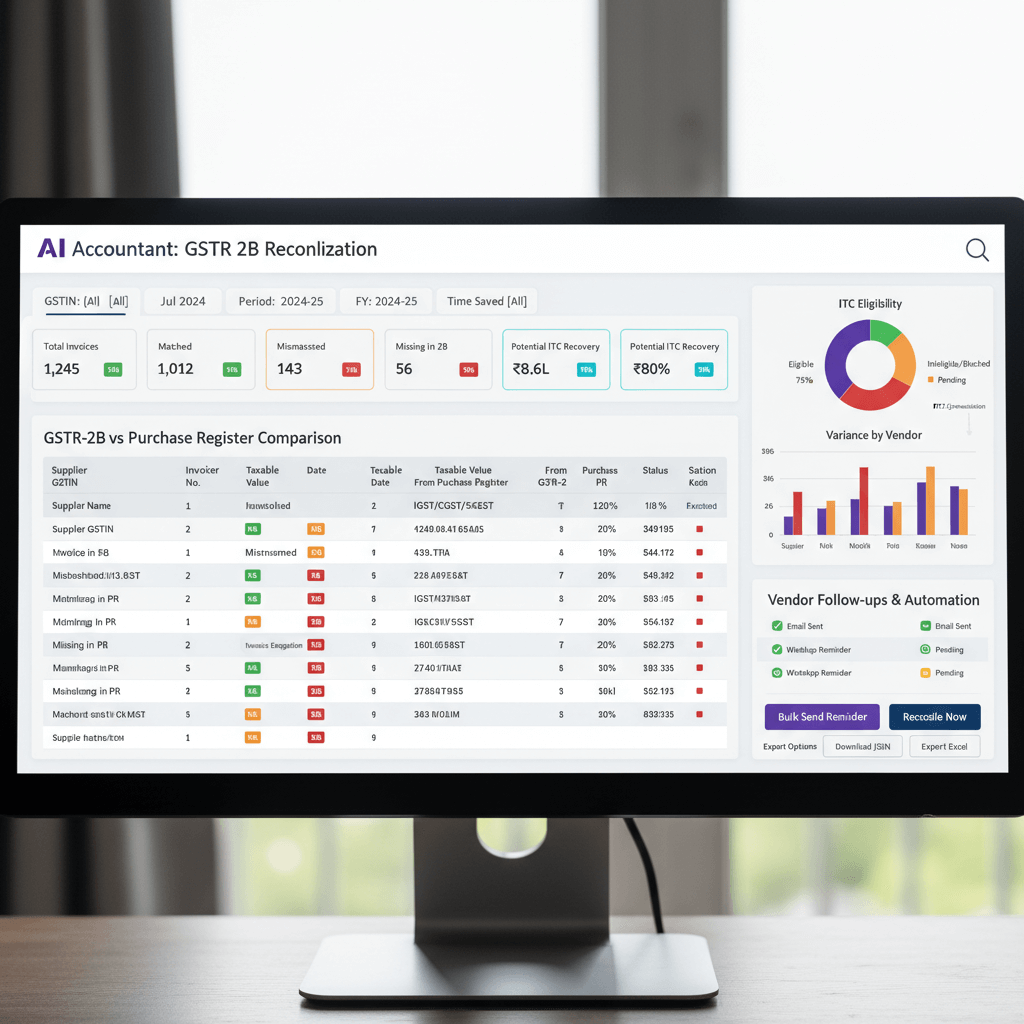
- Effective solutions automatically match purchase registers to GSTR-2B, highlight missing invoices and duplicates, tag ITC eligibility, automate vendor follow ups, and surface CFO grade dashboards.
- Use a clear buying checklist, data inputs, matching intelligence, exception handling, ITC optimisation, vendor automation, ERP integrations, scale and security, reporting, and implementation effort.
- Start with a pilot on last month’s data, validate results against your manual process, then scale, most teams go live within weeks.
- For SMEs on Zoho Books or Tally, AI Accountant or Giddh are strong fits, larger enterprises can evaluate EasyGST or Taxilla, early wins come from systematic vendor nudges and disciplined exception closure.
What is GSTR-2B and why reconciliation matters
GSTR-2B is a static monthly statement that shows your eligible Input Tax Credit, based on suppliers’ filings in GSTR-1, GSTR-5, and GSTR-6. Unlike GSTR-2A, which updates in real time, GSTR-2B freezes on the 14th of every month, giving you a definitive basis for ITC claims. Reconciliation ensures the ITC you book in your purchase register aligns with what the government portal recognizes, miss this step and you risk lost credits, delayed filings, and compliance notices.
Example: Your books reflect Rs 18,000 GST on a vendor invoice, but the vendor has not filed, or filed incorrectly, so the credit is not visible in GSTR-2B. Without reconciliation, the gap stays hidden until a notice, or an avoidable cash outflow.
For independent roundups and tool lists, see this free GST reconciliation software guide and this GST reconciliation software directory.
Common pain points in manual GST reconciliation
- Fragmented data, multiple ERPs, bank feeds, and card statements, with thousands of lines to cross check.
- Limited visibility on missing invoices, duplicates, amendments, and POS mismatches, each needing manual review.
- Ad hoc vendor follow ups, no shared tracker of who was contacted, when, and what they replied.
- No single dashboard for leadership, last minute scramble across spreadsheets.
How to evaluate GSTR 2B reconciliation tools, your buying checklist
Data input capabilities
Ensure support for purchase registers, journal vouchers, credit or debit notes, and standard GSTR-2B formats. Test imports from Tally or your ERP with real files, not samples.
Matching depth and intelligence
Look for exact and fuzzy matching on GSTIN, invoice number, date, and value, with tolerance settings for minor differences and multi ERP scenarios. Leading tools learn from your corrections over time.
Exception handling features
Automatic flags for duplicates, RCM, imports, and POS mismatches, with audit trails showing who changed what, and when.
Missing invoice detection
Two way detection, invoices in books but missing in GSTR-2B, and invoices in GSTR-2B that are not in books. Status tags help drive closure.
ITC optimisation capabilities
Automated tagging, eligible, ineligible, or deferred, with logic for reversals, Rule 36 or vendor delays, plus visibility into potential future credits.
Vendor follow up automation
Bulk reminders by email or WhatsApp, templates, SLA tracking, and evidence logs, this is where hours are saved every month.
ERP integrations
Native sync with Zoho Books or Tally, the ability to push cleaned data back, two way sync avoids CSV ping pong.
Scale and security
Performance at thousands of invoices per month, enterprise controls such as ISO 27001 or SOC 2, multi org access for CA firms.
Reporting and dashboards
Clear ITC trends, vendor risk, and aging of issues, leadership should get answers without drilling into line items.
Implementation effort
Quick onboarding, pragmatic training, and realistic total cost of ownership, not just headline subscription fees.
For AI powered exception insights, explore Taxilla’s reconciliation notes, and for CFO friendly visuals, review Giddh’s compliance blog.
Top GSTR 2B reconciliation tools, detailed comparison
1. AI Accountant
Ingests purchase registers, journal vouchers, and GSTR-2B, with predictive matching across entities. One click lists identify missing invoices, while ITC optimisation uses reason tagging, such as supplier non filing. Vendor follow ups run via WhatsApp and email with full communication history. Native sync for Zoho Books and Tally, dashboards cover ITC position and spend categories. Built for scale with ISO 27001 and SOC 2 controls.
2. ClearTax
Offers a free tier for low volume use, strong matching for GSTR-2B and GSTR-2A reconciliation, smooth Tally or Excel imports. Vendor automation is basic, reports are simple and suitable for straightforward cases.
3. GSTZen
Solid at missing invoice detection and ITC views, matching is reliable. Works primarily with Excel imports, which may limit deeper ERP automation needs.
4. EasyGST
Strong ITC reconciliation and automated vendor reminders, with comprehensive dashboards. Integrations can span Tally and Zoho subject to configuration, with robust security for enterprise adoption.
5. Giddh
Real time matching with multi branch support, helpful for complex structures. ITC trend analytics and strong ERP integrations, widely used for proactive discrepancy detection.
6. Taxilla
AI based exception detection and detailed mismatch reporting, strong enterprise integrations and secure cloud infrastructure.
Match purchase register, how modern tools handle it
Leading software applies multi key matching using GSTIN, invoice number, date, and value, with tolerances to handle splits or merges and links to credit or debit notes. If an invoice is split across two entries in your books, but appears once in GSTR-2B, adaptive algorithms connect the dots automatically. As you correct matches, the system learns vendor name variants and posting patterns, which reduces effort every month.
Tip: Test with two or three months of real data to calibrate tolerance rules before going live.
Identify missing invoices, detection and resolution
Two directions matter, invoices present in books but missing in GSTR-2B, and invoices present in GSTR-2B but missing in books. Tools categorize exceptions by vendor, age, and amount, helping you prioritise follow ups that unlock the most ITC fastest. Duplicate detection is equally critical, amendments or system errors can duplicate entries, automated checks prevent over claiming.
ITC claim optimisation, maximizing your credits
Transactions are tagged as eligible, deferred, or blocked, with logic for POS mismatches and Rule 36 scenarios. 180-day payment reversals are monitored automatically, alerts ensure you reverse and re credit on time. Giddh style real time matching reduces leakage by catching issues before filing, while analytics reveal vendor non compliance patterns that influence procurement decisions.
Vendor follow up automation, streamlining communications
Automated lists segment vendors by mismatch type, non filing, incorrect amounts, wrong tax codes, and more. Bulk nudges are sent with invoice context, and every message is logged for audit evidence. Internal escalations keep procurement and finance aligned, no more vague requests, just crisp, actionable tasks tied to specific invoices.
Monthly dashboard, executive visibility at a glance
CFOs want answers quickly, ITC eligible versus claimed, vendor scorecards, and aging of pending exceptions. Modern dashboards also connect to cash flow, showing how much working capital is locked in unclaimed ITC, and which vendor relationships need attention. Interactive drill downs, filters by location or category, and one click exports make board packs effortless.
Real world implementation, a typical workflow
Ingest purchase registers and GSTR-2B for the month, either via integrations or file uploads. The tool auto matches, flags exceptions, and proposes ITC tags. Eligible ITC posts back to your books, vendor nudges go out automatically, and confirmations attach to the exact invoices. Leadership reviews a dashboard of ITC variance, top vendor risks, and cash impact, and you export a complete audit pack at month end.
Handling edge cases and complex scenarios
- Duplicate invoices and amendments across periods, fuzzy logic flags related documents, such as INV 1234 and INV 1234 A1.
- RCM, imports, and advances, handled via dedicated rules for ITC timing and eligibility.
- Automatic timers for 180 day payment checks, with preventive alerts before the deadline.
- Rounding and partial payments, governed by configurable tolerance bands.
- Multi GSTIN and vendor name variants, resolved via multi key matching anchored on GSTIN plus invoice number.
ROI and metrics, measuring success
- Time saved, about 80 percent for a thousand invoices per month, three days down to half a day.
- Recovered ITC often funds the tool many times over, teams report lakh level credits found in month one.
- Vendor compliance uplift, open exceptions shrink by 60 to 70 percent within a quarter.
- Faster month end close, two to three days earlier, finance focuses on analysis, not data cleanup.
- Error rates drop from mid single digits to under one percent, fewer notices and audit pain.
Step by step implementation playbook
- Sync masters from Zoho Books or Tally to seed consistent ledgers and GSTINs.
- Import two to three months of history, calibrate matching and tolerance rules.
- Configure ITC eligibility policies and approval workflows where needed.
- Draft vendor templates, define SLAs and escalation paths, enable WhatsApp and email channels.
- Train the team on exception queues and dashboards, practice with real cases.
- Run a pilot on last month’s data, compare with manual outputs, adjust, then go live.
Common objections and clear answers
Our Excel sheets work fine. Excel scales poorly, error rates rise with volume, there is no audit trail, and no automation for vendor nudges. One recovered credit worth lakhs can pay for years of subscription.
Vendors will ignore automated messages. Structured reminders with exact invoice context and escalation rules deliver higher response rates than ad hoc emails.
We are worried about data security. Reputable vendors operate with ISO 27001 and SOC 2 controls, encryption, and role based access, stronger than spreadsheet sharing.
Implementation looks complex. Cloud deployments and prebuilt connectors mean most teams go live within weeks, with vendor led onboarding and training.
Success stories and proven results
EasyGST reports 75 percent time savings across CA and corporate users, with firms handling multiple times more clients on the same headcount. Giddh users highlight proactive discrepancy detection that prevents ITC leakage worth lakhs, and enterprises on Taxilla reconcile thousands of invoices daily with minimal manual touch. Early detection, not late firefighting, is the pattern behind these wins.
Making your decision, next steps
If you are starting out, try a free or basic tier to build confidence. For growing SMEs on Zoho Books or Tally, AI Accountant or Giddh provide strong matching, automation, and dashboards. Enterprises and high volume CA firms can evaluate EasyGST or Taxilla for scale and advanced controls. Run a pilot on last month’s data, compare with your manual reconciliation, and quantify time saved plus ITC recovered. The numbers will settle the debate.
Conclusion, transform your GST compliance today
With the right platform, you can accurately reconcile GSTR-2B against books, surface missing invoices early, optimise ITC, automate vendor follow ups, and give leadership real time visibility. The payoff shows up in recovered credits, faster closes, and fewer notices. Start small, prove value with a pilot, and scale with confidence. Your team will gain time, your vendors will respond faster, and your ITC will no longer leak.
FAQ
How should a CA approach GSTR-2B versus purchase register reconciliation for a client with multiple GSTINs and branches?
Start with a tool that supports multi GSTIN hierarchies and branch wise mapping. Configure matching rules per entity, align vendor masters to the correct GSTIN, and run entity level exception queues. AI Accountant supports cross entity predictive matching, then aggregates at the PAN level for CFO views, which is ideal when you must both reconcile locally and report centrally.
What matching tolerances are defensible during audit for date or value differences in GSTR-2B reconciliation?
Auditors usually accept immaterial variances if there is a documented policy, for example date shifts within the same tax period due to posting lag, and small rupee differences due to rounding. Set explicit tolerance bands in your tool, for example plus or minus one day on dates within the filing period, and a value tolerance of say up to Rs 1 or Rs 2 on rounding, and attach system logs to the audit pack to evidence policy application.
How do I automate the 180 day payment based ITC reversal and subsequent re credit without spreadsheet trackers?
Use a reconciliation system that links AP ageing to ITC tagging. Configure the 180 day rule, let the tool auto reverse credit when invoices breach the threshold, and auto re credit once payment clears. AI Accountant implements this workflow end to end, with alerts before the breach date and journal entries posted back to Tally or Zoho Books for a clean ledger trail.
How are RCM, imports, and SEZ supplies handled in ITC eligibility logic inside automation tools?
Good tools maintain dedicated exception classes. RCM requires self invoicing and tax payment before ITC eligibility, imports pull from BOE details, and SEZ supplies depend on documentation completeness. Configure each rule set once, then the system tags transactions correctly and pushes only eligible ITC to the books, while deferring or blocking the rest until conditions are met.
What is the most effective vendor follow up cadence that a CA firm can standardize across clients?
Adopt a three step cadence, day one contextual reminder with invoice numbers and amounts, day four escalation with compliance impact, day seven escalation to senior contact. Capture replies in the tool for audit evidence. AI Accountant automates this cadence via email and WhatsApp, with SLA timers and a vendor wise scorecard so you can coach clients on supplier risk.
How do I migrate a client from Excel reconciliation to an automated system with minimal disruption mid year?
Run a parallel pilot on the last one or two closed months, tune matching and tolerance settings, then switch the current month to the tool while keeping Excel as a shadow for one cycle. Lock historical periods after import to preserve audit integrity. Provide a short SOP for exception handling and vendor nudges, and you will be stable within a fortnight.
For clients split between Tally and Zoho Books, how does two way sync work without duplicate postings?
Pick a reconciliation system that treats your accounting platforms as sources of truth, not as writable ledgers by default. Map vendors and ledgers one time, pull purchase and GSTR-2B data in, then push only approved ITC adjustments back with unique reference numbers. AI Accountant prevents duplicates by checking document keys before posting, and maintains a sync log for audits.
How do I treat prior period amendments reflected in the current month’s GSTR-2B to avoid duplicate ITC claims?
Use amendment aware matching, where the tool links the amendment to its base document via GSTIN, invoice number, and period metadata. The system should present a net impact view, block duplicates, and propose a clean adjustment entry. Attach the amendment trail to your audit pack so the narrative is clear during scrutiny.
Which dashboards should a CFO insist on, and how do these link to cash flow planning?
At minimum, ITC eligible versus claimed, ITC at risk by vendor and age, exception closure rate, and forecast of next month’s credits. Tie these to payables and working capital by showing how much cash is locked due to vendor non compliance. AI Accountant’s CFO view includes drill downs to invoices, making cash conversations concrete.
Can these tools pass enterprise security reviews, and what controls should we verify?
Verify ISO 27001 and SOC 2 controls, encryption of data in transit and at rest, role based access with MFA, audit logs, data residency disclosures, and VAPT reports. Ask for a security summary and a DPA. Enterprise ready vendors will provide these promptly.
What KPIs should a CA firm track to prove ROI of reconciliation automation to its clients?
Cycle time per thousand invoices, ITC recovered from missing invoices, open exception ageing, vendor response SLAs, exception recurrence rate, and notice or penalty avoidance. Present a before and after view for the first three months, this usually makes the investment case self evident.
When is AI Accountant the right fit versus lighter tools like a basic 2B matcher?
Choose AI Accountant when you manage multiple GSTINs, need predictive matching, vendor automation, and two way sync with Zoho Books or Tally. If you are low volume with simple ledgers and few vendors, a basic matcher may suffice, but once exceptions and vendor follow ups dominate your month end, the AI driven workflow pays back quickly through time saved and ITC recovered.

Rohan Sinha is a fintech and growth leader building aiaccountant.com, focused on simplifying accounting and compliance for Indian businesses through automation. An IIT BHU alumnus, he brings hands-on experience across 0 to 1 product building, growth, and strategy in B2B SaaS and fintech.