-01%201.svg)
Key takeaways
- GSTR 2B reconciliation tools automate matching between your purchase register and GSTR-2B, they cut manual effort and reduce errors while surfacing exceptions early.
- Best in class platforms deliver high auto-match rates with layered logic, configurable tolerances, and crisp exception tags for supplier side missing, book side missing, duplicates, and mismatches.
- Effective workflows combine vendor follow up automation, ITC claim optimisation rules, and seamless postings to Zoho Books or Tally for audit ready books.
- Dashboards provide month wise visibility into eligible, claimed, deferred, and ineligible ITC, with vendor wise trends and aging to prevent leakages.
- A structured trial with your own data, clear ITC policies, and success metrics is the fastest route to prove ROI.
Why GSTR-2B matters in India, and where reconciliation breaks
GSTR-2B is your static, auto generated ITC statement, it is the authoritative basis for claiming input tax credit under Section 16. Because it does not change after generation, unlike GSTR-2A, it brings certainty to month end closure and assessments. Yet many businesses still miss 5 to 15 percent of eligible ITC due to messy vendor data, rushed month end reconciliations, and manual Excel lookups that crumble when invoice formats vary.
Great reconciliation produces four outcomes: fast, accurate matching across GSTIN, invoice number, date, value, and tax amount, crystal clear exception tagging, proactive vendor follow up automation, and smooth ERP sync that leaves an audit trail. This is exactly where modern tools shine.
Feature evaluation framework for GSTR 2B reconciliation tools
Data ingestion and normalization
Your tool should accept GSTR-2B in JSON or Excel, and your purchase register in CSV or Excel, along with journal vouchers, credit notes, and debit notes. OCR, template validation, and row level error reporting shorten clean up time, so when line 347 misbehaves in a 5,000 row file, you know exactly why.
Matching engine depth
Advanced platforms go beyond exact matching, they apply layered rules, then fuzzy logic when formats differ. They understand duplicates, amendments, RCM, imports, and SEZ supplies. For example, reverse charge mechanism transactions need distinct treatment from regular supplier invoices.
Status labels keep everyone aligned: matched, value mismatch, supplier side missing, book side missing, duplicate. Configurable tolerance settings handle paise rounding, helping first pass auto match rates reach 80 to 95 percent, so only a small fraction needs review.
Exceptions and insights
Great tools do more than find problems, they prioritize action. Supplier side gaps prompt outreach, book side gaps alert finance to record missing bills, duplicates are caught instantly, and ineligible or time barred ITC is tagged before you claim it. ITC policies should be configurable, so some credits are claimed now, others deferred, some reversed and re availed per rules. For complex scenarios, link your policy to ITC reversal automation.
Workflow automation
Manual chasers cost hours. Smart systems trigger templated emails or WhatsApp nudges with invoice level details, schedule reminders, and log replies. Escalations kick in when vendors delay. Approvals and audit trails keep everything exam ready, without spreadsheet chaos.
Posting and integrations
Once matched, push bills and journals straight into Zoho Books or Tally, with vendor GSTIN masters updated as discrepancies get resolved. This closes the loop and prevents double work.
Reporting and visibility
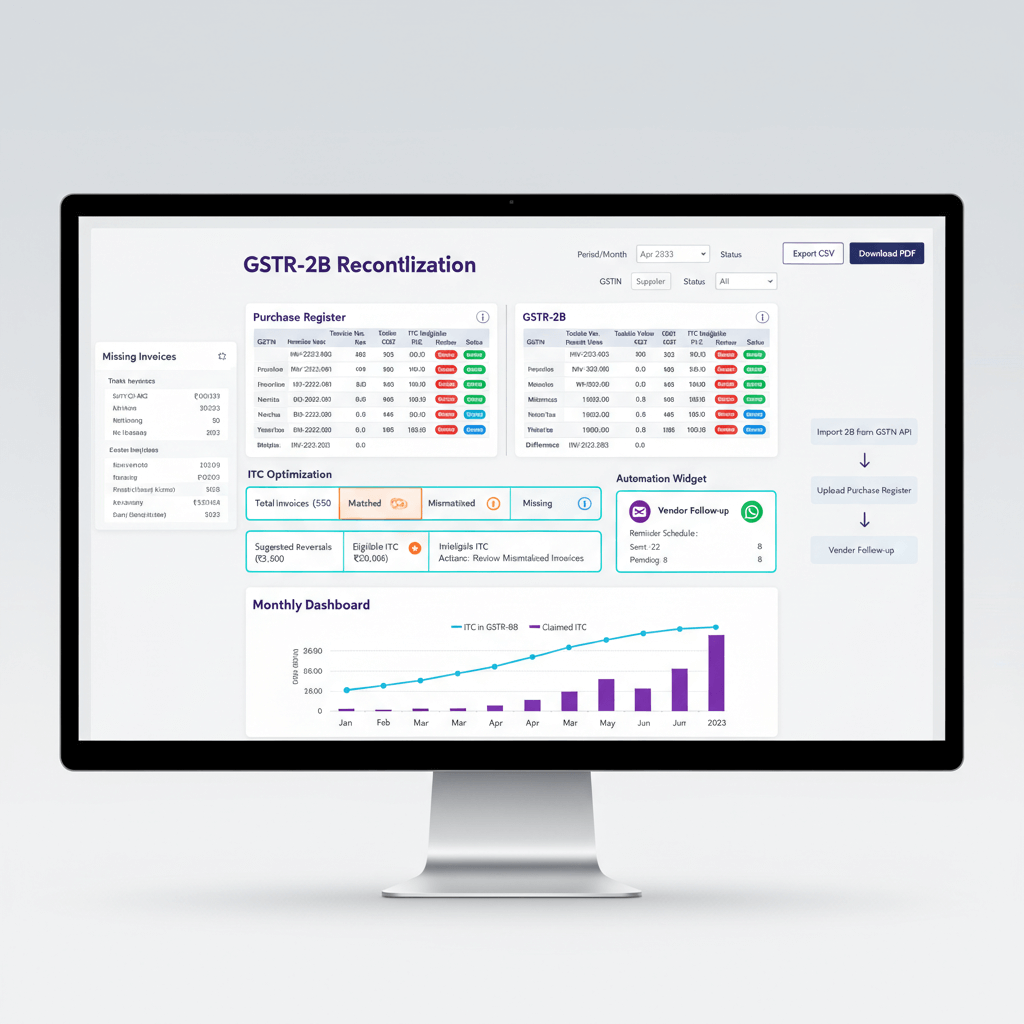
Executives need a clean picture in seconds, analysts need drill downs for hours. A robust monthly dashboard shows eligible versus claimed versus deferred, vendor wise exceptions, and aging of mismatches. Trends reveal whether your controls are getting tighter each month.
Scale, security, governance
For CA firms and mid market enterprises, multi entity support, quarterly filer workflows, and e invoice IRN matching are now table stakes. Look for ISO 27001, SOC 2, and India data residency as standard, not as future roadmap.
Buyer’s checklist, the questions that matter in trials
- Can it reliably match your purchase register to GSTR-2B with configurable tolerances? Insist on a demo using your live files.
- How does it identify missing invoices early, not on the filing day? Ask for examples of predictive alerts.
- What controls drive ITC claim optimisation, including defer, reverse, and re avail logic with a complete audit trail?
- Does vendor follow up automation truly cut manual effort, and does it capture replies and escalate when needed?
- Does the monthly dashboard deliver executive clarity with click through to transaction level?
- How seamless is posting to Zoho Books or Tally, including vendor master sync and period locks?
- Request reconciliation reports, speed benchmarks, security certificates, references, pricing, and SLA backed timelines.
Popular GSTR 2B reconciliation tools in the market
Recommended tools list
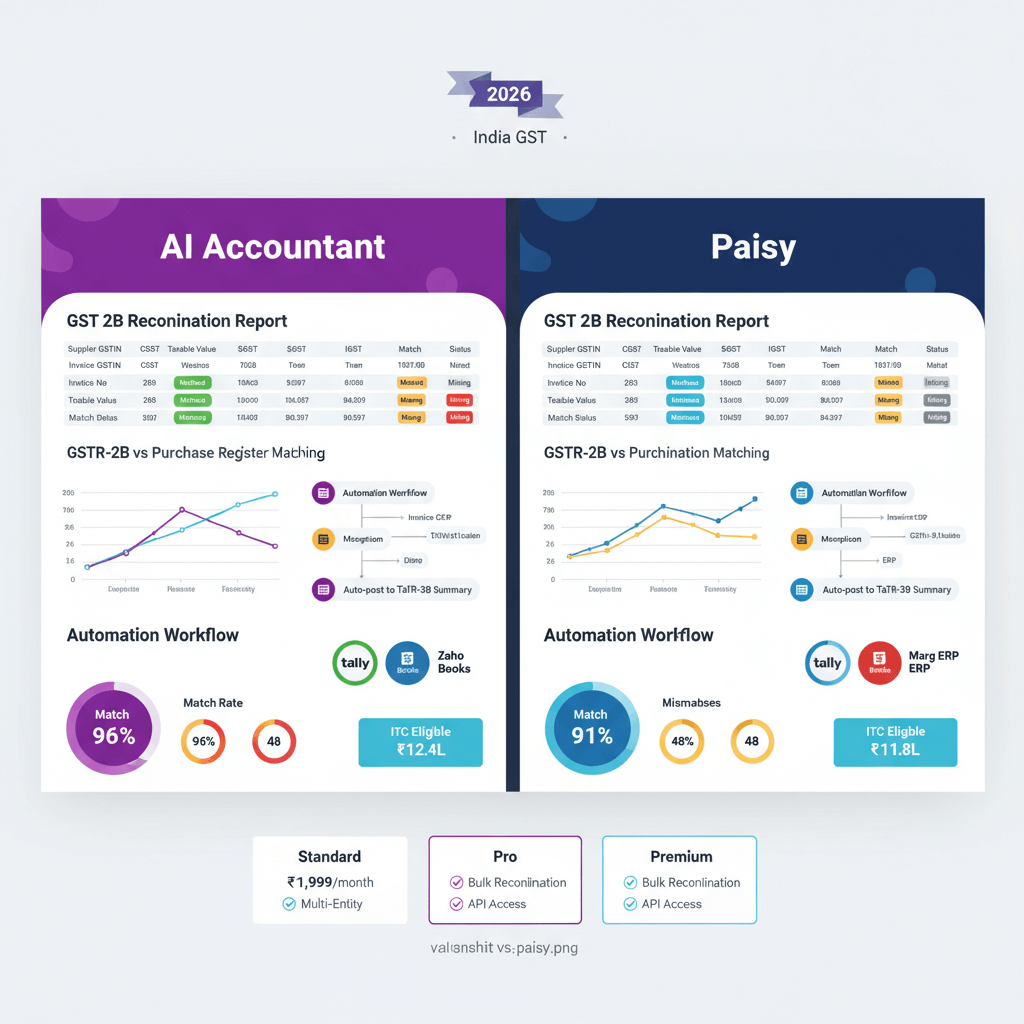
- AI Accountant – Advanced matching, deep ITC optimisation, automated vendor communications, and robust Zoho, Tally integrations with multi entity support.
- Octa GST – Robust reconciliation with configurable matching rules and vendor management, proven for complex cases.
- TallyPrime GST Module – Native for Tally users, suitable for straightforward reconciliations and postings.
- BUSY Accounting Software – Practical GST reconciliation features for small to medium businesses.
- Zoho Books GST – Built in reconciliation for the Zoho ecosystem, simple and integrated.
- RealBooks – Cloud accounting with compliance and reconciliation features.
- Vyapar TaxOne – Focused GST compliance with reconciliation capabilities.
Source Source Source Source Source
End to end reconciliation playbook
Step 1: Data preparation
Ingest purchase registers, JVs, credit, and debit notes, then download GSTR-2B from the portal, and cleanse GSTIN masters.
Step 2: Automated matching
Run the engine, verify a sample of auto matches for sanity.
Step 3: Exception handling
Work the 5 to 20 percent that needs attention, value mismatches, supplier side missing, book side missing, duplicates.
Step 4: Vendor communication
Trigger vendor follow up automation with invoice details, capture replies, escalate when needed.
Step 5: ITC decisions
Apply ITC claim optimisation, decide claim now, defer, reverse, or re avail as per policy.
Step 6: Posting and closure
Push to Zoho Books or Tally, lock the period, keep the audit trail.
Step 7: Monitoring
Review the monthly dashboard, attack aging issues before they expire.
This playbook turns chaos into clockwork, it replaces last minute scrambles with predictable, policy driven outcomes.
Quantified ROI and the business case
- Time savings: SMEs spend 20 to 30 hours monthly on manual reconciliation, automation compresses this to minutes, month end closes finish about three days faster.
- ITC recovery: Typical uplift of 3 to 5 percent, with early discovery of supplier filed credits you almost missed.
- Cost avoidance: Fewer reversals and notices, quicker vendor resolutions, fewer audit queries through stronger documentation.
- Simple ROI formula: (Volume × hours saved per transaction × hourly cost) + recovered ITC − subscription = net benefit.
Example: A CA firm with 25 clients reached 95 percent auto match, identified missing invoices worth ₹12 lakhs in unclaimed ITC, and cut month end by three days. Their monthly dashboard improved visibility, and vendor follow up automation removed 15 hours of weekly phone calls.
Pitfalls to avoid, what to test with vendors
- Exact matching dependence: Ask how amendments and credit notes are handled, rigid engines miss real world variance.
- Opaque ITC rules: Insist on explainable decision logic and full audit trails.
- Weak vendor loops: Confirm the system logs replies automatically and escalates when needed.
- Surface dashboards: Demand drill down from KPIs to individual invoices.
- No ERP integration: Without Zoho or Tally posting, you are duplicating work.
Implementation timeline
Week 1: Foundation
Upload samples, cleanse GSTIN masters, define ITC policies, set matching tolerances.
Week 2: Pilot testing
Pilot one entity, validate accuracy, test vendor follow up automation, confirm exceptions make sense.
Week 3 to 4: Rollout
Scale to all entities, enable the monthly dashboard, document SOPs, and train the team on exception handling.
Taking the next step
GSTR 2B reconciliation tools excel by automating the match against your purchase register, by identifying missing invoices before deadlines, by enabling smart ITC claim optimisation, by orchestrating vendor follow up automation, and by delivering monthly dashboard visibility that aligns finance and compliance.
Run a focused two week pilot with real data. Measure auto match percentage, count missing invoices surfaced, quantify ITC uplift, and validate that vendor follow ups reduce effort. Numbers remove doubt, the right platform proves value fast.
The teams that adopt intelligent reconciliation will close in hours, not days, claim every eligible rupee, and sleep better at audit time.
FAQ
What is the practical difference between GSTR-2A and GSTR-2B for ITC eligibility, and how should a CA advise clients?
GSTR-2A is dynamic and keeps updating as suppliers file or amend, GSTR-2B is static for a given period and is the reference for ITC claims. For monthly closure and assessments, reconcile to 2B, then use 2A only to anticipate upcoming credits. Tools like AI Accountant let you compare both views while locking ITC decisions to 2B.
How should I structure a monthly GSTR-2B versus purchase register reconciliation SOP for multi entity clients?
Create a standard pack: data ingestion checklist, tolerance rules, exception categories, vendor follow up playbook, ITC decision matrix, and posting steps. AI Accountant supports templates per client, quarterly filer workflows, and role based approvals that a CA firm can reuse each month.
What match tolerances are acceptable in practice for invoice value and tax amount, without risking assessments?
Keep tolerances minimal and policy driven, such as paise rounding and minor date format variations, with any value differences routed to manual review. Configure these tolerances explicitly and keep the audit trail. AI Accountant allows invoice level thresholds and flags anything beyond for reviewer sign off.
How do I handle supplier side missing cases when 2B does not show my invoice but the client has booked it?
Trigger vendor follow ups with invoice details, request timely GSTR-1 filing, and defer ITC until it appears in 2B. Good tools schedule reminders, log replies, and recheck the next 2B automatically. AI Accountant automates this loop and updates ITC status when the supplier files.
What is the correct approach for RCM, imports, and SEZ supplies during reconciliation?
RCM invoices are self accounted and need separate tagging and payment tracking, imports often do not reflect in GSTR-2B and require BOE based reconciliation, and SEZ supplies have distinct tax treatment. Use a tool that supports rules for each path, for example AI Accountant maps these cases with separate buckets and reports.
How do I operationalize ITC claim optimisation, including defer, reversal, and re avail, with documentation?
Adopt a rules engine tied to Section 16 and Rule 37, document criteria for defer and reversal, and capture evidence like GRN, supplier replies, and aging. AI Accountant provides configurable policies, integrates ITC reversal automation, and keeps an audit trail for every status change.
What controls should I implement to prevent duplicate ITC claims across amendments and credit notes?
Use multi key matching on GSTIN, invoice number, date, taxable value, and tax, plus amendment tracking across periods. Force reviewer approval for duplicate candidates. AI Accountant highlights potential duplicates, shows lineage across months, and blocks postings until resolved.
How do quarterly filer suppliers impact monthly 2B reconciliation, and what is the mitigation?
Monthly 2B may miss credits until the supplier files their quarterly GSTR-1, so maintain a predictive watchlist and defer ITC with reminders. A system like AI Accountant supports multi period reconciliation, rolling over exceptions, and clears ITC automatically when the quarter files.
What posting approach to Tally or Zoho Books avoids double entry and preserves an audit trail?
Post only reconciled, approved transactions, lock the posting batch with a reference, and sync vendor masters first. AI Accountant pushes cleaned bills, preserves source document links, and records a posting reference so auditors can trace each entry back to reconciliation.
How can I evidence reconciliation quality to management and auditors quickly?
Use a monthly dashboard showing eligible, claimed, deferred, and ineligible ITC, with vendor wise exception counts, and an exceptions aging report. Export a reconciliation pack with policy settings, tolerance snapshots, and action logs. AI Accountant generates this pack in clicks.
What KPIs should a CA track to prove ROI from GSTR-2B reconciliation automation?
Track auto match rate, exception clearance time, ITC uplift percentage, number of supplier side missing resolved before filing, days to close, and audit queries raised. AI Accountant’s dashboard displays these KPIs and trends month over month.
How do I transition from Excel based reconciliation to a tool without disrupting month end?
Run a two week parallel pilot on one entity, compare variance reports, calibrate tolerances, then scale. Migrate remaining entities in weeks three to four with SOPs and short training. AI Accountant’s guided onboarding and mapping templates reduce change management risk.

Rohan Sinha is a fintech and growth leader building aiaccountant.com, focused on simplifying accounting and compliance for Indian businesses through automation. An IIT BHU alumnus, he brings hands-on experience across 0 to 1 product building, growth, and strategy in B2B SaaS and fintech.