-01%201.svg)
Key takeaways
- GSTR-2B reconciliation is a monthly control process, not a one-time project, the right tool automates matching, improves ITC accuracy, and reduces notices dramatically.
- Evaluate tools against a practical checklist, matching logic depth, ITC rules engine, vendor follow up automation, dashboards, integrations, audit controls, and security.
- Expect 80 percent time savings, 5 to 10 percent improvement in ITC realization, and a sharp drop in notices when you move from spreadsheets to dedicated software.
- Run a proof-of-value demo with your real data, validate matching, ITC computation, exception handling, exports, audit trails, and accounting sync before purchase.
- Adopt a 30 day rollout plan, start with foundation setup, configure processes, then pilot and refine, measure ROI from day one.
Why GSTR-2B Reconciliation Matters Every Single Month
GSTR-2B is a static, monthly snapshot of supplier reported invoices, which makes it the authoritative base for ITC claims, but also a deadline driven pressure point. Miss your reconciliation window and you risk blocked credit, interest, and notices. Smart finance teams implement automation and a monthly cadence to avoid costly rework.
When teams rely on manual matching, purchase registers get messy quickly, vendors delay uploads, and errors multiply. Interest charges accumulate, penalties follow, and inboxes fill with notices. See a streamlined GST notices automation workflow to understand how disciplined follow through closes these loops. Independent roundups like SoftwareSuggest on GST reconciliation software and this Masters India guide on GSTR-2A versus GSTR-2B echo the same lesson, monthly reconciliation drives compliant ITC in GSTR-3B.
Bottom line: Firms report up to 80 percent faster closes, 5 to 10 percent higher ITC realization, and about 70 percent fewer notices after automating reconciliation, vendor nudges, and dashboards.
How GSTR-2B Reconciliation Actually Works
Great tools follow a clear sequence that you can test during a trial:
- Ingestion: Import purchase registers from your accounting system, credit and debit notes, journal vouchers, and GSTR-2B JSON or PDF.
- Normalization: Standardize formats, validate GSTINs, and remove duplicates to create a clean base.
- Matching engine: Use GSTIN, invoice number and date, and tolerance rules to match, with fuzzy logic for near matches, not just exact ones.
- Exception surfacing: Instantly flag missing invoices, date or GSTIN mismatches, and amendment driven gaps.
- ITC computation: Apply Section 16 timing, Section 17(5) blocks, and RCM, with clear notes, and structured input tax credit reversal automation where required.
- Vendor follow up: Create discrepancy specific tasks and reminders, capture evidence, and track resolution.
- Posting and insight: Push back reconciled entries to books, then monitor a monthly dashboard with KPIs and drill downs.
For process walk throughs, review this concise purchase register versus GSTR-2B reconciliation explainer alongside the SoftwareSuggest comparison and the Masters India guide.
Essential Features Every GSTR-2B Reconciliation Tool Must Have
Match Purchase Register Capabilities
Expect robust bulk import of Excel and CSV, automatic GSTIN validation, de-duplication, and configurable fuzzy matching with tolerances, for example, percent or amount bands. Flexible mapping should support split invoices, partial matches, and consolidation on either side. Cross check claims in the SoftwareSuggest comparison and this hands on guide.
Identify Missing Invoices Intelligence
Your system should tag vendor wise and month wise gaps, highlight amendments distinctly, and allow thresholds so immaterial variances auto clear. Attach proofs and notes for future audits. See coverage references in SoftwareSuggest and the Masters India explainer.
ITC Claim Optimisation Engine
Look for a rules engine that enforces blocks, reversals, RCM, and aging, and that explains decisions with audit notes. Provisional ITC tracking with reminder prompts is essential. The best systems even recommend claim timing to protect cash flow. Validate claims against SoftwareSuggest and the Masters India guide.
Vendor Follow Up Automation
Discrepancy aware templates over email and WhatsApp save hours, while status boards, reminders, and escalation rules accelerate closure. Preserve a communication trail for audits. A quick market scan begins here, SoftwareSuggest.
Monthly Dashboard Analytics
Your dashboard should track eligible ITC, claim rates, pending exceptions, and trends, supported by a recon health view like this GST health check dashboard for clients. Look for mismatch aging, top vendor contributors, month over month patterns, and clean Excel exports. See typical offerings on SoftwareSuggest.
Integration Requirements
Seamless sync with Zoho Books and Tally is crucial, including masters, reconciled postings, and updates. APIs enable custom flows and multi source consolidation for groups. Shortlist options using SoftwareSuggest.
Scale and Usability Features
High volume processing, bulk edits, multi organization workspaces, role based access, and mobile approvals reduce friction, especially for CA firms. For broader reconciliation design patterns, skim this Solvexia reconciliation guide in addition to SoftwareSuggest.
Compliance and Audit Features
Tagging, maker checker, time stamped audit logs, and assessment ready reports are non negotiable. Benchmark expectations with SoftwareSuggest insights and the Solvexia audit controls overview.
Security Standards
Insist on strong encryption, ISO 27001, or SOC 2, high uptime SLAs, India data residency, and periodic audits. Begin your checklists here, SoftwareSuggest.
Comparing Tool Categories, From Spreadsheets to AI Powered Solutions
Manual Spreadsheet Methods
Excel is familiar and low cost for very small volumes, but formulas break, matching is slow, and there is no audit trail. For more than a hundred invoices a month, the time cost outstrips license savings. See typical breakpoints in SoftwareSuggest’s roundup.
Accounting Software Native Features
Native modules in accounting platforms, for example Zoho Books, provide basic matching and dashboards with minimal training. Limits show up with vendor workflows, complex ITC rules, and scale. A quick benefits versus limits scan is available on SoftwareSuggest.
Dedicated GSTR-2B Reconciliation Tools
Specialized products offer full automation, advanced matching, vendor messaging, analytics, and multi client scale. Examples include:
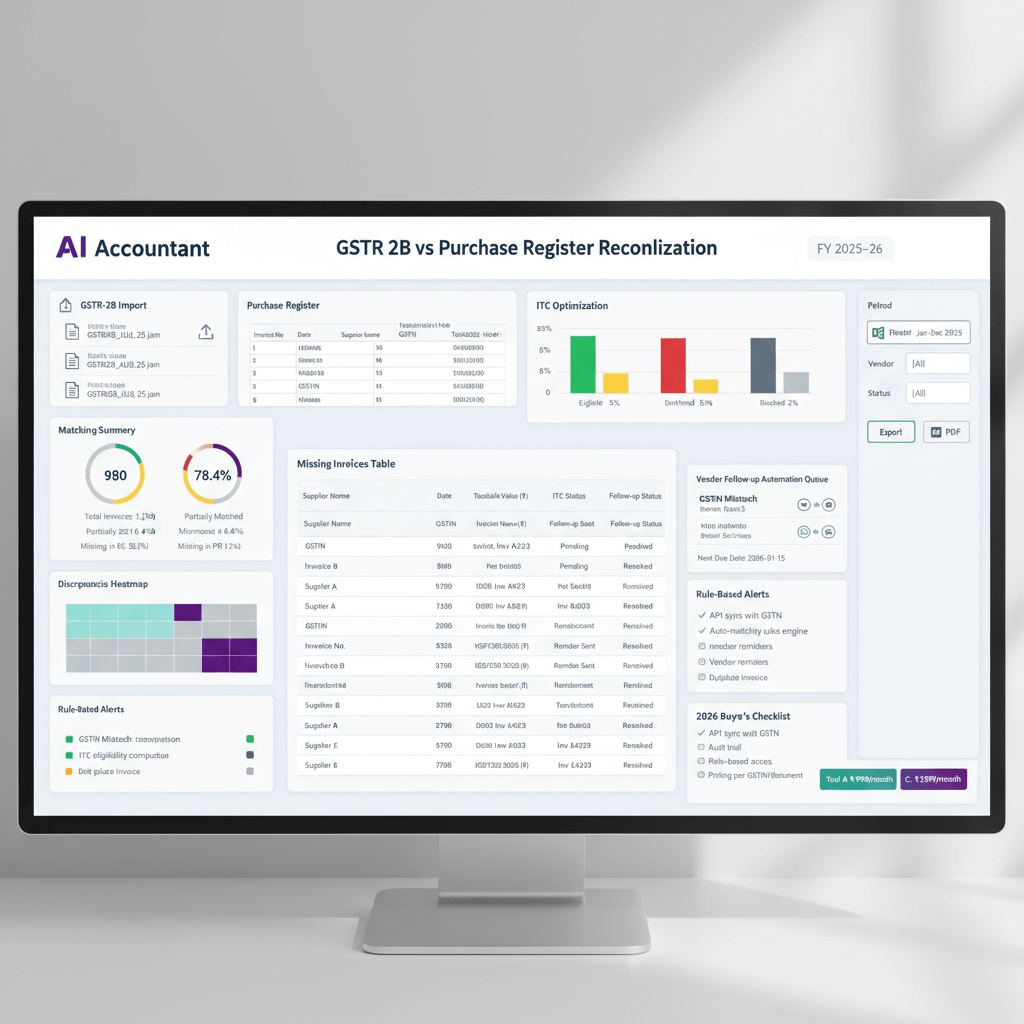
- AI Accountant, purchase register matching with status tags, ITC optimization, vendor workflows, drill down dashboards, Zoho and Tally integration, and enterprise scale with certifications.
- ClearTax, faster filing, 2A and 2B reminders, and ITC split handling.
- GSTZen, multi GSTIN reconciliation and bulk processing.
- expressGST, quick reconciliation with templates and guided flows.
- Tally Prime, native reconciliation inside the Tally ecosystem.
For a market view and AI trends, see SoftwareSuggest and this TaxGuru article on AI in 2A and 2B reconciliation.
Critical Evaluation Questions for Your RFP Process
Data Handling Questions
- Can the tool process JSON, PDF, and historical versions of GSTR-2B, and how are amendments, credit notes, and supplementary filings treated across periods?
- What is the tested maximum transaction volume per run, and do live customers match or exceed your volumes?
- How does the system detect and repair corrupted or malformed files without silent data loss?
Cross reference vendor claims with SoftwareSuggest and the Masters India guide.
Matching Logic Questions
- What fuzzy matching methods are available, can you configure different tolerances by scenario or vendor type?
- How are partial matches, split invoices, and consolidations resolved, with what audit notes?
- Can rules vary by vendor category, GSTIN group, or risk score?
See design patterns in the Solvexia reconciliation guide and market options on SoftwareSuggest.
ITC Optimization Questions
- How is provisional ITC tracked through reversal deadlines, and can rules be customized to match internal policies?
- Which Section 16 and Section 17(5) validations are embedded, and how quickly are regulatory changes reflected?
- Does the system recommend claim timing strategies to balance cash flow and audit safety?
Background reading, Masters India guide and SoftwareSuggest.
Vendor Management Questions
- What automation exists for reminders, can templates, frequency, and escalation be customized?
- Are vendor response rates and resolution time tracked, with management escalations?
- Is there a portal for vendors to submit documents directly with audit trails?
Compare practical features on SoftwareSuggest.
Integration Questions
- How does sync with Zoho Books or Tally work, real time or batch, and what is the retry behavior on downtime?
- Are journal entries and credit or debit notes posted back with references to reconciliation states?
- What safeguards prevent duplicate postings if sync is interrupted?
Shortlist integrators with the help of SoftwareSuggest.
Reporting Questions
- Can stakeholders get custom dashboards by role, and can reports be scheduled to email automatically?
- Which standard audit and assessment templates are included out of the box?
- How deep is drill down, from entity to vendor to invoice level?
Review options in Solvexia’s reporting overview and on SoftwareSuggest.
Pricing and Support Questions
- What is included in base pricing versus add ons, how does pricing scale by entities, users, or documents?
- What onboarding, training, and SLA commitments exist, and who resolves GST portal related blockers?
- Can you run a paid pilot for a single GSTIN or entity before a wider rollout?
For context on pricing frameworks, check this pricing and value guide for reconciliation software.
Your Proof-of-Value Demo Script
Use real, messy data, not a curated sample. Then validate the following end to end:
- Upload last month’s purchase register with all adjustments, then upload the same period’s GSTR-2B JSON or PDF.
- Review normalization and data quality checks, confirm duplicates and GSTIN errors are flagged.
- Inspect automatic matches and exceptions, confirm fuzzy rules make sense for your data.
- Drill into missing invoices, verify reason tags and evidence requirements are clear for vendors.
- Test ITC logic against Section 16 and Section 17(5), validate reversals, and check recommendations.
- Trigger vendor reminders for top mismatches, review templates, escalation, and status tracking.
- Study the monthly dashboard for KPIs, aging, and vendor trends.
- Export reports to Excel, confirm integrity and audit ready formatting.
- Post reconciled entries back to books, verify references on vouchers.
- Add a second user, test maker checker and access controls.
Helpful primers to align expectations, SoftwareSuggest and a practical reconciliation walkthrough.
30-Day Implementation Roadmap for Success
Days 1 to 7, Foundation Setup
- Clean GSTIN masters, remove duplicates, and standardize vendor naming.
- Sync chart of accounts and vendor masters across systems.
- Define ITC tolerances and materiality thresholds, start conservative.
- Configure maker checker roles, prepare, review, approve.
- Provision users and access from day one.
Days 8 to 14, Process Configuration
- Segment vendors by risk, higher risk vendors get tighter rules and faster nudges.
- Schedule automated reminders, start gentle, then escalate for non responses.
- Create templates for recurring reconciliation scenarios to reduce rework.
- Test each integration path with small batches and verify postings.
- Document the reconciliation playbook for onboarding and audits.
Days 15 to 30, Pilot and Refinement
- Run weekly mini recons, do not wait for the month close.
- Track hours saved, ITC claim rate, and exception aging.
- Collect user feedback, then tune matching and thresholds.
- Complete first full close, record lessons, and finalize SOPs.
For conceptual grounding, revisit the Masters India 2A versus 2B guide.
Measuring ROI, What to Track and Expect
Time Savings Metrics
- Hours from upload to posting, days become hours with good automation.
- Manual interventions per hundred invoices, the lower the better.
Financial Impact Metrics
- ITC claimed versus eligible, target a 5 to 10 percent lift with stronger matching.
- Working capital impact from faster credit, even small percentage gains matter.
- Interest and penalty avoidance, a leading indicator of control strength.
Operational Metrics
- Count of notices, many teams see about 70 percent reduction.
- Vendor resolution time from first nudge to closure.
- Clients managed per team member for CA firms.
See benchmarking cues on SoftwareSuggest and this pricing and value analysis.
Tip: Revisit ROI after two cycles, initial gains grow as rules and vendor behavior stabilize.
Red Flags, What to Avoid in GSTR-2B Reconciliation Tools
Opaque ITC Rules
If the system cannot explain why credit is claimed or held, audit defense becomes risky. Demand clear rationales and notes.
Limited Export Options
CSV only exports and missing communication logs block audits and management reviews, insist on rich, consistent exports.
Weak Amendment Handling
Inadequate treatment of amendments and supplementary 2B files recreates manual work. Test these scenarios in your pilot.
Missing Dashboard Analytics
No monthly KPIs, no aging, and no drill downs mean flying blind. Dashboards are non negotiable.
Single Organization Limitations
CA firms need multi entity workspaces and role based access from day one. Retrofitting is expensive and error prone.
Cross check vendor claims using SoftwareSuggest and the Masters India guide.
FAQ
How do I reconcile GSTR-2B with my purchase register in Tally without breaking my month close timelines?
Export a complete purchase register from Tally, include debit and credit notes, import GSTR-2B JSON into your tool, then run auto match with GSTIN, invoice number, and date. Use fuzzy tolerances for rounding differences, review exceptions, trigger vendor nudges, and post reconciled entries back to Tally. Tools like AI Accountant offer direct Tally sync, maker checker, and audit notes so you can close within hours, not days.
What tolerance settings should a CA firm start with for fuzzy matching in 2B reconciliation?
Begin with tight controls, for example, invoice amount variance up to one percent or a small absolute cap, allow date variance within a few days when evidence exists, and disallow GSTIN variance. Review exception patterns in your first cycle, then relax rules for vendors with proven accuracy. AI Accountant lets you set vendor category wise tolerances and logs every auto clear for audits.
How do I treat provisional ITC and reversals under Section 16 when suppliers delay uploads?
Track provisional claims by document, set auto reminders for reversal deadlines, and link vendor follow ups to each claim. If the supplier uploads later, the system should auto reclassify and reinstate credit. AI Accountant maintains a ledger of provisional, reversed, and reinstated ITC with reasons, which simplifies scrutiny.
What is the cleanest way to handle amendments, credit notes, and supplemental 2B files?
Insist that your tool processes multiple 2B files per period, pairs amendments to original invoices, and replays matching logic without duplications. Credit notes should adjust ITC with traceable references. AI Accountant’s amendment reconciliation links revised and original entries, preserving an audit trail.
Can I automate vendor reminders via WhatsApp and email, and track who is delaying my ITC?
Yes, modern tools send discrepancy specific WhatsApp and email reminders with evidence requests, track opens and responses, and escalate by aging or amount. Dashboards expose top delaying vendors so partners can intervene. AI Accountant includes prebuilt templates, escalation matrices, and vendor wise scorecards.
How should I measure ROI for a GSTR-2B reconciliation tool during a pilot?
Track hours saved, cycle time to post, percent of eligible ITC claimed, notices received, and vendor resolution time. Also quantify working capital impact from earlier ITC. AI Accountant provides a reconciliation efficiency report that compares pre and post metrics by entity.
Do I still need spreadsheets if my accounting platform has native 2B matching?
Native features are fine for low volumes and simple cases, but most CA firms and mid market teams outgrow them when handling amendments, risk based vendor nudges, and multi entity reporting. Dedicated tools like AI Accountant layer advanced matching, vendor automation, and audit trails on top of your books, removing the need for parallel spreadsheets.
What security assurances should I demand before moving client data to a reconciliation tool?
Require encryption in transit and at rest, ISO 27001 or SOC 2 certifications, annual penetration tests, India data residency options, and strict access controls with audit logs. AI Accountant offers enterprise grade security and role based access, which is essential for multi client CA setups.
How can I run a low risk pilot for one GSTIN and then scale to all clients?
Select a medium complexity entity, run one full cycle, document lessons, and standardize templates. Ensure contract terms allow entity wise expansion without reimplementation. AI Accountant supports entity by entity rollout, shared vendor catalogs, and reusable rule sets.
What reports do auditors usually ask for during GST assessments, and can these be generated quickly?
Auditors typically ask for matched and unmatched reports, ITC claimed versus eligible with reasons, amendment logs, vendor communication trails, and posting references back to books. AI Accountant can export these in audit ready Excel with consistent column structures.
How do I reconcile multi GSTIN businesses where purchases and invoices flow across branches?
Use a tool that supports multi GSTIN data ingestion, cross entity vendor mapping, and entity wise posting. Matching rules should be configurable by entity, but reporting should roll up to group level. AI Accountant’s multi organization workspaces and role based access are designed for such structures.
What is the best way to transition from Excel to an AI powered reconciliation tool mid financial year?
Import historic 2B files and purchase registers for two to three months, run back testing to validate rules, then switch the live process from the next filing cycle. Keep Excel as a read only backup for one month. AI Accountant includes migration assistants and health checks to streamline the cutover.

Rohan Sinha is a fintech and growth leader building aiaccountant.com, focused on simplifying accounting and compliance for Indian businesses through automation. An IIT BHU alumnus, he brings hands-on experience across 0 to 1 product building, growth, and strategy in B2B SaaS and fintech.