-01%201.svg)
Key takeaways
- GSTR-2B is a static monthly ITC statement that must be reconciled with your purchase register before GSTR-3B, accurate reconciliation protects cash flow and prevents penalties.
- Strong tools ingest GSTR-2B JSON and Excel files, connect to Zoho Books and Tally, then match exact and fuzzy to minimise review time.
- Exception dashboards identify missing invoices, period shifts, amendments, RCM, and blocked credits automatically, so you only review what matters.
- Rule based ITC eligibility with audit trails, plus vendor follow up automation via email and WhatsApp, accelerates closure and locks accurate ITC.
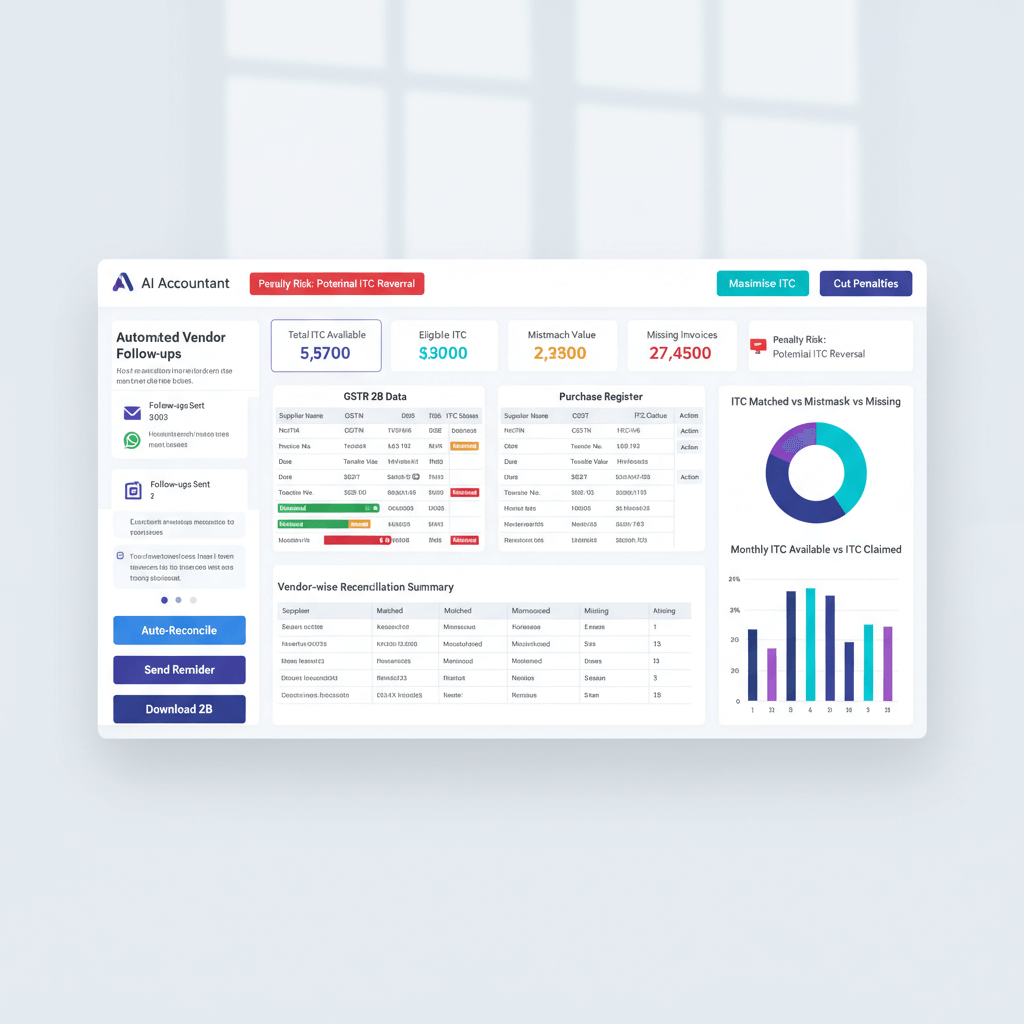
- Monthly dashboards show eligible, ineligible, and deferred ITC, with ageing and trends to reduce leakage over time.
- Expect 95 percent plus matching accuracy at scale, with minute level processing, and enterprise controls like SOC 2 and ISO 27001.
- Automation typically cuts effort from 20 to 40 hours to under 2 hours per month, and recovers 5 to 10 percent additional ITC.
What is GSTR-2B Reconciliation and Why It Matters
GSTR-2B is a static snapshot of your Input Tax Credit, it freezes on the 14th of each month, so you must align it with your purchase register before filing GSTR-3B. Unlike GSTR-2A which updates continuously, GSTR-2B gives a clean basis for monthly ITC claims. Slippages happen when suppliers delay filing, GSTIN or name mismatches creep in, invoice numbers or dates vary, credit notes go missing, amendments like B2BA or CDNRA appear in later months, or invoices shift across periods.
Manual Excel reconciliations often miss 10 to 20 percent of eligible credits, draining working capital and inviting reversals. Smart teams use a tool that normalises data, flags exceptions, and explains every decision with evidence. For an at a glance primer, explore this comprehensive overview of GSTR-2B reconciliation tools, the difference between GSTR-2A and 2B, and why manual versus automated GSTR-2B reconciliation changes outcomes.
When the tax officer comes calling, clean reconciliation trails turn tough questions into quick closures.
Core Evaluation Criteria for GSTR-2B Reconciliation Tools
Data Ingestion Capabilities
Your tool should import GSTR-2B in JSON and Excel, handle multiple GSTINs in one run, and ingest purchase registers, credit and debit notes, and journal vouchers. Native connectors for Zoho Books and Tally, or validated Excel templates that pre check errors, cut setup time. See the tooling overview, a detailed buyer’s guide for GSTR-2B reconciliation tools, and an example GSTR-2B reconciliation solution.
Matching Engine Depth to Match Purchase Register
Look for exact and fuzzy matching on GSTIN and invoice numbers, date tolerances to handle month end carryovers, and amount thresholds for rounding. The engine should class transactions as matched, probable, missing in GSTR-2B, missing in purchase register, or duplicates, with multi line invoice logic that keeps lines together. More detail in this overview, the buyer’s guide, and Octa’s GSTR-2B reconciliation solution.
Exception Handling to Identify Missing Invoices
You want vendor wise gaps, period shifts, and amendment tracking surfaced automatically. RCM transactions and blocked credits like motor vehicles should be auto flagged, so you never claim ineligible ITC. Reference the overview and Octa’s solution notes.
Decision Support for ITC Claim Optimisation
Rule based eligibility is essential, with buckets for eligible, deferred, and blocked, plus explanations. Provisional ITC logic should be configurable when vendors delay filing but you hold valid invoices, see input tax credit reversal automation. Every manual override must be fully audited. Guidance is in the overview and buyer’s guide.
Workflow Features for Vendor Follow Up Automation
Pre built email and WhatsApp templates listing pending invoices, scheduled reminders at 7, 14, and 21 days, and optional vendor portals keep suppliers accountable. Activity logs prevent duplicate nudges and measure responsiveness. See the overview and Octa’s workflow example.
Visibility Through Monthly Dashboard
Dashboards should split eligible, ineligible, and deferred ITC, show vendor exposure, and highlight mismatch ageing. A GST health check dashboard with trends and drill downs drives continuous improvement. More in the tooling overview and Octa’s dashboard views.
Accuracy, Scale, and Speed Benchmarks
Target 95 percent plus accuracy on 100,000 plus invoice lines, with processing measured in seconds or minutes. The engine should stay stable at peak volumes. Benchmarks are discussed in the overview and Octa’s performance notes.
Integration and Sync Requirements
Two way sync with Zoho Books and Tally is a must, pull masters and vouchers in, then push reconciled results back to eliminate manual keying. Explore the overview and the buyer’s guide.
Security and Compliance Standards
Insist on ISO 27001 and SOC 2 Type II, encryption at rest and in transit, role based access, and immutable audit logs. More detail in the overview.
Usability and Support Quality
Inline edits, bulk actions, and short learning curves matter. India timezone support becomes critical at month end. The buyer’s guide covers adoption tips, anchored by the overview.
Pricing and Total Cost Considerations
Look for transparent, volume based plans, then compute payback from time saved and ITC recovered. Most teams see a one to two quarter ROI, as outlined in the overview.
Quick Evaluation Checklist
- Data Ingestion: JSON or Excel GSTR-2B, Zoho Books or Tally imports included.
- Matching: Fuzzy rules and date or amount tolerances to match purchase register with precision.
- Exceptions: Vendor rollups that identify missing invoices and period shifts.
- ITC Logic: Clear rule explanations for ITC claim optimisation, with override audits.
- Workflow: Tracked vendor follow up automation across channels.
- Dashboard: Monthly dashboard with ageing and trend analysis.
- Integrations: Zoho and Tally two way push back of cleaned entries.
- Security: SOC 2 and ISO 27001 proofs plus encryption and RBAC.
- Implementation: Live within three weeks including training.
- Pricing: Transparent, volume scaled tiers without hidden fees.
For deeper dives, see the overview, the buyer’s guide, and Octa’s solution page.
Sample Month End Reconciliation Workflow
Step 1: Sync masters from Zoho Books or Tally, ingest purchase register, credit or debit notes, and JVs.
Step 2: Import GSTR-2B, auto match to the purchase register, then review probable matches that need judgment.
Step 3: Use exception reports to identify missing invoices, trigger vendor follow up automation for gaps.
Step 4: Apply ITC rules, including provisional logic where allowed, then lock the final ITC for GSTR-3B.
Step 5: Push reconciled adjustments back to Zoho or Tally, archive a complete audit pack.
Step 6: Review the monthly dashboard for trends, share insights with the CFO or client.
Process accelerators and examples: overview, buyer’s guide, Octa’s reconciliation solution.
Edge Cases and How Good Tools Handle Them
- Vendor GSTIN or name mismatches: Fuzzy normalisation aligns ABC Pvt Ltd with ABC Private Limited automatically.
- Amendments and credit notes: Multi period logic reconciles B2BA and CDNRA entries across months.
- RCM and blocked credits: Auto classification excludes ineligible items like motor vehicles and personal expenses.
- Duplicates and round offs: Threshold rules isolate true duplicates while tolerating small differences.
- Multi branch GSTINs: Entity or location mapping keeps inter branch purchases clean.
Design patterns are summarised in the overview and the buyer’s guide.
ROI and Business Case for Automation
Teams report a shift from 20 to 40 hours monthly to under 2 hours, with 5 to 10 percent more ITC recovered through faster vendor chases and fewer period misses. Penalty risk drops, and audit readiness improves.
Illustration, a business with 5,000 invoices a month and a 2 percent miss rate can recover about 2 lakh rupees in ITC annually. A tool priced near 50,000 rupees per year pays back within one quarter. For context, compare tool benefits and a manual versus automated GSTR-2B reconciliation study.
Top GSTR-2B Reconciliation Tools to Consider
1. AI Accountant, specialised for SMEs and CA firms, offers Zoho Books and Tally integrations, fuzzy matching to accurately match purchase register data, exception buckets for missing invoices, configurable ITC rules with audit trails, vendor follow up automation, and dashboards with GST specific trends. With large scale processing history and certifications like ISO 27001 and SOC 2 Type II, it suits multi organisation CA workflows.
2. ClearTax GST, full stack GST compliance with large volume reconciliation, ERP integrations, and comprehensive reports, common in enterprise setups.
3. Zoho GST, smoothest inside Zoho Books, solid reconciliation for smaller businesses already using Zoho.
4. Masters India, strong for multi state registrations, robust reconciliation features, good analytics.
5. IRIS Sapphire, end to end GST automation with 2B reconciliation, deep analytics, and compliance scoring.
Shortlists are easier with the overview and the buyer’s guide.
Implementation Plan and Timeline
Week 1: Connect your organisation, import masters, run last month’s data to map the flow.
Week 2: Configure tolerances and rules, train your team on exceptions, set vendor reminder templates.
Week 3: Run parallel to your current process, validate ITC, go live once confident.
Pro tips: Document every configuration choice, keep a parallel spreadsheet as a control for one month, train the full team to avoid bottlenecks. A step by step context is in the overview.
Real Success Stories
A CA firm with 20 plus SME clients halved monthly closing time and recovered 5 lakh rupees of missed ITC within two months. A manufacturing SME cut missing invoices by 70 percent via systematic follow ups, stabilising working capital as ITC became predictable. See highlights in the overview of outcomes.
Next Steps for Your Team
Move from spreadsheet chaos to systematic control by taking three simple steps, download an evaluation checklist, book a 30 minute demo on your live data, and pilot one GSTIN this month. The right platform transforms compliance into a dependable routine, gives your team hours back, and keeps your books audit ready.
Choose a solution that matches your scale, plugs into your systems, and makes reconciliation easier than Excel. Your month end will shift from days to hours.
FAQ
As a CA, how do I structure a monthly GSTR-2B reconciliation SOP that my articles can run end to end?
Adopt a six step SOP, sync masters from Zoho or Tally, import GSTR-2B, auto match and review probables, extract exceptions to chase vendors, apply ITC eligibility rules with documented overrides, push entries back to books, and archive an audit pack. Tools like AI Accountant provide checklists, user roles, and audit trails so juniors can execute while partners review exceptions only.
How do I quantify ROI for clients when proposing a 2B reconciliation tool in my CA practice?
Calculate time saved per month, reduction in penalties, and ITC recovered from missing invoices or period shifts. For example, if your team saves 18 hours monthly at a blended rate and recovers even 1 percent extra ITC, the subscription often pays back within one quarter. AI Accountant dashboards show recovered ITC and time metrics that feed your ROI model.
What matching tolerances should I set for invoice date and amount to minimise false positives?
Start with date tolerance of plus or minus three days at month ends, and amount tolerance of up to one percent or a fixed rupee threshold for rounding and freight differences. Review outliers monthly and tune. Tools like AI Accountant let you configure per GSTIN or per vendor for finer control.
How do I treat provisional ITC when vendors habitually file late, without risking reversals?
Define a provisional bucket with vendor risk scoring and documentary checks, then claim conservatively with clear notes. Auto reverse if not reflected by a defined cut off, and re avail when it lands. Features inspired by input tax credit reversal automation keep the journal trail clean.
What is the cleanest way to handle B2BA or CDNRA amendments that land in later months?
Use multi period tracking that aligns the amended document to the original invoice, then auto adjusts eligibility and narratives. The review screen should show original versus amended values, and the month of impact. AI Accountant style drill downs make partner reviews quicker.
Can I manage multiple GSTINs across branches and distinct business verticals without data overlap?
Yes, choose a tool with entity and branch mapping, role based access, and separate import queues. Cross entity purchases must be tagged correctly to avoid double claims. Multi organisation workspaces in AI Accountant help CA firms keep client data isolated.
How do I operationalise vendor follow ups so juniors can chase without chaos?
Adopt templated emails and WhatsApp, attach invoice level lists, schedule reminders at 7, 14, and 21 days, and log each touch. Escalate chronic defaulters to procurement. Vendor portals in tools like AI Accountant reduce back and forth by giving suppliers a live pending list.
What controls satisfy auditors, especially for manual overrides to ITC eligibility?
Require reasons on every override, capture user and timestamp, and lock versions post filing. Export a reconciliation certificate with matched, deferred, and blocked buckets. Platforms patterned on the tooling overview emphasise immutable audit logs.
How do I differentiate between real duplicates and legitimate split line invoices in bulk data?
Use invoice level dedupe with tolerances plus line level grouping by GSTIN, invoice number, and tax rate, then validate tax amount sums. Engines with multi line logic, for example in AI Accountant, prevent accidental splits.
For clients on Zoho Books and Tally, what is the best practice for two way sync during month end?
Pull masters and vouchers nightly, reconcile daily or weekly, then push back cleaned adjustments only after partner review. Lock the dataset for the filing window, and reopen after GSTR-3B. AI Accountant style connectors allow safe push backs with controls.
What security assurances should I demand before onboarding a reconciliation tool for my firm?
Insist on ISO 27001 and SOC 2 Type II, encryption at rest and in transit, segregated client workspaces, and detailed access logs. Request the latest audit reports and a data retention policy. Many firms prefer tools like AI Accountant that publish certifications upfront.
If a client resists change, how do I run a low risk pilot that proves value quickly?
Pick one GSTIN, import last two months, configure default tolerances, and run exceptions to recover missing ITC. Measure time saved and credits recovered, then present the dashboard. A one GSTIN pilot in a platform like AI Accountant usually demonstrates payback within weeks.

Rohan Sinha is a fintech and growth leader building aiaccountant.com, focused on simplifying accounting and compliance for Indian businesses through automation. An IIT BHU alumnus, he brings hands-on experience across 0 to 1 product building, growth, and strategy in B2B SaaS and fintech.