-01%201.svg)
Key takeaways
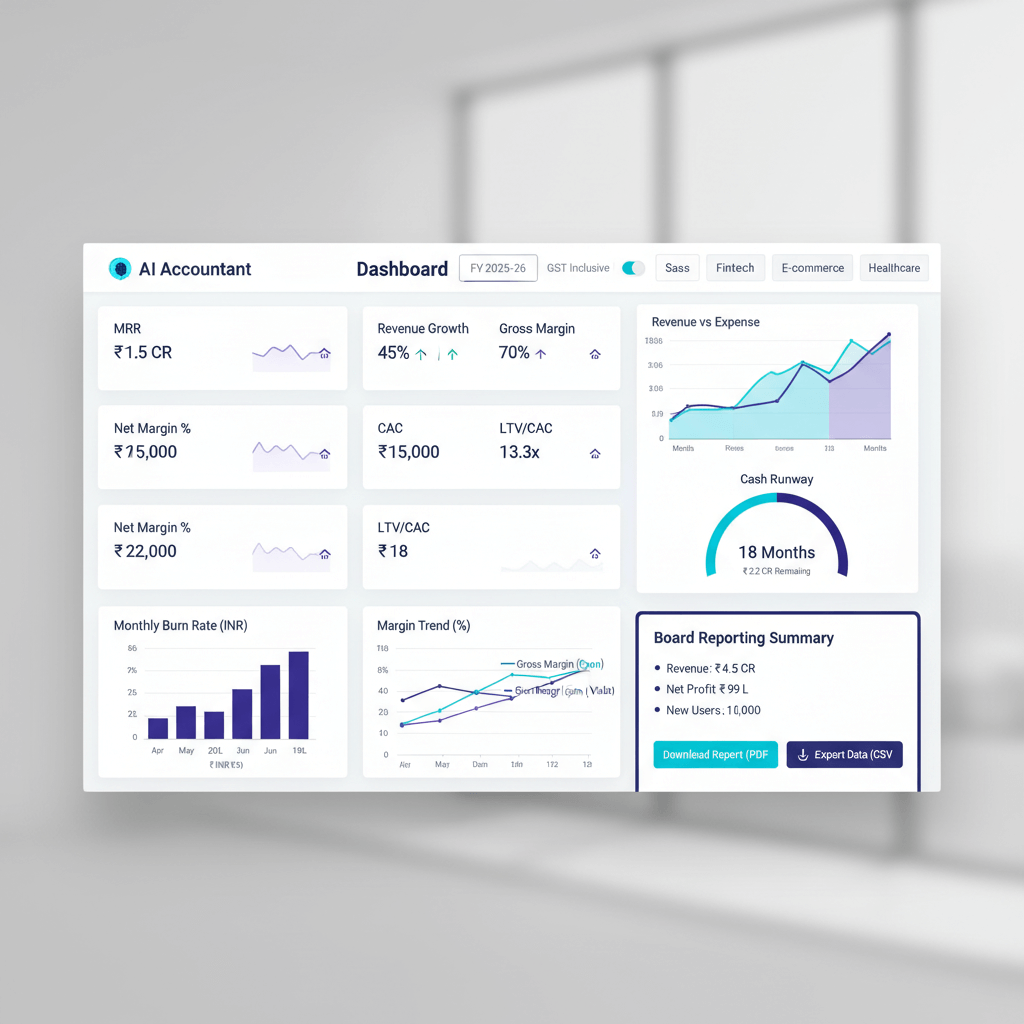
- A founder finance dashboard India gives startup CEOs a live, single screen view of cash, revenue, burn, margins, and compliance so weekly decisions are faster, less risky, and backed by real numbers rather than gut feel.
- The most effective dashboards follow the "3 Metric Rule" for weekly focus: cash runway, revenue growth, and unit economics, with deeper drilldowns reserved for monthly and quarterly reviews.
- India specific realities like GST timing, TDS deposits, UPI refunds, and Razorpay or PayU settlement holds must be baked into your dashboard; ignoring them causes cash surprises that kill otherwise profitable startups.
- Automating data ingestion from Tally, banks, and payment gateways eliminates four or more hours of manual work per month and reduces classification errors that distort margin analysis.
- Founders who engage directly with their numbers (receivables, payment cycles, spend impact) build sharper financial instincts than those who only glance at P&L summaries.
- If your team still assembles dashboards manually or your data is older than a week, AI Accountant's MIS reporting automates the entire pipeline from raw transactions to board ready visuals in under 60 minutes.
Founder Finance Dashboard India: What's New in 2026
Until mid 2025, most seed stage Indian startups tracked runway using a simple three month trailing burn average. By Q1 2026, Inc42's funding data shows founders now prefer 12 week forward projections with hiring and marketing sensitivity toggles, reflecting lessons learned from the 2023 to 2024 layoff cycle. The benchmark has also shifted: seed stage startups target nine months of runway (up from six), while growth stage targets remain at six months.
The biggest operational shift is GST 2.0. Pilot programs went live in Q2 2026, mandating e-invoicing for businesses previously below the threshold. Dashboards that auto reconcile GSTR 2B matches now process mismatches 95% faster than manual methods, per GST portal notifications. If your turnover exceeds ₹5 crore, you are already in scope. If you are between ₹1 crore and ₹5 crore, compliance is imminent.
UPI 2.0 credit line integrations (tracked via RBI's master directions) now feed directly into settlement dashboards. This means net realization calculations must account for new fee structures on UPI credit transactions, not just traditional gateway holds. Startups ignoring DPO stretches beyond 60 days are getting flagged by AI anomaly detection, a trend affecting roughly 40% of early stage companies.
Cost of inaction is tangible: missed e-invoicing compliance triggers penalties under Section 122, ITC claims get blocked, and fundraising due diligence stalls when reconciliation gaps appear. What to do now:
- Audit your dashboard against GST 2.0 e-invoicing requirements before your next filing cycle
- Switch runway calculations to 12 week forward projections with scenario toggles
- Add UPI 2.0 settlement lag tracking if you accept UPI credit payments
AI Accountant's GST reconciliation module already supports 2B auto matching under the new framework, reducing manual review to exceptions only.
Table of contents
Founder Finance Dashboard India, why it matters
Every Indian startup founder needs a founder finance dashboard India to make smart weekly decisions on cash, growth, and runway. Without one, you end up with late board decks, surprise cash crunches, and mismatched metrics across spreadsheets or Tally.
Whether you are a seed stage founder watching every rupee, or a Series B CEO planning a growth sprint, a focused dashboard turns noise into action. Sharp founders don't outsource thinking about their numbers. They engage directly with receivables, payment cycles, and spend impact to build instincts that spreadsheets alone cannot deliver.
Think of your dashboard as the cockpit. You get a single live view of cash, growth, unit economics, and compliance, updated in near real time.
What is a Founder Finance Dashboard, India context
A founder finance dashboard India is your control panel for cash, growth, unit economics, and compliance health. It must reflect India specific realities.
GST and TDS affect cash timing. Vendor credit norms commonly push payables to 45 to 60 days. UPI refunds and chargebacks can land days after transactions. Payment gateway holds from Razorpay or PayU can lock up lakhs for settlement.
Your dashboard should sync bi-directionally with Tally, auto map your chart of accounts, and use GST aware tagging so revenue shows net of tax. The best dashboards pull from multiple sources automatically, normalize into a consistent format, and update continuously so you always know where you stand.
The emerging "3 Metric Rule" suggests limiting your weekly focus to three core numbers: cash runway, revenue growth, and unit economics. Everything else is a monthly deep dive. This prevents dashboard fatigue and keeps founder attention on what actually drives decisions.
The non-negotiable components to include
KPI tiles for startups, top row
Your KPI tiles for startups sit at the top like a car's instrument panel. Start with cash balance and runway in weeks or months. Aggregate all bank balances and fire threshold alerts when you drop below a limit.
For monthly revenue, show MRR for SaaS or recognized revenue for other models. Include growth percentage. Track bookings versus collections. Always show revenue net of GST and label accrual or cash basis as appropriate.
Burn needs two tiles. Net burn for outflows minus operating inflows. Gross burn for total outflows excluding financing or one offs. Set auto alerts if burn exceeds 20% month over month growth, a signal that spending is outpacing plan.
Margin tiles track profitability. Gross margin percentage equals revenue minus COGS divided by revenue. Contribution margin removes variable costs as well. Monitor trends closely.
Working capital tiles show receivables DSO, payables DPO, and net working capital. Break into aging buckets to spot issues early. Benchmark DSO to 45 days or less for Indian fintech and SaaS companies (2026 industry norm per Economic Times startup coverage). For SaaS, add net revenue retention and gross revenue retention. For all startups include CAC, CAC payback, and LTV to CAC. Segment by customer type or acquisition channel for insight.
Revenue versus expense chart
Your revenue versus expense chart tells the growth story at a glance. Use a monthly bar or area chart for revenue on one side, total opex on the other. The gap shows burn or profit.
Add variance. Highlight months when expenses grow faster than revenue. Stack expense categories (people costs, marketing, tools, and COGS) for quick drill downs. Keep this operational view separate from statutory P&L.
Cash runway and burn
Cash runway and burn deserve tiles and trend lines. Runway equals current cash divided by trailing three month average net burn (or better, use a 12 week forward projection with scenario toggles for hiring and marketing changes).
Overlay GST and TDS effects on timing. Project forward at least 12 weeks so you never hit surprise walls. Add sensitivity toggles so you can answer "what if we hire two more engineers next month?" in seconds rather than hours.
Margin trends
Margin trends reveal sustainability. Track gross margin percentage, contribution margin percentage, and EBITDA margin over at least 12 months.
Split by cohort or product lines when you have multiple streams. Use three or six month rolling averages to smooth volatility and reveal the actual trajectory beneath monthly noise.
Operating cash flow panel
Collections timing kills more startups than profitability. Track collections versus billings, AR aging by customer, and payment gateway settlement lags.
Include fees, refunds, and chargebacks that reduce realized revenue. Show on time customers versus those stretching terms. With UPI 2.0 credit lines now active, add a separate line for UPI credit settlement timing, which differs from standard UPI instant settlements.
Compliance pulse, India
Show GST 2B reconciliation status, TDS and TCS deposit confirmations, and filing deadlines. Under GST 2.0 pilots, e-invoicing reconciliation is becoming automated, but exceptions still need human review.
Color code overdue items red in your BI tool. Add workflow views for month end close tasks. This avoids unpleasant due diligence or audit surprises during fundraising. Reference the latest CBIC circulars for updated filing timelines and penalty structures.
Drilldowns
Every summary metric needs drilldown capability. Click revenue to see top customers. Click expenses to see vendor breakdowns. Click anomaly flags to jump to problem transactions.
Boards specifically expect revenue drilldowns by customer, product, and channel, and expense drilldowns by vendor and category. One click access to underlying data builds trust and speeds problem solving.
Management reporting layout, make it board-ready
Your management reporting layout transforms raw metrics into board ready narratives. Start with a one page executive summary: top row tiles for cash, revenue, burn, and margins, with quick wins or risks in a concise sidebar.
Structure your monthly pack for impact. Overview tiles first, then your revenue versus expense chart, followed by margin trends, then cash runway and burn. Add working capital aging for AR and AP, marketing efficiency, and sales productivity drivers. Close with compliance status and action notes.
Match cadence to audience. Founders want weekly views for operations. Boards want monthly management reporting layouts with deeper analysis. The Ploughback.ai framework recommends a dedicated one hour weekly dive into reports, receivables, and spend impact to build financial instincts that compound over time.
Keep granularity consistent. Always show prior period and target comparisons. Use traffic light indicators. Add footnotes explaining variances. Design for clarity by integrating real time data from Tally, creating a single source of truth that eliminates version confusion across stakeholders.
Data foundations, getting accurate inputs
Garbage in means garbage out. Pull from Tally for accounting data. Add bank and credit card statements from HDFC, ICICI, or Axis. Include payment gateway reports, payroll systems, and marketing platforms.
Normalization matters. Map your chart of accounts consistently. Separate COGS from operating expenses correctly. Standardize date formats and narrations. Handle inter account transfers without double counting.
For GST, separate output tax from input tax. Handle reverse charge scenarios. Always show revenue net of GST. TDS creates timing differences between P&L and cash. Track TDS on vendor payments separately and show both views to understand true cash position.
For gateways, parse settlement reports. Extract fees, refunds, and holds that affect net realization. With UPI 2.0, new fee structures on credit line transactions require separate parsing logic.
Choose accrual for performance measurement, cash for runway, and label each metric clearly. As 65% of Series A and above Indian startups now use AI tools for auto ingestion (per Economic Times April 2026 reporting), manual data entry is increasingly a competitive disadvantage rather than a cost saving measure.
Step-by-step, build each component
Revenue versus expense chart
Calculate revenue as recognized monthly amount net of GST. Sum COGS plus operating expenses. Stack categories for clarity. Compute variance as revenue minus expenses. Highlight break even month clearly.
Add a trend line showing the gap narrowing or widening. If expenses consistently grow faster than revenue for three or more months, that is a red flag worth discussing in your weekly huddle.
Cash runway and burn
Gross burn equals total cash outflows excluding financing and one offs. Net burn equals outflows minus operating inflows. Runway equals current cash divided by average net burn.
Use 12 week forward projections rather than only backward looking averages. Build sensitivity models over three to six months. Remove one off items to avoid distorted trends. Flag normalized burn separately from reported burn so boards see both views.
Margin trends
Gross margin percentage equals revenue minus COGS divided by revenue multiplied by 100. Contribution margin percentage equals revenue minus COGS minus variable costs divided by revenue multiplied by 100.
Use three or six month rolling averages to reveal trajectory rather than reacting to single month spikes. Compare against industry benchmarks: Indian SaaS companies typically target 70% or above gross margins, while services companies target 40% to 55%.
KPI tiles for startups
MRR equals sum of recurring monthly revenue. ARR equals MRR times 12. Month over month growth equals current MRR minus prior MRR divided by prior MRR.
DSO equals accounts receivable divided by daily sales. DPO equals accounts payable divided by daily COGS. Cash conversion cycle equals DSO plus inventory days minus DPO. Target DSO below 45 days for Indian startups.
CAC equals sales and marketing costs divided by new customers acquired. CAC payback equals CAC divided by average revenue per customer minus costs to serve. LTV equals average revenue per customer times gross margin times average customer lifetime. Benchmark to stage and model.
Stage-based variants, what to emphasize
Pre revenue startups should obsess over cash runway and burn. Track hiring plan against budget. Break operating expenses by category to find savings. Target nine months of runway minimum (2026 seed stage benchmark).
Early revenue startups must watch collections versus billings. Monitor gross margins and unit economics. Validate CAC payback period. The "Founder Cockpit" approach suggests limiting your weekly dashboard to three metrics and auto alerting when burn exceeds 20% month over month growth.
Scale ups need sophisticated margin trend analysis. Track net revenue retention by cohort. Monitor working capital efficiency. Analyze unit economics by product and channel. Add cohort views once you have repeatable revenue and clear customer segments.
Common pitfalls and how to avoid them
- Mixing invoice accrual revenue with gateway collections creates confusion. Keep separate views for performance and liquidity. Label each chart clearly.
- Misclassifying COGS as operating expenses breaks margin analysis. Create mapping rules and train your team. Review monthly. Use a margin audit view to flag anomalies when gross margin swings more than 5% without explanation.
- Ignoring GST and TDS timing causes cash surprises. Build overlay views and separate ledgers. Track payment versus filing dates. Under GST 2.0, penalties under Section 122 of the CGST Act apply for non compliance with e-invoicing mandates.
- One time expenses distort burn. Flag adjustments. Compute normalized burn excluding one offs. Show both normalized and reported burn on your dashboard.
- Stale master data in Tally creates matching errors. Set auto matching. Review unmatched items weekly. Clean duplicates monthly.
- Dashboard fatigue from too many metrics. Apply the 3 Metric Rule weekly (cash runway, revenue growth, unit economics) and reserve deep dives for monthly reviews.
Review cadence and decisions
Run weekly 30 minute founder huddles. Review top tiles first. Check cash runway and burn for surprises. Toggle scenarios. Decide quickly on spend and collections focus.
The Ploughback.ai framework recommends mapping every rupee to outcomes during these sessions. Ask: "Is this spend creating momentum or just maintaining status quo?" This builds the financial instinct that separates sharp founders from passive ones.
Monthly sessions need narrative context. Document actions. Track commitments against prior month promises. Compare actuals to forecasts and explain variances in two sentences or less.
Quarterly board reviews require trend analysis, margin improvement plans, capital requirements, and scenario models. Boards expect traffic light indicators and footnotes, not raw data dumps.
Tools to build your dashboard
- AI Accountant automates data ingestion from banks and credit cards, extracts bills, matches vendors, and maps transactions. Syncs with Tally, includes built in dashboards for cash overview, receivables, and payables, handles GST reconciliation (including 2B auto matching under GST 2.0), supports cohort NRR tiles, and manages multiple entities under one login. ISO 27001 and SOC 2 Type II certified.
- Microsoft Power BI offers powerful visualization and connectors with native GST and TDS connectors added in 2026. Good for custom dashboards. Requires technical setup and maintenance.
- Tableau provides enterprise grade analytics, strong visualization, and AI anomaly detection for margins. Fits complex data. Comes with higher costs and a learning curve.
- Google Data Studio connects well with Google Sheets. Good for basic dashboards. Limited for complex financial analysis.
- Zoho Analytics integrates with Zoho Books and provides pre built reports for Indian businesses. Offers a free tier for sub ₹10 crore ARR startups. Balances features and ease of use.
- QuickBooks Online Advanced includes basic dashboards with accounting. Limited customization. Works out of the box for simple needs.
Each tool involves trade offs between automation, customization, and complexity. AI Accountant focuses on automating painful data prep and providing ready to use financial dashboards for Indian startups on Tally.
Quick start options
You have two paths to launch your founder finance dashboard India this week.
Option A uses a spreadsheet template with KPI tiles for startups, a revenue versus expense chart, and a clean management reporting layout. Connect manually to exports. Update weekly or monthly. Perfect for early stage simplicity. Plan to migrate when manual updates exceed four hours per month.
Option B leverages automation with AI Accountant. Connect Tally in minutes. Ingest bank statements automatically. Map transactions using AI. Eliminate manual work. Enable dashboard modules for cash, receivables, and payables. Add custom margin trends and cash runway views with 12 week forward projections. Full setup in about 60 minutes.
FAQ
How often should I refresh the dashboard for founder visibility, and what cadence do boards prefer
Refresh operational metrics like cash balance daily and full financial metrics monthly after books close. Founders review weekly for action; boards review monthly for trends and decisions. During crisis periods, move to daily updates for critical metrics. AI Accountant can auto refresh bank and gateway feeds so tiles stay current without manual effort.
Should Indian startups use cash basis or accrual basis in dashboards, and how do we label correctly
Use cash basis for runway calculations and accrual basis for performance metrics like revenue growth and margins. Label each tile clearly, for example "cash runway (cash basis)" and "gross margin (accrual basis)." Showing both views side by side prevents stakeholders from mixing them.
How do we incorporate GST, TDS, and payment gateway delays into weekly decision making
Create overlay views for GST and TDS timing, report revenue net of GST, track TDS liabilities separately, and add settlement lag tracking for gateways. Under GST 2.0 (live Q2 2026), e-invoicing auto reconciliation handles 2B matches 95% faster, but exceptions still need review (2026 update). UPI 2.0 credit line settlements have different timing than standard UPI and require separate parsing logic.
Can we begin with Excel or Google Sheets, then migrate to an automated platform later
Yes, spreadsheets work initially and most startups begin there. Plan to switch when manual updates exceed four hours per month, when data sources grow beyond two or three, or when you need real time operational visibility. Migration is smoother when you have consistent chart of accounts mapping from day one.
Which KPI tiles should a marketplace, SaaS, or services company prioritize
Marketplaces should track DSO by platform, SaaS should track cohort based NRR and GRR, and services should emphasize utilization, project margins, and WIP. Start with the common three (cash runway, revenue growth, unit economics) and add model specific tiles as you scale. The "3 Metric Rule" keeps weekly reviews focused while deeper segmentation happens monthly.
What is the ideal cash runway target for Indian startups in 2026
Seed stage startups should target nine months of runway minimum, while growth stage companies should maintain at least six months (2026 update). These benchmarks shifted upward after the 2023 to 2024 funding slowdown taught founders that fundraising timelines often stretch beyond plan. Calculate using 12 week forward projections with sensitivity toggles rather than only backward looking averages.
What security and access controls should finance teams enforce when sharing dashboards
Choose platforms with ISO 27001 and SOC 2 Type II certification, enforce role based access so team members see only relevant sections, and enable audit trails for all changes. Granular permissions and maker checker workflows help during audits and due diligence, especially when sharing with investors or acquirers.
Next steps
Building your founder finance dashboard India is straightforward. Start with the core components. Add KPI tiles for startups that matter most. Build your revenue versus expense chart. Monitor cash runway and burn with 12 week forward projections. Watch margin trends using rolling averages.
Package everything in a clean management reporting layout for your board. Apply the 3 Metric Rule for weekly focus: cash runway, revenue growth, and unit economics.
Download the free management reporting layout template and KPI checklist to get started. Ready to automate end to end? Book a 20 minute walkthrough of AI Accountant, connect Tally, automate categorization, and generate board ready reports without manual work. Your investors expect clean, timely reporting. Your team needs clear metrics. You need reliable numbers to decide confidently. Build your dashboard this week, and take control of your startup's financial future.

Rohan Sinha is a fintech and growth leader building aiaccountant.com, focused on simplifying accounting and compliance for Indian businesses through automation. An IIT BHU alumnus, he brings hands-on experience across 0 to 1 product building, growth, and strategy in B2B SaaS and fintech.