-01%201.svg)
Key takeaways
- Cash flow tools give a clear, daily view of money moving in and out, so you can plan spending and avoid surprises.
- Track operating, investing, and financing cash flows for complete visibility, then watch trends in working capital.
- Use the direct method for day to day control, use the indirect method for reporting and audit alignment, many dashboards show both.
- Build a simple rolling forecast with receipts, payments, scenarios, and variance tracking, then adjust weekly.
- Stay on top of GST and TDS timelines, match input tax credit, and plan deposits to prevent interest and penalties.
- Monitor burn rate and runway, test scenarios, and use alerts to act early when collections slip or dues spike.
- Clean bank reconciliation is the heartbeat of cash accuracy, unmatched items break trust in your dashboard.
- AI insights can flag outliers, predict shortfalls, and nudge compliance, you still decide, the system guides.
- Pick tools that fit your size and GST TDS needs, then set up bank feeds, chart of accounts, roles, and alerts.
- AI Accountant blends a CA led managed service with a live dashboard, bringing reliable cash visibility to Indian businesses.
Introduction to cash flow analysis tools
Cash flow analysis tools help you see money coming in and going out, they show cash from sales, cash paid to vendors, and the cash left to run your business. With the right setup, you can track liquidity, plan spend, and avoid surprises. For a quick primer on the statement format, see Investopedia on cash flow statements.
AI Accountant’s Virtual Accounting pairs a CA led service with a live dashboard, you get end to end bookkeeping, GST and TDS compliance, and a clear view of cash flow trends, burn rate, and runway. It feels like having a friendly finance team in your corner, with numbers you can trust.
This guide breaks down what to look for, how to set up, and how to use cash flow analysis tools for simple daily decisions, it uses plain words, it is detailed, it is built for India based freelancers, startups, and small companies.
Cash clarity reduces stress, better visibility means fewer last minute scrambles and more confident decisions.
Cash flow analysis tools basics
Cash flow tools track three buckets, operating, investing, and financing, together they show total cash change and working capital moves.
- Operating cash flow, cash from sales, collections, vendor payments, salaries, and taxes.
- Investing cash flow, cash used for assets and equipment, or received from selling assets.
- Financing cash flow, cash from loans, equity, interest, and repayments.
A good tool shows net cash in each area and the total change, it helps you spot trends like slow collections or rising unpaid bills. For reporting guidance, see IAS 7 cash flow standard, and for working capital basics, review working capital on Investopedia.
Core features to expect
- Live cash balance, bank and payment gateway feeds keep balances fresh.
- Category views, income and expense breakdowns by product and cost type.
- Cash flow statements, direct or indirect method, updated from your ledgers.
- Forecasts, simple projections based on bills and invoices due.
- Alerts, nudges on low cash, high burn, late GST, or TDS dues.
- Document vault, invoices, challans, and returns in one place.
- Compliance status, filing dates and forms with done or pending tags.
- Team chat, one thread with your CA team so decisions are quick.
AI Accountant’s dashboard includes these parts, with a CA team managing execution behind the scenes, what you see on screen matches what gets filed.
Direct cash flow method and indirect cash flow
Direct method
The direct cash flow method lists cash receipts and cash payments, it shows cash from customers, cash paid to suppliers, cash wages, cash for taxes, and cash interest, it gives a clean picture of money movement, it is simple to read, it is great for day to day control. Read more on the direct method, and the statement framework under IAS 7.
Indirect method
The indirect cash flow method starts with profit, adjusts for non cash items like depreciation, then shows changes in working capital like receivables and payables, it is easier to prepare from accrual ledgers, it connects profit to cash.
Which one should you use
- Use direct for cash control and short term planning, it works well with bank feeds and payment gateways.
- Use indirect for year end reporting and audit support, it lines up with accrual books and tax schedules.
Many dashboards show both, AI Accountant can prepare statements using either method, so you get the clarity of direct and the linkage of indirect.
Cash flow forecasting for planning
Cash flow forecasting projects future cash in and cash out, it helps you plan salary runs, vendor payouts, and tax obligations, see forecasting ideas from AI Accountant, then browse guidance on cash flow forecasts and ACCA’s notes.
How to build a simple forecast
- Start with opening cash, use bank balance across accounts.
- Add expected receipts, list invoice collections, subscription renewals, and other income.
- Subtract planned payments, include vendor bills, rent, payroll, GST, TDS, and loan repayments.
- Set time buckets, daily, weekly, and monthly buckets work best for small firms.
- Update continuously, a forecast is a living view, not a one time file.
- Track variance, compare plan versus actual each week to learn and adjust.
- Add scenarios, create best, base, and worst cases to see runway under stress.
AI generated insights can help, if collections slip by seven days the tool can show runway impact, if a large bill is due next week it can flag a shortfall, alerts turn numbers into timely action.
GST cash flow for Indian businesses
GST affects cash flow every month, returns like GSTR 1 and GSTR 3B have fixed timelines, input tax credit can lower cash outlay when matched, reverse charge can trigger cash payments even without vendor GST invoices, e invoice rules change invoice flow and tax capture.
Key GST points for cash planning
- Filing dates, know due dates for GSTR 1 and GSTR 3B, plan cash for tax payment before due dates, check the portal at gst.gov.in.
- Input tax credit, match purchase invoices and vendor filings to claim credit, unmatched bills slow cash relief.
- Place of supply, map correct tax rates for interstate and intrastate supply, wrong mapping can cause interest and cash leakage.
- Reverse charge, plan cash for RCM liabilities and claim credit in the next period.
- E invoice, keep e invoice enabled for qualifying turnovers to ensure timely compliance and cash timing accuracy, see einvoice portal.
AI Accountant’s CA team manages GST filings, reconciliations, and advisory, the dashboard shows compliance dates and filing status, this helps you plan cash for taxes without surprises.
TDS cash flow and compliance
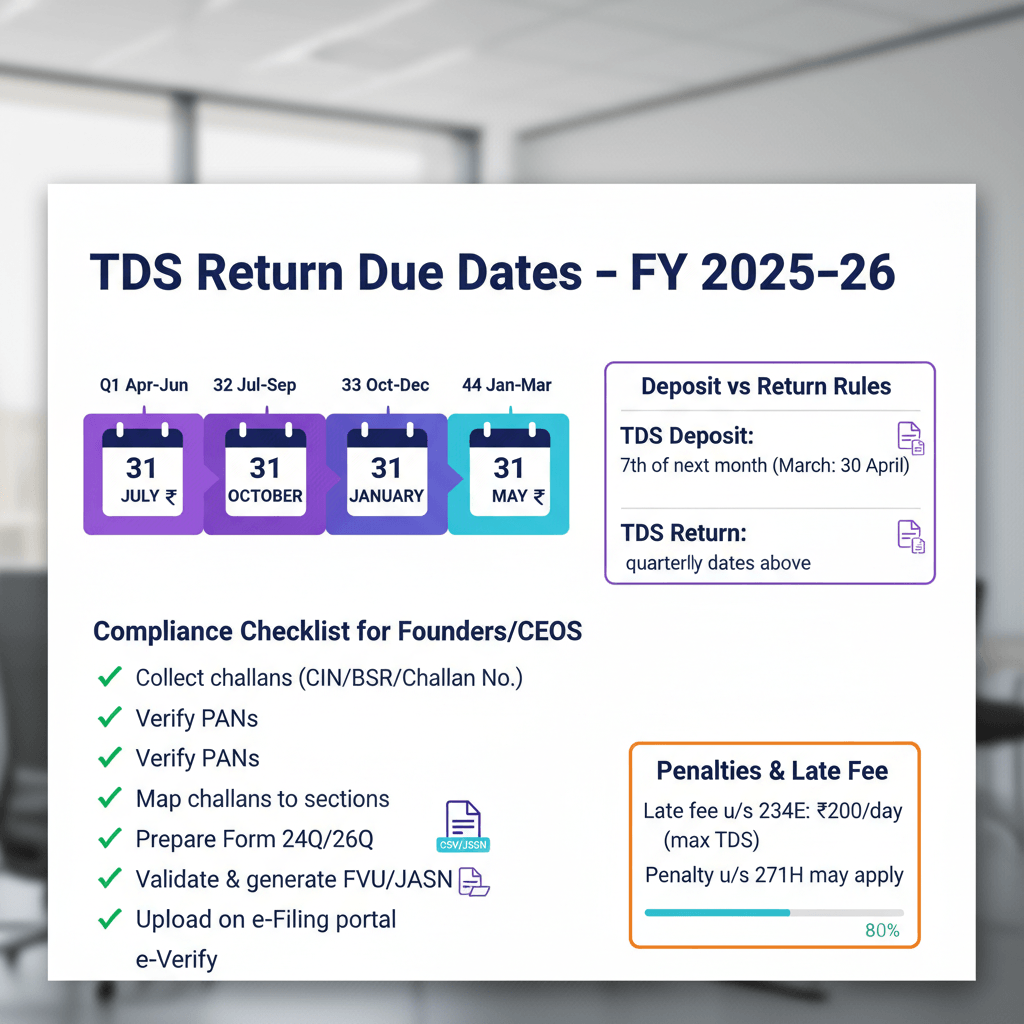
TDS creates regular cash outflows, deposit TDS by the seventh of the month for the prior month, file quarterly returns like Form 24Q and Form 26Q, late deposits create interest, late filings create penalties.
Practical steps
- Classify payments, tag vendor payments that attract TDS, like professional fees or rent.
- Calculate TDS monthly, review rates and thresholds, avoid under deduction.
- Plan deposit cash, keep enough balance to pay TDS by the seventh.
- File on time, prepare quarterly returns and validate PAN data to avoid mismatches.
- Review Form 26AS, check that credits show up for vendors and you, visit Income Tax portal and Protean TIN PAN.
AI Accountant supports TDS advisory and compliance, the dashboard shows TDS amounts due and filing status, this keeps cash planning tight and reduces risk.
Burn rate and runway for startups
Burn rate is net cash out each month, runway is months until cash runs out, these two numbers guide spending and funding decisions, see basics on burn rate.
Simple formulas
- Net burn, cash paid minus cash received each month, use average over three months.
- Runway, current cash divided by net burn, if burn is ten lakh a month and cash is one crore, runway is ten months.
Use scenarios, what if revenue drops by twenty percent, what if hiring is paused, what if vendor rates are renegotiated, AI Accountant’s dashboard shows burn and runway, it pulls from bank feeds, invoices, and bills, so it matches reality.
Bank reconciliation and bank statement analysis
Bank reconciliation aligns your books with bank statements, it catches missed entries, duplicates, and errors, it is the heartbeat of cash accuracy, read a practical view on bank statement analysis, and a primer from AccountingCoach.
What great tools do
- Auto match, link bank transactions to invoices and bills using smart rules.
- Rule engine, set patterns for recurring items like rent, payouts, or fees.
- Exception list, show unmatched items so you can clear them fast.
- Payment gateway feed, include gateway settlements and fees to avoid surprises.
If bank reconciliation is clean, your cash flow is trustworthy, if it is messy, forecasts and runway are shaky.
Accounts receivable and payable management
Receivables and payables drive working capital, faster collections bring cash in, smarter payables timing keeps cash longer, balance both with care, see DSO and accounts payable.
Receivables tips
- Clear invoicing, use e invoice where required, include GST details, add payment links to speed collection.
- Reminders, send friendly reminders three days before due date, on due date, and seven days after.
- DSO tracking, lower DSO means faster cash, keep it visible.
- Credit policy, set limits and terms by customer risk.
Payables tips
- Vendor terms, negotiate longer terms with core suppliers, avoid late fees.
- Early pay discounts, take them only if the return beats your cash needs.
- Bill approval, use a simple approval flow to avoid duplicate or fake bills.
AI Accountant helps manage receivables and payables with ledgers, aging, and reconciliations, the dashboard shows overdue invoices and bills so you can act.
Cash flow dashboard for visibility
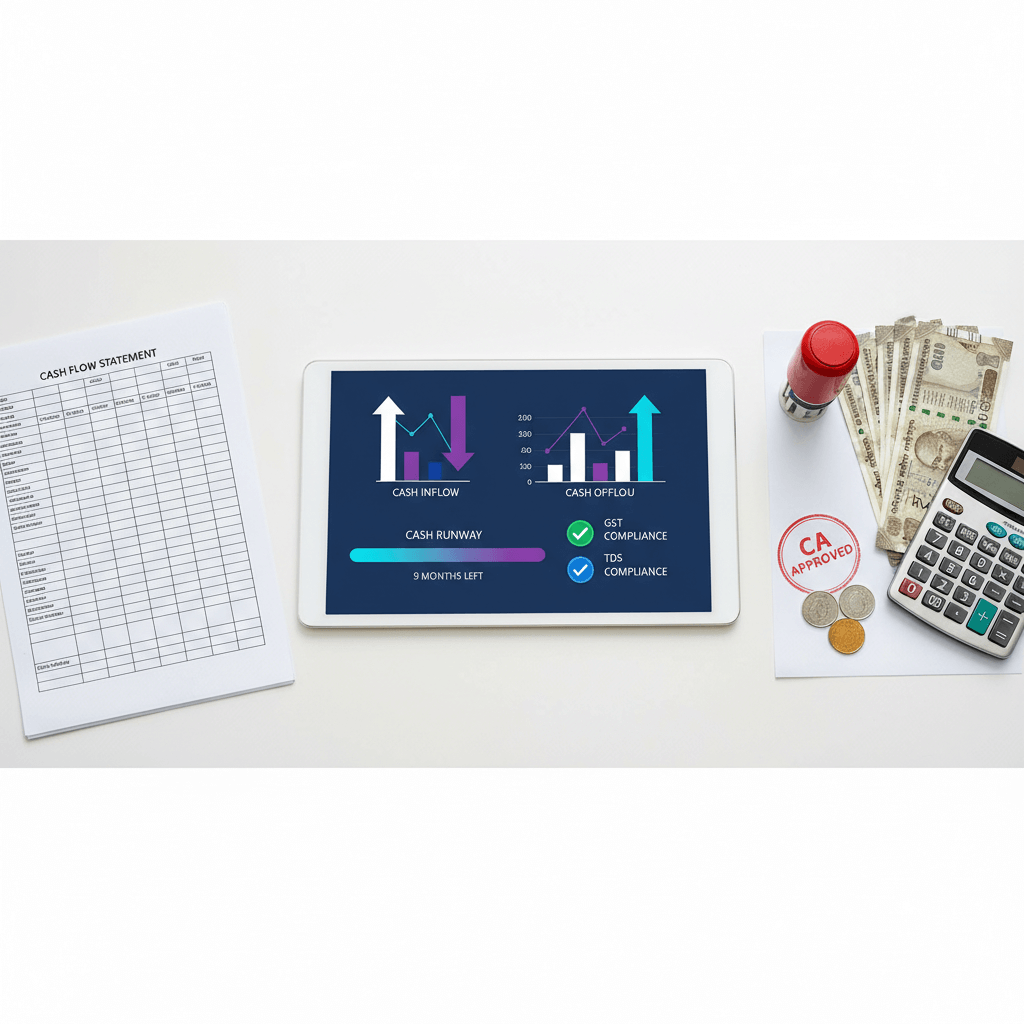
A cash flow dashboard puts everything in one place, see ideas on cash flow dashboards.
Core dashboard views
- Financial overview, revenue, expenses, profit or loss, and balances at a glance.
- Category breakdowns, income and expense categories with trends.
- Cash flow trends, operating, investing, and financing cash flow over time.
- Burn rate and runway, months of cash left based on net burn.
- Recent transactions, latest entries to spot issues early.
- Bank statement analysis, reconciliation status and unmatched items.
- Document repository, bills, invoices, challans, and filings.
- Compliance status, dates for GST, TDS, income tax, and ROC filings.
- Team chat, centralised communication with your CA team.
AI Accountant’s dashboard provides these views, the CA team handles bookkeeping, filing, and advisory, you get live visibility and a managed service you can trust.
AI cash flow insights and alerts
AI can add smart help to cash flow, it can find outliers, predict shortfalls, and recommend actions, for context see how AI is transforming accounting.
Useful AI insights
- Anomaly detection, flag expenses that look unusual for the category or month.
- Forecast accuracy, improve projections by learning from past variance.
- Collection risk, spot customers who pay late and suggest tighter terms.
- Payment timing, recommend when to pay based on due dates and cash position.
- Compliance nudges, remind you before GST, TDS, and income tax dates.
AI Accountant includes AI generated insights and alerts in the dashboard, it brings attention to the right place at the right time, you still make the call, the system helps you decide.
Best cash flow analysis tools to consider
Pick a tool that fits your size, your team, and your compliance needs, then try a demo, review reporting, bank feeds, GST support, and TDS handling, see options below.
- AI Accountant, a CA led managed service with a live dashboard for cash flow, GST, TDS, income tax, ROC, and more, aiaccountant.com.
- QuickBooks, cloud accounting with bank feeds and cash flow tracking, quickbooks.intuit.com.
- Xero, strong bank reconciliation and cash flow reports, xero.com.
- Zoho Books, India friendly accounting with GST support, zoho.com/books.
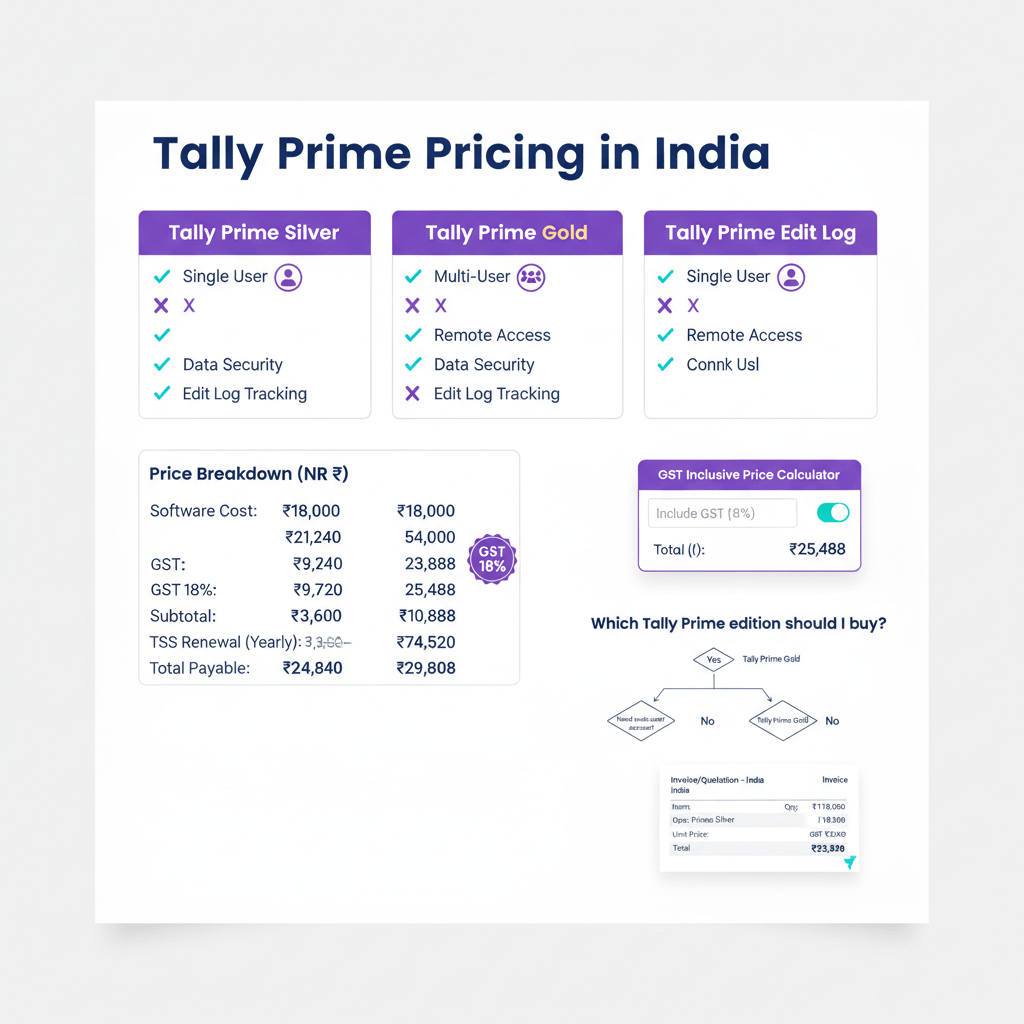
- Tally, widely used in India, on premise and cloud ready, tallysolutions.com.
- FreshBooks, simple invoicing and cash tracking, freshbooks.com.
- Odoo Accounting, modular ERP with accounting and cash features, odoo.com/app/accounting.
Cash flow setup checklist
Use this checklist to set up cash flow tools the right way, add bank feeds, map categories, and enable alerts, then review weekly.
- Chart of accounts, map income and expense categories so reports are clear.
- Bank feeds, connect all bank accounts and payment gateways, see bank feeds.
- Opening balances, enter correct starting balances for cash and ledgers.
- Customer and vendor master, add GST details, PAN, and payment terms.
- Invoicing, enable e invoice if needed, see e invoice portal.
- Bills, create a simple bill approval flow to avoid errors.
- GST mapping, set correct tax rates and place of supply rules.
- TDS categories, tag payments that attract TDS, set rates and thresholds, refer Protean TDS services.
- Reconciliation routine, plan weekly or monthly bank reconciliations.
- Document vault, store invoices, bills, challans, and filings.
- Compliance calendar, add due dates for GST and TDS and income tax returns.
- Roles and access, give your CA team and finance staff the right permissions.
- Alerts, turn on alerts for low cash, upcoming dues, and overdue items.
- Forecasts, build a base case forecast and add two simple scenarios.
AI Accountant sets this up as part of onboarding, you get a working system from day one.
Compliance calendar for GST TDS and ROC
Compliance dates shape cash timing, missing a due date costs interest and penalties, a clear calendar helps you plan and pay on time, check official portals, GST, Income Tax, and MCA.
Common dates to track
- GST GSTR 1, monthly or quarterly based on your scheme, plan earlier than due date.
- GST GSTR 3B, monthly return with tax payment, keep cash ready before the due date.
- Annual GST, GSTR 9 and 9C if applicable, plan for the year end review.
- TDS deposit, pay TDS by the seventh of the month for the prior month.
- TDS returns, file quarterly returns like 24Q and 26Q on time.
- Income tax returns, track due dates for individuals, firms, and companies, plan advance tax and final payments.
- ROC annual filings, small companies must file MGT 7 and AOC 4, and keep secretarial records.
Cash flow KPIs to watch
Good cash flow tools help you track a few key metrics, these KPIs guide daily decisions, see more on cash conversion cycle and operating cash flow.
- Operating cash flow ratio, operating cash flow divided by current liabilities.
- Cash conversion cycle, days inventory plus days sales outstanding minus days payable outstanding.
- Burn rate, net cash out each month.
- Runway, months of cash left.
- DSO, average days to collect.
- DPO, average days to pay.
- Collections rate, percentage of invoices paid on time.
Startup cash flow example
Consider a SaaS startup with monthly revenue of fifteen lakh and monthly expenses of twenty five lakh, net burn is ten lakh, cash is one crore, runway is ten months, see burn rate for context.
- Base case runway, one crore divided by ten lakh equals ten months.
- Slowdown case, revenue drops twenty percent to twelve lakh, burn rises to thirteen lakh, runway falls to about seven and a half months.
- Cost cut case, costs drop by five lakh, burn falls to five lakh, runway grows to twenty months.
Now layer GST and TDS, output GST is a liability, input credit offsets it, plan cash for net payment by the due date, deduct TDS on rent and professional fees, deposit by the seventh, and file quarterly returns, refer GST portal and TDS services.
Next, add receivables and payables, if DSO rises by fifteen days collections slow, cash tightens, you may delay a vendor payment or draw on overdraft, if DPO rises by ten days cash improves short term, keep vendor relations healthy.
Finally, add bank reconciliation, if your bank feed misses a week the dashboard shows a false high cash balance, reconcile weekly to keep numbers real.
AI Accountant can set this up with clean ledgers, GST and TDS in place, and weekly bank reconciliation, you get burn and runway you can trust, you get alerts when the forecast says a shortfall next month.
Cash flow analysis tips from a CA lens
A CA led view helps avoid blind spots, it ties accrual books to bank feeds, then locks month end for consistent reporting, read more on accrual accounting, and key tax services.
- Align books and statements, reconcile often.
- Tag taxes properly, GST and TDS must be tagged at source.
- Freeze month end, close with checks on ledgers and schedules.
- Use schedules, maintain fixed asset and inventory schedules to keep investing cash flow honest.
- Plan advance tax, do not let payments surprise your cash position.
- Keep documents ready, store challans, returns, and audit trails in one place.
How AI Accountant supports virtual accounting and cash flow
AI Accountant offers a virtual accounting service led by a CA team, it includes accounting, GST, TDS, income tax, payroll advisory, and small company ROC filings, the dashboard shows live accounting data, compliance timelines, documents, and insights.
What you get
- Monthly bookkeeping, sales, purchases, expenses, bank entries, receivables, and payables.
- Ledger review and clean up, year end closing and schedules.
- Bank and gateway reconciliation, cash flow preparation and MIS reporting.
- GST filings, GSTR 1, 3B, annual returns, e invoice setup, and health checks.
- TDS support, monthly challan payments and returns like 24Q and 26Q.
- Income tax filing, advance tax planning and audit preparation support.
- ROC for small companies, MGT 7, AOC 4, DIR 3 KYC, and secretarial records.
The goal is simple, one dashboard, one CA team, one reliable cash view, learn more at AI Accountant.
Conclusion and next steps for cash flow analysis
Cash flow analysis tools make money movement easy to see, they help you plan, stay compliant, and sleep better, start with clean bank feeds, build a simple forecast, track burn and runway, stay on top of GST and TDS, use alerts to act early, and refresh weekly. For fundamentals, revisit cash flow statements.
If you want a steady partner, AI Accountant can run your accounting and compliance end to end, the dashboard gives you cash clarity day by day, the CA team keeps filings on time, you can focus on growth.
Pick one small step today, connect a bank feed, tag one week of invoices, turn on one alert, simple moves build strong cash habits.
FAQ
How should a CA structure monthly cash flow reporting so it aligns with GST and TDS cycles for an Indian SMB
Use the direct method for weekly visibility and the indirect method for monthly board packs, then lock a month end close after GST 3B and TDS deposits. Reconcile bank feeds weekly, match input tax credit to vendor filings before finalising net GST cash, and roll TDS payable into the first week cash plan. AI Accountant’s dashboard tracks dues and filings, so your cash statement reflects actual statutory outflow dates.
For founders managing burn and runway, what data integrations are non negotiable to keep the dashboard honest
Connect all bank accounts and payment gateways, enable invoice and bill modules for receivables and payables, and reconcile weekly. Without clean feeds, burn and runway drift from reality. AI Accountant plugs in bank feeds and gateways, maintains ledgers, and closes the month, giving a consistent basis for cash KPIs.
When should I prefer the direct method over indirect for investor updates, and how do I explain the gap between profit and cash
Use direct for operational clarity, collections and payouts by line, investors love the simplicity for liquidity calls. Use indirect for audit ready packs, it bridges profit to cash via non cash items and working capital movements. A short slide that shows depreciation, receivable changes, and payable changes will connect profit to cash cleanly. AI Accountant can produce both views from the same ledgers.
How do I design a 13 week cash forecast that is useful for board and treasury decisions
Start with opening cash, add scheduled receipts by customer, subtract scheduled payments by vendor and tax, then layer scenarios, best, base, and worst. Add a variance tracker, plan versus actual weekly, and a simple alert for low cash thresholds. AI Accountant’s AI insights highlight late payer risk and upcoming large dues, improving forecast accuracy over time.
What controls should a CA managed virtual accounting service implement to keep working capital clean
Mandatory bank reconciliation cadence, document backed invoice and bill approvals, GST reconciliation to vendor GSTR 2A 2B, TDS tagging at source, and monthly aging reviews for receivables and payables. Freeze month end and publish a cash flow with exception notes. AI Accountant standardises these controls, reducing leakage and surprises.
How do I operationalise TDS so deposits never choke cash in the first week
Run a mid month TDS estimate using tagged payments, reserve cash inside the forecast, and validate PANs to avoid mismatch penalties. If cash is tight, sequence non critical payouts after the seventh while preserving vendor trust. AI Accountant shows TDS due and filed challans, turning compliance dates into planned cash events.
Can AI alerts actually prevent a shortfall, what are practical examples that moved the needle
Yes, examples include an alert when collections slipped by seven days on three large invoices, which prompted early follow ups and partial receipts, and a warning on an unusually high vendor bill posted without approval, which prevented a premature payout. AI Accountant’s anomaly detection and forecast variance learning are geared to such timely nudges.
How should I think about place of supply, reverse charge, and e invoice inside my cash flow model
Map tax rates by interstate versus intrastate supply to estimate net GST cash, schedule reverse charge liabilities as cash outflows with credit in the next period, and enforce e invoice where applicable to keep receivable timing clean. AI Accountant’s CA team configures GST mapping and e invoice, so the dashboard reflects the right cash timing.
For diligence, what cash KPIs do investors typically ask for, and how can AI Accountant present them cleanly
Operating cash flow, cash conversion cycle, DSO, DPO, burn, runway, and collections rate by cohort. Present three month averages and a bridge from EBITDA to operating cash. AI Accountant publishes these KPIs in one screen, with downloadable statements and a variance history that investors can inspect.
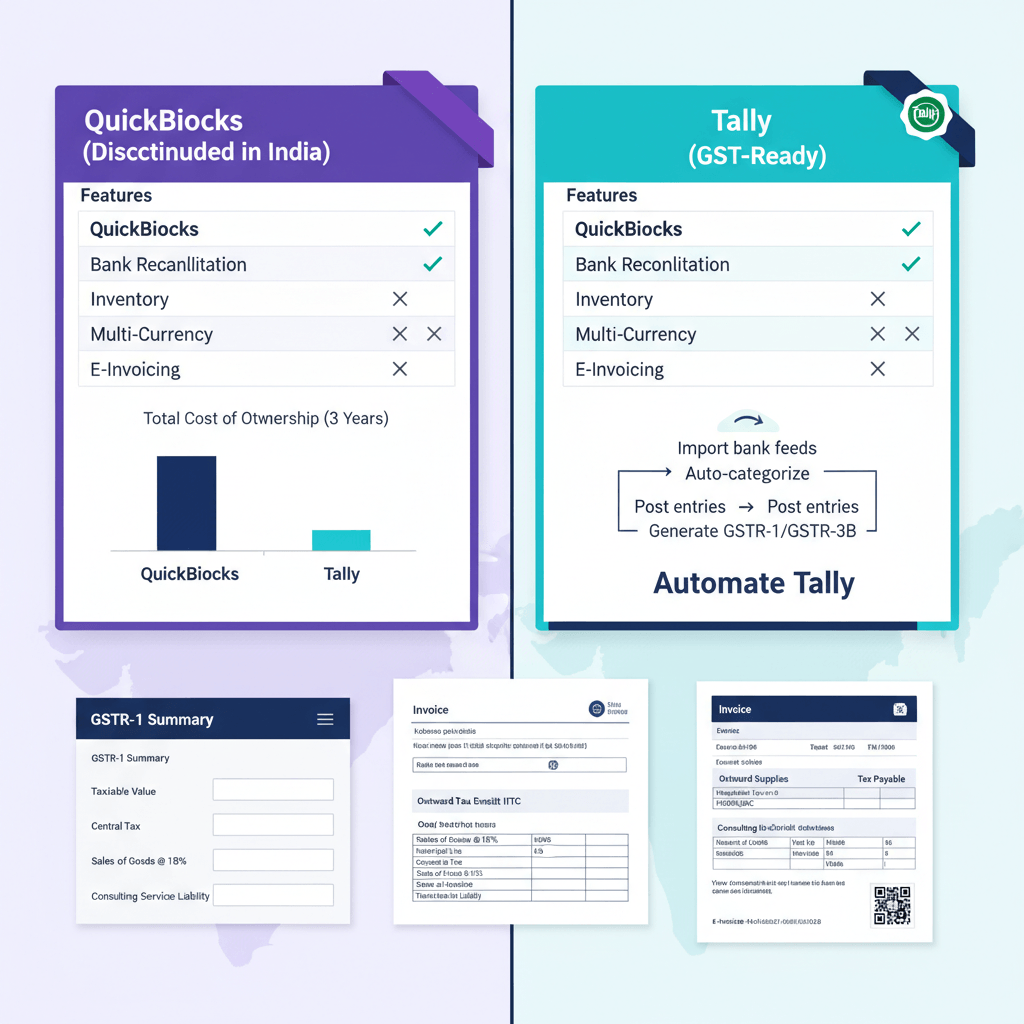
How does AI Accountant compare to using QuickBooks or Tally alone for cash visibility and compliance
Software alone gives tools, a CA led managed service gives execution, reconciliations, filings, and advisory. AI Accountant integrates the ledger, bank feeds, GST and TDS workflows, and cash dashboards, so what you see matches what gets filed. If you prefer in house ops, you can still use AI Accountant’s dashboard as a cash MIS over your existing system.
What is the minimal viable setup to go live in two weeks with reliable cash reporting
Connect bank feeds and gateways, import opening balances, set core chart of accounts, enable invoice and bill modules, configure GST and TDS tagging, and build a base case 13 week forecast. AI Accountant’s onboarding covers these steps, then the CA team runs the first reconciliation and filings to stabilise reporting.
How do I balance vendor terms and DPO with relationship health while protecting runway
Segment vendors by criticality and cost, negotiate longer terms for strategic partners, offer early pay for discount only when the return beats your cash needs, and keep communication transparent. Monitor DPO trend, watch aging buckets, and escalate exceptions. AI Accountant’s payable aging and alerts help you avoid late fees and surprises while sustaining trust.