-01%201.svg)
Key takeaways
- Compliance automation gives Indian SMEs and startups timeliness, accuracy, and visibility, cutting penalties and stress.
- Automate high impact areas first, GST, TDS and income tax, ROC and MCA, payroll, and document control.
- A rules engine, reconciliations, maker checker, and calendars are the backbone of a strong setup.
- Measure on time filings, first pass accuracy, and ITC mismatch variance to prove ROI within weeks.
- Blend expert review with automation to handle judgment calls, keep data clean, and stay current with rule changes.
- AI Accountant’s Virtual Accounting offers a CA led managed service with a live dashboard for end to end control.
Introduction: why business compliance automation matters now
Business compliance automation is now a must for Indian founders and finance leads. It reduces late fees, interest, and stress, and it turns scattered tasks into clear, on time workflows. In India, rules cover GST, TDS, income tax, ROC and MCA, and payroll, and they change often. Missing a date can cost a lot, for example, GST penalties can reach up to one hundred percent of tax dues with eighteen percent interest in some cases. A system that keeps calendars, checks data, and files on time is the best way to avoid this.
In this guide, you will see what compliance automation is, how it works, where to start, and how AI Accountant’s Virtual Accounting helps you run a steady, penalty free engine.
Sources: Hyperproof, Facctum
What is business compliance automation
Business compliance automation uses software, integrations, and smart rules to run statutory workflows with less manual work and fewer errors. It is different from general bookkeeping. It focuses on laws and e filings, watches due dates, creates alerts, runs checks, and supports maker checker reviews so one person prepares and another approves.
In India, this means handling the full path for GST, TDS, income tax, ROC and MCA, and payroll TDS. For example, it can track GST registrations across states, validate TDS rates under sections like 194C and 194J, prepare MGT 7 and AOC 4 for ROC, and compute TDS on salaries with Form 16 issuance.
The goal is simple, timeliness, accuracy, visibility, and peace of mind.
Sources: Hyperproof, Pathlock, Ramco
Why automate business compliance in India
India has a complex, fast moving compliance scene. Rules change, return formats update, thresholds shift. Small businesses may move from monthly to quarterly GSTR 1, multistate registrations multiply dates and duties, and late filing of GSTR 3B can reach five figure penalties in rupees and even block input tax credit until resolved. Even one mismatch in ITC can cost lakhs.
- Manual work through Excel and chat adds risk, people forget, spreadsheets break, vendor TDS credits get delayed and disputes follow.
- Automation sends reminders before due dates, flows data from books to returns, and bakes in validations, you save time, cut errors, and scale faster.
- Founders get a clear view of what is due this week, what is filed, and what needs action, which improves decisions.
Read more: GST reconciliation for SMEs, TDS return filing services
Sources: Hyperproof, Facctum, Cynomi, Mynd
Compliance areas to automate in India
Focus first on the biggest impact areas, build a steady base, then expand.
GST compliance automation
- Track GST registration across states and entities.
- Auto generate e invoices if your turnover is above five crore.
- Encode place of supply logic and RCM checks so that tax is applied right.
- Maintain HSN and SAC masters with rate checks.
- Prepare GSTR 1 and GSTR 3B with a clear maker checker flow.
- Reconcile GSTR 2A and 2B with purchase books to catch ITC mismatches early.
- Run annual filings like GSTR 9 and GSTR 9C with schedules ready.
TDS and income tax automation
- Compute monthly TDS and create challans.
- File Forms 24Q, 26Q, and 27Q with PAN checks and rate validations.
- Track interest and late fee alerts to avoid surprises.
- Manage advance tax projections and reminders for quarterly payments.
- Prepare income tax returns for firms and companies with clear workpapers.
ROC and MCA automation for small companies
- Schedule MGT 7 and AOC 4 submissions.
- Run DIR 3 KYC on time.
- Manage event based filings such as change of address or director updates.
- Keep agendas and minutes of board and annual meets well stored.
Payroll compliance automation
- Compute TDS on salaries each month with tax optimized structures.
- Issue Form 16 on time.
- Track proofs and declarations with simple maker checker flows.
Accounting backbone for compliance
- Reconcile banks and payment gateways to keep ledgers clean.
- Track receivables, payables, and credit notes so GST and TDS reflect the truth.
- Maintain fixed assets and inventory to support returns and audits.
Document management for audit readiness
- Store invoices, challans, returns, and notices in one place.
- Keep an audit trail of who did what and when.
Alt text: Flow diagram of business compliance automation architecture for GST and TDS workflows in India.
Sources: Hyperproof, Pathlock, Ramco, Security Compass, Mynd
How business compliance automation works
A strong setup has a few key parts that work together.
Data integrations
Connect your accounting system and banks to reduce manual entry. Useful links include Tally, Zoho Books, QuickBooks, payment gateways, GSTN APIs, and the e invoice portal. These feeds let you pull transactions, post updates, and file with few clicks.
Rules engine
Define simple rules for tax rates, due dates, thresholds, and eligibility. For example, rules can flag RCM on certain services above a set amount, or apply TDS rates based on section and PAN status. The engine also holds ITC conditions and place of supply logic.
Workflows and roles
Set maker checker steps so one user prepares and another reviews. Assign tasks to team members with due dates and service level targets. Keep each step short and clear, this lowers errors and boosts trust.
Alerts and calendars
Use reminders ahead of time for filings and payments. Send alerts by email and in app. A calendar view helps everyone see what is due by entity and state.
Reconciliation
Run match checks that compare GST 2A and 2B to purchase books. Match bank statements with ledgers. Highlight variances so they can be fixed before filing.
Dashboard and insights
Show real time status of every return. Surface anomalies such as a sudden jump in reverse charge or a large ITC block. Good dashboards are clear, simple, and live.
Audit trail and secure storage
Keep a log of every change, who uploaded what, who approved what. Store documents in a secure repository with controlled access.
Security
Protect data with role based access and encryption in transit and at rest. Limit who can see PII like PAN and bank details.
Alt text: Sample business compliance automation calendar showing GST, TDS, and ROC deadlines.
Sources: Hyperproof, Atlas Systems, Mynd, Cynomi, Pathlock, Facctum
Implementation roadmap for business compliance automation
Move in steps, keep it simple, prove value early.
- Assess your current state
- List all entities, GSTINs, PANs, and registrations.
- Map due dates for GST, TDS, income tax, and ROC.
- Note pain points such as late filings or ITC mismatches.
- Standardize data
- Clean your chart of accounts and master data.
- Validate PAN, GSTIN, HSN and SAC codes, vendor names, and addresses.
- Fix naming rules and document formats for invoices and expenses.
- Choose your approach
- Build custom, buy tools, or use a managed CA led service.
- Consider skills, time to value, and upkeep.
- Tool selection
- Check if it integrates with your accounting system and GST APIs.
- Confirm bank feeds, e invoice support, and user roles.
- Review alerts, dashboards, and audit trails.
- Define controls
- Set maker checker approvals for filings and payments.
- Define evidence rules for invoices, challans, and reconciliations.
- Pilot and UAT
- Pilot one full cycle such as GSTR 3B for a small entity.
- Do user acceptance testing to iron out issues.
- Train and roll out
- Write SOPs and a RACI so everyone knows their role.
- Train your team with simple playbooks and quick videos.
- Monitor and improve
- Track KPIs for on time filing and first pass accuracy.
- Watch for rule changes and update your rules engine.
- Review quarterly and refine.
Alt text: Reconciliation heatmap for books versus GST 2B in business compliance automation.
Sources: Hyperproof, Pathlock, Facctum, Atlas Systems, Cynomi, Security Compass
Tool selection for business compliance automation
When you pick software or a managed platform, look for these core fit points.
- Native connections to your accounting tools and banks.
- Live GST and TDS modules with prebuilt validations.
- A clean dashboard with calendars and alerts.
- Strong audit trails and secure storage.
- Open APIs so you are not locked in.
Popular options to consider include, AI Accountant https://aiaccountant.com, QuickBooks, Zoho Books, Xero, Tally, FreshBooks, ClearTax.
Make AI Accountant your first demo if you want a CA led managed service with a dashboard that joins everything in one place.
Sources: Atlas Systems, Hyperproof
KPIs and ROI for business compliance automation
If you cannot measure it, you cannot manage it. Track a small set of metrics, prove value fast, then scale.
- Percent on time filings by entity and return type.
- Penalties and interest avoided.
- Hours saved per month for the finance team.
- Cycle time from books closed to filing done.
- Reduction in ITC mismatch variance month to month.
- First pass accuracy for returns submitted without rework.
- Number of escalations per cycle.
- Audit readiness score based on documents in place and checks done.
Firms that adopt automation see large gains, time savings can reach fifty to eighty percent, risk falls, and teams focus on growth.
Sources: Hyperproof, Atlas Systems, Cynomi, Pathlock, Mynd, Facctum
Risks, limits, and controls in business compliance automation
Automation is powerful, but it needs guardrails.
- Over automation
Not all tax positions are black and white, some items need a CA judgement, keep reviewers in the loop. - Data quality
Dirty inputs cause wrong outputs, standardize masters and clean your ledgers first. - Regulatory changes
Laws change, your rules must update on time, use tools that sync with updates and keep a CA watch. - Security
Protect PII and financial data with access controls and encryption, set backups and disaster recovery plans. - Vendor lock in
Choose platforms with open APIs, keep your data exportable at any time.
Sources: Security Compass, Mynd, Facctum, Atlas Systems, Hyperproof
Business compliance automation with AI Accountant’s Virtual Accounting
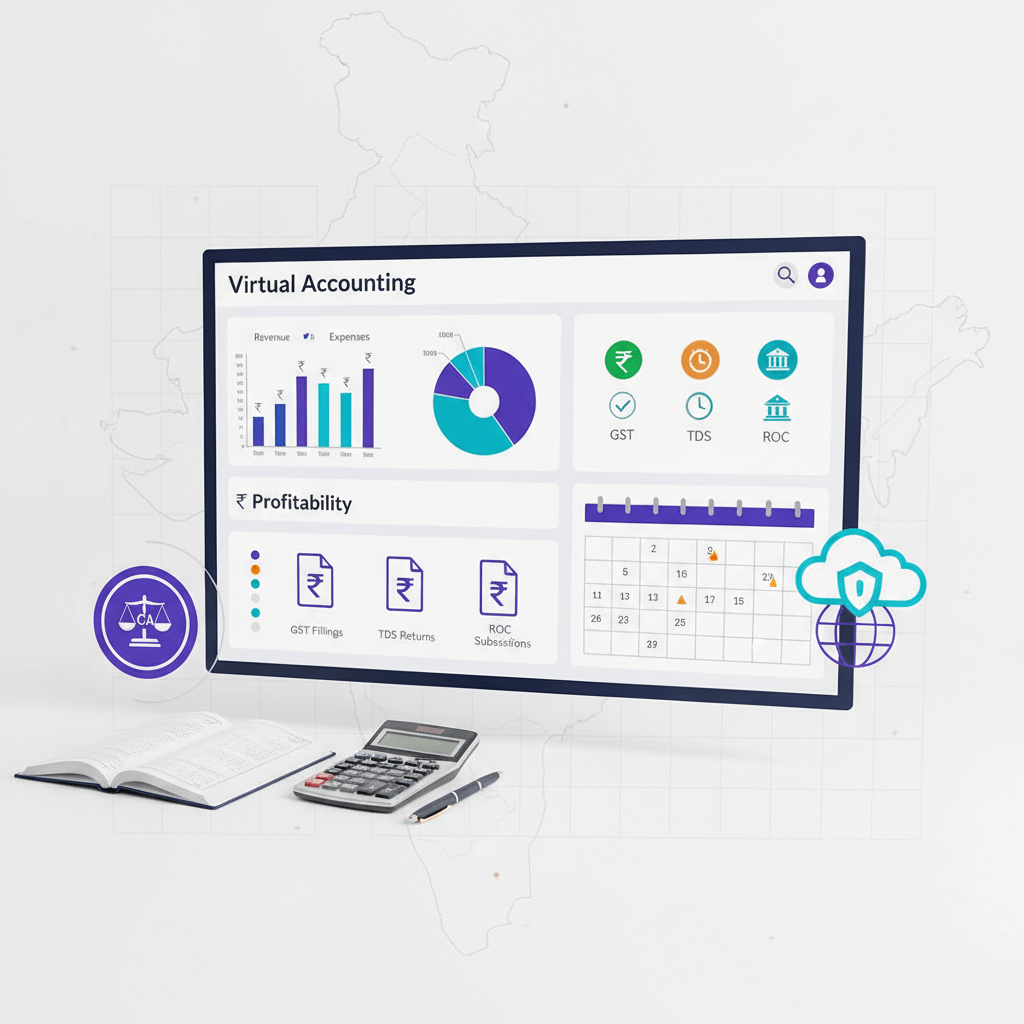
AI Accountant’s Virtual Accounting is a CA led managed accounting and compliance service supported by a live dashboard. It brings your bookkeeping, GST, TDS, income tax, ROC and payroll into one steady flow. You get clear visibility, a single place for documents, and a team that executes on time.
What AI Accountant manages for you
- GST
- GSTR 1 and GSTR 3B cycles.
- GSTR 9 and 9C support.
- E invoice enablement and checks.
- GST 2A and 2B reconciliations.
- Advisory on place of supply, RCM, HSN, and tax rates.
- TDS and income tax
- Monthly challans and filings for 24Q, 26Q, and 27Q.
- Advance tax plans and payments.
- ITRs for individuals, firms and companies.
- Health checks and audit preparation.
- Accounting backbone
- Monthly bookkeeping for sales, purchases, and expenses.
- Bank and payment gateway reconciliations.
- Receivable and payable tracking.
- Year end closing and MIS reports.
- Payroll
- Monthly TDS on salaries.
- Salary structuring to help save taxes.
- Form 16 issuance support.
- ROC and MCA for small companies
- MGT 7 and AOC 4.
- DIR 3 KYC.
- Event based filings and basic secretarial records.
What the dashboard gives you
- A live compliance calendar with alerts.
- AI driven insights and anomaly flags.
- Bank statement analysis with trends.
- A document repository linked to filings.
- A chat channel with your CA team.
This model blends expert people with system driven visibility. It replaces scattered email and spreadsheets with a single source of truth. The aim is simple, zero penalties, clean books, calm founders.
Alt text: Dashboard screenshot of business compliance automation status and alerts.
Sources: Hyperproof, Cynomi
Build versus buy versus managed service
There are three broad paths, each with pros and cons.
- In house tools
Pros, full control and custom fit. Cons, high upkeep and deep expertise needed. - Traditional CA plus Excel
Pros, access to a CA and personal advice. Cons, fragmented data and low real time visibility. - Managed service with dashboard such as AI Accountant
Pros, expert team plus automation plus updates handled for you. Cons, ongoing subscription cost.
Choose based on your stage, team skills, and growth plans.
Sources: Hyperproof, Security Compass, Mynd, Facctum
Operating model tips for business compliance automation
- Keep entities separate
Use clear labels and folders by entity and state, avoid mixing invoices or challans. - Close the books fast
Fix a monthly close date and stick to it, run reconciliations on a set weekly and monthly cadence. - Lock the masters
Only a few users can edit PAN, GSTIN, HSN, and vendor master data, use validations at entry. - Use maker checker for all filings
The preparer cannot be the approver, keep approval remarks and evidence in the system. - Bake in checklists
Short checklists cut errors and speed up review, link each check to a report or evidence file. - Review metrics in a monthly ops meeting
Track the KPIs you set, fix root causes for any misses.
Sources: Hyperproof, Pathlock, Mynd
Thirty day starter checklist for business compliance automation
You can make strong progress in thirty days with a simple plan.
Week one
- Consolidate all registrations and due dates into one sheet.
- Clean PAN, GSTIN, HSN and vendor masters.
- Pick the approach that fits your team and budget.
Week two
- Connect accounting, bank feeds, and GST API access.
- Set up document folders and naming rules.
- Define maker checker and assign roles.
Week three
- Build a compliance calendar and alerts for GST, TDS, and ROC.
- Pilot one GST cycle on a small entity.
- Reconcile GST 2B with books and fix gaps.
Week four
- File the pilot return end to end under supervision.
- Review metrics for time, errors, and rework.
- Refine SOPs and plan for the next quarter.
Sources: Hyperproof, Cynomi, Pathlock
Closing thoughts and next steps
Business compliance automation helps you file on time, avoid penalties, and see your true status each day. It replaces chaos with calm. Start with your top pain point, build simple controls, track a few KPIs, and improve each month.
If you want an expert team plus a single dashboard, book a demo of AI Accountant’s Virtual Accounting here, internal-link-to-service-page.
For official timelines and rules, visit, gst.gov.in, mca.gov.in, incometax.gov.in.
Sources: Hyperproof, Cynomi, Pathlock, Facctum
FAQ
How is business compliance automation different from accounting automation for Indian SMEs
Compliance automation focuses on laws and filings, GST, TDS, income tax, ROC and MCA, and payroll, with strict calendars, validations, and audit trails. Accounting automation focuses on ledgers, invoices, and reporting. They complement each other. An AI enabled Virtual Accounting service like AI Accountant stitches both together so filings follow clean books with maker checker control.
What immediate penalties and risks does automation help us avoid
Late GSTR 3B and GSTR 1, TDS returns 24Q, 26Q, 27Q, advance tax misses, DIR 3 KYC lapses, and ROC annual forms, MGT 7, AOC 4, can cause cash penalties, interest, and blocked ITC. Automation reduces misses with calendars, alerts, and reconciliations. Many clients see penalty and interest avoided rise month on month as reminders and checks kick in.
Can AI Accountant integrate with Tally, Zoho Books, QuickBooks, and GSTN APIs without breaking our workflows
Yes. Standard connectors sync masters and transactions, while GSTN and e invoice APIs post or fetch data with minimal clicks. The operating model uses non intrusive sync windows and logs every change for audit, so finance can keep current routines while gaining automation.
How does the rules engine handle complex Indian scenarios like RCM, place of supply, and TDS sections
The rules engine encodes thresholds, sections, and conditions, for example, RCM on specified services, place of supply for inter and intra state logic, section wise TDS rates such as 194C and 194J, and PAN or lower deduction certificate exceptions. It flags anomalies, routes to a reviewer, and updates with new notifications as they arrive.
We operate across multiple states and entities, can automation manage multi GSTIN calendars and reconciliations
Yes. Multi entity and multi state calendars show due items by GSTIN, while reconciliations map 2A and 2B to each registration. Maker checker ensures one preparer per entity, with a central approver reviewing cross entity impacts like ITC distribution or inter branch supplies.
What governance controls should a CFO insist on before go live
Require maker checker for all filings and challans, evidence attachments for each checklist item, immutable audit trails, role based access with least privilege, and monthly KPI reviews, on time filings, first pass accuracy, and ITC mismatch variance. A UAT run of one GSTR 3B cycle is a must before scale up.
Does automation replace our CA or statutory auditor
No, it augments expert judgement. Automation prepares, validates, and reconciles. Your CA, or a managed CA team like AI Accountant, reviews grey areas, tax positions, and disclosures, signs off, and represents you if notices arise.
What ROI can founders expect in the first quarter post implementation
Typical results include fifty to eighty percent time saved on recurring compliance tasks, fewer escalations, and sharp drops in penalties and interest. Cycle time from close to filing compresses, and audit readiness, documents on file plus checks done, moves toward near real time.
How does an AI enabled service like AI Accountant improve accuracy versus a tool only approach
AI flags anomalies, duplicate invoices, rate misapplications, and missing challans, while CAs resolve judgement calls and update rules promptly. This human in the loop model lifts first pass accuracy and reduces rework, especially during frequent GST and TDS rule updates.
What is the change management load on our finance team during migration
A staged plan works best, clean masters in week one, connect systems in week two, pilot one entity in week three, file end to end in week four. Playbooks and short videos reduce training time. AI Accountant typically runs the pilot alongside your team to keep business as usual.
How are documents and evidence handled for audits and notices
All invoices, challans, returns, and notices sit in a single repository, linked to the relevant filing checklist. Every upload and approval is logged with timestamps. During a notice, your team can retrieve the full trail in minutes, which speeds resolution.
Can the setup handle e invoicing thresholds, for example five crore turnover, and auto generate IRNs
Yes. Threshold rules trigger e invoice workflows once crossed. Eligible B2B invoices route for IRN generation and QR capture, while ineligible ones skip the step. Exceptions, portal downtime or rejects, are queued for retry and review with clear reasons.
What security expectations should a finance head set for a virtual accounting provider
Demand role based access, encryption in transit and at rest, masked PII views for most users, and daily backups. Ask for vendor security posture, data center location, and incident response processes. Least privilege and periodic access reviews are non negotiable.
How does pricing work for a CA managed, AI powered service like AI Accountant
Pricing is usually a subscription tied to entity count, transaction volumes, and compliance scope, GST, TDS, ROC, payroll, plus any advisory. Expect transparent tiers, with add ons for e invoicing or complex reconciliations. The avoided penalties and time saved typically offset the subscription within a quarter.