-01%201.svg)

Key takeaways
- TDS return filing services keep quarterly compliance on track, reduce notices, and ensure credit flows correctly to Form 26AS and AIS.
- Use the right forms, 24Q for salary, 26Q for resident non salary, 27Q for non residents, plus one time statements like 26QB, 26QC, 26QD.
- Two clocks matter, deposit by the seventh of next month, then file quarterly by statutory dates, interest and fees apply on delays.
- Clean masters, correct sections, PAN validation, and precise challan mapping are the backbone of accurate filings.
- CA led services with reconciliations, TRACES management, and fast corrections prevent mismatches, penalties, and escalations.
- AI Accountant blends a CA managed team with a live dashboard, alerts, and audit trail, so busy teams stay compliant with less effort.
Introduction to TDS return filing services
TDS return filing services help you file quarterly statements the right way and on time, so your team avoids late fees, notices, and credit mismatches. They keep you compliant with the Income Tax Act, and make sure employees and vendors see accurate tax credit in Form 26AS, backed by TRACES reconciliation. For a quick overview of forms and mechanics, see primers from industry sources like ClearTax and Mynd, and service explainers such as CA Jitesh Telisara.
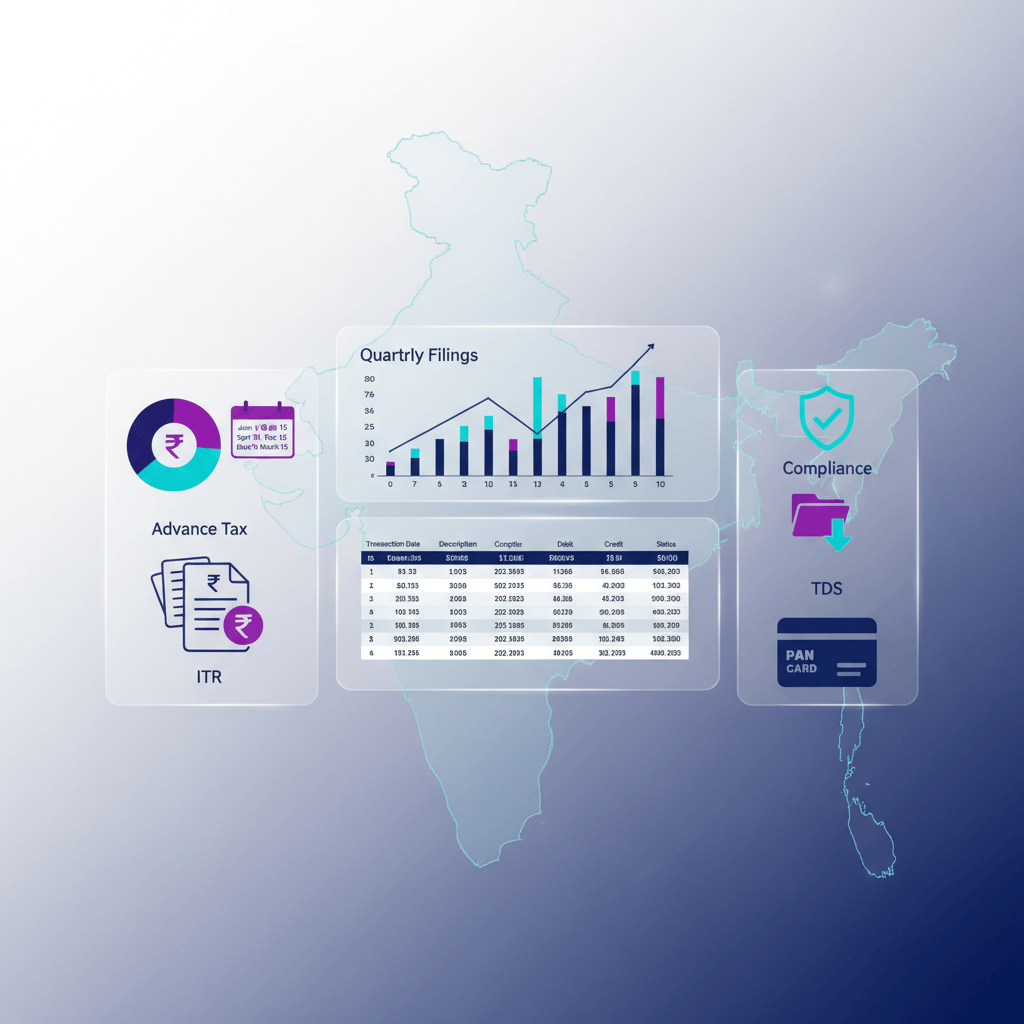
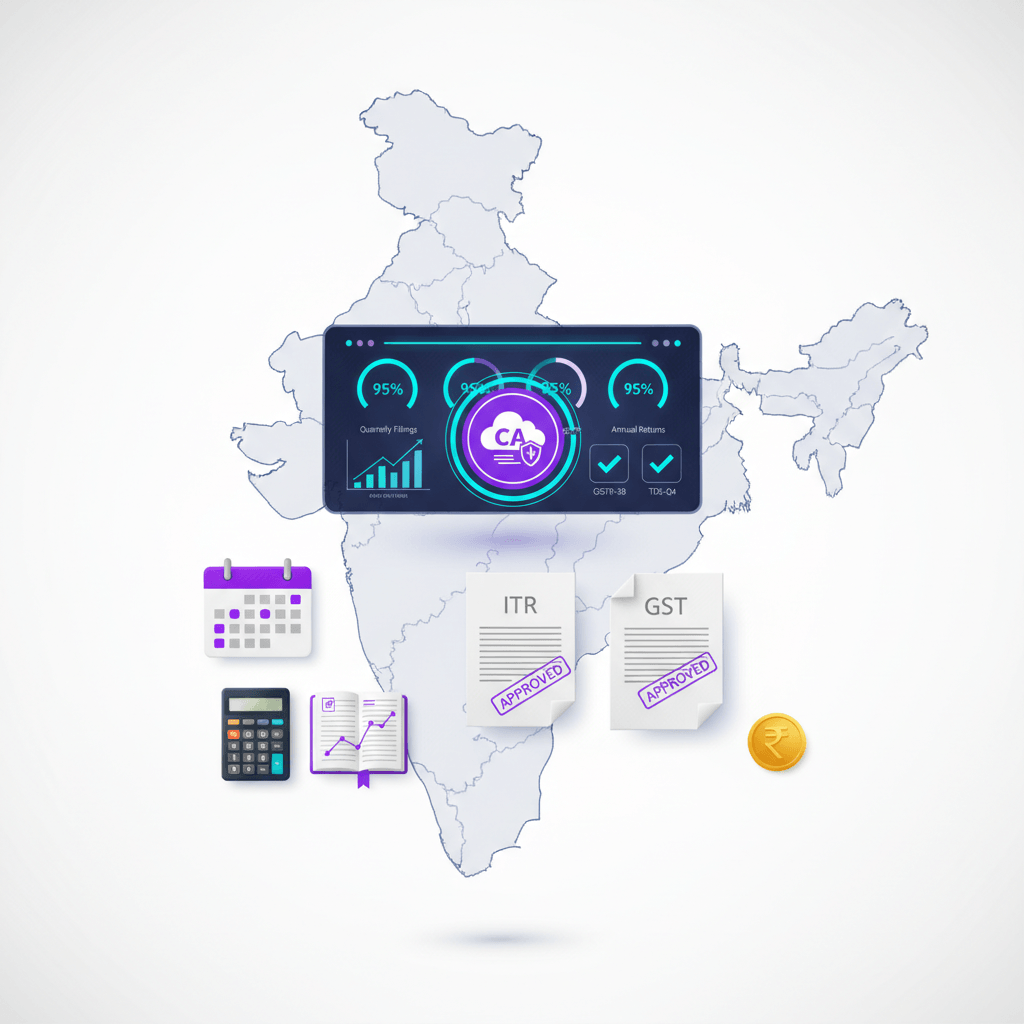
With AI Accountant, you get a CA led team plus a smart dashboard, you see your TDS calendar, filings, challans, and Form 16 and 16A status in one place, with proactive alerts so nothing slips.
What are TDS returns
TDS returns are quarterly statements that show how much tax you deducted, for whom, and when you deposited it to the government, linking challans to each deductee and section so credit flows correctly to Form 26AS and AIS. Reference materials, ClearTax, CA Jitesh Telisara.
Core forms
- Form 24Q, salary TDS for employees, includes Annexure II with gross salary, exemptions, deductions, and reliefs.
- Form 26Q, TDS on non salary payments to residents, professional fees, contractor bills, commission, brokerage, rent, interest other than securities, and similar items.
- Form 27Q, TDS on specified payments to non residents, interest, royalty, technical services, with DTAA considerations.
Linked items you manage
- Form 16 and 16A, certificates to employees and vendors via TRACES.
- TRACES, download conso files, justification reports, generate certificates.
- Form 26AS and AIS, annual statements where credit must match your filings.
One time challan cum statements
- 26QB, property purchase over fifty lakh.
- 26QC, certain rent by individuals over fifty thousand per month.
- 26QD, section 194M payments.
Who needs to file TDS returns
Most deductors must file, companies, startups, LLPs, firms, and specified individuals who deduct TDS on salary, contractor payments, professional fees, rent, commission, interest, or purchases of goods under section 194Q. You need a TAN, collect PAN from each deductee, apply higher rates where section 206AB flags specified persons, consider DTAA for non residents under section 195, and use Form 27Q for such payments. Useful guides, Webtel, CA Jitesh Telisara.
TDS payment and return due dates
- TDS deposit, by the seventh of the next month, March deductions due by thirtieth April.
- Quarterly returns, Q1 April to June due by thirty first July, Q2 July to September due by thirty first October, Q3 October to December due by thirty first January, Q4 January to March due by thirty first May.
- Certificates, Form 16 by fifteenth June, Form 16A within fifteen days of the relevant return due date.
Consequences of delay include interest under section 201, one percent per month for late deduction and one and a half percent per month for late deposit after deduction, fee under section 234E at two hundred per day, capped at TDS, and penalties up to one lakh under section 271H for incorrect returns. See ClearTax, Mynd, Webtel.
Pro tip, a live calendar and alerts reduce interest and fees, AI Accountant’s dashboard keeps your dates visible and predictable.
Information and documents required for TDS return filing
Accurate filings start with complete data. Before you prepare returns, assemble and verify these items, supported by checklists from ClearTax, Webtel, CA Jitesh Telisara.
- TAN and deductor master data, name, address, category.
- Challan details, CIN with BSR code, challan serial number, date, and amount.
- Nature of payment and section, 192 salary, 194C contractors, 194J fees, 194I rent, 194Q goods, and others.
- TDS rate, surcharge, cess where applicable.
- Deductee list, PAN, name, address.
- Payment amount, TDS amount, date of deduction.
- Date of deposit and challan mapping for each item.
- For 24Q Annexure II, salary break up, exemptions, deductions, proofs.
- Section 197 lower or nil deduction certificates, if any.
- Section 206AB checks for specified persons.
- For 27Q, DTAA rate support, tax residency proof where claimed.
TDS return filing step by step
A repeatable quarterly workflow helps teams execute without stress. See step by step outlines from Webtel, ClearTax, Grant Thornton, and the e filing entry point, Income Tax India.
- Identify the correct section and compute TDS, review contracts and invoices, consider thresholds, surcharge, cess, PAN availability.
- Deposit TDS online and capture the challan, BSR code, challan number, date, and amount.
- Prepare the statement using RPU, validate with FVU, resolve validation errors, generate the dot fvu file.
- Upload the return on the portal, retain the acknowledgement.
- After processing, download conso file and justification report from TRACES, address short deduction or payment issues.
- Issue Form 16 or 16A by due dates.
- If needed, file a correction statement, edit using latest conso, re validate with FVU, re upload.
Think of it as a clean flow, source data to calculation, deposit and challan capture, prepare and validate, upload and acknowledge, certify and reconcile, then close the quarter.
This rhythm reduces exceptions and speeds up closure.
Common mistakes and how TDS return filing services prevent them
- PAN errors, credit does not reflect for the deductee, PAN validation and bulk checks catch typos.
- Wrong section or rate, under deduction leads to interest and notices, expert mapping to 194C, 194J, 194I, 194Q, 195 prevents this.
- Challan mismatches, amounts in returns do not tie to deposits, disciplined mapping and reconciliation avoid defaults.
- Missed 206AB checks, higher rates not applied to specified persons, automated checks fix this.
- Ignoring 197 certificates, excess TDS, review and application of valid lower deduction certificates prevent over deduction.
- Late deposit and filing, interest and fee pile up, calendar controls and reminders keep you current.
- Weak payroll data for 24Q, incomplete year end proofs inflate tax, payroll and HR coordination closes gaps.
Professional CA led services add layers of validation, reconciliation, and fast corrections, so small data issues do not turn into costly defaults.
Penalties, interest, and consequences for TDS
- Interest under section 201, one percent per month for delay in deduction, one and a half percent per month for delay in deposit after deduction.
- Late filing fee under section 234E, two hundred per day, capped at TDS amount.
- Penalty under section 271H, ten thousand to one lakh for incorrect or late returns, subject to conditions.
Beyond cash costs, mismatches hit 26AS and AIS, stakeholders raise tickets, and notices arrive. In extreme cases, prosecution risks exist for willful defaults. Context, Mynd, ClearTax, CA Jitesh Telisara, related compliance thinking, AI Accountant.
What professional TDS return filing services include
A robust service is end to end compliance plus control, not just file preparation. See examples from CA Jitesh Telisara, ClearTax, and an AI enabled approach from AI Accountant.
- Applicability review, sections, thresholds, and correct rates.
- TAN and PAN hygiene checks, reliable masters.
- Monthly support for deposit and challan management.
- Quarterly filing for 24Q, 26Q, 27Q with full validations, FVU checks.
- Support for 26QB, 26QC, 26QD one time statements.
- TRACES management, conso files, justification reports, certificate generation.
- Form 16 and 16A issuance within due dates.
- Section 197 and section 206AB checks embedded in workflow.
- Reconciliation with 26AS and AIS to ensure credit accuracy.
- Notice handling, correction statements, and audit ready documentation.
How to evaluate TDS return filing services, a checklist
- CA led expertise across payroll, vendor payments, cross border withholding.
- Defined reconciliations and SLAs for deposits, filings, and certificates.
- Secure data handling, audit trails, maker checker controls.
- Transparent pricing, clear inclusions, event based items spelled out.
- Dashboard with live status, due dates, alerts, and document repository.
- Experience with startups, freelancers, non resident payments, section 194Q.
- Capability for 26QB, 26QC, 26QD, and corrections.
- Proactive communication, a single place to collaborate with your CA team.
Explore a service overview, CA Jitesh Telisara.
AI Accountant Virtual Accounting, TDS return filing services
AI Accountant brings a CA led managed service with a smart, central dashboard, so TDS operations slot neatly into your monthly accounting and tax workflow, see AI Accountant.
How it works
- Monthly challan workflow, identify TDS events, compute correct sections and rates, deposit on time.
- Quarterly filings for 24Q, 26Q, 27Q with full validations.
- Support for one time statements, 26QB, 26QC, 26QD.
- Advisory and TDS health checks, sections, exemptions, certificates aligned.
- Rapid corrections and notice responses.
What you see on the dashboard
- Compliance calendar, deposit dates, return due dates, certificate deadlines.
- Filing status, acknowledgements, processing updates.
- Transaction and bank analysis to detect TDS events and exceptions.
- AI powered alerts for deadlines, mismatches, missing PANs, section 206AB flags.
- Document repository for challans, returns, Form 16, and 16A.
- Central chat with the CA team, payroll integration for section 192.
Outcome, fewer last minute scrambles, cleaner ledgers, and reliable tax credits for employees and vendors.
Use cases for TDS return filing services
- Startups with many contractors and service providers, 26Q across 194C, 194J, and 194Q for goods.
- Teams with payroll, 24Q and Form 16 coordination among HR, payroll, and tax, see payroll context at AI Accountant.
- Property transactions, 26QB on purchases over fifty lakh.
- Non resident payments, 27Q with DTAA checks and documentation.
- Freelancers and creators, section 194M or 194C depending on payer and nature.
For domain primers, review ClearTax and CA Jitesh Telisara.
Sample cadence for TDS return filing services
Monthly cadence
- Identify TDS from payables, payroll, and bank statements.
- Compute and deposit by the seventh.
- Update the dashboard and map challans.
Quarterly cadence
- Reconcile ledgers to challans.
- Prepare and validate 24Q, 26Q, 27Q.
- File by due dates, issue 16A within fifteen days thereafter.
Year end cadence for salary
- Collect proofs and deductions for Annexure II.
- Recompute year end tax in 24Q.
- Issue Form 16 by fifteenth June.
Post filing checks
- Run variance checks with 26AS and AIS.
- Download TRACES justification reports.
- File correction statements if needed.
Steady micro steps prevent quarter end pile ups, see additional how tos at Webtel and ClearTax.
Closing thoughts and next steps
Timely TDS return filing services keep withholding accurate, reduce penalties, and save hours for lean finance teams. With CA oversight and a live dashboard, you gain control, visibility, and proof of compliance. For a practical start, review a service overview at CA Jitesh Telisara, skim a quick form guide at ClearTax, and explore a managed, AI enabled option at AI Accountant.
If you want a simple way to run TDS without chaos, book a demo of AI Accountant’s Virtual Accounting, download the TDS compliance checklist, and request a CA led TDS health check.
FAQ
What is the practical difference between Form 24Q and 26Q for our monthly close and quarterly compliance
Form 24Q covers salary TDS under section 192 and needs Annexure II details at year end, salary structure, exemptions, deductions, relief, while Form 26Q covers resident non salary payments, fees, contractors, rent, interest, commission, so your data sources differ, payroll system for 24Q and AP ledgers for 26Q, certificate timelines differ too, 16 versus 16A, see ClearTax.
How do interest under section 201 and fee under section 234E impact our P and L if we miss deposit versus filing
Late deduction attracts one percent per month, late deposit after deduction attracts one and a half percent per month, both under section 201, late filing triggers two hundred per day fee under section 234E, capped at TDS, these amounts add up across multiple challans and quarters, an AI enabled service like AI Accountant reduces misses through alerts and cut off controls.
Can we revise TDS returns if we discover PAN errors or challan mapping issues during audit, how fast do changes reflect on TRACES and 26AS
Yes, file a correction statement using the latest conso file, validate via FVU, then upload, processing times vary, once processed, TRACES updates flow to 26AS, vendors and employees then see corrected credit, this is why periodic reconciliations and early corrections matter.
What happens if a vendor does not furnish PAN, can we still pay them, and what rate applies
You can pay, but higher TDS, often twenty percent, can apply without PAN, this creates cash flow friction and reconciliation issues, best practice is to validate PANs before payment runs, services run bulk PAN checks to avoid this.
Do we need to file a NIL TDS return for a quarter with no deductions to keep our TAN in good standing
Filing a NIL return is advisable for audit trail and to prevent compliance queries, it confirms that no TDS events occurred, AI Accountant streamlines this with preset NIL workflows and acknowledgements.
How should we handle non resident payments under section 195, and when should we use 27Q versus relying on DTAA rates
Use 27Q for non resident payments, apply DTAA rates only with proper documentation, tax residency certificate, form declarations, and subject to beneficial provisions, maintain a documentation pack for review, a CA managed service ensures treaty positions are applied correctly and defensibly.
What controls prevent short deduction due to wrong section tagging, for example confusing 194C with 194J or missing section 194Q on goods
Implement vendor master classification, contract review, and invoice scanning rules, pair that with periodic exception reports, AI Accountant uses transaction analytics and rule libraries to flag suspect mappings before filings.
We receive frequent vendor tickets about credit not showing in 26AS, what top three fixes reduce those escalations
First, validate PANs at onboarding and periodically, second, ensure challan mapping accuracy and timely filings, third, download TRACES justification reports post processing and clear short payment or deduction flags, these steps cut credit issues significantly.
How do 26QB, 26QC, and 26QD differ from regular quarterly returns, and can finance handle them without a TAN
They are one time challan cum statements for specific scenarios, property, certain rent, section 194M, many can be filed without a TAN, however, documentation and timelines still matter, a managed service schedules these alongside your quarterly routine to avoid misses.
What SLA should we demand from a TDS return filing partner on deposits, filings, certificates, and corrections
Typical SLAs, deposit computation and payment readiness three business days before the seventh, return preparation and validation within ten days after quarter close, certificates within statutory timelines, corrections initiated within three business days of issue detection, AI Accountant publishes due dates and acknowledgements in a live dashboard.
How does section 206AB interplay with our vendor master, what automation helps apply higher rates to specified persons
Section 206AB mandates higher TDS for specified non filers, automation checks vendor PANs against the notified list, flags those vendors, and applies higher rates until status changes, AI Accountant runs periodic 206AB checks and annotates transactions for audit trail.
For payroll, how do we reduce year end 24Q Annexure II surprises, and ensure accurate Form 16 by fifteenth June
Freeze payroll policies early, collect proofs in time, run mid year and pre March recomputations, lock final payroll with verified declarations, and reconcile before filing, AI Accountant integrates with payroll data to run variance checks and generate clean Form 16 packs.
What documentation pack should we keep for DTAA claims on 27Q to withstand scrutiny
Maintain tax residency certificate, PAN or foreign TIN data as applicable, no PE or beneficial ownership declarations where relevant, invoice contracts mapping to article and rate, and computation memo, a CA review ties these to each remittance and return line.
If we migrate mid year to a new TDS service, how do we handle historical mismatches and pending corrections
Run a baseline reconciliation, challans to return lines to 26AS, pull TRACES conso and justification reports, prepare a correction backlog with priorities, fix PAN and section errors first, then short payments, a provider like AI Accountant delivers a remediation plan with dated milestones.
What reporting should our board or founders see monthly to confirm TDS compliance status without diving into details
A one page snapshot, deposits due versus done, open exceptions, upcoming quarterly deadlines, and certificate issuance status, the AI Accountant dashboard can export a summary for leadership that highlights risk, deadlines, and actions due.