-01%201.svg)
Key takeaways
- Real time financial statement analysis turns finance from past reports to live guidance, founders and finance heads see cash, margin, and compliance status as it changes.
- A CA led managed service with AI Accountant brings clean books, GST and TDS accuracy, ROC filings, and a single dashboard that stays current every day.
- Core metrics like cash runway, burn rate, gross margin, AR aging, and filing status drive quick, practical decisions, not lengthy reviews.
- A simple data pipeline, capture, classify, reconcile, review, publish, keeps entries correct and the audit trail intact.
- Implementation is staged, define KPIs, map systems, set chart of accounts, connect feeds, build reconciliations, create dashboards, close and file, then improve.
- Governance and access control matter, maker checker, strong logs, and a document repository support internal reviews and external audits.
- ROI shows up in fewer penalties, faster close, higher collections, better margins, and more accurate forecasts that extend runway.
Table of contents
Real time financial statement analysis for Indian businesses with AI Accountant
Introduction
Real time financial statement analysis made simple. You see money in and money out as it happens, not weeks later. With AI Accountant and a CA led team, you get one clear view of revenue, costs, cash, profit, and tax status in one place. This is not just quick reports, it is a steady system that brings live data, clean books, and compliance in sync so you can decide faster and act sooner.
This guide shows how to set up real time reporting, what to track, how Indian GST and TDS fit in, and how a CA managed service plus a dashboard keeps your numbers correct every day. We will stay practical and direct. For fundamentals, see AI Accountant, the ICAI reference on fundamentals ICAI, and background on financial statements Financial statement.
What is real time financial statement analysis
Real time financial statement analysis means you read your profit and loss, balance sheet, and cash flow using live entries, not only month end batches. It blends accounting data streaming, bank feeds, and smart checks, so you get insights and alerts on cash runway, burn rate, gross margin, and receivables aging. Finance shifts from backward looking reports to forward looking guidance.
- Live ledger updates as sales, purchases, and expenses post
- Bank and payment gateway reconciliation daily, see bank statement analysis
- Instant view of GST and TDS status
- AI generated insights and signals that flag anomalies
- A dashboard for one source of truth
When done right, teams avoid surprises and catch issues early, like fast rising costs, or a cash gap next week.
Useful primers include financial analysis, FP and A context, and real time analytics.
Real time is not about speed only, it is about clarity that prompts timely action.
Why real time matters for startups and small businesses
Startups and small firms move fast, cash can be tight. One late invoice or one big tax challan can upset plans. Real time analysis lets founders and finance leads answer simple, vital questions all week:
- Do we have enough cash for payroll
- Which customers are late on payments
- What is our burn rate this month
- Are we charging the right GST rate for each sale
- Did we file GSTR 3B on time
It reduces stress, and improves trust with investors and boards. Instead of old numbers, you bring current KPIs and clear narratives. See perspectives from KPMG India, the balanced scorecard, and governance updates SEBI.
Core metrics to track in real time
Real time works best when you focus on a few high value metrics and keep them clean.
Revenue and sales mix
- Total revenue today and month to date
- Product or service split
- GST category and HSN split
Expenses and cost drivers
- Fixed and variable costs
- Vendor spend by category
- Input tax credits tracked against purchases
Gross margin and net margin
- Margin by SKU or service
- Month over month trend
Cash and liquidity
- Bank balances
- Cash runway in weeks
- Burn rate per month
- Upcoming cash needs like GST and TDS payments
Receivables and payables
- AR aging buckets
- AP due next seven days
- Collection risk signals
Compliance status
- GSTR 1 filed yes or no
- GSTR 3B filed yes or no
- TDS challan paid yes or no
- Income tax advance tax paid
- MCA annual forms AOC 4 and MGT 7 filed
These metrics tie to daily actions, AR aging drives collection calls, burn rate guides hiring pace, GST status avoids penalties. For references, see GST portal, Income tax, MCA, and ICAI guidance.
Indian GST and TDS compliance in real time
Indian compliance needs steady tracking, real time views help avoid interest, late fees, and notices.
GST live tracking
- GSTR 1 reports outward supplies monthly or quarterly
- GSTR 3B summarizes tax liability and input tax credit
- Annual GSTR 9, and for eligible taxpayers GSTR 9C
- E invoice for eligible businesses with IRN and QR code
- Place of supply rules guide interstate and intrastate GST
- Reverse charge mechanism for specific services
Key actions, reconcile books with the GST portal via GST compliance services, match input tax credit with GSTR 2B, check HSN and tax rates, keep e invoice enabled where required. Check official portals, CBIC GST, E invoice.
TDS live tracking
- Monthly challan payments for TDS
- Quarterly returns, Form 24Q for salary, 26Q for non salary, 27Q for non resident
- Section specific forms, 26QB for property, 26QC for rent, 26QD for contractors
- Verify PAN and deductee details
- Use Form 15CA for certain foreign remittances
Income tax and advance tax, estimate quarterly advance tax based on current profits, prepare for tax audit where required, watch due dates to avoid interest under sections like 234B and 234C. Use Income tax portal and TIN NSDL.
MCA and ROC filings
- Annual AOC 4 for financial statements
- MGT 7 for annual return
- DIR 3 KYC for director KYC
- MSME Form for vendor dues when applicable
- Event based filings for board changes, share capital changes, and allotments
A dashboard with dates and filing status reduces miss risk, it keeps documents in one place so you can show proof if asked. Official references, MCA, GST, E invoice, Income tax.
How AI Accountant Virtual Accounting enables real time analysis
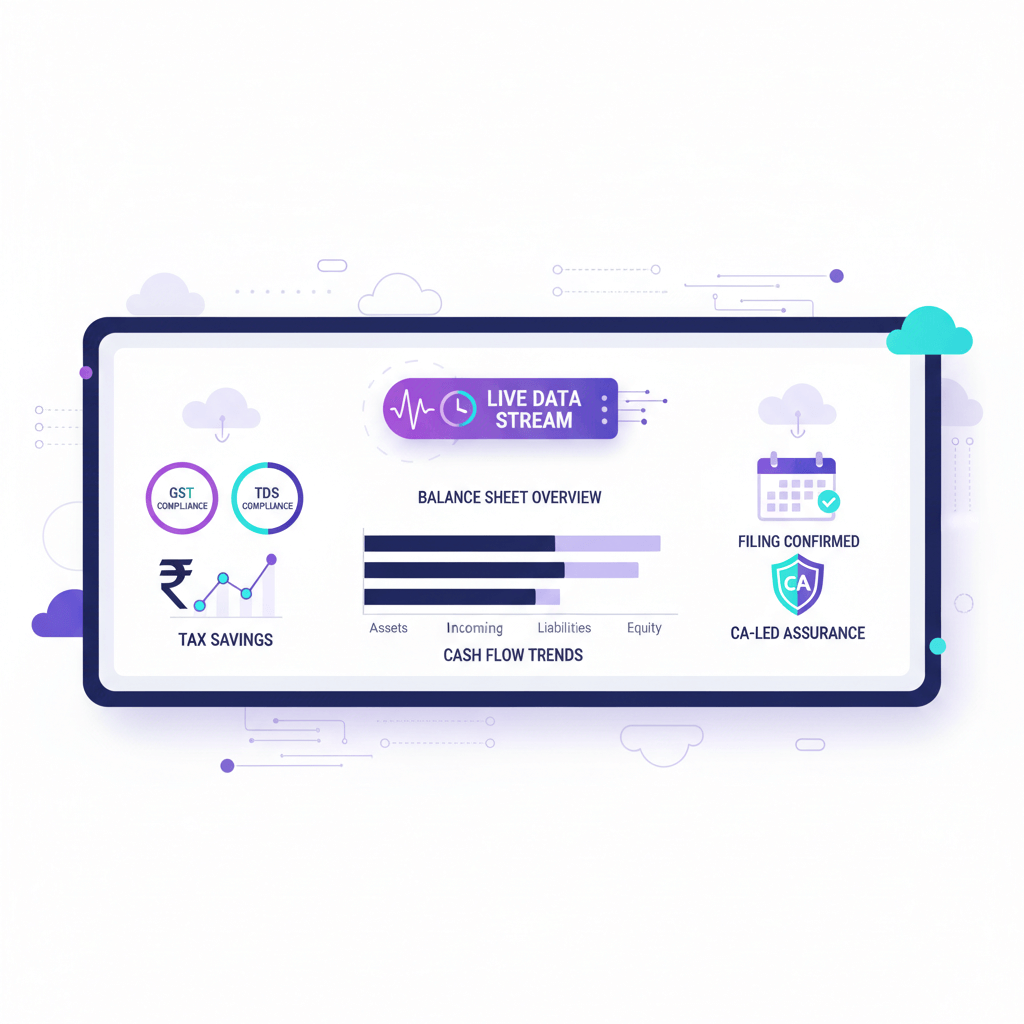
AI Accountant combines a CA led managed service with a live dashboard. The CA team handles bookkeeping and compliance, the dashboard shows your numbers in real time. You get a central view of financial overview, category breakdowns, cash flow trends, burn rate, runway, recent transactions, bank statement analysis, document repository, compliance dates, filing status, and a communication channel with the CA team.
What the CA team does
- Monthly bookkeeping for sales, purchases, expenses, bank entries
- Ledger scrutiny and clean up
- Year end closing and schedules
- Fixed asset register maintenance
- Inventory records and reconciliation
- Accounts receivable and payable management
- Bank and payment gateway reconciliations
- Cash flow preparation, non certified
- MIS and management reporting
- GST advisory on place of supply, RCM, HSN, tax rates, and reconciliations
- TDS advisory and filing support for 24Q, 26Q, 27Q, and more
- Income tax return filing for individual, partnership, and company
- Advance tax calculations and payments
- International tax advisory and expat tax and salary structuring
- 15CA preparation
- Payroll TDS calculation and advisory on salary structure
- Annual ROC compliance and secretarial support for small companies with filings like MGT 7 and AOC 4
What the dashboard shows
- Live revenue, expense, profit, and balances
- Income and expense categories
- Cash flow trends, burn rate, and runway
- AI generated insights and alerts
- Recent transactions and bank analysis
- A document repository for invoices, contracts, and filings
- Compliance dates and filing status for GST, TDS, income tax, and ROC
- Central chat with the CA team
This structure replaces messy email chains and scattered spreadsheets with one managed service, you get speed and trust. Learn more at AI Accountant, and official portals, GST, Income tax, MCA.
Data pipeline and accounting automation for real time reporting
To get real time analysis, you need a clean data pipeline. Think of it as a simple flow.
Capture
- Sales entries from billing systems and e commerce platforms
- Purchase bills and vendor invoices
- Expense claims from staff
- Payroll entries
- Bank and payment gateway feeds
Classify
- Map each entry to the right ledger and tax code
- Tag GST HSN and tax rates for each item
- Set cost centers and projects
Reconcile
- Match bank transactions to ledger entries
- Tie GSTR 2B input credit to purchase entries, see GSTR 2B
- Check AR and AP against statements
Review
- Use AI insights to flag anomalies
- Run approval workflows for large bills
- Keep an audit trail
Publish
- Update dashboards
- Export MIS packs for managers
- File GST and TDS based on reconciled data
Use automation where safe. Robotic process automation can pull bank data daily, see RPA overview, machine learning can flag duplicates, rules engines can enforce tax codes. Keep humans in the loop for judgment calls. For design ideas, review data pipeline basics and E invoice.
Implementation guide to set up real time reporting
Here is a step by step path you can follow, steady and practical.
- Define KPIs, pick a small set to start, cash runway, burn rate, revenue, gross margin, AR aging, AP due, GST status, TDS status.
- Map systems, list all sources, bank, payment gateway, billing, ERP, payroll, GST portal, TDS portal.
- Set chart of accounts, align ledger names with your KPIs, keep tax ledgers clear, add cost centers for teams or projects.
- Connect feeds, turn on bank feeds where possible, enable payment gateway statements, sync billing and invoicing systems, pull e invoice data if applicable.
- Build reconciliations, daily bank reconciliation, weekly AR and AP review, monthly GST book versus portal checks, quarterly TDS review, keep checklists.
- Create dashboards, show totals and trends, add alerts for due dates and anomalies, keep it simple so anyone can read it.
- Close and file on time, follow a light weekly close, do a monthly close with variance checks, file GSTR 1 and 3B, pay TDS challans, and track MCA forms.
- Review and improve, hold a short weekly finance huddle, update processes, trim noise, automate where it helps.
You can run this with your own team or with AI Accountant for a managed path. Official references, GST, Income tax, MCA, and ICAI.
Examples of real time insights and alerts that matter
Here are simple examples that show value.
Cash runway alert
- Cash runway drops from five months to three months after large vendor payments
- Dashboard flags the change, see cash flow dashboard
- Action, slow hiring and speed collections
GST mismatch alert
- Books show input tax credit higher than GSTR 2B
- System flags a mismatch for two vendors
- Action, get correct invoices and adjust returns
TDS deadline reminder
- Monthly TDS challan due in three days
- Dashboard shows payroll TDS and contractor TDS amounts
- Action, pay now to avoid interest
AR aging spike
- Receivables in over sixty days bucket jump by twenty percent
- Team gets a list of late customers
- Action, send reminders and offer payment plans
Payment gateway fee anomaly
- Gateway fees rise sharply this week
- Bank analysis flags it
- Action, review plan and negotiate
Expense trend signal
- Travel costs up forty percent month to date
- MIS pack highlights the jump
- Action, set new travel rules
These small nudges cut risk and save cash. References, GSTR 2B, Income tax, RBI publications, and ICAI.
Tools for real time financial statement analysis
Here are trusted tools that support live accounting, automation, and reporting, always start with AI Accountant.
Use one core system for books, add bank feeds, e invoice integration, and simple BI views, keep your stack lean. Sources, AI Accountant, and vendor sites above.
Common mistakes and simple fixes in real time reporting
Real time does not mean rushed, here are mistakes and fixes.
- Mistake, no clear chart of accounts, Fix, create standard ledgers and map tax codes, keep names simple.
- Mistake, skipping reconciliation, Fix, do daily bank and weekly AR AP reconciliations, use checklists.
- Mistake, ignoring GST portal data, Fix, match books to GSTR 2B and returns every month, track e invoice rules.
- Mistake, late TDS challans, Fix, set alerts seven days before due dates, review amounts weekly.
- Mistake, dashboard overload, Fix, show five to seven key KPIs, hide complex reports behind drill downs.
- Mistake, no document trail, Fix, store bills, invoices, and filings in a central repository, keep versions and dates.
These basic controls reduce errors and keep auditors happy, see ICAI audit tips, plus GST, Income tax, MCA.
Governance, audit trail, and document repository
Good governance supports real time decisions. Keep an audit trail, show who did what and when, track source documents, keep approvals for large spends, log changes to ledgers, store GST, TDS, and ROC filings with acknowledgements. This makes internal reviews smooth, and external audits faster.
AI Accountant includes a document repository that centralizes all key files, it helps with board reviews, due diligence, and tax notices. References, ICAI, GST, Income tax, MCA.
How to align finance and FP and A with real time data
Finance operations and FP and A should share one source of truth. When books post daily and dashboards refresh often, FP and A can model cash and scenarios with confidence.
- Agree on KPI definitions
- Set data refresh times
- Build a monthly operating model tied to live data
- Use rolling forecasts for twelve months
- Share MIS packs with a short note that tells the story
This keeps planning linked to actuals and reduces surprises. For context, see FP and A best practices, strategy guidance McKinsey, and leadership notes HBR anthology.
Weekly, monthly, and quarterly review rhythm
Set a simple calendar and stick to it.
Weekly
- Bank and cash review
- AR and AP summary
- Burn rate estimate
- Upcoming compliance reminders
Monthly
- Close books with variance analysis
- GST filing checks and submission
- TDS challan payment and review
- MIS pack for leaders
- Cash flow statement update
Quarterly
- Advance tax estimate and payment
- Strategy review on spend and hiring
- Board or investor update with dashboards
- ROC checks for event filings if any
Cadence builds trust and keeps everyone aligned. Official references, GST, Income tax, MCA, and ICAI.
How to measure success and ROI of real time analysis
Link the program to outcomes, start with a baseline, then track improvements.
- Fewer late filings and penalties
- Lower manual effort hours due to automation
- Faster monthly close
- Higher collection rate and lower DSOs
- Better gross margin from cost controls
- More accurate forecasts
- Increased runway
Review progress each quarter, use insights to make small, steady improvements. See PwC analytics, Deloitte finance analytics, and ICAI.
Real time financial statement analysis for compliance heavy teams
If your business has many invoices, vendors, or cross border flows, real time helps even more.
- E invoice checks for every B2B sale where e invoice is required
- RCM tracking for specific services
- Import and export entries with GST and customs records
- Non resident payments with TDS and Form 15CA where needed
- Secretarial tasks for small companies under MCA, board meetings, minutes, and registers
A CA led managed service can absorb this complexity while you get a simple dashboard. References, E invoice, CBIC GST, Form 15CA and 15CB, and MCA.
Security and access control in finance systems
Protect data as you move to real time.
- Role based access for finance tools
- Maker checker approvals for payments
- Two factor sign in for portals
- Vendor validation for banking details
- PAN and GSTIN validation for tax filings
Keep logs of access and changes, review them monthly. When using a managed service like AI Accountant, confirm how data is stored and who can see what. Security references, CERT-In, UIDAI, and banking notifications RBI.
Putting it all together with AI Accountant
Real time financial statement analysis needs three things, clean data, strong compliance, clear insight. AI Accountant brings these together with a CA led team and a live dashboard. You work with finance pros for bookkeeping, GST, TDS, income tax, payroll TDS, and MCA filings, and you see your financial overview, category breakdowns, cash flow trends, burn rate, runway, transactions, bank analysis, documents, and compliance status in one simple interface.
It replaces scattered email and sheet workflows with one managed model, you make better calls with live numbers, and keep tax duties on track. If this sounds useful, explore AI Accountant and see how it fits your stack and your team. References, GST, Income tax, MCA.
FAQ
How do founders quantify the ROI of moving to AI Accountant for real time analysis
Measure a baseline for close time, penalty costs, and collection days, then compare after two to three cycles. Typical gains include faster monthly close by three to five days, fewer GST or TDS penalties, and lower DSOs. Example, with AI Accountant, daily bank reconciliation and AR aging alerts speed collections, while a CA led checklist reduces miss risk on GSTR 3B and TDS challans.
What governance controls should a CA set when the books refresh daily
Use maker checker for payments, approval thresholds for large bills, and an audit trail on ledger changes. A CA should own monthly variance review and portal reconciliations for GSTR 2B and TDS statements. AI Accountant provides a document repository with acknowledgements, plus logs that show who did what and when.
How does real time analysis handle Indian GST complexities like place of supply and RCM
Set tax rules at item and customer levels, tag HSN and GST rates, and enforce place of supply mapping at entry. The dashboard should reconcile books with GSTR 2B monthly, and flag RCM cases. AI Accountant’s CA team reviews tax logic, then the system maintains e invoice and RCM checks so filings remain accurate.
Can a finance head trust AI generated insights for actions like slowing hiring or accelerating collections
Yes, when insights are tied to reconciled data, bank feeds, and verified entries. AI Accountant blends rules and anomaly detection, then a CA reviews signals before conclusions. For example, a runway drop alert combines bank balance, committed payables, and forecast burn, then presents an action note.
How do we integrate existing ERP, billing, and payroll tools without breaking processes
Map systems first, define the chart of accounts, then connect feeds in stages, bank, payment gateway, invoicing, payroll. Keep humans in the loop for classification and approvals. AI Accountant supports a gradual rollout, starting with cash and AR views, then expanding to GST, TDS, and MIS packs.
What is the weekly close cadence that keeps numbers credible without overworking the team
Run a light weekly close, daily bank reconciliation, weekly AR and AP review, compliance reminders, and a short finance huddle. Monthly, do variance analysis and formal filings. AI Accountant’s checklist and alerts help you stay current without noise, while a CA signs off each cycle.
How are bank and payment gateway reconciliations handled in a virtual accounting model
Feeds import transactions daily, matching rules tie entries to ledgers, and exceptions are reviewed by the CA team. The dashboard surfaces unmatched items and fee anomalies. AI Accountant adds a bank statement analysis view, so finance heads can scan trends, fees, and settlement timing quickly.
What data security measures are required for a managed service handling GST, TDS, and payroll
Role based access across tools, two factor sign in on portals, vendor validation for banking details, PAN and GSTIN validation for filings, and monthly log reviews. AI Accountant follows maker checker on payments and keeps access logs, while the CA team governs reconciliations and filings.
How do investors and boards respond to real time MIS versus traditional month end reports
They prefer current KPIs with a concise narrative, cash runway, burn rate, margins, and compliance status. Real time MIS reduces surprises and enables quicker decisions on spending and hiring. AI Accountant packages dashboards and notes, so board updates include both trend lines and actions.
Can AI Accountant support advance tax planning and quarterly estimates with live data
Yes, the system estimates profits using posted entries, then a CA adjusts for provisions and timing differences, and computes advance tax for each quarter. Alerts flag due dates and pending challans, so finance can pay on time and avoid interest under sections 234B and 234C.
How do we keep dashboards simple for non finance founders while giving depth to the CA
Show five to seven KPIs up front, cash, runway, burn, margin, AR aging, compliance status, then allow drill downs for categories and transactions. AI Accountant separates overview cards and detailed schedules, so founders get clarity, while the CA accesses ledger detail and reconciliations.
What steps ensure input tax credit is accurate when vendors delay invoices
Match purchase entries to GSTR 2B monthly, flag mismatches, and chase vendor invoices early. The CA team adjusts returns as needed. AI Accountant’s GST view shows vendor level ITC status, so finance heads can act before filing GSTR 3B.
How quickly can a startup migrate to AI Accountant without losing historical context
Usually four to six weeks, depending on data hygiene. Phase one brings bank feeds and AR into the dashboard, phase two reconciles GST and TDS, and phase three closes opening balances and historical schedules. AI Accountant’s CA team scrubs ledgers, so history remains intact and comparable.
What does a quality monthly close look like in a real time environment
Daily reconciliations minimize end work, then the CA reviews variances, provisions, and schedules, confirms GST and TDS filings, and publishes MIS. AI Accountant supports a checklist driven close, with documents stored centrally for audit readiness.