-01%201.svg)
Key takeaways
- Automated investor exports pull data straight from your ledger and assemble investor ready reports in minutes, replacing 8 to 12 hours of manual work each month.
- Native integrations with Indian accounting systems like Tally eliminate copy paste errors, protect confidentiality, and surface GST and TDS compliance context inside every update.
- Standardized templates with audience based redactions ensure the right stakeholders see the right information, consistently, without one off formatting each cycle.
- Secure links with expirations, watermarks, and audit trails replace risky email attachments, elevating data governance and professionalism during fundraises.
- Automation scales from five to fifty investors without adding headcount, so start now before your next fundraise or board cycle adds pressure. Platforms like AI Accountant's MIS reporting handle the heavy lifting while you provide the strategy.
- AI driven insights are shifting reports from static history to proactive narratives, variance explanations, and risk alerts, giving investors forward looking context alongside the numbers.
Investor Reporting Automation: What's New in 2026
Until early 2025, most Indian SMBs treated investor reporting as a manual ritual, exporting Tally data, formatting spreadsheets, and emailing PDFs. In 2026, the baseline expectation has shifted. Investors now routinely ask for live dashboard access, real time GST filing confirmations, and AI drafted variance narratives rather than static monthly attachments.
One notable compliance shift: India's e-invoicing mandate has expanded its reach, pulling more SMEs into structured digital reporting. This means investor updates can now draw from richer, machine readable transaction data without manual re-entry. Firms already on automated GST reconciliation workflows benefit most, since compliance data flows directly into investor facing dashboards.
Who feels this most? CA firms managing 10 or more clients and SME finance teams preparing for Series A or B rounds. The cost of sticking with manual processes is tangible: delayed updates erode investor trust, unreconciled entries trigger follow up queries, and ad hoc formatting burns 30 to 40 hours monthly that could go toward advisory work or fundraising strategy.
What to do now:
- Audit your current investor reporting workflow. If any step involves copy pasting from Tally or manually building charts, flag it for automation.
- Confirm your GST reconciliation and TDS tracking feed into your reporting pipeline, not just your compliance filings.
- Pilot link based sharing with audit trails for at least one investor group this quarter. Track engagement to see who reads what.
Platforms with native Tally connectors and bookkeeping automation capabilities make this transition straightforward, often completing onboarding in minutes per client once the process is templated.
Why Traditional Investor Reporting Falls Short
The Hidden Cost of Manual Updates
Export data from Tally, copy into spreadsheets, build charts, format, redact, convert to PDF, email, repeat. For most Indian SMBs this ritual consumes 8 to 12 hours every month, stealing focus from strategy and causing fatigue for CAs handling many clients at once.
Error risk compounds under pressure. A single broken formula can misstate runway. A missed redaction can expose sensitive vendor rates. Investors expect precision, and manual processes make precision fragile.
Investor confidence is earned in the details, one accurate, timely update at a time.
Compliance Complexities Add More Burden
GST reconciliations, TDS tracking, and foreign exchange treatment add unique Indian context to reporting. The GST portal requires regular return filings whose status investors increasingly want verified inside updates, alongside receivables aging and cash flow forecasts.
During fundraises, cadence accelerates to weekly or even daily updates. Manual workflows cannot sustain this pace without burning out teams. The Institute of Chartered Accountants of India (ICAI) has emphasized the importance of digital tools in improving reporting accuracy and timeliness, a signal that automation is no longer optional for practices serious about scale.
Understanding Automated Investor Update Exports
What Makes Automation Different
Automated exports read your books directly, understand patterns, and assemble investor ready narratives continuously. Think of it as a tireless analyst that converts your accounting truth into clear, consistent updates whenever you need them.
Modern platforms connect natively to Indian systems and compliance structures. This makes them far more useful than generic global tools that lack context for GST returns, TDS certificates, or INR denominated cash flow statements.
Key Components of Export Automation
- Period selection for flexible date ranges, monthly, quarterly, or custom windows.
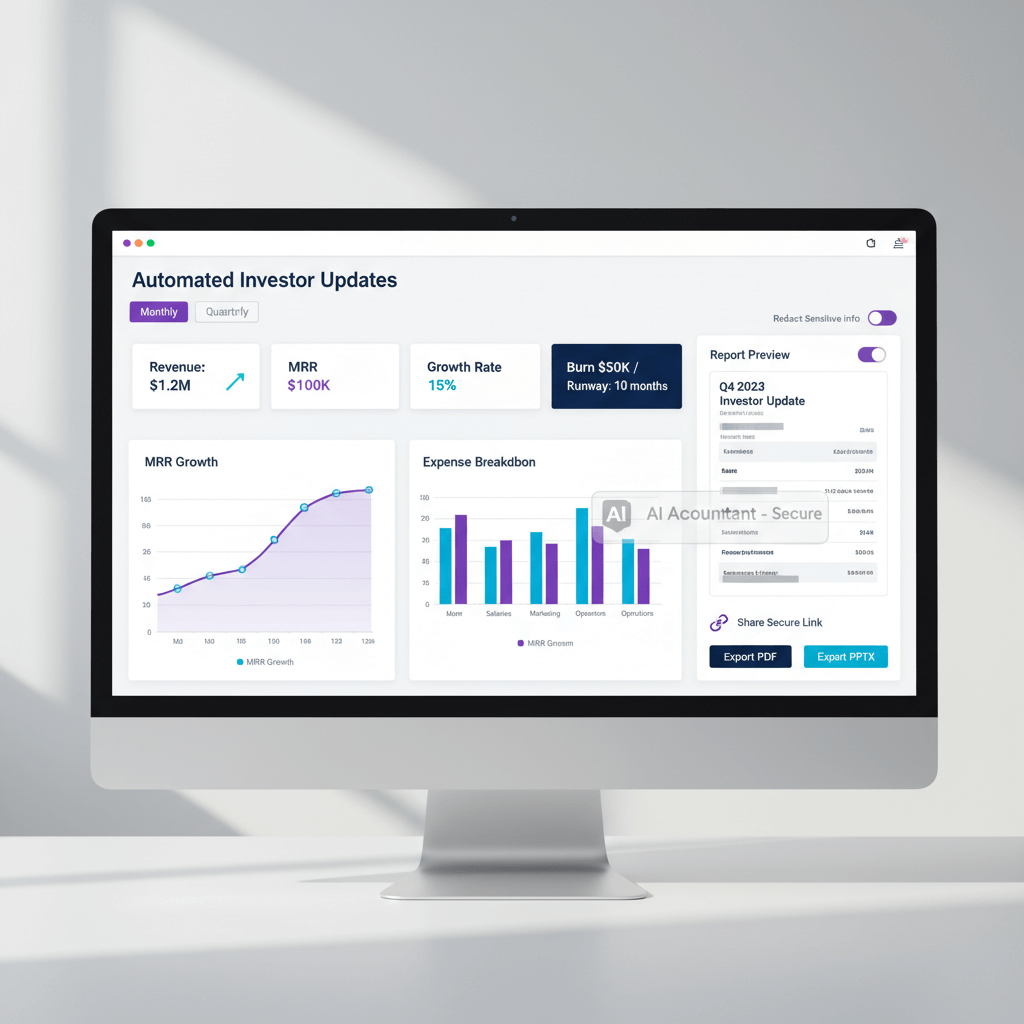
- Auto charting of key metrics, from MRR and burn rate to aging reports and revenue waterfalls.
- Granular redactions for vendor names, billing rates, and employee salaries.
- Multi format exports: PDF for boards, shareable links for investors, Excel for analysts.
- Secure distribution with watermarks, expirations, and access logs for full audit trails.
Pro tip: Replace attachments with protected links. You gain revocation, tracking, and a professional first impression.
Step by Step Guide to Setting Up Automated Exports
Initial Configuration and Integration
Connect your accounting data source in minutes. Platforms with native connectors to Tally keep the setup fast and reliable, with no middleware or CSV imports required.
Authenticate, grant read permissions, and let the system sync history. As it learns your chart of accounts and vendor relationships, configure investor focused metrics: revenue, gross margin, burn rate, runway, and cash position.
The platform will remember these preferences for future runs, so each subsequent export takes a fraction of the initial setup time.
Customizing Your Export Templates
Different stakeholders require different depth. Lead investors often want full financial statements. Angels prefer visual dashboards. Boards need operational context alongside financials.
Start with pre built templates for SaaS, marketplaces, or traditional P&L businesses, then tailor sections based on feedback. Favor clarity over decoration. Keep charts legible on desktop and mobile. Use consistent headings and ordering so readers build muscle memory across months.
Managing Data Security and Redactions
- Define audience based redactions: hide vendor names and rates for most investors, mask salaries for non board recipients, remove customer identifiers unless required.
- Require CFO approvals for sensitive exports. Add legal checks for M&A or acquirer outreach.
- Enable audit trails to track views and downloads. Alert on unusual access patterns.
Treat every export as both a communication artifact and a governance artifact. You will thank yourself during diligence.
Best Practices for Different Stakeholder Reports
Monthly Investor Updates
Monthly updates should be concise, comprehensive, and narrative driven. Include an executive summary, a dashboard of MRR, burn, and runway, revenue waterfall, expense breakdowns, and bank balance trends.
Explain variances from plan. Highlight wins and risks. Share near term milestones. Send on a predictable date. For many, the fifth of each month works well after closing books. Consistency builds trust.
Board Meeting Materials
Board packs require depth and traceability. Include P&L, balance sheet, cash flow, and supporting schedules. Add variance analysis against plan and prior periods.
Layer in operational metrics like CAC, LTV, payback period, product milestones, hiring updates, and competitive shifts. Share at least three days before the meeting. Use password protected links with watermarking for confidentiality.
Due Diligence Data Rooms
Create a standard export set for fundraises: three years of historicals, cohorts, AR aging, customer concentration, and GST filing confirmations from the GST portal.
Organize by history, projections, and operations, with an index that explains folder contents. Share expiring links per investor. Revoke on demand. Track file level access to understand which documents attract the most attention.
Recommended Tools for Automated Investor Reporting
Top Automation Platforms
- AI Accountant focuses on Indian SMBs, integrates deeply with Tally and Zoho Books, and surfaces GST and TDS context inside investor updates. With ISO 27001 and SOC 2 Type II certifications, it is suitable for sensitive data and diligence grade reporting.
- QuickBooks Online provides scheduled delivery of standard financial reports, useful if you already operate on QBO.
- Xero supports report packs with scheduling and can be extended via app integrations for additional analytics.
- FreshBooks suits very small businesses that need simple, dependable summaries without complex configuration.
- Zoho Analytics pairs with Zoho Books for advanced visual analysis, better for teams comfortable with configuration and custom dashboards.
Integration Considerations
Prioritize native connectors to your ledger. Middleware and CSV based workflows introduce delay and error. Plan for growth so you do not outgrow the tool mid round.
Consider total cost of ownership, including implementation, training, and ongoing support, not just the subscription fee. A tool that saves 30 to 40 hours monthly at ₹1,500 per hour of CA time pays for itself within the first cycle.
Common Challenges and Solutions
Data Accuracy and Reconciliation
Automation cannot fix bad inputs. Institute daily bank matching, weekly invoice reviews, and monthly suspense clearing. Choose tools with anomaly detection that flag mismatches before reports go out.
Conduct quarterly spot checks against source documents. As RBI guidelines on digital lending and payment reconciliation tighten, clean ledger data becomes non negotiable for investor facing reporting.
Customization vs Standardization
Resist the creep of one off templates. Maintain three reusable sets: quick updates, board depth, and diligence comprehensive.
Educate stakeholders on the benefits of consistency. Build modular blocks you can assemble when custom asks are justified, like cohort analysis for a specific investor or unit economics for a board deep dive.
Security and Compliance Requirements
Implement role based access for exports. Limit who can share externally. Require approvals for sensitive packets.
Prefer platforms with ISO and SOC attestations. Document your distribution and retention policies for investor transparency. India's evolving data protection framework makes formal governance around financial data sharing increasingly important.
ROI of Automated Investor Updates
Time Savings Analysis
Teams typically save 75 percent of reporting time, reducing a two day effort to roughly two hours. Translating hours into cost: CFO time saved alone can equal ₹50,000 or more monthly at typical CA billing rates, before considering opportunity costs like fundraising preparation or process improvement.
Enhanced Stakeholder Relationships
Predictable, polished updates reduce ad hoc queries and interruptions. This enables more strategic discussions during investor calls. During diligence, professional reporting can improve perceived governance and contribute to better terms.
Scalability Benefits
As investor counts grow, automation prevents investor relations from becoming a full time role. Implement early and avoid retooling in the middle of a fundraise when stakes are highest.
Future of Investor Reporting Automation
AI Powered Insights
AI is moving from compiling data to drafting narratives, comparing scenarios, and flagging leading indicators. Expect variance explanations, sensitivity analyses, and probability weighted forecasts to be generated alongside the numbers, reducing the time CAs spend writing commentary.
Real Time Reporting Dashboards
Interactive investor portals with live metrics are replacing static PDFs. Mobile first access is becoming standard. This raises the bar on secure, role based, real time data sharing, especially for firms managing multiple investor relationships simultaneously.
Regulatory Technology Integration
Direct links to government portals will automate GST status checks, TDS verification, and audit readiness confirmations. Cross border investors will receive INR translations and concise explanations of local compliance context, reducing back and forth during diligence.
Conclusion
Automated investor exports turn a monthly grind into a predictable, high quality process. Connect your ledger, standardize templates, set redactions and approvals, and distribute via secure links.
Start with a monthly dashboard. Expand to board packs. Then build diligence exports. Automation amplifies human judgment: the system assembles accurate data and visuals, while you provide context, nuance, and strategy.
Move this week: map your current workflow, identify the biggest friction point, and pilot an automation tool that addresses it. Your future self, and your investors, will appreciate the efficiency and professionalism it brings.
One click exports beat all nighters, every time.
FAQ
How can a CA cut month end investor reporting from a full day to under an hour without losing control?
Use ledger native automation that pulls data directly from Tally, standardize three templates (investor dashboard, board pack, diligence room), set redaction rules by audience, and distribute via secure links. Approvals and audit trails preserve oversight while cutting 75 percent of the manual effort.
What is the fastest way to set up Tally based investor exports for multiple clients?
Use a platform with native Tally connectors and onboard clients with a repeatable checklist: connect, sync history, apply a baseline template, and schedule delivery. Most firms complete setup in minutes per client once the pattern is defined.
How do I show GST and TDS status inside investor updates without manual screenshots?
Choose automation that ingests compliance data from your ledger and surfaces it as widgets, for example, GSTR filing status and TDS summaries. This eliminates manual collation and ensures the data matches what is filed on the GST portal.
What redactions are sensible for investor packets versus board packs?
For investors, hide vendor names, billing rates, employee salaries, and any customer PII. For boards, include more operational detail but still mask PII. Configure these as rules in your export tool so they apply automatically and consistently every cycle.
What metrics should always be in a monthly investor update for a SaaS SMB?
Include MRR, burn rate, runway (in months), net revenue retention, new bookings versus churn, expense categories, and closing bank balances. Add a brief narrative explaining variances from plan and highlighting near term milestones.
Is email delivery acceptable, or should I switch to link based sharing?
Prefer link based sharing with authentication, expirations, and watermarks. It is more secure, easier to revoke, and creates an audit trail. Email attachments are impossible to control once sent, which creates risk during diligence or if investor discussions end.
How should I explain the ROI of automation to a founder who is skeptical about subscription costs?
Quantify time saved: reclaiming 30 to 40 hours monthly at ₹1,500 per hour of CA time equals ₹45,000 to ₹60,000 in direct savings, often exceeding the annual subscription cost within the first month. Add the opportunity value of fewer interruptions and faster fundraising preparation for a complete picture.

Rohan Sinha is a fintech and growth leader building aiaccountant.com, focused on simplifying accounting and compliance for Indian businesses through automation. An IIT BHU alumnus, he brings hands-on experience across 0 to 1 product building, growth, and strategy in B2B SaaS and fintech.