-01%201.svg)
Key takeaways
- A template warehouse is a centralized repository of reusable, parameterised financial reporting templates that eliminates repetitive Excel rebuilding for GST, TDS, bank reconciliations, and multi entity consolidations every single month.
- Indian CA firms using a structured template warehouse cut month end close times by 50 to 70 percent and reduce reporting errors by 40 percent or more, freeing capacity to onboard new clients without adding headcount.
- Governance features like version control, maker checker approvals, and audit trails prevent template drift, a common problem when multiple juniors and seniors touch the same reports across dozens of clients.
- India specific complexities (GSTIN level reconciliations, UPI aggregator settlements, TDS by section, diverse bank formats) are standardised once and reused across every entity and every filing cycle.
- If your firm still rebuilds the same reports manually each month, you are losing 100+ hours across 50 clients. AI Accountant's MIS reporting automation generates reusable templates from your existing Tally data, enabling scale without the rework.
Reusable Financial Reporting Templates for CA Firms: What's New in 2026
Until mid 2025, most CA firms built reporting templates in isolation, updating them reactively when GST portal changes broke existing workflows. In 2026, the shift is proactive. Industry adoption of template based reporting automation is up roughly 25 percent year on year, driven by tighter compliance windows and the expanding scope of e invoicing.
The most significant operational change: GSTN's API infrastructure now supports more reliable auto fetch of GSTR 1, 3B, and 2B data. Firms that prepared API placeholders in their templates (as recommended in 2025) are now pulling live return data into reconciliation templates without manual downloads from the GST portal. Those still downloading CSVs manually face a growing gap in speed and accuracy.
The Account Aggregator (AA) framework, regulated by RBI, has matured for bank data streaming. Early adopter firms now run continuous bank reconciliation rather than periodic matching, a workflow that demands templates designed for streaming inputs and automated categorisation from day one.
Who does this hit hardest? Mid sized CA firms managing 100 to 300 SMB clients on Tally. Without parameterised, API ready templates, these firms face:
- Delayed filings that trigger interest under Section 50 of the CGST Act (18 percent per annum on late tax payments)
- Blocked ITC claims when GSTR 2B mismatches remain unresolved past return deadlines
- Audit flags from inconsistent reconciliation outputs across entities
What to do now: audit your top 10 compliance templates for API readiness, ensure GSTIN and period parameters are clean, and test at least one live GSTN data pull before the next quarterly filing cycle. Firms already using automated GST reconciliation workflows are completing these pulls in minutes rather than hours (2026 update).
Template Warehouse India: How Accounting Teams Build Reusable Reporting Assets That Scale
Picture this. It is 11:30 PM on the last day of month close. Your senior accountant is consolidating financial reports for 12 different entities. Each has its own Excel file, different formats, different formulas, hours of copy paste work ahead. Sound familiar?
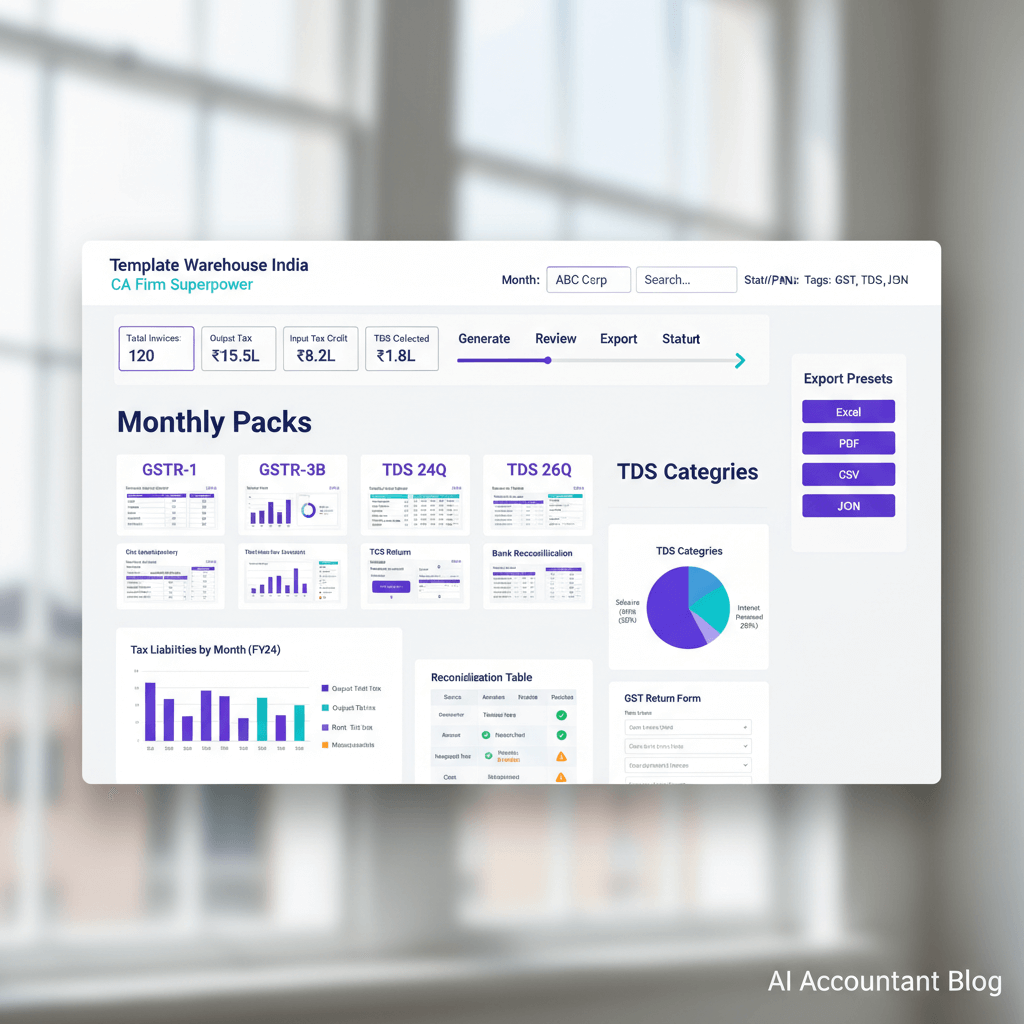
This is where a template warehouse India changes everything. It is a central repository of reusable financial reporting templates, dashboards, and workflows. Design a GST reconciliation template once, use it across 100 clients. No more rebuilding the same reports every month.
For Indian CA firms managing multiple SMB clients, this is not just about efficiency. It is about survival in a market where compliance deadlines never stop and client expectations keep rising.
Standardise the logic, parameterise the entity, automate the export, then scale across every client, every month.
What Makes a Template Warehouse India Different
A template warehouse India is not another shared folder with Excel files. It is a structured system designed for Indian accounting realities.
- It stores reusable financial templates for GST returns, TDS calculations, and bank reconciliations for SBI, HDFC, ICICI, PSU, and cooperative banks, each compatible with Tally and Zoho Books.
- Templates are parameterised. Change the GSTIN or financial year, the same template adapts. No manual edits, no formula errors.
- Embedded Indian accounting standards cover Input Tax Credit, reverse charge mechanism, TDS sections, multi GSTINs, interstate transactions, and RBI reporting.
For CA firms, this delivers uniform GST logic, consistent DRO and DPO calculations, and standardised cash runway metrics. Juniors learn one system. Seniors review consistent outputs. Partners see uniform quality across the practice.
Why Indian Accounting Teams Need This Now
The push toward accounting automation tools in India is driven by three realities.
- Messy implementations. Most firms use Tally or Zoho Books, but ledger naming conventions, GST setup, and bank statement formats vary wildly across clients.
- Repetitive, rules driven workloads. GST and TDS follow statutory logic, yet every entity brings unique GSTINs, branches, and filing calendars.
- Banking complexity. Chargebacks, EMI entries, UPI settlements, and forex charges need repeatable reconciliation patterns that work across multiple bank formats.
A well designed financial reporting automation system handles all this through templates that adapt per client while maintaining consistency. The ICAI has repeatedly emphasised the importance of standardised documentation and quality control in audit and accounting practices, making template governance not just an efficiency play but a professional requirement.
Building Your Core Template Library
Reusable Visual Components
Create a standard library of charts and tables. Include cash flow trends under direct and indirect methods, revenue versus expense by month and quarter, and AP and AR ageing buckets for 0 to 30, 31 to 60, 61 to 90, and beyond 90 days.
Add DPO and DRO trend charts, GST liability movements, Input Tax Credit tracking, and expense breakdowns by cost centre, segment, or GSTIN. Define measures once, use the same DRO formula everywhere. Apply consistent aggregation rules for fiscal versus calendar year reporting.
Parameterised Filter Systems
Parameterised filters let one template serve many clients. Key parameters include:
- Entity codes and GSTINs
- Financial years and reporting periods
- Bank names and branch codes
- Segments and cost centres
- Currency types for forex heavy clients
Keep parameters high signal. Document allowed values and smart defaults like current financial year and last closed month. Ensure templates run entirely on parameters. Never hardcode entity names or static ledger IDs.
Narrative Building Blocks
Numbers need context. Narrative blocks are modular text sections with data bound placeholders. For example:
- "Revenue increased by {variance%} versus last month, driven by {top_customers}."
- "Top 5 overdue vendors beyond 90 days account for {overdue_amount}, led by {vendor_list}."
Maintain a standard placeholder set per report type. Review quarterly to keep commentary fresh and relevant to current business conditions.
Export Preset Configurations
Export presets eliminate manual formatting. Define board pack orders: executive summary first, then P&L, balance sheet, cash flow, DPO, DRO, runway, and commentary.
Build compliance packs with PDF summaries and Excel workings. Include GSTR 1, GSTR 2B, TDS, TCS, and exception lists. This ensures every deliverable looks professional without last minute formatting scrambles.
Change Governance Systems
Without governance of changes, templates drift. Implement version control, change logs, and maker checker approvals for critical GST, tax, and audit templates.
Run monthly or quarterly releases. Announce updates and deprecations. Highlight breaking changes. This mirrors best practices from software release management, applied to your accounting template library.
India Specific Template Requirements
GST Compliance Templates
Build GSTIN level views for revenue, ITC, and liability by registration type and place of supply. Create GSTR 1 and GSTR 2B reconciliation aligned templates that compare books versus GSTN data. Flag missing invoices, mismatches, wrong tax rates, and timing differences.
Design ITC matching reports. Compare ITC claimed versus eligible versus appearing in 2B. Surface discrepancies for investigation. The CBIC continues to tighten ITC claim validation, making automated matching templates essential rather than optional.
TDS and TCS Management
Develop section wise TDS and TCS templates. Show deductor and deductee views, due dates, and filing status. Build vendor ageing that incorporates TDS and TCS sections.
Distinguish registered from unregistered vendors. Track payments by due date versus bill date to avoid interest and penalties under Section 201 of the Income Tax Act.
Bank Reconciliation Patterns
Handle diverse Indian bank formats for SBI, HDFC, ICICI, PSU, and cooperative banks. Include pattern recognition for bank charges, forex levies, chargebacks, refunds, loan disbursements, and EMI repayments.
Highlight UPI aggregator settlements, payment gateway fees, and international transaction charges. With UPI transaction volumes crossing 14 billion per month in India, reconciliation templates must handle high volume, low value entries efficiently.
Multi Entity Consolidations
Design rollups for groups with multiple Indian entities. Show consolidated revenue versus expenses, combined cash runway, and intercompany elimination. Enable drill down from group level to entity or GSTIN.
This is especially critical for manufacturing and services groups where related party transactions require clean elimination and disclosure in consolidated financials.
Implementation Roadmap for CA Firms
Phase 1: Current State Assessment
Inventory your top 50 reports across GST, TDS, MIS, and bank reconciliation. Identify patterns, formula variations, and presentation styles to set a baseline. Document which reports consume the most hours and which have the highest error rates.
Phase 2: Data Standardisation
Normalise source systems. For Tally and Zoho Books, implement ledger mapping automation. Define canonical fields for revenue, COGS, operating expenses, GST accounts, and TDS provisions.
Build a bank statement schema covering date, value, narration, instrument type, and running balance. This schema becomes the foundation every bank reconciliation template draws from.
Phase 3: Template Development
Start with high impact templates across three categories:
- Compliance: GSTR 2B reconciliation and TDS statements
- Operations: Bank reconciliation and vendor ageing (also called accounts payable ageing)
- Management: Cash runway and operating expense analysis
Use your reusable visuals, parameterised filters, narrative blocks, and export presets from day one.
Phase 4: Testing and Validation
Test with diverse client data. Verify totals against Tally and Zoho trial balances. Confirm GST calculations match filed returns. Reconcile bank closing balances.
Create UAT scripts and sample datasets for regression testing. This prevents the "it works for one client but breaks for another" problem.
Phase 5: Rollout and Training
Pilot with three to five entities. Gather feedback from juniors and seniors. Train teams on parameters, narratives, and exports. Document common issues and solutions in a quick reference guide.
Phase 6: Continuous Improvement
Track usage, error rates, and time savings. Prioritise enhancements based on client feedback. Run quarterly reviews. Update for regulatory changes. Refresh narratives. Deprecate obsolete templates.
Choosing the Right Technology Stack
Storage Architecture
Small firms can start with structured cloud folders for Excel and PDF. Medium firms benefit from BI platforms such as Power BI or Zoho Analytics. Large firms should store definitions as code in Git for version control.
A hybrid approach often works best. Use Excel for working papers, BI tools for dashboards, and Git for template version history.
Metadata Management
Tag templates with type, compliance area, last review date, owner, compatible tools, and status. This enables quick searches. Juniors find approved GST templates for their specific platform in seconds rather than hunting through shared drives.
Access Control Systems
Implement role based access aligned to hierarchy. Partners approve and view all. Seniors edit and propose changes. Juniors run templates with predefined parameters.
Enforce data segregation between clients. Apply row level security for finance dashboards to keep client boundaries intact. This is non negotiable for firms managing competing businesses.
Measuring Success and ROI
Time Savings Metrics
Measure month end hours before and after implementation. Track reduction in manual formatting time. Document report generation times.
A mature warehouse cuts reporting time by 50 to 70 percent. Calculate multipliers: two hours saved per client per month across 50 clients equals 100 hours saved monthly. At average senior accountant rates, that is significant recovered capacity.
Quality Improvements
Monitor error rates, restatements, and auditor queries. Track reconciliation completion rates. Push completion above 95 percent. Target error reduction of 40 percent or more within the first quarter of adoption.
Adoption Indicators
Track template usage versus ad hoc report creation. Identify high use and low use templates. Survey juniors, seniors, and partners for trust and ease of use scores.
Business Impact
Measure client satisfaction scores, delivery speed improvements, error reduction percentages, and new client acquisitions enabled by capacity gains. Calculate full ROI over six to twelve months, including both direct time savings and indirect revenue growth.
Common Pitfalls and Solutions
Over Customisation Trap
Do not create unique templates per client. Standardise the core. Push client differences into parameters. Document rare exceptions separately rather than building them into the main template.
Stale Content Problem
Outdated narratives erode credibility with clients and partners. Schedule quarterly updates. Refresh placeholders and messaging to reflect current conditions and regulatory changes.
Parameter Explosion
Too many filters confuse users and slow report generation. Limit to essential dimensions. Set clear defaults. Add dependency rules so branch codes only appear after bank selection.
Weak Governance
Enforce approvals. Maintain change logs. Use version numbers. Publish release notes. This preserves trust and clarity, especially when multiple team members modify templates.
Poor Training
Even great templates fail without proper onboarding. Create role specific training programs, quick guides, and video tutorials. Make help easy to access. A five minute walkthrough saves hours of support queries.
Future Proofing Your Warehouse
GSTN Integration
Prepare for direct GSTN connectivity. Auto fetch GSTR 1, 3B, and 2B for reconciliation. Build placeholders for API retrieval and robust error handling for connectivity timeouts.
Aim for real time compliance monitoring where templates flag mismatches within hours of return filing, not days later during manual review.
Account Aggregator Framework
Design for streaming bank data via Account Aggregators. Shift from periodic matching to continuous reconciliation. Use standardised formats with automated categorisation and anomaly detection.
This is particularly relevant for firms managing high transaction volume clients in e commerce and retail sectors.
Predictive Analytics
Templates should forecast cash positions, model scenarios, and suggest actions. Flag likely late paying customers based on historical patterns. Highlight early payment discounts. Optimise payment timing for working capital efficiency.
Multi Platform Support
Ensure templates work across devices. Remain readable on mobile for partners reviewing on the go. Support offline operations where needed, syncing on reconnection. This matters for CA firms with field staff visiting client locations.
Security and Compliance Standards
Access Segregation
Segment access by client, role, and function. Isolate workspaces. Enforce Chinese walls where conflicts exist, such as when your firm manages two competing businesses in the same industry.
Audit Trail Requirements
Log every template access and modification. Record who changed what, when, and why. Link changes to approved change requests. Retain logs for inspection periods. Enable forensic traceability.
This is increasingly important as the MCA strengthens corporate governance requirements around financial reporting accuracy and documentation.
Compliance Certifications
For cloud based warehouses, verify platform certifications such as ISO 27001 and SOC 2 Type 2. Ensure GDPR readiness for EU connected operations. Data security is not optional when handling financial records for multiple clients.
Data Residency
Understand where data resides. Ensure Indian financial data stays within Indian borders where required. Plan backups and disaster recovery. Templates are valuable intellectual property that represent months of accumulated domain knowledge.
Real World Success Patterns
The Mid Sized CA Firm
A 50 person firm managing 200 SMB clients adopted five core templates: GSTR 2B reconciliation, bank reconciliation, cash runway dashboard, AP ageing, and monthly variance analysis.
Month end time dropped 40 percent. Errors fell 60 percent. They now manage 300 clients with the same team size, a 50 percent capacity increase without hiring.
The Growing SMB
A manufacturing SMB with six entities implemented multi entity templates. Consolidated P&L with drill downs, group cash flow, and intercompany elimination.
Report generation fell from three days to three hours. Board packs became consistent and professional. The CFO now spends time on analysis rather than data assembly.
The Boutique Advisory
A specialised advisory serving 30 high value clients built templates that combine compliance and analytics. GST optimisation dashboards, working capital insights, and profitability by product and customer segment.
They differentiated on insights rather than compliance alone. Revenue doubled without major headcount growth. Clients stayed longer because they received strategic value beyond basic filing.
Getting Started: Your 30 Day Plan
Week 1: Assessment and Planning
Identify five painful processes. Survey teams for time spent and rework frequency. Set measurable goals. Choose platforms such as Power BI or Zoho Analytics for dashboards.
Week 2: Template Design
Create three templates in one category. Use parameters from the start. Include basic narratives and export presets. Depth beats breadth at this stage. Get one template working perfectly before expanding.
Week 3: Testing and Refinement
Test with real client data. Validate calculations against trial balances and filed returns. Gather feedback from juniors and seniors. Iterate rapidly based on what breaks.
Week 4: Rollout and Training
Pilot with enthusiastic early adopters. Deliver hands on training. Provide quick reference guides. Monitor usage closely and address friction points immediately.
Week 5 and Beyond
Expand gradually. Add templates in proven categories. Extend to more user groups. Establish governance processes. Schedule monthly reviews and quarterly releases.
The Path Forward
Building a template warehouse India transforms reporting for CA firms and SMBs. It does not replace accountants. It frees them from repetitive formatting so they can focus on analysis and advisory.
Start with painful reports. Address Indian specifics like GST, TDS, and multi GSTIN operations. Use parameters for reuse. Implement governance for consistency.
The firms winning tomorrow are building warehouses today. They turn repetitive compliance into scalable processes. They deliver insights faster with fewer errors. They give accountants time to think strategically.
Remember that senior accountant at 11:30 PM? With a proper warehouse, they are home by 7 PM. Consolidated reports run automatically. Narrative blocks write themselves. Export presets ensure professional presentation.
Transformation happens one template at a time. Start today. Build one template. Save one hour. Then multiply across every report, every client, every month.
FAQ
How can a CA firm standardise ledger mapping across Tally and Zoho Books without breaking trial balance integrity?
Define a canonical chart of accounts and map client specific ledgers to those canonical fields, then validate totals against trial balance for every import. Use a controlled mapping repository and regression test on sample datasets. Automated ledger mapping tools with built in validation checks ensure debits equal credits post transformation, preventing integrity breaks across diverse client setups.
What parameters should be mandatory in a reusable GST template for multi GSTIN entities?
At minimum, include entity code, GSTIN, place of supply, period start and end, and filing calendar. Optional parameters like branch codes and registration types should only appear when needed. Set smart defaults to current financial year and last closed month to prevent misconfiguration by junior team members.
How do I ensure GSTR 2B reconciliation aligns with books and GSTN while reducing manual exception handling?
Use a template that compares invoice level data between books and GSTN, applying matching rules for supplier GSTIN, invoice number, tax rate, and taxable value. Surface unmatched records with reason codes and automate exception workflows for vendor follow ups. With GSTN APIs now supporting more reliable auto fetch (2026 update), templates can pull 2B data directly rather than relying on manual CSV downloads.
How should bank reconciliation templates handle UPI aggregators and payment gateways across multiple banks?
Introduce standard categories for aggregator settlements, gateway fees, refunds, chargebacks, and EMI schedules, then apply pattern recognition on narration and instrument type. Maintain a canonical bank schema covering date, value, narration, instrument, and running balance. With UPI volumes exceeding 14 billion monthly transactions, templates must handle high volume batch matching efficiently.
What governance controls prevent template drift across teams?
Version control for definitions, maker checker approvals for compliance templates, release notes for every change, and audit logs recording who changed what, when, and why. Enforce usage of only approved versions in client workflows. Lock completed revisions and enable rollback with full change histories when errors surface.
How do I measure ROI of a template warehouse over six to twelve months?
Track time savings for month end close, reduction in restatements and auditor queries, reconciliation completion rates, and client satisfaction scores. Convert hours saved to cost savings at senior and junior billing rates, then add revenue uplift from capacity to onboard more clients. A firm saving 2 hours per client per month across 50 clients recovers 100 hours monthly, translating to significant capacity gains.
Is a template warehouse relevant for firms with fewer than 50 clients?
Yes, even firms with 10 to 20 clients benefit because the consistency and error reduction compound from month one. Start with three high impact templates (bank reconciliation, GST matching, monthly variance) and expand as the practice grows. The initial investment of two to three weeks pays back within the first quarter through reduced rework and faster deliveries.

A results-driven finance and sales professional with hands-on experience through finance internships and a fast-paced sales role. With a strong interest in accounting and business finance, Harsh focuses on turning complex topics into clear, practical takeaways for founders and finance teams.