-01%201.svg)
Key takeaways
- Early-stage companies in India can replace ad hoc investor updates with a predictable, 10 day monthly close and reporting rhythm that consistently builds trust.
- A five pillar framework, monthly deck, metrics library, audit ready backup, delivery timeline, and communication protocol, aligns founders, finance, and investors.
- India specific realities, GST reconciliation, TDS certificate delays, and vendor invoice lag, must be tracked transparently to avoid surprises.
- A concise one page executive summary plus detailed appendices beats flashy decks, investors want clarity, consistency, and comparability.
- Automation tools, especially AI Accountant, reduce manual grunt work, improve accuracy, and accelerate monthly close.
- A living metrics library prevents definition drift, enabling apples to apples comparisons across months and entities.
- Strong documentation and maker checker controls make audits smooth, reduce follow up queries, and increase investor confidence.
Investor Reporting Service India: Building a Reliable Monthly Reporting Framework for Early-Stage Companies
Running a startup in India is hard enough without a monthly scramble for investor updates. Between GST filings, TDS certificates, and bank reconciliations, founders end up firefighting mid month, sending inconsistent numbers, and eroding trust. A reliable investor reporting service turns chaos into cadence, delivering accurate updates on time, every time.
Consistency builds credibility, credibility attracts capital.
In this guide, you will learn how to implement a practical, India aware framework that founders and Chartered Accountants can run with confidence.
Why Investor Reporting Matters More Than Ever
The fundraising climate has shifted, investors now expect timely, comparable, transparent reporting. They manage portfolios of 20 or more companies, each with different formats and definitions, so your job is to eliminate friction, align on metrics, and ship updates predictably.
- Establish a single source of truth across Tally, Zoho Books, banks, and GSTN.
- Automate ingestion and reconciliation, reduce manual errors, and shorten close time.
- Deliver outputs aligned to board and IC calendars, enabling follow on decisions.
Benefits extend beyond investor relations, smoother audits, fewer query cycles, and better positioning for Series A, secondaries, or M&A.
The Five Pillars of Professional Investor Reporting
World class investor reporting rests on five interlocked pillars that reinforce each other.
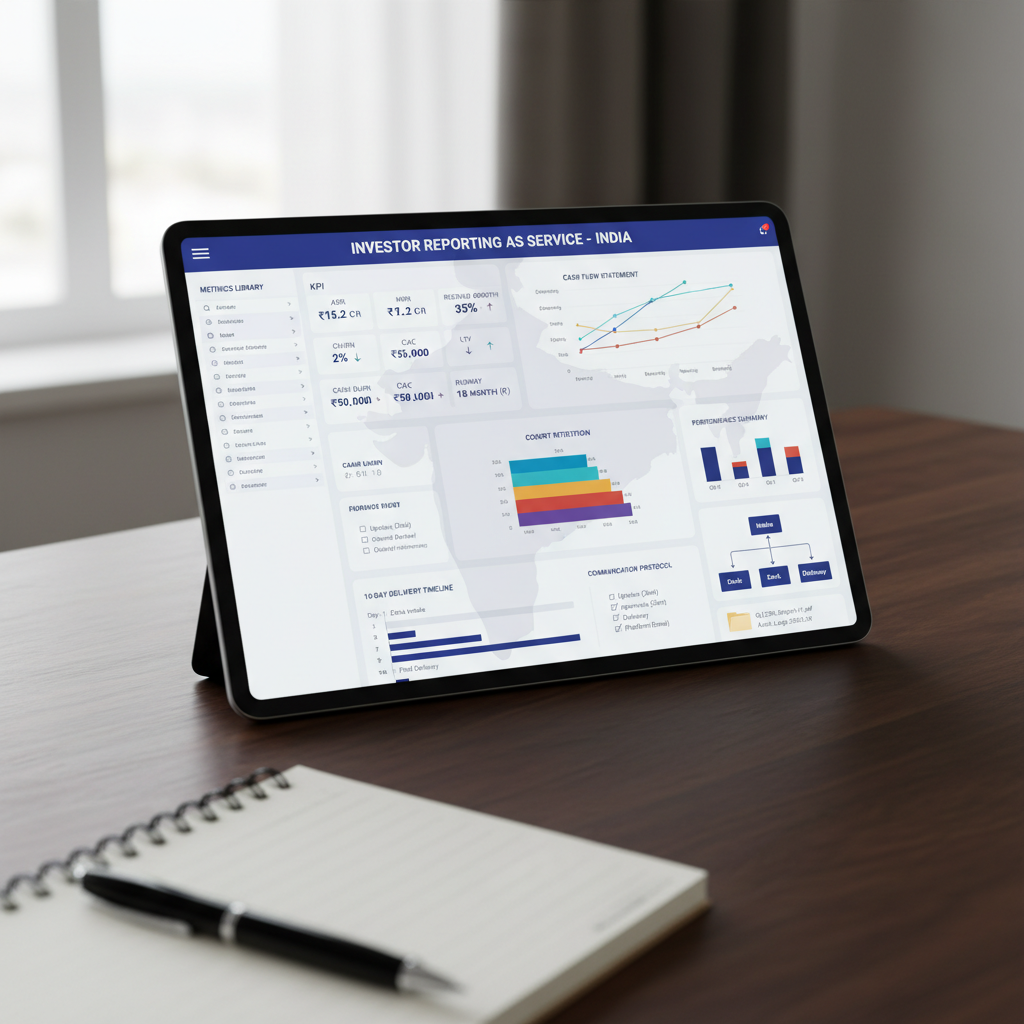
- Monthly Deck and Updates deliver a standard one page summary followed by appendices covering highlights, performance, working capital, compliance, risks, and specific investor asks, typically delivered by Day 10.
- Metrics Library defines standardized names, formulas, sources, owners, and a change log, your guardrail against definition drift.
- Audit-Ready Backup ties every number to invoices, bank statements, ledgers, GST returns, TDS certificates, and reconciliations.
- Delivery Timeline sets a predictable 10 day operating calendar, with SLAs and review gates.
- Communication Protocol clarifies recipients, cadence, channels, confidentiality labels, and escalation paths.
Great reporting is a system, not a slide deck. The slide deck is just the visible tip.
Monthly Deck Structure That Actually Works
The One Page Executive Summary
Lead with a single page investors can digest in 30 seconds.
- Two or three highlights, wins, milestones, or surprises.
- Four core financials as month on month and year on year, Revenue versus Expenses, Gross Profit and Net Profit percentages, Cash Flow Trend, Cash in Bank, Runway and Burn.
- Working capital snapshot, Days Receivable Outstanding and Days Payable Outstanding.
- Top operating KPIs matched to your model, SaaS MRR and churn, D2C order frequency and repeat rate, Marketplace GMV and take rate.
Make it crisp, comparable, and decision focused.
The Detailed Appendix
- Full P&L, cash flow, balance sheet snapshots, with 12 month trends.
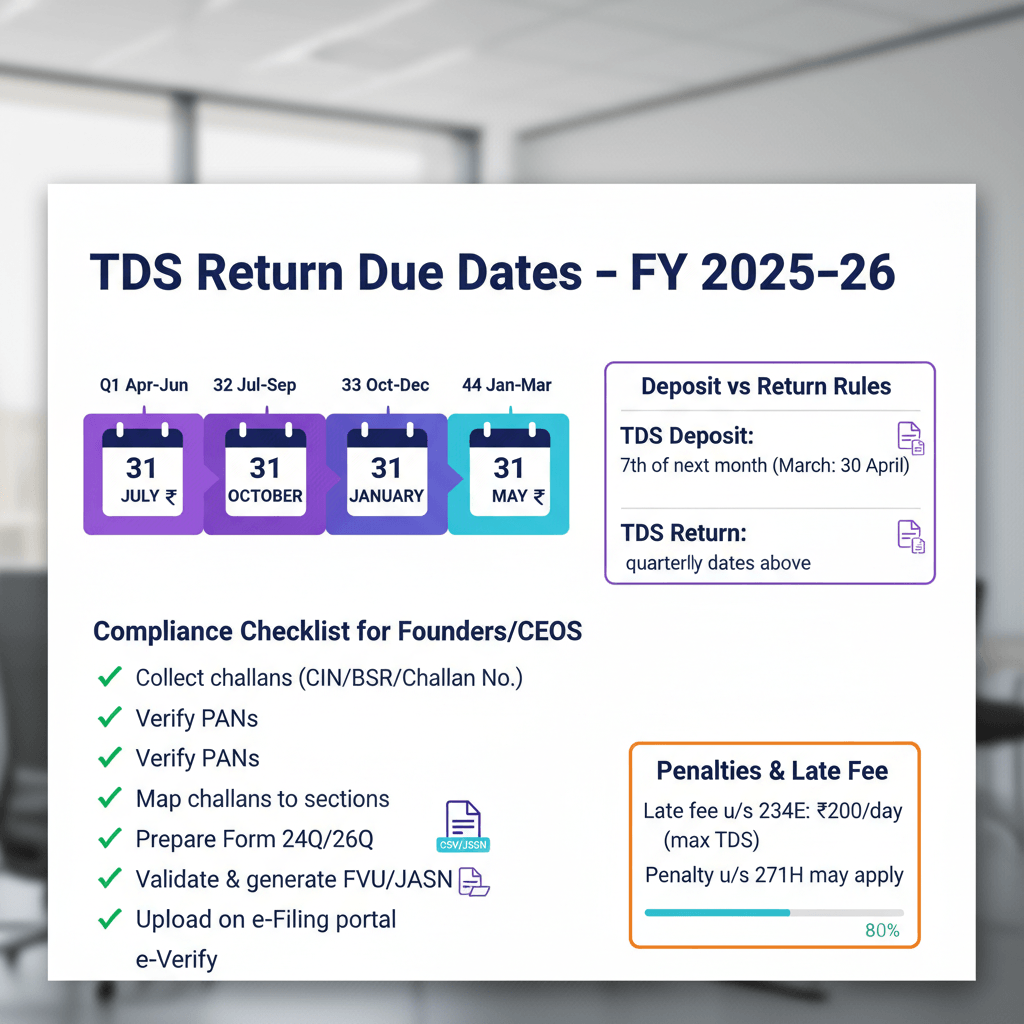
- Compliance status, GST, TDS, MCA submissions, audit timeline, flag GSTR-2B mismatches or delayed TDS deposits.
- Risks and actions, each risk with remediation, owner, and target date.
- Explicit investor asks, introductions, advice, follow on timing.
India Specific Reporting Realities
- GSTR reconciliation months, March and June often spike variance, disclose early with cash and liability impact.
- TDS certificate delays, show separate TDS pending receivables and aging, so DRO is interpreted correctly.
- Vendor invoice delays, build a 5 to 7 day buffer and run aging to surface stress.
Building Your Metrics Library
The Foundation of Consistency
Your metrics library is the backbone, not a side note. Each entry should include name, definition, formula, source system, frequency, owner, change log. This is how you avoid month end debates about “what is revenue.”
Core Financial Metrics Every Company Needs
- Revenue, invoiced sales excluding GST, sourced from Tally Sales Register or Zoho Invoices.
- Expenses, cash payments plus accruals, driven by GL and bank analysis.
- Gross Profit and Net Profit, unit economics and path to profitability.
- Cash Burn, operating cash outflow excluding capex and loan repayments, calculated from bank data.
- Runway, Cash in Bank divided by Monthly Burn, the survival clock.
Working Capital and Operational Metrics
- Days Receivable Outstanding, AR divided by Monthly Revenue times 30, high DRO signals collection risk or generous terms.
- Days Payable Outstanding, AP divided by Monthly COGS or Expenses times 30, interpret with context.
- Aging buckets, 0 to 30, 31 to 60, 61 to 90, over 90, scrutinize over 90 carefully.
- Operational KPIs tailored to model, not vanity metrics.
Compliance and Exception Tracking
- GST credit variance, track 2B versus claimed with aging to prevent surprise liabilities.
- TDS adjustments, track receivable and deposited as separate line items.
- Exceptions, one time charges, refunds, FX movements, loans, disclosed with short narratives.
Creating Audit-Ready Documentation
What Auditors Actually Need
- Invoice and bill images for every transaction, organized by date and entity.
- Monthly bank statements imported and reconciled, no year end surprises.
- Ledger mappings, with reconciliation notes explaining timing differences.
- GST filings, GSTR-1, 2B, 3B, reconciled to books with mismatches flagged promptly.
- TDS certificates, Form 16 and 16A matched to GL, avoid credibility hits.
Organizing Your Evidence Trail
Create a standard folder structure by fiscal year and month, with subfolders for invoices, bills, bank statements, GL exports, reconciliations, GST returns, TDS certificates, exceptions, and the monthly close checklist. When an auditor requests support for a transaction from eight months ago, you should find it in minutes.
Building Maker Checker Controls
- Segregate duties, maker, reviewer, approver, and read only auditor access.
- Enable access logs for a complete trail.
- Use a close checklist with timestamps and sign offs, driving consistency and improvement.
The 10 Day Monthly Close Calendar
Days 1 to 3: Data Ingestion and Initial Reconciliation
- Collect bank statements, GL export from Tally or Zoho, GSTR-2B, all invoices and bills.
- Maintain an ingestion log, files, record counts, missing items.
- Do preliminary bank recs to surface major discrepancies early.
Days 4 to 6: Classification and Exception Handling
- Map GL entries to metric categories per the library.
- Flag outliers, large round numbers, duplicate invoices, new vendors, unusual amounts.
- Reconcile GST credits to 2B, quantify cash impact of mismatches.
Days 7 to 8: Deck Creation and Internal Review
- Apply formulas, generate trend charts, draft the one page summary and investor asks.
- Compile appendices, financials, compliance, operations, with footnotes on variances.
- Controller or CFO review, resolve queries before investors see the pack.
Days 9 to 10: Final Approval and Distribution
- Founder review and approval, confirm recipients per protocol.
- Index backup folders, distribute the deck on Day 10, update logs.
Building Buffer for Compliance Conflicts
GST and TDS deadlines often collide with the close. Build buffers, shift internal close to the 3rd or 5th in heavy months, and issue preliminary decks marked as draft when necessary.
Communication Protocols That Prevent Confusion
Defining Who Gets What When
- Founders, full deck plus backup index.
- Lead investors, one page summary and key metrics, appendices on request.
- Board, comprehensive quarterly packs, with pre reads 48 hours before meetings.
- Secondary investors, concise quarterly summaries.
- Auditors, on demand secure access to backup only.
Choosing the Right Channels
- Email for formal delivery, BCC multiple investors, clear subject lines.
- Secure shared drives for backup, version history enabled.
- Board portals for governance grade distribution and tracking.
- WhatsApp or Slack for urgent alerts, followed by formal email.
Managing Versions and Changes
Every deck needs metadata, preparer, reviewer, approval date, version number, recipients, confidentiality, change log. If you correct errors post distribution, issue an amended version within 24 hours and highlight changes.
Automation Tools That Transform Efficiency
Where Technology Makes the Biggest Impact
- Bills and transactions, automated extraction of dates, amounts, vendors, GST classifications, and line items.
- Ledger mapping, ML driven coding that learns patterns and reduces manual entry.
- Bank reconciliation, shift to exception management, machines match, humans review outliers.
- Dashboards, real time metrics for revenue, burn, runway, working capital.
Essential Automation Capabilities
- AI Accountant, purpose built for Indian SMBs and CA firms, bank ingestion, automated ledger mapping, Tally and Zoho sync, investor ready dashboards, strong on Indian bank formats and GST.
- QuickBooks Online, global leader with solid automation, less optimized for GST and TDS.
- Zoho Books, Indian friendly GST features, good ecosystem, basic automation.
- Xero, strong automation and app marketplace, limited India specifics.
- FreshBooks, simple and user friendly, better for smaller operations.
Integration Requirements
- Bidirectional sync with Tally and Zoho Books, fetch and post clean entries.
- Bank feeds via CSV, PDF, or Account Aggregator where available.
- GST portal integration, pull 2B, push 1, automate reconciliation.
Building Confidence in Automation
- Start small, automate bank recs first with manual oversight.
- Run parallel for one or two months, fix rules, then switch over.
- Use exception reports for outliers, large transactions, new vendors, unusual categorizations.
Templates and Tools for Immediate Implementation
Monthly Deck Template Structure
- Cover Page, company, period, preparation date, confidentiality.
- Executive Summary, highlights, four core financials, working capital, operating KPIs.
- Financial Appendix, P&L, cash flow, balance sheet, trailing twelve months, variance to budget.
- Operational Appendix, cohorts, unit economics, concentration, product mix.
- Compliance Appendix, GST, TDS, audit status, upcoming deadlines.
- Risk Register, risks, mitigation, owners, due dates.
Metrics Library Spreadsheet
- Columns, Metric Name, Definition, Formula, Data Source, Frequency, Owner, Last Updated, Change Log.
- Start with 10 to 15 metrics, expand as the business evolves.
Audit Backup Checklist
- Bank statements for all accounts
- Tally or Zoho GL export
- Customer invoices, vendor bills
- Bank reconciliation with explanations
- AR and AP aging with notes
- GSTR-1, GSTR-2B, GSTR-3B
- TDS certificates and payment receipts
- Exception report with narratives
- Close checklist with sign offs
- Version control log
Communication Calendar Template
- Day 1 to 3, data ingestion
- Day 4 to 6, processing and classification
- Day 7, draft deck
- Day 8, internal review
- Day 9, approval and backup
- Day 10, distribution
- Day 12, investor call optional
- Day 15, query resolution deadline
- Quarter end, board meeting pack
Common Pitfalls and Solutions
The TDS Certificate Delay Problem
Problem: Customers withhold tax, but issue certificates months later, inflating AR.
Solution: Separate “Customer Receivables” and “Receivables Pending TDS Certificates,” run a TDS tracker with invoice date, withholding date, expected certificate date, follow ups. This clarifies DRO and supports cash planning.
GST Input Credit Reconciliation Nightmares
Problem: Variance between GSTR-2B and credits claimed triggers risk and queries.
Solution: Line item matching process, chase missing vendor filings, disclose “2B available” versus “claimed” with narrative. Transparency builds trust.
Foreign Exchange Confusion
Problem: Cash and P&L move with rates, investors question whether losses are real.
Solution: Define FX policy, report cash at spot with separate “FX impact this month,” track SAFE or loan registers with original currency and INR equivalents, add commentary when swings exceed 5 percent of cash.
Revenue Recognition Complexity
Problem: Mixing SaaS and D2C recognition confuses performance assessment.
Solution: Separate metrics, SaaS MRR, D2C Revenue, and Total, maintain deferred revenue schedules and payment gateway reconciliations, show cohorts for retention clarity.
Multiple Compliance Deadlines
Problem: ROC, GST, TDS bunch up, reporting quality suffers.
Solution: Master compliance calendar, preliminary decks in heavy months, finalize post compliance, reset stakeholder expectations early.
Pricing Your Investor Reporting Service
Understanding Scope Variables
- Entity count, each additional entity adds consolidation work.
- Transaction volume, under 1000, 1000 to 5000, over 5000 drives tooling and resourcing.
- Metrics depth, operational metrics require domain data and analysis.
- Service level, standard 10 day, premium 5 day, or rapid query SLAs.
Typical Pricing Models
- Starter ₹15,000 to ₹25,000 per month, single entity, up to 1000 transactions, core metrics, Day 10 deck, five day query support.
- Growth ₹40,000 to ₹60,000 per month, two entities, up to 3000 transactions, ops metrics, monthly and quarterly reporting, 48 hour queries, basic audit support.
- Premium ₹75,000 to ₹125,000 per month, three plus entities, high volume, comprehensive metrics and cohorts, dedicated hours, auditor portal, SOC2 or ISO processes.
Value Based Pricing Considerations
Price for outcomes, faster follow on raises, lower audit costs, founder time saved. Use quarterly contracts with monthly billing, SLAs for delivery and quality, and escalators tied to growth.
Implementation Roadmap
Month 1: Foundation Building
- Map current state, sources, processes, stakeholders.
- Draft a metrics library with 10 to 12 core metrics.
- Design the monthly deck template, simple and consistent.
- Stand up the audit backup structure, start clean from this month.
Month 2: Process Implementation
- Run the first close on the 10 day calendar, document bottlenecks.
- Ship the first deck on time, gather investor feedback.
- Automate bank recs and invoice capture with oversight.
Month 3: Refinement and Optimization
- Fix bottlenecks, refine templates, tighten timelines.
- Expand automation to ledger posting and dashboards.
- Produce the first quarterly board pack with forward guidance.
Ongoing: Continuous Improvement
- Monthly, ship one improvement, automation, definition, or communication.
- Quarterly, review and update the metrics library.
- Annually, run a service review, investor survey, and plan upgrades.
India-Specific Compliance Integration
Managing GST Complexity
Flag input credit variances, reconcile GSTR-2B to claimed credits, and disclose cash impact when variances hit working capital. Investors value early warning over surprises.
TDS and Withholding Tax Clarity
Track TDS withheld as receivables, and TDS deposited as tax assets, with clear aging for certificates. This clarifies why DRO may look inflated without true collection risk.
Annual Compliance Calendar Integration
MCA and ROC filings often collide with reporting periods. Build buffers, shift close dates in heavy months, issue drafts, then finalize post compliance completion.
Foreign Investment Compliance
For companies with foreign capital, maintain FEMA, RBI, and forex registers in your compliance appendix. Escalate material gaps promptly to the board for guidance.
Conclusion
Professional investor reporting is now table stakes in India’s startup ecosystem. Implement the five pillar framework, lean on automation, and institutionalize a 10 day close. Start small, iterate monthly, communicate clearly, and keep improving. The payoff is real, stronger investor confidence, smoother audits, faster follow on funding, and more founder time for building the business.
FAQ
As a CA advising early-stage startups, what are the minimum artifacts I must deliver in an investor reporting service India each month?
Deliver a one page executive summary, detailed appendices with P&L, cash flow, balance sheet, working capital aging, compliance status, and risks, plus an audit backup index. Ship by Day 10 with a version history. Use a metrics library so Revenue, Burn, Runway, DRO, and DPO are consistently defined. If you want speed and accuracy, use AI Accountant for ingestion, mapping, and dashboards.
How can I defend the numbers during investor diligence without slowing the close process?
Build audit ready backup in parallel with the close. As invoices, bills, and bank statements are ingested, they are auto filed into the month’s folders. Maintain maker checker controls, and keep a reconciliation notes file. With AI Accountant, you can export evidence trails linking GL lines to documents, which shortens diligence calls dramatically.
What is a practical way to present TDS receivables so investors do not misread collection risk?
Split AR into “Customer Receivables” and “Receivables Pending TDS Certificates,” show separate aging, and add a TDS tracker with expected certificate dates. In the executive summary, disclose the quantum sitting in TDS pending, so DRO interpretation remains fair. This is easy to automate with an AR aging view in AI Accountant.
For SaaS plus services companies, how should I structure revenue recognition to avoid pushback from auditors and investors?
Define separate metrics, SaaS MRR recognized over service period, services revenue recognized at delivery, and Total Revenue. Maintain a deferred revenue schedule for SaaS and reconcile payment gateways to deposits for services. Your metrics library must codify both formulas and sources. Automate schedules in your accounting tool or in AI Accountant dashboards.
What close timeline do you recommend when I manage multiple entities with inter-company transactions?
Keep the same 10 day cadence, but enforce Day 2 cutoffs for inter company postings, Day 4 eliminations, and Day 6 variance reviews. Use a consolidation checklist and a master eliminations sheet. If volume is high, shift to a 3, 6, 8, 10 rhythm, ingestion by Day 3, classification by Day 6, review by Day 8, distribution Day 10.
How do I standardize metric definitions across Tally and Zoho Books environments?
Create a single metrics library and map each metric to source reports in both systems. For example, Revenue equals Sales Register excluding GST in Tally, equals Invoice list excluding tax in Zoho Books. Lock definitions with reviewer approval, store change logs, and distribute read only copies to stakeholders. Tools like AI Accountant help enforce mappings consistently.
What is the simplest way to communicate changes or corrections post distribution without damaging credibility?
Issue a revised deck within 24 hours, increment the version number, include a clear change log, and call out the impact on key metrics, for example, Burn increased by ₹1.2 lakh due to a late utility bill. Send a brief note to investors explaining the correction and attach the updated deck, then update the version control log.
How should I quantify and present GST 2B versus claimed credit variance to avoid month end surprises?
Show a small table in the appendix, 2B available, credit claimed, variance, and cash impact. Add an aging view of invoices missing in 2B. In the summary, disclose material variances and expected resolution timelines. Automate a 2B match report, or pull it via your GST tool or AI Accountant.
For FX heavy cap tables, how do I present cash and runway clearly to global investors?
Report cash in INR at month end spot, show a separate line for FX impact this month, and provide a short narrative when swings are material. Maintain a register for USD or other currency instruments, with original amounts, conversion dates, and current INR equivalents. Runway should be presented in months, based on INR burn.
What governance artifacts should I maintain to satisfy both auditors and lead investors?
Keep a monthly close checklist with timestamps, an ingestion log, bank rec sign offs, a variance analysis memo, the deck with metadata, and a version control sheet. Maintain access logs for your backup folder. This evidence of process discipline often matters as much as the numbers.
Can I achieve a five day close at scale, or should I stick to 10 days for reliability?
Five day closes are feasible for low volume or highly automated environments. For most early stage companies, a 10 day cycle balances accuracy and speed. If you must compress, start ingestion earlier, lock cutoffs, and reserve Day 5 for CFO sign off only. Invest in automation, especially bank feeds and GL coding through AI Accountant.
How do I structure investor asks so they actually convert into useful help?
Be specific, include the context, the ask, and the owner. For example, Context, pilots with three logistics aggregators. Ask, introduction to two enterprise shippers in NCR. Owner, COO, expected close in 30 days. Track asks and outcomes on a rolling sheet, and update status in the next monthly deck.

Rohan Sinha is a fintech and growth leader building aiaccountant.com, focused on simplifying accounting and compliance for Indian businesses through automation. An IIT BHU alumnus, he brings hands-on experience across 0 to 1 product building, growth, and strategy in B2B SaaS and fintech.