-01%201.svg)
Key takeaways
- Paisy suits entry level bookkeeping automation, but complex GST, scale, and multi org needs often require deeper automation and stronger integrations.
- Prioritize automation accuracy, two way sync with Zoho Books and Tally, GST workflows like GSTR 2B reconciliation, and multi org controls for CA firms.
- Evaluate pricing with a total cost of ownership lens, include tool fees, implementation, internal effort, and scale costs, not just the base plan.
- For AP automation, bank ingestion, predictive mapping, and GST reconciliation at scale, AI Accountant is typically the strongest India first Paisy alternative.
- Run a two week pilot with your real data, define success metrics, and verify edge cases such as advances, intercompany, splits, and credit notes.
- Dashboards that reveal cash, receivables, payables, and aging without manual spreadsheets are critical for founders and finance leaders.
- Security and scale matter, verify certifications, data handling, and proven high volume performance before committing.
What Paisy is and where it fits
Paisy is a bookkeeping focused software in India built for entry level automation of categorization, basic reconciliations, and simple data entry workflows. It can work well for small teams with modest transaction volumes and straightforward compliance needs.
As volumes grow and GST requirements become complex, teams often encounter gaps in automation accuracy, manual cleanup overhead, and India specific features like GSTR 2B reconciliation and vendor GSTIN validation. When teams look for a Paisy alternative India, they typically prioritize accuracy, two way sync with Zoho Books and Tally, GST purchase side reconciliation at scale, multi org support for CA firms, transparent pricing, and India first features like e invoice compatibility, TDS or TCS, and vendor master validation.
Practical evaluations beat generic rankings, focus on the workflows you run every day, not a long feature table.
Evaluation checklist for Indian bookkeeping and finance tools
India specific compliance
- GST purchase side reconciliation, GSTR 2B matching and mismatch flagging
- E invoice and e way bill readiness integrated into daily workflows
- Vendor GSTIN, name, and address validation to prevent posting errors
- TDS and TCS workflows aligned with Indian statutory needs
Integrations and data flow
- Native sync with Zoho Books and Tally that pulls masters and pushes cleaned transactions back
- Master data deduplication to prevent duplicate vendors and customers
- Real time or near real time bidirectional updates without manual exports
AP and bills automation
- Bulk bill ingestion from PDFs, images, scans, and Excel
- High accuracy field extraction, vendor, amount, date, line items
- Vendor mismatch detection before posting
- Excel import with row level error flagging and validation rules
Bank and card ingestion
- Statement normalization for Indian bank layouts and formats
- Automatic handling of splits, transfers, and internal movements
- Narration cleanup and standardization for easier categorization
Transaction mapping and matching
- Predictive ledger and vendor assignment based on history
- Bulk edits for exceptions and fast rule refinement
- Automatic linking of payments to open bills and invoices
- Handling of advances, intercompany adjustments, and credit notes
Dashboards and visibility
- Cash, receivables, and payables dashboards with aging buckets
- Due versus overdue tracking for working capital decisions
- Category wise spend visibility without spreadsheets
Multi org and access control
- Single login for multiple entities and client accounts
- Organization specific learning that improves per client accuracy
- Role based access for finance, CA, approvers, and auditors
Scale and security
- Enterprise grade encryption and secure data handling
- ISO 27001 and SOC 2 Type II certifications
- Proven volume handling without performance degradation
Support and onboarding
- India time zone support and responsive implementation
- Guided onboarding for migration, configuration, and parallel testing
Paisy pricing India, how to read it and verify
Paisy pricing often operates per organization or per user, with potential add ons. When evaluating Paisy pricing India, verify the pricing model, any implementation fees, GST reconciliation modules, advanced bank rules, and multi org features, billing cycle, and how costs scale by volume and users.
Total cost of ownership
- Tool cost, monthly or annual software fees
- Onboarding and setup, implementation, data migration, configuration
- Internal time investment, parallel testing, rule building, UAT
- Scale costs, increments as volume or client roster grows
- Time saved or added, headcount offset versus any new manual overhead
For current pricing and add ons, check Paisy’s official site directly.
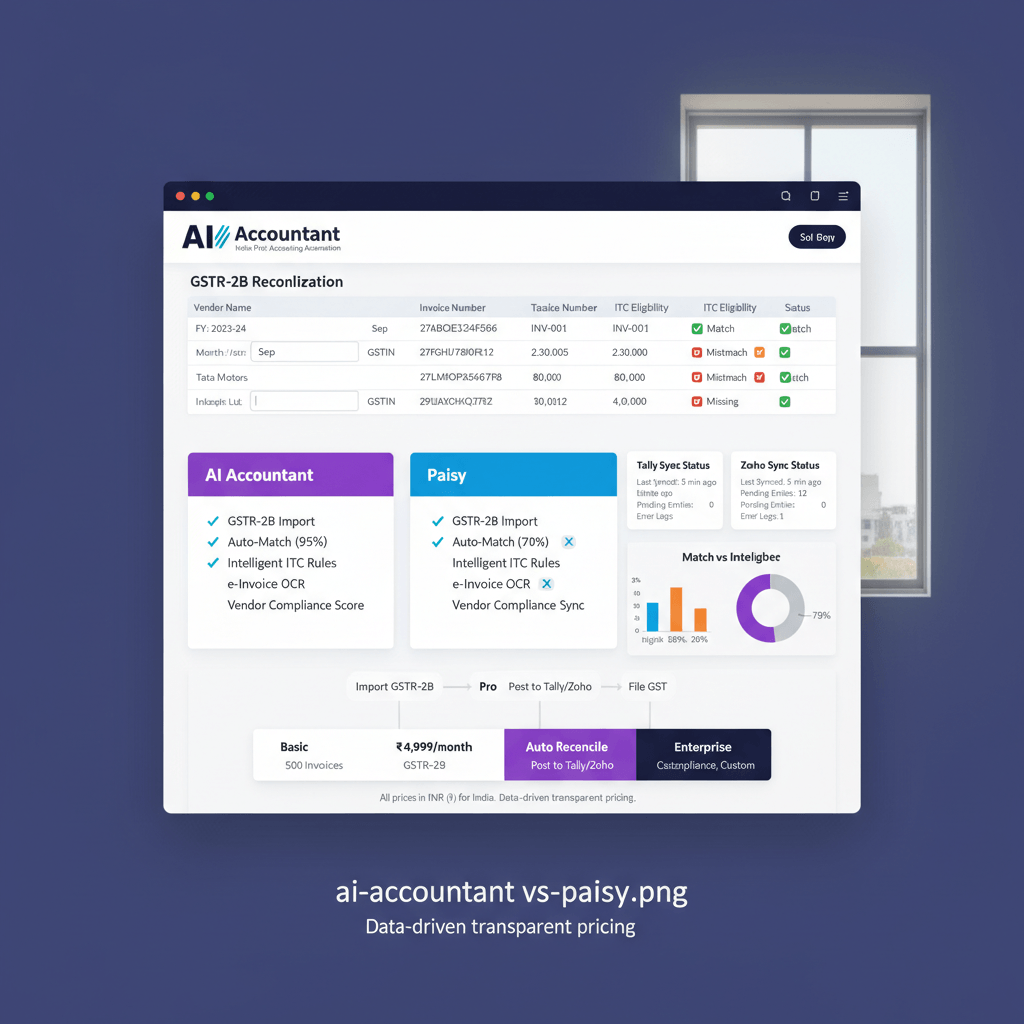
Paisy vs AI Accountant, capability by capability
When comparing Paisy vs AI Accountant, use concrete workflows to guide the decision.
Where Paisy excels
Paisy focuses on entry level bookkeeping automation and basic categorization, making it suitable for small teams with simple compliance needs and modest transaction volumes. Its strength is fast onboarding for basic workflows without complex integrations.
AP and bills automation
AI Accountant ingests bills in bulk from PDFs, images, and Excel, extracts vendor, amount, date, and line items with high accuracy, flags vendor mismatches before posting to Tally or Zoho Books, and shows row level error visibility on Excel imports. The result is fewer posting errors and cleaner vendor masters.
Bank and credit card statement ingestion
AI Accountant normalizes diverse Indian bank layouts, structures data for categorization without reentry, and handles splits and internal transfers automatically, which saves hours each month.
Transaction mapping and matching
The platform uses predictive AI to suggest the correct ledger, vendor, and customer based on history. Bulk edits speed up exception handling. Payments link to open bills and invoices while splits, transfers, and intercompany adjustments are handled intelligently.
Sync with Zoho Books and Tally
AI Accountant pulls master data from Zoho Books or Tally, then pushes cleaned bills and categorized transactions back, enabling true two way sync. It prevents duplicates in masters and updates ledgers directly in your accounting system.
Dashboards
Dashboards cover cash, receivables, and payables with due versus overdue aging, category wise spend, and working capital visibility, without manual exports.
GST reconciliation
AI Accountant supports purchase side reconciliation against GSTR 2B at scale, with status indicators and exception tagging. Vendor GSTIN validation catches posting errors early.
Multi org support
CA firms can manage dozens of clients from one login. Organization specific learning improves accuracy per client, and role based access ensures appropriate visibility.
Scale and trust
AI Accountant has processed 300M plus transactions across 450 plus customers, including 100 plus CA firms, with ISO 27001 and SOC 2 Type II certifications, and is built for heavy month ends.
What to verify with Paisy
- Depth of automation in AP, categorization, and GST reconciliation, plus residual manual effort
- Whether two way integrations with Zoho Books and Tally exist, not just exports
- Multi org workflows for CA firms, with org specific learning and role based access
- Dashboards for cash, receivables, and payables with aging views
- Security certifications and data handling practices
Decision guidance
If you need product led automation, deep Zoho or Tally sync, and GSTR 2B workflows at scale, AI Accountant is usually the stronger Paisy alternative. If you prefer a bundled bookkeeping service, confirm Paisy’s service scope, SLAs, and turnaround times first.
Side by side outcomes that matter, India first
Month end close time reduction
Teams often spend 5 to 10 days on reconciliation, categorization, and GST matching. With automation, many reduce this to 2 to 3 days. Track percent auto mapped, exceptions resolved per hour, and total days to close.
GST credit accuracy and mismatch handling
GST mismatches can block credit and trigger audit flags. Measure GSTR 2B reconciliation coverage, mismatches caught before filing, and credit blocking events.
Time saved on bank and card ingestion
Statement normalization and auto categorization eliminate reentry. Measure hours saved each month on download, upload, and categorization.
Vendor bill cleanliness
Duplicate vendors, GSTIN typos, and address mismatches cause posting errors. Track mismatch detection, duplicates merged, and clean posting accuracy.
Visibility for founders
Spreadsheets hide cash risk. Dashboards reveal aging buckets, overdue invoices, and payment term breaches at a glance. Measure days to dashboard visibility and cash runway clarity.
Mini use case stories, India context
CA firm, 30 plus SME clients, multi org switching
A CA firm using Paisy for entry work still faced manual consolidation at month end and heavy GST matching. Switching to AI Accountant delivered one login across clients, client specific learning, and role based access. The firm cut month end time by 60 to 70 percent, and reduced GST reconciliation errors by over 80 percent.
Manufacturing SME, PDFs and scanned bills, vendor mismatches
A manufacturer entered bills into Tally manually, creating GSTIN typos and vendor name variants. With AI Accountant, they automated bill ingestion from images, validated GSTINs before posting, and cleared GSTR 2B exceptions in hours rather than days.
Services startup on Zoho Books, card splits, receivables visibility
A services startup struggled with card statement ingestion, splits, and reimbursements, and had poor visibility into overdue invoices. AI Accountant’s bank ingestion and dashboards gave real time visibility, automated splits, and synced aging buckets back to Zoho Books without manual exports.
Best accounting automation tools for Indian businesses
- AI Accountant, deep automation for AP, GST reconciliation, native Zoho or Tally sync, and multi org support for CA firms
- QuickBooks India, cloud accounting with GST features and basic automation
- Zoho Books, comprehensive accounting with GST compliance and Indian banking integrations
- Tally Prime, robust desktop accounting with strong GST capabilities
- Xero, cloud accounting with some India specific functionality
- FreshBooks, simple invoicing with basic automation
How to evaluate a Paisy alternative, step by step
Step 1, run a two week pilot
- Use real data, not samples
- Include two months of bank statements across accounts
- Add 50 to 100 recent AP bills, PDFs, scans, Excel imports
- Include your latest GSTR 2B report for reconciliation
Step 2, define success metrics
- Target 80 percent or more auto mapped transactions for known vendors and ledgers
- Track exceptions resolved per hour by your finance team
- Verify 20 to 30 postings back to Zoho or Tally for correctness
- Measure percent of GSTR 2B line items matched or correctly tagged
- Baseline and re measure close time after two weeks
Step 3, involve your CA and finance ops early
- Document edge cases, advances, prepayments, intercompany
- Test credit notes, reversals, and multi currency if relevant
- Try vendor bill splits across projects or cost centers
- Ask how the vendor handles each scenario, manual workarounds are a yellow flag
Step 4, compare support responsiveness
- Check response times in India hours
- Assess quality of implementation guidance, rules, and best practices
- Confirm willingness to align with your audit trail and approvals
Switching guide, from consideration to go live
Phase 1, data prep
- Export vendor and customer masters from Zoho Books or Tally, clean duplicates and typos, validate GSTINs
- Export 3 to 6 months of bills, payments, and bank statements
- Document chart of accounts and cost centers
Phase 2, configuration
- Map bill fields to ledgers in Zoho or Tally
- Define approval flows for auto categorized transactions
- Create user roles for finance, CA reviewer, approver, and auditor
- Configure GST rules for purchase side reconciliation and TDS or TCS
Phase 3, parallel run
- Run a full close in the new tool alongside your current process
- Validate postings back to Zoho or Tally
- Test GST reconciliation against your actual GSTR 2B
- Capture feedback and refine rules
Phase 4, go live
- Choose a cutover date at month end or fiscal boundary
- Plan backlog ingestion for older invoices or statements
- Validate dashboards and reports before day one
- Schedule check ins at week 1, week 2, and month 1
Next steps, pilot and benchmark
If you are ready to test a Paisy alternative India, run a no obligation pilot with two months of statements, recent AP bills, and GSTR 2B. Use a success checklist, automation percentage, exceptions per hour, posting accuracy, and GST recon coverage. Book a 30 minute workflow review with your finance team and the vendor to benchmark current versus target outcomes.
Focus on measurable outcomes, time saved, errors reduced, and visibility gained. The right automation turns month end from a marathon into a simple checklist.
FAQ
For a CA firm managing 25 clients across Tally and Zoho Books, how should we structure multi org access and audit trails, and can AI Accountant support this?
Use a single workspace with client level entities, enable role based access per entity, and restrict posting rights to senior reviewers. AI Accountant supports one login for many orgs, organization specific learning that adapts to each client, and approval flows that capture who reviewed and posted each transaction, which satisfies most audit requirements for CA firms.
How do I measure the accuracy of GSTR 2B reconciliation during a pilot, and what metrics should a CA report to a client?
Track reconciliation coverage percent, percent of 2B line items auto matched, mismatch categories like GSTIN mismatch, invoice number mismatch, tax rate variance, and time to resolve exceptions. With AI Accountant, CA firms often target 95 percent plus coverage on 2B, and provide a report showing mismatches resolved before filing, which directly impacts input credit reliability.
Does AI Accountant push cleaned data back into Tally and Zoho Books including cost centers, and how is duplicate master data avoided?
Yes, AI Accountant performs two way sync. It pulls vendors, customers, and ledgers, and pushes cleaned bills and categorized transactions back, including cost center mapping where configured. Masters are deduplicated using matching rules, for example GSTIN, PAN, phone, and name normalization, so you do not create duplicates during sync.
We use SBI, HDFC, and ICICI statements with very different layouts, can bank normalization and narration cleanup really standardize this?
Yes. Bank ingestion in AI Accountant standardizes headers, dates, amounts, and narrations into a consistent schema, then applies categorization rules and predictive mapping. This allows you to run one set of rules across banks, and materially reduces manual reformatting effort during close.
How are advances, credit notes, and intercompany adjustments handled so that ledgers do not get messy at month end?
During pilot design, create scenarios for advances on both AP and AR, apply mapping rules that park advances to specific ledgers, and enable automatic application when the final bill or invoice arrives. AI Accountant supports linking payments to open bills, applying credit notes, and tagging intercompany transfers so close entries remain clean.
What security assurances should a CA demand from a Paisy alternative, and does AI Accountant meet them?
Ask for ISO 27001 certification, SOC 2 Type II, data encryption at rest and in transit, access logs, and least privilege controls. AI Accountant holds ISO 27001 and SOC 2 Type II certifications, uses enterprise grade encryption, and provides access controls suited for CA firms handling multiple clients.
How do I compute total cost of ownership for 40,000 transactions a month across 12 entities, and where do hidden costs creep in?
Compute software subscription, one time implementation, internal team hours for configuration and parallel run, ongoing exception handling time, and incremental costs as volumes grow. Hidden costs often appear in manual reconciliation effort, export or import steps, and duplicate cleanup. AI Accountant reduces these by automating bank ingestion, AP extraction, and predictive mapping with two way sync, which lowers ongoing manual time.
Can AI Accountant replace a junior accountant, or should I think of it as a co pilot for my finance team?
Treat it as a co pilot. Routine ingestion, extraction, and categorization are automated, while your team focuses on exceptions, approvals, and controls. Many CA firms redeploy junior capacity to higher value reviews, rather than increase headcount during scale.
What is a practical pilot success checklist that a CA can share with a client board before greenlighting a switch?
Include percent auto mapped, target 80 percent plus for known vendors, exceptions resolved per hour, at least 15, posting accuracy back to Tally or Zoho on a 20 to 30 item sample, GSTR 2B coverage and mismatch resolution rate, and net days reduced in close. AI Accountant typically demonstrates measurable gains on these metrics in two weeks.
How should we migrate and deduplicate vendor masters when moving from spreadsheets and Tally to a centralized workflow?
Export masters, standardize fields, run GSTIN and PAN validation, and apply fuzzy matching on name and address. AI Accountant flags possible duplicates, for example same GSTIN with minor name variation, and lets you merge before sync, which prevents master bloat.
We use custom fields in Zoho Books, for example project code and department, will those map through during sync?
Yes, map your Zoho custom fields to AI Accountant fields during configuration. Once mapped, these values flow with bills and transactions during push back, ensuring project or department level reporting remains intact.
What timeline should a CA expect from kick off to go live across five entities, and how do we de risk the transition?
Typical timelines are one week for data prep, one week for configuration, two weeks for a parallel run, and a clean cutover at month end. De risk by validating postings daily during the parallel run, reviewing GSTR 2B reconciliations mid cycle, and scheduling weekly check ins. AI Accountant’s implementation team supports this cadence in India time zones.

Rohan Sinha is a fintech and growth leader building aiaccountant.com, focused on simplifying accounting and compliance for Indian businesses through automation. An IIT BHU alumnus, he brings hands-on experience across 0 to 1 product building, growth, and strategy in B2B SaaS and fintech.