-01%201.svg)
Key takeaways
- AI Accountant is the standout Paisy alternative in India for CA firms and SMEs using Zoho Books or Tally, delivering 60 to 70 percent time savings with 80 percent plus automation across AP, banking, and GST.
- Evaluate tools with a practical framework that covers AP ingestion, multi bank statement normalization, AI categorization, GST reconciliation at scale, deep integrations, dashboards, multi org controls, and security.
- Look beyond sticker price, factor in total cost of ownership, error reduction, and scaling capacity. The right automation often pays for itself within the first month.
- For teams on Zoho or Tally, layering AI Accountant on top unlocks two way sync, cleaned data posting, and real time visibility without changing your system of record.
- Onboarding can be fast and low risk with a four week plan, beginning with sync, then historical ingestion, AI training, and go live, with parallel runs for safety.
Why Indian teams are seeking a Paisy alternative
If you are evaluating a paisy alternative india, you are likely facing manual data entry, month end backlogs, and GST reconciliation delays. CA firms and SME finance teams report that manual workflows throttle growth. AI Accountant changes the equation by automating bank ingestion, ledger mapping, and GST processes, so your team can reclaim time for analysis and advisory.
What used to take days becomes hours, what used to require headcount becomes a background process managed by AI.
Paisy Bookkeeping Review: The Framework That Matters
When you run a paisy bookkeeping review, judge solutions by outcomes, not just features. Below is the practical checklist adopted by 450 plus customers processing 300 million transactions.
AP and Bills Automation Capabilities
Confirm bulk OCR ingestion, automatic vendor mismatch detection, and Excel imports with built in validations. These are essential once you process more than 100 bills monthly.
Bank and Card Statement Processing
Multi bank statement normalization is critical. Your tool should standardize PDFs, CSVs, and scanned images without breaking a sweat, aligning dates, narration styles, and debit or credit classifications automatically.
Transaction Categorization and Matching Intelligence
AI should predict transaction types, map to correct ledgers, and handle splits, transfers, and bulk matching. Learning from your historic patterns is non negotiable.
GST Workflow Automation
Indian operations demand GSTR 2B reconciliation at scale, purchase register management, and credit or debit note handling. Without this, you face days of manual work each month.
Integration Depth with Existing Systems
Two way sync with Tally and Zoho Books is fundamental. Expect master sync, automated processing, and seamless push back of cleaned entries, with zero CSV juggling.
Dashboard and Visibility Features
Real time cash flow, receivables aging, payables tracking, and category wise spending should be available at a glance, highlighting exceptions that need action.
Multi Organization and Access Control
For CA firms, look for quick org switching, role based access, and client specific learning patterns that preserve each entity’s preferences.
Security and Compliance Standards
Insist on ISO 27001, SOC 2 Type II, encryption, audit trails, and disciplined access controls. Financial data deserves enterprise grade protection.
Support and Onboarding Experience
Low learning curves, structured training, and dedicated support for high volume teams make the difference between stalled rollouts and rapid success.
Paisy Pricing India: Understanding the Real Costs
Paisy pricing india varies across models, from per organization and per user, to transaction based fees and add ons for GST or TDS. The headline price rarely tells the full story.
Common Pricing Models in Indian Bookkeeping Software
- Per organization can work for single entity SMEs, yet becomes expensive for CA firms with many clients.
- Per user penalizes growth as your team expands.
- Transaction based pricing scales with volume, which can spike costs during busy periods.
- Add ons for critical GST workflows often surprise teams later.
Calculating Total Cost of Ownership
- Setup and data cleanup fees are common when migrating from manual processes.
- Reconciliation charges for complex cases add up quickly.
- Basic support may be insufficient during month end, while premium tiers increase spend.
- Beware overage fees on transaction or storage limits.
Comparing Value Beyond Sticker Price
Quantify hours saved on manual entry, error correction, and imports. If your current stack relies on manual Tally imports, and an automation layer posts clean data back automatically, the ROI becomes obvious.
Cheapest is rarely best. The right automation reduces month end time, shrinks error rates, and lifts capacity so you can scale clients without hiring.
Paisy vs AI Accountant: The Direct Comparison
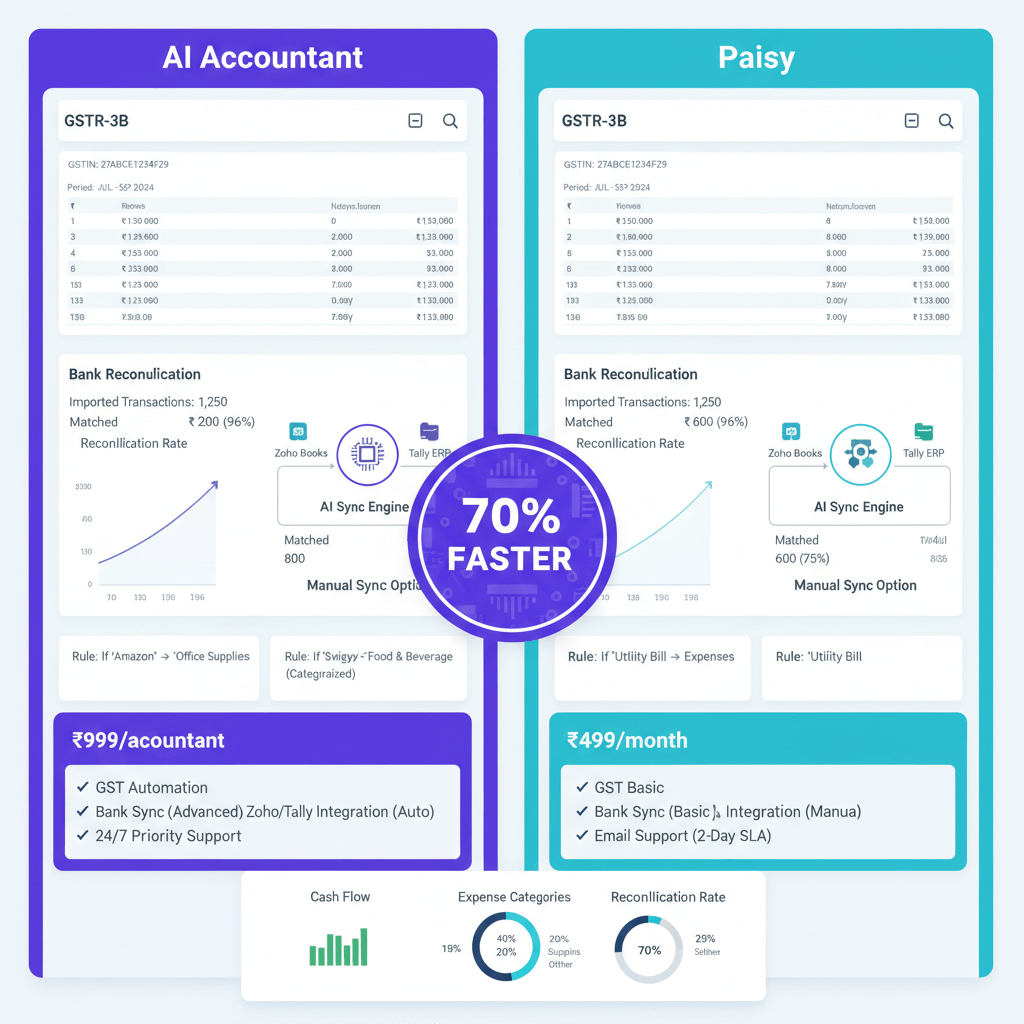
Cut through marketing and compare paisy vs ai accountant on what actually matters for Indian finance teams using Zoho or Tally.
Accounts Payable and Bills Processing
Check if Paisy supports OCR based bulk ingestion. AI Accountant offers bulk OCR, vendor mismatch detection, and Excel imports with validations, so you upload hundreds of bills in one go and review only exceptions.
Bank Statement Ingestion Capabilities
Evaluate multi format support. AI Accountant automates normalization for PDFs, CSVs, and scanned images across every major Indian bank, unifying dates, narrations, and transaction types automatically.
Transaction Mapping Intelligence
AI Accountant learns from your history to auto categorize with 80 percent plus accuracy, handles splits and transfers, and performs bulk matching to clear the remaining items quickly.
GST Reconciliation Depth
AI Accountant manages purchase registers, journal vouchers, credit and debit notes, and GSTR 2B matching with robust status tracking at scale.
Integration Architecture
Expect one click two way sync with automated posting of cleaned data. Masters sync continuously, and there is no manual export or import routine.
Dashboard and Reporting Power
Get predictive cash flow, AR tracking, AP monitoring, and multi org switching. Dashboards surface risks and suggest next actions.
Security and Scale Credentials
AI Accountant operates with ISO 27001 and SOC 2 Type II controls, proven across 300 million plus transactions.
Decision Scenarios
- Using Zoho or Tally and need faster month ends, choose AI Accountant.
- Managing 20 plus clients as a CA firm, use multi org controls to save 75 percent time.
- High volume banking, automate ingestion and normalization to scale without headcount.
- Founders seeking working capital visibility, rely on real time dashboards.
Top Paisy Alternative Options in India
Best Accounting Automation Tools for Indian Businesses
- AI Accountant stands out as the automation layer for Zoho and Tally users, delivering deep sync and 80 percent plus coverage across GST, TDS, and banking.
- TallyPrime remains a compliance staple for offline operations, yet requires substantial manual entry.
- Zoho Books offers strong cloud collaboration with moderate native automation.
- QuickBooks Online brings international grade features but may miss India specific GST workflows.
- Marg ERP fits distribution centric businesses, while service firms may find automation limited.
MSME Focused Solutions
Vyapar is effective for basic invoicing, yet limited for advanced automation. Khatabook and similar apps help micro businesses record transactions but do not scale to complex workflows. OkCredit is useful for credit tracking, not full bookkeeping.
Integration Strategies That Work
Smart teams keep Zoho or Tally as the system of record, then layer AI Accountant for automation. This combination delivers compliance, speed, and visibility without forcing a platform change.
Making the Right Choice
Match capabilities to pain points. Heavy transactions demand robust automation, multi entity operations require mature org handling, and GST intensive processes need deep reconciliation.
How AI Accountant Delivers ROI vs Manual or Semi Manual Bookkeeping
The roi bookkeeping automation case is compelling when you count the hours and the errors avoided.
Quantifiable Time Savings
- AP entry drops by 60 to 70 percent, eight hours becomes two to three.
- Bank categorization shrinks from days to hours.
- GST reconciliation time reduces by 80 percent for many teams.
Month End Acceleration Benefits
Fewer errors mean less rework and faster closes. Predictive checks catch vendor mismatches, duplicates, and categorization misfires before they snowball.
Enhanced Financial Visibility
Real time dashboards deliver cash positions, receivables aging, and payables status instantly, enabling working capital optimization and proactive decisions.
Key Performance Indicators That Matter
- Auto categorization rate above 80 percent after initial training.
- Forty to sixty hours saved per month for typical teams.
- Overdue receivables reduced by 20 to 30 percent.
- Three times client scaling for CA firms with the same headcount.
Real World Impact Stories
A Bangalore CA firm cut month end from 12 days to 4 while adding 15 clients without hiring. A Mumbai SME finished GST reconciliation in a fraction of prior time. A startup founder improved working capital by 25 percent with daily cash visibility.
Beyond Direct Cost Savings
Teams focus on analysis and advisory instead of data entry. Client relationships improve with faster turnarounds and insight rich conversations.
Onboarding and Migration with AI Accountant
Onboarding accounting software can be smooth when structured week by week, with parallel safety nets.
Week One: Connection and Sync
Connect Zoho Books or Tally, auto sync masters, and validate with a small subset before full migration.
Week Two: Historical Data Ingestion
Upload PDFs, CSVs, Excel files, or scans. OCR extracts vendor details, invoice numbers, dates, line items, and amounts at scale.
Week Three: AI Training and Mapping
Let AI learn your categorization patterns, then clear exceptions with bulk operations and set rules for recurring scenarios.
Week Four: Go Live and Optimization
Post cleaned entries back to Zoho or Tally, turn on dashboards, and train your team on daily flows.
Ongoing Support and Scaling
Track automation rates weekly, add new workflows gradually, and onboard new entities with multi org controls.
CA Firm Specific Considerations
Bulk client onboarding, role based access, and client specific learning ensure each entity’s rules are respected.
Migration Best Practices
- Start with high volume, repetitive processes for quick wins.
- Run parallel for confidence, then cut over.
- Document current workflows to spot automation opportunities.
- Involve the whole team early for better change management.
Take the Next Step Toward Automation
Choosing the right paisy alternative india can transform your month end, your error rates, and your ability to scale. AI Accountant brings the automation depth Indian teams need, from GST reconciliation to multi bank processing, from AP automation to real time dashboards.
Book a demo to see bulk AP automation and real time sync in action. Download the Paisy bookkeeping review checklist to evaluate options systematically. Stop drowning in manual work, start scaling with intelligent automation.
FAQs About Choosing a Paisy Alternative
Is AI Accountant a good Paisy alternative for CA firms handling multi client GST and banking?
Yes, AI Accountant is built for CA firms that need high volume GST and bank automation with multi organization controls. Firms manage dozens of clients from a single login, apply role based access, and benefit from client specific learning that preserves each entity’s categorization patterns. Most firms report three times client capacity with the same team.
Does AI Accountant replace Zoho Books or Tally, or does it sit on top as an automation layer?
AI Accountant sits on top of Zoho Books or Tally as an automation layer. Masters sync in, cleaned transactions post back, and your ERP or accounting system remains the system of record. This design preserves compliance while delivering automation speed.
How does AI Accountant pricing compare to typical Paisy pricing India models?
Pricing is tiered around volumes and modules, but the critical comparison is total cost of ownership. When AP entry time drops by 60 to 70 percent and month end compresses significantly, most firms achieve positive ROI in the first month. Consider avoided hiring, reduced errors, and faster receivables collection in your evaluation.
What security assurances matter for a CA practice moving client data to an automation platform?
Look for ISO 27001 and SOC 2 Type II, strong encryption in transit and at rest, audit trails, and granular role based access. AI Accountant meets these standards and is designed around India first compliance for GST and TDS.
How quickly can a CA firm migrate 20 plus clients without disrupting ongoing work?
In practice, firms run a phased rollout. Week one connects and validates sync, week two ingests historical documents, week three tunes AI mapping, and week four goes live with parallel safety. Larger firms stage clients in cohorts, often completing full deployment in four to six weeks.
Can AI Accountant auto categorize Indian bank transactions reliably across different formats?
Yes. The platform normalizes multi bank PDFs and CSVs, learns from your history, and achieves 80 percent plus auto categorization after initial training. The remainder is cleared in bulk with efficient review flows, saving days of manual tagging each month.
How does AI Accountant handle GSTR 2B reconciliation at scale for purchase side workflows?
The tool automates download and matching against the purchase register, supports journal vouchers, credit and debit notes, and maintains status tracking for thousands of entries. This removes the month end pileup and reduces reconciliation errors materially.
What integration depth should a CA expect with Zoho Books and Tally?
Expect two way sync, master data alignment, and automated posting of cleaned entries without manual export or import. AI Accountant was architected specifically for Zoho and Tally users, so it respects ledger structures and avoids duplicate or conflicting postings.
Which KPIs should a CA partner track to prove ROI from an AI bookkeeping layer?
Track auto categorization rate, hours saved per month in AP and bank workflows, error correction effort, overdue receivables trend, and client capacity per staff member. Firms using AI Accountant often see auto categorization above 80 percent, 40 to 60 hours saved monthly, and 20 to 30 percent improvement in overdue collections.
We use spreadsheets heavily. Can AI Accountant ingest Excel and scanned bills in bulk?
Yes. Bulk ingestion accepts PDFs, CSVs, Excel files, and scanned images. OCR extracts vendor, invoice number, date, line items, and amounts, then validates against masters to flag mismatches for quick resolution.
How should a CA firm structure change management to ensure adoption across the team?
Start with a clear playbook, run parallel for a short window, designate champions, and prioritize quick wins such as bank ingestion and AP entry. Provide short training sessions focused on daily tasks, then expand into GST workflows once confidence is high.
We have niche edge cases in ledger mapping. Can rules and AI work together?
They can, and they should. AI Accountant learns from historical behavior, while you can add deterministic rules for recurring scenarios such as subscriptions, loan EMI splits, or inter account transfers. The combination yields high accuracy with minimal manual touch.

Rohan Sinha is a fintech and growth leader building aiaccountant.com, focused on simplifying accounting and compliance for Indian businesses through automation. An IIT BHU alumnus, he brings hands-on experience across 0 to 1 product building, growth, and strategy in B2B SaaS and fintech.