-01%201.svg)
Key takeaways
- A CA team for business operations is a managed finance back office led by a Chartered Accountant, it keeps books clean, filings on time, and MIS ready for decisions.
- When wired into daily ops with a shared calendar and approval flows, you reduce penalties, improve collections, and gain live visibility on cash, burn, and runway.
- Specialists cover GST, TDS, income tax, ROC, payroll, and MIS, creating a reliable system with audit trails and standardized documents.
- AI Accountant delivers this as one service with a real time dashboard, alerts, and a single place to collaborate with your CA team.
- Choose in house, outsourced, or hybrid based on stage, volume, and complexity, early stage firms often benefit from an outsourced or hybrid model.
Introduction to a CA team for business operations
A CA team for business operations is a Chartered Accountant led, managed finance function that runs your back office end to end. It connects accounting, GST, TDS, income tax, ROC, and payroll to your daily work, delivering clean ledgers, on time filings, and simple MIS you can actually use.
Instead of messy email chains and scattered spreadsheets, you get one system, clear roles, and a shared calendar that prevents surprises.
With live visibility into cash flow, burn, and runway, you get alerts before problems grow, and more time to build the business.
What is a CA team for business operations
It is a coordinated team of finance specialists led by a Chartered Accountant. The team operates to a shared calendar, uses clear maker checker approvals, and maintains a portal or dashboard for documents and updates. Formats are standardized, and every action leaves an audit trail, which keeps you prepared for scrutiny at any time.
Key roles and responsibilities
Chartered Accountant lead
- Sets the finance plan, aligns scope and cadence with business goals.
- Reviews books, guides audit prep, and ensures policies and controls stay tight.
- Advises on tax positions and compliance posture.
Tax specialist for GST, TDS, and income tax
- Runs GST registration and filings such as GSTR 1 and GSTR 3B, and annual GSTR 9 and GSTR 9C, refer to the GST portal at https://www.gst.gov.in.
- Enables e invoicing for eligible taxpayers, see https://einvoice.gst.gov.in.
- Manages TDS challans and returns 24Q, 26Q, 27Q, and property related 26QB, 26QC, 26QD, refer to https://www.tdscpc.gov.in.
- Handles income tax returns and advance tax, see https://www.incometax.gov.in.
Bookkeeping lead
- Posts sales, purchases, expenses, and bank or wallet entries.
- Runs bank and payment gateway reconciliations.
- Owns AR or AP aging and follow ups, maintains fixed asset register, and supports inventory tracking.
Payroll specialist
- Computes salary TDS and coordinates PF or ESIC with HR where relevant, see a payroll compliance explainer at https://www.aiaccountant.com/blog/payroll-compliance-support-section-192.
- Advises on tax efficient salary structure that stays compliant.
ROC and secretarial support for small companies
- Files MGT 7 and AOC 4, maintains DIR 3 KYC and MSME filings, and prepares BM, MOM, Board Report, and Annual Report under MCA rules, refer to https://www.mca.gov.in.
MIS and analytics
- Prepares non attest MIS, including P and L, cash flow, burn, runway, and basic cohort or margin analysis.
How the team connects to business operations
- Shared calendar, one view of GST, TDS, ROC, income tax, and payroll cutoffs, no more date surprises.
- Approval workflows, maker checker on expenses and vendor bills, budget owners approve online, full logs for each action.
- Weekly exception reports, unreconciled items, overdue AR or AP, GST or TDS mismatches, all summarized for quick action.
- Standard documents, invoice formats, proof rules, and naming standards aligned with audit best practice.
Scope of work mapped to daily operations
Accounting and bookkeeping
- Monthly entries, ledger cleanup, and year end close.
- Bank and payment gateway reconciliations.
- AR and AP aging with reminders.
- Fixed assets and depreciation tracking.
- Inventory records and reconciliations.
GST
- Registration and enrollment, filings for GSTR 1 and GSTR 3B, annual GSTR 9 and GSTR 9C.
- E invoicing enablement where thresholds apply, see https://einvoice.gst.gov.in.
- Quarterly GST health checks and reconciliations, refer to https://www.gst.gov.in.
Income tax and TDS
- ITR filing for individuals, partnerships, and companies.
- TDS challan payments and returns 24Q, 26Q, 27Q, and property related returns 26QB, 26QC, 26QD.
- Advance tax planning and payments, and tax audit preparation under Section 44AB where applicable, see https://www.incometax.gov.in.
Payroll
- Monthly TDS computation and salary structuring advice.
- Coordination on PF and ESIC as needed.
ROC and secretarial for small companies
- Annual filings MGT 7 and AOC 4, DIR 3 KYC and event updates, MSME filings, and AGM or board documentation.
MIS reporting
- Monthly P and L and cash flow statements, burn rate and runway, and category or channel margins.
Why a CA team for business operations matters for compliance and growth
Compliance risk control, a tight calendar and checklists prevent late filings and interest. TDS interest can be one percent per month for late deduction and one and a half percent per month for late deposit, and GST late fees can be steep, see https://www.gst.gov.in and https://www.tdscpc.gov.in.
Operational enablement, better invoicing improves collections and lowers DSO, accurate GST or TDS on bills avoids disputes, tight reconciliations reduce shrinkage.
Strategic finance, live MIS supports cash forecasting, pricing, and margins, helps investor diligence, and speeds decisions with less guesswork.
Scalability, SOPs and simple tech scale with volume and support diligence readiness, refer to ICAI at https://www.icai.org.
In house vs outsourced vs hybrid
In house model
- Pros, full control, deep daily integration, quick decisions.
- Cons, higher fixed cost, skill gaps across GST or TDS or ROC or payroll or analytics, slower tool maturity.
- Best for, larger volumes or complex internal workflows.
Outsourced model
- Pros, cost effective breadth of expertise, mature tools and dashboards, specialists on demand.
- Cons, needs clear SLAs and communication rhythm.
- Best for, startups and SMEs, multi state GST or cross border complexity, see https://www.aiaccountant.com/blog/business-accounting-outsourcing-indian-startups.
Hybrid model
- Pros, in house billing or collections, outsourced compliance, review, and audit prep.
- Cons, requires unambiguous handoffs and a shared system.
Choose based on stage, volume, complexity, and diligence needs, early stage teams often benefit from an outsourced or hybrid setup.
How AI Accountant provides a CA team for business operations
AI Accountant offers a single managed service that executes accounting, GST, TDS, income tax, payroll, and ROC for small companies. A central dashboard gives live data, documents, and compliance status, replacing scattered email chains with a single source of truth. Explore the service at https://aiaccountant.com/virtual-accounting.
You get one login, one chat with your CA team, and one calendar for all due dates, plus insights and alerts that highlight what to fix now, see modules for GST, TDS, ROC, and Payroll.
Dashboard capabilities for real time finance and compliance
- Real time overview, revenue, expenses, P and L, and bank balances at a glance, see a guide at https://www.aiaccountant.com/blog/real-time-financial-dashboards-guide.
- Trends and breakdowns, cash flow trends, burn rate, runway, category wise spend and income.
- Transactions and reconciliation, bank analysis, recent transactions, and reconciliation status to clear pending items.
- Compliance calendar, GST, TDS, ROC, and income tax dates, with alerts and status, see official references at https://www.gst.gov.in and https://www.incometax.gov.in.
- AI insights and alerts, exceptions such as unmatched invoices or anomalies are surfaced for rapid review.
- Central hub, secure document repository, chat with your CA team, and quick MIS exports.
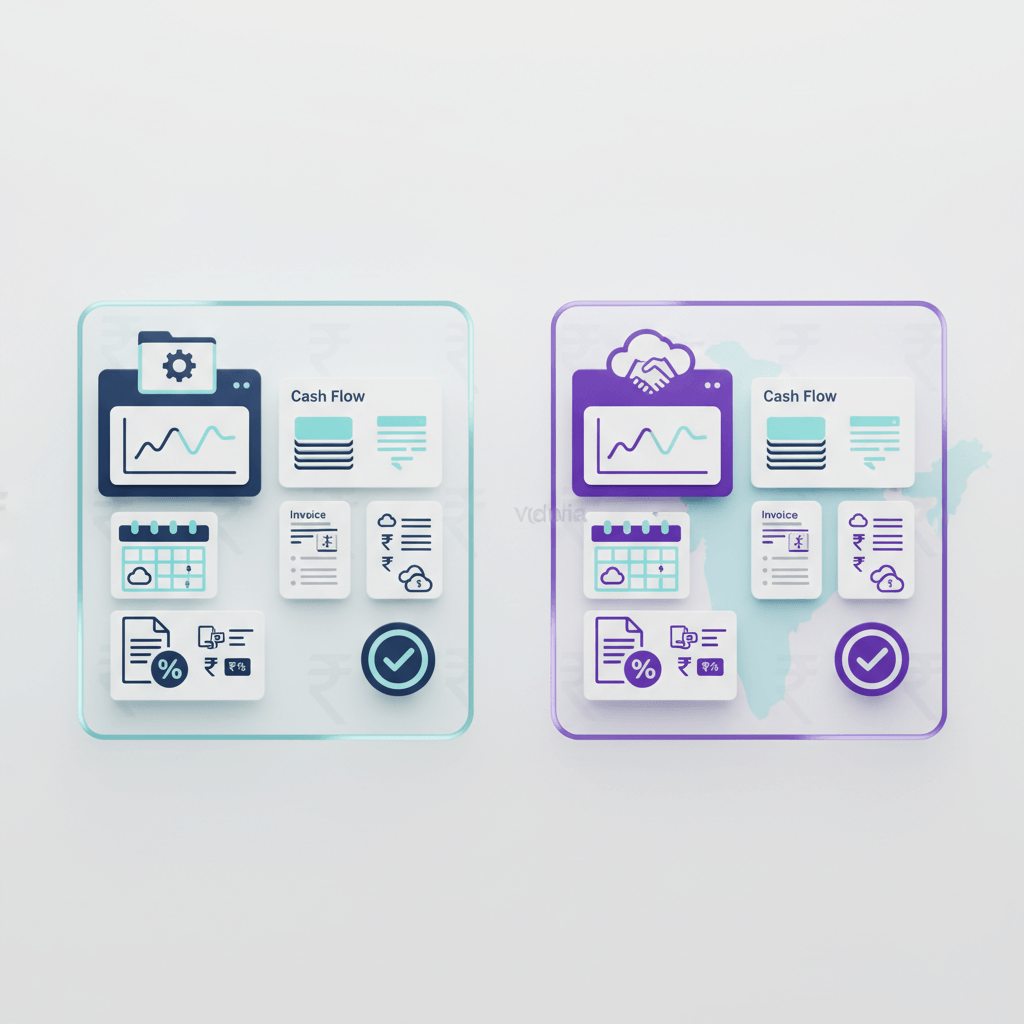
Screenshot mockups you can expect, a color coded compliance calendar, a P and L widget for month to date and year to date, and a burn and runway chart that shows months of runway at current burn.
Typical monthly operating cadence
Onboarding in week one
- Data migration and chart of accounts setup, templates and access configured, backlog and catch up addressed.
Weekly
- Bank feeds ingestion and invoice posting, AR or AP follow ups, exception reviews, and quick reconciliations.
Monthly
- Full reconciliations, GST and TDS filings, MIS pack within agreed timelines, and a short review call.
Quarterly
- Forecast refresh, tax planning, and SOP tweaks based on findings.
Year end
- Books close, audit schedules, and ROC annual filings like AOC 4 and MGT 7 for small companies.
Flow in simple steps, onboarding, then weekly tasks, then monthly close, then quarterly planning, then year end close.
Industry specific use cases
SaaS and startups
- Revenue recognition aligned with Ind AS 115 concepts, board ready burn and runway tracking.
- R and D incentives such as Section 35 2AB where eligible with DSIR guidance, see https://dst.gov.in/dsir.
E commerce and D2C
- Reconciliation across gateways like Razorpay and PayU, see docs at https://razorpay.com/docs.
- Inventory valuation using FIFO, returns handling with GST adjustments, correct HSN and tax rates.
- E invoicing where thresholds apply, see https://einvoice.gst.gov.in.
Services and freelancers
- Milestone based billing and collections, cross border receipts with Form 15CA and where needed 15CB, coordinate with your banker and CA.
- Simple payroll TDS and expense tracking for lean teams.
Growth stage companies
- Non attest consolidation for internal MIS, board packs with charts and commentary.
- Cap table diligence support with legal coordination, refer to ICAI resources at https://www.icai.org.
KPIs to track and improve
- Efficiency, DSO and DPO, aim under forty five days DSO and near thirty days DPO where your model allows, see https://www.investopedia.com/terms/d/dso.asp.
- Cash conversion cycle, target under sixty days where feasible, see https://www.investopedia.com/terms/c/cashconversioncycle.asp.
- Compliance, one hundred percent on time filings, zero penalties, reconciliation aging under seven days.
- Finance, gross margin variance under five percent, forecast accuracy above ninety percent, runway above twelve months.
- Operations, AR or AP dispute resolution under fifteen days.
Data security and governance
Controls
- Role based access, document retention aligned to seven years context under the Income Tax Act, and audit trails.
Processes
- Maker checker for entries and payments, evidence storage such as GST portal screenshots and challans, version control for reports, refer to https://www.incometax.gov.in.
Continuity
- Backup CAs, handover SOPs, and high dashboard uptime, align with ISO guidance at https://www.iso.org/standard/82875.html.
Tooling and integrations
Core integrations
- Bank feeds with HDFC and ICICI or similar, see https://www.hdfcbank.com and https://www.icicibank.com.
- Payment gateways like Razorpay and PayU, see https://razorpay.com/docs.
- GSTN and e invoicing portal sync, https://www.gst.gov.in and https://einvoice.gst.gov.in.
- Secure repositories like Google Drive or ownCloud, team chat via Slack or Teams.
- Exports to Excel or PDF for auditors and investors.
Recommended accounting and finance tools
- AI Accountant https://aiaccountant.com
- QuickBooks Online https://quickbooks.intuit.com
- Xero https://www.xero.com
- Zoho Books https://www.zoho.com/books
- TallyPrime https://tallysolutions.com
- FreshBooks https://www.freshbooks.com
Common pitfalls solved
- Missed deadlines, a reliable calendar and alerts prevent late GST or TDS filings and interest, see https://www.cbic.gov.in.
- Wrong tax rates or HSN, standardized coding avoids mismatches and notices, see https://www.gst.gov.in.
- Ledger issues, duplicate vendors or stale balances fixed through regular reviews and reconciliations.
- Blind spots in spend, category tracking and burn reports surface leaks early.
- Audit risks, organized proofs and evidence speed audits and reduce queries.
How to choose the right CA team checklist
[ ] Expertise across GST, TDS, ROC, payroll, with ICAI qualified leads and strong references, see https://www.icai.org.
[ ] SLAs for weekly postings and monthly MIS inside five working days of month end.
[ ] Technology with a dashboard, bank auto reconciliation, and a clear calendar.
[ ] Sample MIS and two or three references in your industry.
[ ] Clear scope with inclusions and exclusions, and a weekly communication rhythm.
[ ] Security posture such as ISO certification, NDA, and response time under twenty four hours, see https://www.iso.org/standard/82875.html.
Pricing and ROI
Pricing models
- Monthly retainers that scale with turnover and complexity, for example Rs fifteen thousand to Rs fifty thousand for early to mid stage needs.
- Tiers that grow with revenue brackets, plus add ons for complexity.
Return on investment
- Penalties avoided can exceed Rs fifty thousand per year for growing firms.
- Founder time saved can be twenty hours or more per month.
- Faster collections can improve cash inflow by ten to twenty percent.
- Smart tax planning can save five to fifteen percent based on profile.
An example, if annual cost is Rs three lakh and you avoid Rs five lakh of penalties while speeding up Rs ten lakh of inflows, the payoff is strong. Actuals vary by size and risk, explore at https://aiaccountant.com/virtual-accounting and consult official sources at https://www.gst.gov.in and https://www.incometax.gov.in.
Migration plan
Pre migration
- Audit backlog for gaps, clean up ledgers, and agree opening balances, two weeks typical for small setups.
Handover
- Share a data and document checklist, ledgers, invoices, prior returns, bank statements, and key contracts.
Parallel run
- Validate one month in parallel, compare reports, reconcile differences.
Go live
- Stabilize over ninety days with weekly checks, lock SOPs and finalize the monthly cadence, see https://aiaccountant.com/virtual-accounting.
Proof and credibility
AI Accountant is CA led and serves startups and SMEs at scale. Teams report a high rate of on time filings and cleaner books. One SaaS client cut DSO from ninety days to forty five days and avoided a GST penalty after a health check. Runway extensions of several months are common once burn is tracked and waste trimmed. Book a demo at https://aiaccountant.com/virtual-accounting or contact the team at https://aiaccountant.com/contact.
How AI Accountant works with your team day to day
- Define the shared calendar and weekly input cutoffs.
- Upload bills and bank proofs or connect bank feeds.
- Team posts and reconciles weekly, flags exceptions for quick decisions.
- File GST and TDS on time, share proofs and portal screenshots.
- Deliver MIS inside five working days post month end, review actions together.
This rhythm builds trust, reduces noise, and creates a steady, low drama finance function.
Final word
A CA team for business operations brings order to finance, protects against compliance risk, and turns data into simple insights that scale with your business. With AI Accountant, you get a CA team and a dashboard in one service, so you can grow with confidence and sleep well at night. If you want to see this in action, book a short walkthrough and bring your toughest finance problem to the call, start at https://aiaccountant.com/virtual-accounting or https://aiaccountant.com/contact.
FAQ
What outcomes should I expect in the first ninety days with a CA managed service or an AI Accountant style Virtual Accounting team
Expect ledger cleanup, bank and gateway reconciliations current, a working compliance calendar, and a monthly MIS pack delivered inside five working days of month end. You should also see a prioritized issues list, for example unreconciled entries, vendor TDS mismatches, GST portal gaps, with owners and due dates.
How do you structure SLAs for bookkeeping, reconciliations, GST, TDS, and MIS so I can hold the team accountable
Typical SLAs include weekly posting and reconciliation cadence, response time under one business day, filing proofs shared within twenty four hours of submission, and MIS within five working days after month end. AI Accountant formalizes these in the engagement letter and the dashboard shows status in real time.
Can a Virtual Accounting team handle multi state GST, e invoicing, and e way implications without disrupting order to cash
Yes, the GST specialist configures registrations and place of supply logic, aligns invoice series, and enables e invoicing where thresholds apply using the NIC portal, see https://einvoice.gst.gov.in. The team then tests end to end with your billing tool to avoid dispatch delays.
How are maker checker controls enforced for payments and journal entries in an outsourced model
Controls are embedded in workflows, preparer posts entries, reviewer approves, and payment runs require dual authorization. Evidence such as challans or portal screenshots is attached to each step, and the dashboard audit trail confirms who did what and when.
What is the approach to GST or TDS notices and reconciliations, and who owns representation if a query escalates
First, the team performs a root cause review, invoice or HSN mismatches, GSTR 2B reconciliation, 26AS or AIS variances. Second, a corrective filing or response draft is prepared with annexures. Third, a CA reviews and signs off. For escalations, AI Accountant supports representation up to the agreed scope, complex cases may involve your legal counsel.
How do you measure ROI on a CA team beyond avoided penalties, give a concrete framework
Track four buckets, on time filings, DSO or DPO or cash conversion cycle improvements, finance team time saved, and forecast accuracy. For example, cutting DSO from sixty to forty five days on Rs two crore monthly revenue can free about Rs thirty lakh of working capital, which dwarfs the monthly retainer.
Can AI Accountant integrate with Tally, QuickBooks, Xero, Razorpay, and my bank feeds without breaking existing workflows
Yes, standard connectors or exports handle core sync. For Tally, periodic imports or ODBC based sync bring in ledgers, for QBO or Xero, API connections fetch transactions, and gateways like Razorpay provide settlement and fee detail, see https://razorpay.com/docs. Bank feeds leverage HDFC or ICICI connectors where available.
What does non attest MIS mean in practice, and how does it interact with my statutory audit
Non attest means management use only, the CA team prepares P and L, cash flow, burn, and analytics without certifying accounts. For statutory audits, the team compiles schedules, supports sample pulls, and coordinates with your auditor, refer to ICAI guidance at https://www.icai.org.
How quickly can you onboard if our books have a six month backlog and multiple GST registrations
Typical timeline is four weeks for backlog cleanup across six months, including COA alignment, GST reconciliations per registration, and baseline MIS. If data quality is strong and volumes are modest, two weeks is feasible.
What governance should founders insist on for data security, access, and retention with a Virtual Accounting provider
Insist on role based access, weekly backups, seven year document retention aligned to tax expectations, and documented incident response. Evidence of ISO aligned practices is a plus, see https://www.iso.org/standard/82875.html. AI Accountant implements audit trails and least privilege access by default.
How do you ensure accuracy on TDS for salaries and vendor payments, and what happens if rates change mid year
The payroll specialist and tax lead maintain current slabs and sections, Section 192 for salaries and 194 series for vendors, compute on each run, and true up quarterly. If rates change, the system updates rules and a variance report adjusts remaining months to avoid year end surprises, refer to https://www.incometax.gov.in.
What visibility do I get as CFO on exceptions and reconciliations without drowning in detail
You receive a weekly exception digest, unreconciled amounts by bank or gateway, overdue AR or AP, GST or TDS mismatches, and a heat map of risk. Drill downs are available on the dashboard, but the default view stays concise for fast decision making.
How does the CA team support board reporting and fundraise diligence with clean MIS and evidence
The team standardizes monthly packs, P and L, cash flow, KPI scorecards, cohort or margin analysis, and attaches evidences, bank statements, GST or TDS proofs, ROC filings. For diligence, AI Accountant prepares a data room checklist, locks cut off dates, and supports Q and A with time bound responses.
Do you cover cross border payments and DTAA documentation for contractors or tools we pay overseas
Yes, the team handles Form 15CA and where required 15CB with the signing CA, validates PE risk assumptions with your advisor, and maintains DTAA support files. RBI or bank queries are answered with invoices, contracts, and relevant treaty extracts, see https://www.rbi.org.in.
What happens if my in house accountant resigns mid month, can AI Accountant step in without disruption
With documented SOPs and an onboarding checklist, AI Accountant can assume critical tasks within days, stabilize reconciliations, and backfill routine postings. Maker checker controls and the calendar reduce single point dependency, ensuring continuity through the transition.