-01%201.svg)

Key takeaways
- Cost effective means value per rupee, not just low fees, combine accuracy, compliance, speed, visibility, and advice to avoid penalties and speed up closes.
- A strong base package blends bookkeeping, reconciliations, GST, TDS, income tax, ROC for small companies, and tight MIS with dashboards.
- Use a compliance calendar for GST, TDS, income tax, and ROC, file on time, reconcile banks and gateways each month, keep documents centralised.
- Compare providers by pricing model, volume drivers, software costs, and time saved, calculate total cost of ownership and ROI with real examples.
- Virtual accounting with CA oversight and a dashboard gives end to end execution and real time visibility, making it scalable and lean.
- Onboarding well in the first ninety days, then running a monthly close and review rhythm, locks in speed and zero penalty outcomes.
- Track KPIs like days to close, on time filings, penalties avoided, DSO, cash forecast accuracy, and audit readiness to prove value.
Why cost effective actually means value for Indian startups
Cost effective accounting services for startups in India deliver more than a low quote, they remove leakages, reduce rework, and prevent avoidable penalties. The value stack is simple, accuracy, compliance, speed, visibility, and advice. Together, they save time, reduce stress, and support growth.
Think of outcomes, on time GST and TDS filings prevent late fees and interest, clean ledgers mean faster audits and quicker funding, a clear P and L and cash flow sharpen control of burn and runway, automated MIS and alerts help you act early, not late.
Hidden costs hurt, rework from unclean books, late GST fees that can reach ten thousand rupees per return, TDS interest at one point five percent per month, delays with auditors because schedules are not ready, and payment gateway mismatches that stall cash. These add up and reduce runway.
The big win, close months fast, file on time, reconcile every bank and gateway, keep a live view of spend, burn, DSO, and runway.
Sources, AI Accountant, Jordensky
Core components to include in lean, end to end packages
Bookkeeping and ledgers
- Monthly ledgers for sales, purchases, expenses, and bank entries, ledger scrutiny and clean up, year end closing and schedules.
- Fixed asset register upkeep, inventory tracking and reconciliation, coordination support for statutory auditors.
Reconciliations
- Bank reconciliations for all accounts, payment gateway reconciliations for Razorpay, Stripe, PayU, Paytm, and more.
- Accounts receivable and payable reconciliation, fee and GST treatment checks on gateways.
GST compliance
- Registration on threshold, GSTR 1 and 3B monthly or quarterly, annual GSTR 9 and 9C.
- E invoicing enablement over five crore turnover, 2A and 2B health checks and reconciliations, place of supply, HSN, SAC, reverse charge.
Income tax
- ITR filing for individuals, partnerships, and companies, advance tax working and payments, tax audit preparation support.
- International tax and expat advice, Form 15CA preparation for foreign remittances.
TDS
- Section advisory, monthly challans by the seventh, quarterly filings for 24Q, 26Q, 27Q, and property or rent forms 26QB or 26QC or 26QD.
- Health checks for rates and thresholds.
Payroll
- Monthly TDS computation, salary structuring to lift in hand pay while staying compliant.
ROC and secretarial for small companies
- MGT 7 and AOC 4 annual filings, DIR 3 KYC, MSME filings, board and AGM documents, authorised share capital changes and allotments, statutory registers.
MIS and reporting
- P and L, balance sheet, and cash flow, category views for income and expense, cash burn and runway.
- Cohort and unit metrics for SaaS or ecommerce, dashboards for recent transactions, bank analysis, and compliance status.
Sources, AI Accountant, The Munim
India specific compliance checklist and timelines
GST
- Registration when turnover crosses twenty lakh rupees, ten lakh in some special states.
- E invoicing mandatory when aggregate turnover exceeds five crore rupees.
- GSTR 1 usually by the eleventh or thirteenth, GSTR 3B by the twentieth for most taxpayers, annual GSTR 9 and 9C by thirty first December.
- Late fees up to ten thousand rupees per return, interest at eighteen percent per year on net tax dues.
TDS
- Triggered on salary, contractor, and professional payments, for example 194J at ten percent, 194C at two percent.
- Deposit challans by the seventh of the next month, quarterly statements due by thirty first May, July, October, and February.
- Interest at one point five percent per month for non deduction or late deposit, late fee at two hundred rupees per day.
Income tax
- Advance tax if annual tax due exceeds ten thousand rupees, pay fifteen percent, forty five percent, seventy five percent, and one hundred percent by March fifteen.
- ITR due date for non audit cases is usually July thirty one, Form 15CA and 15CB for foreign remittances when needed, interest at one percent per month for late payment.
ROC for small companies
- MGT 7 and AOC 4 generally due by October thirty for many cases after AGM timelines, DIR 3 KYC by April thirty, MSME filing half yearly.
- Late fee at one hundred rupees per day for many forms, event filings have specific due dates for directors, share capital, or address changes.
Prevention playbook, use a live calendar with alerts, review monthly with your CA, reconcile books before filing, and keep documents in a central repository.
Sources, AI Accountant, The Munim
Pricing models, cost drivers, and TCO
Common pricing models
- Monthly retainer, fixed fee for a base scope such as bookkeeping and standard compliance, market entry points often start near eight thousand rupees per month.
- Transaction tier, fees scale with activity, useful for SaaS or ecommerce where invoices or orders surge.
- Bundled compliance, GST, TDS, ITR, ROC as a bundle, add ons like payroll or secretarial handled separately.
Cost drivers
- Transaction volume, number of entities, count of GSTINs and states, payroll size, number and complexity of gateways, forex receipts, cross border needs, cleanup backlog.
Total cost of ownership and ROI
Add service fee and software costs, subtract penalties avoided and founder or finance team time saved. For example, Zoho Books can be about seven hundred forty nine rupees per month, if managed services avoid fifty thousand rupees of late fees annually and save twenty founder hours per month, the net cost compresses fast. Track ROI, zero penalties in a year, DSO cut by fifteen days, closes down to under seven days, cleaner MIS that trims fund raise cycles.
Sources, AI Accountant pricing guide, Jordensky, The Munim
Build, buy, or hybrid for startup accounting
DIY with tools
- Pros, low out of pocket, full control, fine for solo founders below twenty five lakh rupees with simple domestic flows.
- Cons, errors and missed compliance risk, time sink as volume grows.
- Tools, AI Accountant, QuickBooks Online, Xero, Zoho Books, Tally Prime, FreshBooks.
Freelance accountant plus a CA
- Pros, lower fee than a firm, workable for very simple operations.
- Cons, fragmented workflows, follow ups rise, reconciliations and MIS gaps are common.
CA led virtual accounting with a dashboard
- Pros, end to end execution and advice, real time visibility, scales with more entities, more GSTINs, and more volume.
- Cons, onboarding needs effort to clean and set up.
Sources, AI Accountant, The Munim
How to evaluate providers, a practical checklist
- Credentials and scope, CA oversight, clarity on non attest scope versus statutory audit responsibilities.
- Systems and data flow, dashboard, bank feeds, audit trails, document repository, one source of truth.
- Automation and integrations, AI driven alerts, e invoice setup, automated bank and gateway reconciliations.
- Compliance mastery, GST, TDS, income tax, ROC timelines, multiple gateways and foreign receipts experience.
- Service model, SLAs such as forty eight hour responses, clear escalation, named CA and support pod.
- Security, role based access, logs, document controls, data location clarity.
- Scalability, multi entity, multi GSTIN, growth stage readiness.
- Proof points, free health check, sample MIS pack, references, third party reviews.
Actions, request a demo dashboard, verify GSTN and Income Tax Department integrations, find client stories showing penalty savings and faster closes, run a pilot month.
Sources, AI Accountant guide, Clutch reviews
Example, AI Accountant Virtual Accounting and why it is cost efficient
AI Accountant Virtual Accounting is CA led and dashboard first, it blends execution and visibility so you can stay compliant, cut rework, and move faster.
What the dashboard shows
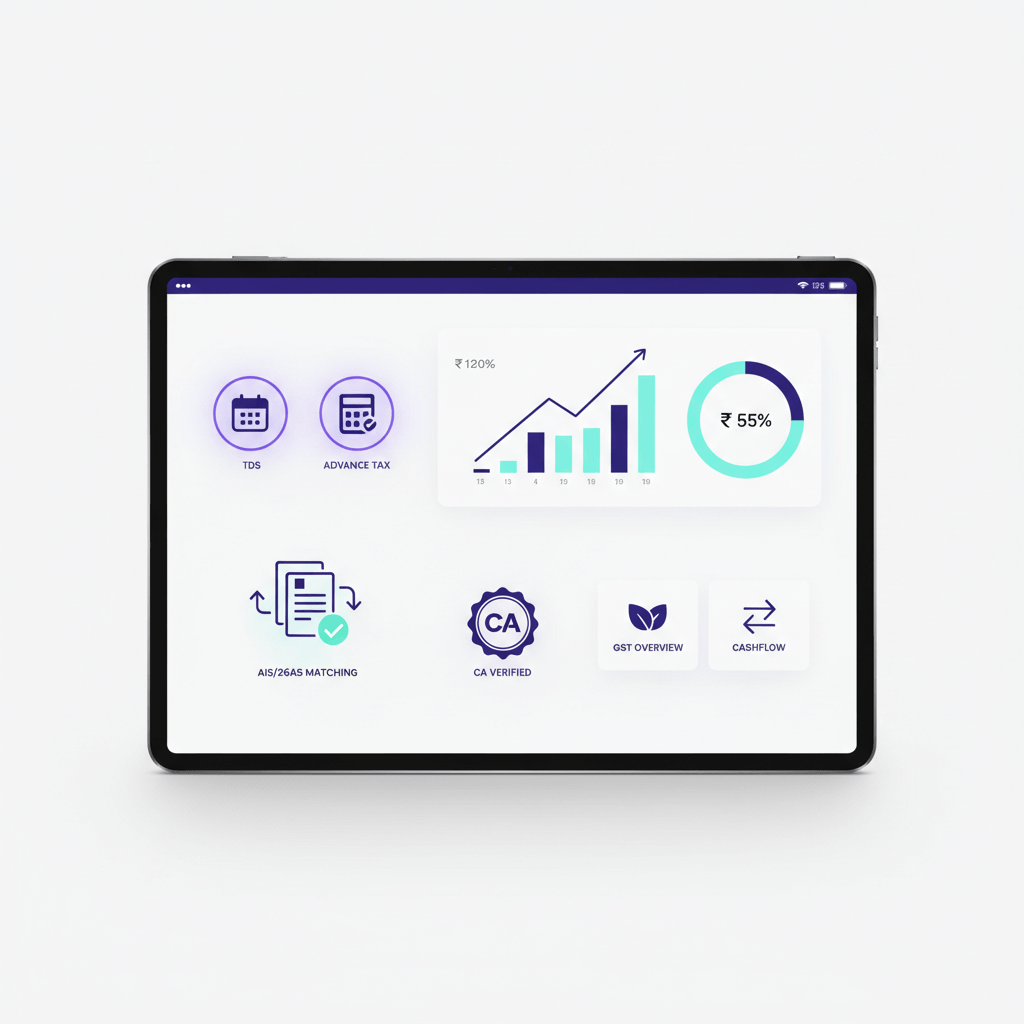
- Revenue and expenses, P and L, cash burn and runway, recent transactions, and bank analysis.
- AI generated insights and alerts, a live compliance calendar for GST, TDS, ITR, and ROC, a document repository, and a team chat.
What the service covers
- Monthly bookkeeping, cleanup and year end closing, fixed asset and inventory, AR and AP, bank and gateway reconciliations, MIS and reporting.
- GST registration, GSTR 1, 3B, 9, 9C, e invoice enablement, place of supply, RCM, HSN, periodic health checks and 2A, 2B reconciliations.
- Income tax ITRs, advance tax, tax audit prep, expat and international tax, Form 15CA preparation.
- TDS advisory, monthly challans, returns for 24Q, 26Q, 27Q, and property or rent forms, and health checks.
- Payroll TDS and tax efficient salary structures, ROC annuals like MGT 7, AOC 4, DIR 3 KYC, MSME filings, and board records for small companies.
Where savings show up, month end drops from around twenty days to under a week, alerts prevent late filings, reconciliations fix gateway mismatches that stall cash, MIS makes you investor ready anytime. Delivered by a dedicated CA team with a structured plan and continuous visibility.
Sources, AI Accountant
Implementation and onboarding playbook
Pre onboarding checklist
- Entity documents, PAN, GST, TAN, CIN, incorporation certificate.
- Bank and gateway access, read or download access for all accounts and gateways like Razorpay and Stripe.
- Historic data, ledgers, trial balances, invoices, returns, settlements, and fee statements.
- Opening balances with support schedules on handover date.
Setup in week one
- Chart of accounts tuned to the model, bank feeds or fetch workflows, e invoice settings if applicable.
- Document repository with clear folders, compliance calendar with alerts and owners.
The first thirty to ninety days
- Backlog cleanup, reconcile banks and gateways, align GST and TDS credits and challans, define SOPs for bills, invoices, and approvals.
- Monthly close cadence by day five to seven, on time filings, MIS templates live with P and L, cash flow, burn and runway, cohort or unit metrics if needed.
- Compliance calendar fully green, audit readiness checks, contracts and registers collected.
Governance rhythm
- Monthly CA review on cash, burn, DSO, and pending actions, SLA tracking with under five percent breaches, quarterly strategy updates for new entities or states.
Sources, AI Accountant, The Munim
Metrics and KPIs that prove value
- Days to close, target under seven days from month end.
- On time filings, aim for one hundred percent across GST, TDS, ITR, and ROC.
- Penalties avoided, track rupees saved per year, many teams save fifty thousand rupees or more.
- DSO improvement, target a fifteen day cut, unlocks real cash.
- Cash forecast accuracy, above ninety percent on a sixty day view.
- Burn and runway visibility, a live burn rate with months of runway displayed.
- Audit readiness, schedules and reconciliations complete, documents centralised.
Sources, AI Accountant
Common pitfalls and how to avoid them
- TDS misclassification, wrong sections or rates, use a section checker, run monthly TDS health checks, review vendors before first payment.
- Payment gateway skips, missed reconciliations on Razorpay or Stripe, set auto feeds, reconcile settlements, fees, chargebacks, and GST treatment monthly.
- Missing advance tax, quarterly alerts and CA reviews prevent interest.
- Weak document control, centralise bills and contracts, simple naming rules, track access.
- Delayed month end, fix a close day, perform variance reviews with your CA.
Mini case, a SaaS startup with domestic and international receipts and three gateways moved from spreadsheets to virtual accounting, closes shifted to day five, zero penalties in twelve months, runway clarity improved and cash stayed on track.
Sources, AI Accountant
FAQ
What should a cost effective accounting package for an Indian startup include end to end
Include bookkeeping with monthly ledgers, bank and gateway reconciliations, GST returns with 2A and 2B checks, TDS challans and quarterly statements, income tax with advance tax working, and ROC annuals for small companies, add MIS with P and L, cash flow, burn, runway, and a dashboard. An AI enabled service like AI Accountant folds these into one workflow with CA oversight.
How do founders compare total cost across providers without missing hidden costs
Map volume drivers, transactions, entities, GSTINs, payroll headcount, gateways, and forex, then price software, for example accounting app, e invoice, workflow, add service fees, subtract penalties avoided and hours saved, run a three month pilot and track days to close, on time filings, and escalations. AI Accountant shares a sample MIS and a health check that clarifies rework and cleanup upfront.
When is virtual accounting better than hiring an in house accountant
Choose virtual when you need multi compliance and multi gateway reconciliations, but cannot justify a full time team, typically pre Series A and revenue above one crore, or any stage with cross border receipts that need tight GST place of supply and 15CA workflows. Post Series B, a hybrid model with in house finance plus CA led virtual execution often works best.
Will a CA managed virtual service satisfy audit expectations under Indian law
Yes, the service operates under non attest scope, it prepares books, schedules, and returns, a separate statutory auditor performs the audit and certification. A clean monthly close, reconciliations, and a document repository reduce audit queries and shorten timelines.
How do GST, TDS, and ROC activities fit into a monthly cadence without chaos
Run a fixed monthly close by day five to seven, file GSTR 3B and deposit TDS challans by the seventh, push GSTR 1 on its due date, reconcile 2A and 2B credits monthly, prepare ROC annuals on a calendar, and lock quarterly TDS statements, a dashboard with AI alerts, like AI Accountant, prevents misses and centralises documents.
Can a virtual service handle payroll TDS and optimise salary structures for employees
Yes, monthly TDS is computed and booked, year to date reconciliations are tracked, and salary structures are tuned for tax efficiency, for example standard deduction use and flexible allowances, while keeping compliance intact.
How do finance heads ensure gateway reconciliations are airtight across Razorpay, Stripe, and PayU
Enable automated fetch, reconcile settlements to orders and invoices, net of fees and GST, account for chargebacks and refunds, and verify HSN or SAC and place of supply logic. AI Accountant’s dashboard surfaces unreconciled items and fee anomalies so cash timing is accurate.
What SLAs and governance rhythm should we demand from a managed service
Seek forty eight hour response SLAs on routine queries, named CA ownership, weekly backlog reviews during onboarding, monthly close reviews with variance analysis, quarterly strategic reviews for new entities or states, and escalation paths with timelines. Measure breaches and keep them under five percent.
How does an AI enabled service actually reduce penalties and rework in practice
AI flags due dates, anomalies in ITC or TDS rates, missing challans, and unmatched bank or gateway entries, this prevents last minute rushes and wrong filings, a single source of truth cuts repeated data requests, most teams see zero penalties in a year and a close time under seven days with AI Accountant.
What migration timeline should we expect when switching mid year
Plan a ninety day arc, week one setup for chart of accounts, bank feeds, e invoice, repository, days seven to thirty for cleanup and historical reconciliations, day thirty to sixty to stabilise the monthly close, day sixty to ninety to lock MIS templates and audit readiness. Ensure opening balances and schedules are mutually agreed on a handover date.
How should startups think about revenue recognition for SaaS and prepaid subscriptions
Adopt accrual rules with deferrals, recognise revenue over the service period, maintain a deferred revenue roll forward, align invoicing and collections with revenue recognition entries, and reconcile to payment gateways. A dashboard like AI Accountant can generate monthly deferral schedules and MIS cohorts for net revenue retention.
What security and access controls are non negotiable when sharing banking and documents
Role based access, activity logs, read or download only access where possible, segregated client repositories, and a clear data location and retention policy. Ask your provider to demonstrate user provisioning and de provisioning workflows during the demo.
How do we measure ROI from month one in a way that finance and founders both trust
Set baseline metrics, days to close, on time filings, penalties, DSO, and a sixty day cash forecast variance, then review monthly. If AI Accountant shrinks closes to under seven days, prevents late fees, and improves cash forecast accuracy above ninety percent, the ROI is explicit and shared.
Can a virtual CA managed model support multi entity, multi GSTIN consolidation
Yes, with a standard chart of accounts across entities, intercompany matrices, monthly eliminations, and GSTIN wise tracking, the dashboard should consolidate P and L, cash flow, and compliance status, while preserving drill down to each entity and registration.
What does a good MIS pack look like for investor readiness
Monthly P and L with variance analysis, cash flow, balance sheet, burn and runway, DSO and ageing, cohort and unit economics for SaaS or ecommerce, plus a compliance dashboard. AI Accountant shares a sample MIS pack and runs a free compliance health check before you commit.
References and further reading, AI Accountant, CA services for startups, Jordensky on affordable startup accounting, The Munim on cost efficiency
Closing note, if you want a CA led managed service with a clear dashboard and tight compliance, consider AI Accountant Virtual Accounting. You can request a free compliance health check and a sample MIS pack to gauge fit before you decide, see, AI Accountant.