-01%201.svg)
Key takeaways
- Paisy suits micro businesses with simple books, but growing Indian SMEs and CA firms outgrow it quickly once GST complexity and volumes rise.
- Depth in GSTR-2B reconciliation, bank statement processing, and multi-entity control is the real differentiator when evaluating a Paisy alternative in India.
- Sticker price can mislead, the true cost includes manual cleanup, spreadsheet work, and delays during month end, which often exceed license fees.
- AI Accountant integrates deeply with Zoho Books and Tally, scales to high volumes, and delivers audit ready automation with ISO 27001 and SOC 2 Type II security.
- For a side by side breakdown, see the detailed AI Accountant vs Paisy comparison.
What is Paisy? Quick context for India evaluators
Paisy positions itself as a hands off bookkeeping service for small teams. It handles routine ledger entries, invoice capture, and basic reconciliations in India. Most workflows depend on document sharing by email, with simple checks on top.
Where India specific needs get serious, gaps start to show. Deep GSTR-2B reconciliation is limited, especially when you must trace every mismatch, status, and credit note. Alignment with Tally or Zoho masters feels brittle for multi entity setups with different charts of accounts.
Once teams cross a few thousand monthly transactions, delays appear, manual workarounds grow, and spreadsheets return. For micro businesses, it may be fine, but CA firms and scaling SMEs hit ceilings fast. For a fuller context, review the independent AI Accountant vs Paisy analysis.
Paisy bookkeeping review, the good, the gaps, and the gotchas
Where Paisy shines
Onboarding feels simple, the interface is clean, and first timers get started quickly. Under 1,000 monthly transactions, freelancers and small service companies can run basic books with minimal setup.
Where the limitations hit hard
Complex AP or AR workflows become manual. If you need bulk ingestion from PDFs, images, or Excel, prepare for copy and paste. Bank statement normalization across HDFC, ICICI, SBI, and others is painful at scale. Split transactions, transfers, vendor matching, and robust validations often push you back to Excel.
GST needs remain surface level. Multi entity management for CA firms is constrained, and compliance oversight is mostly manual. The result is rework, delays, and loss of confidence during month end.
Service quality and support reality
Support exists, but response times lag right when pressure peaks, especially during closes. Teams end up doing manual overrides to meet deadlines. That is acceptable for simple books, but not for firms that must maintain audit readiness.
Bottom line, Paisy can be a good start for micro businesses, but most teams with growing volumes, complex GST, or multi client needs will look for stronger automation. See the comparative lens in AI Accountant vs Paisy.
Paisy pricing India, understanding the real costs
At first glance, Paisy appears affordable with low base tiers. Add ons for reports or features increase costs slowly, but the real expense hides in the manual work that persists.
Hidden costs that add up
- Setup time, weeks of formatting and training reduce team bandwidth.
- Data cleanup, without strong validation, errors creep in and must be fixed manually.
- Parallel spreadsheets, reconciliation and categorization gaps force Excel back into the process.
- Manual headcount, instead of reducing workload, staff time expands with volume.
ROI reality check
At 2,000 to 5,000 monthly transactions, the ROI math changes. If an accountant spends 3 extra hours daily on tasks that should be automated, at ₹500 per hour, that is ₹31,500 monthly in hidden cost. The budget tool stops looking affordable once you include effort, rework, and delayed closes. For an end to end view, cross check the AI Accountant vs Paisy pricing perspective.
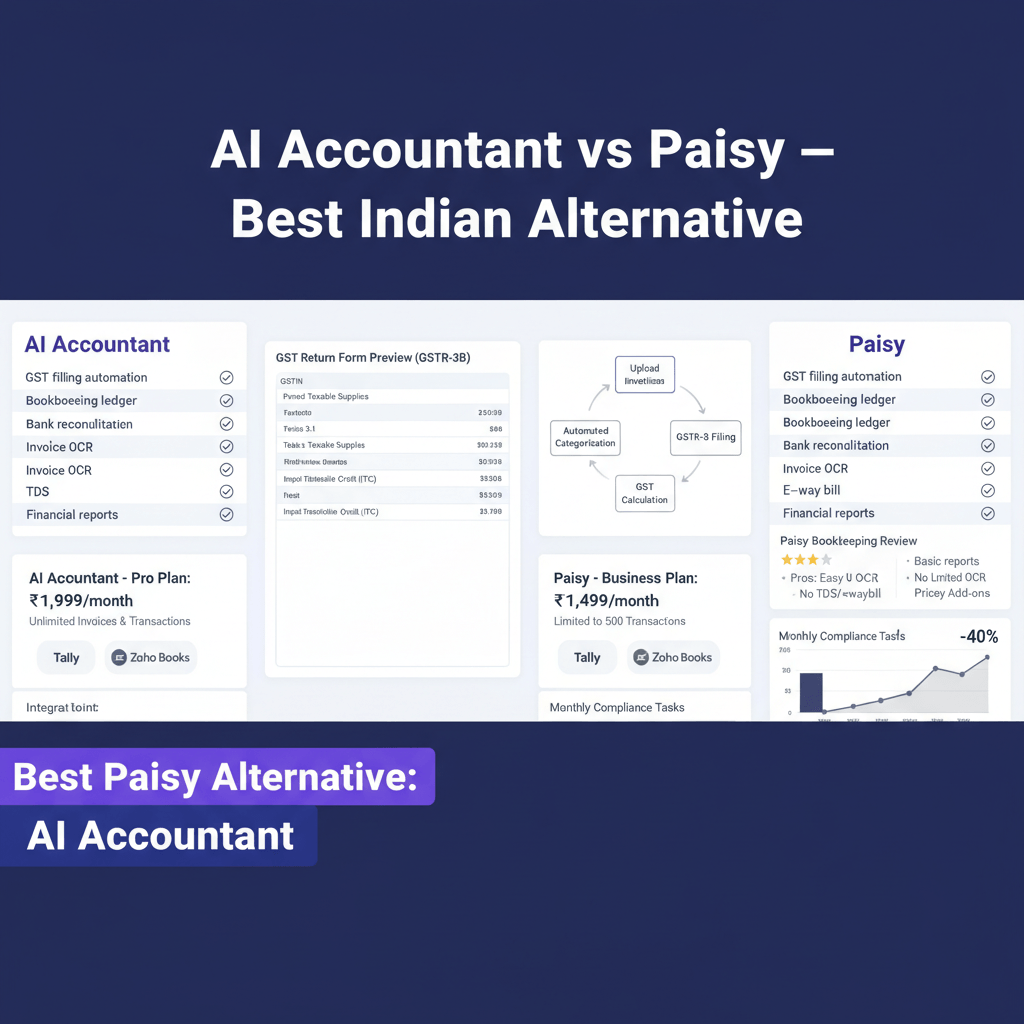
Paisy vs AI Accountant, side by side feature comparison
AP and bills automation
Paisy offers basic ingestion, but bulk processing and OCR are limited, so vendor matching and validations stay manual. AI Accountant ingests PDFs, images, CSVs, and Excel at scale, extracts fields accurately, flags GSTIN mismatches, and validates rows before posting.
Bank and credit card statement processing
Paisy struggles with format diversity across Indian banks, which slows teams beyond a few thousand lines. AI Accountant auto normalizes statements across major Indian banks, processes very large files, and preserves accuracy during peak loads.
Transaction mapping and matching intelligence
Paisy links basics, but predictions on ledgers, tax codes, or vendors stay weak, and splits or transfers need manual steps. AI Accountant learns from your patterns, predicts correct allocations, supports bulk edits, and auto links payments to open invoices, including partials.
GST reconciliation depth
Paisy provides surface level checks. AI Accountant automates end to end matching for GSTR-2B reconciliation, tracks compliance status, maintains audit trails, and supports government template exports.
Integration architecture
Paisy offers limited sync with Zoho Books and Tally. AI Accountant provides deep, bidirectional sync with both platforms, aligns masters, and eliminates duplicate entries. Explore the specifics in Tally integration with AI Accountant.
Dashboards and visibility
Paisy shows basic metrics. AI Accountant surfaces cash position, receivables aging, payables, and category wise spend in real time, with CA firm views across clients.
Multi organization management
Paisy focuses on a single organization. AI Accountant supports multi org by design, with role based access, per entity learning, and quick switching.
Security and compliance
Paisy follows standard protocols. AI Accountant holds ISO 27001 and SOC 2 Type II, encrypts data, and logs all activity for audits.
Implementation and support
Paisy setup is quick, but training is manual. AI Accountant offers guided rollouts, processed more than 300 million transactions, and typically goes live in days. For a complete feature map, see AI Accountant vs Paisy.
Why AI Accountant stands out as a Paisy alternative in India
Solving India specific challenges
AI driven OCR handles poorly scanned bills, validation rules block errors early, and smart vendor matching eliminates GSTIN mismatches. Bank and card statements normalize automatically for Indian banks, learned from millions of transactions.
Transaction mapping respects Indian accounting patterns, including GST, and recommends correct ledgers and codes. Matching closes open invoices even when references are partial or mistyped. Deep GSTR-2B reconciliation keeps compliance visible, with export files ready for filing.
Seamless Zoho Books and Tally integration
Masters stay in sync, vendors and customers never duplicate, and cleaned data posts back to your source system. CA firms get client wise dashboards, while SME leaders track cash and working capital with confidence.
Proven scale and results
More than 450 customers, including over 100 CA firms, use AI Accountant. The platform processed 300 million plus transactions and continues to grow monthly. Firms report reconciliation time reductions near 70 percent, and error rates dropping to under 2 percent.
Security that matters
ISO 27001 and SOC 2 Type II are backed by encryption, secure APIs, and thorough audit trails. For CA firms handling many clients, this structure protects sensitive data, while role based access preserves confidentiality.
Who should choose what, your decision guide
Choose Paisy if you have
- Simple books, minimal GST, and less than 1,000 monthly transactions.
- A single organization and basic reporting needs.
- Preference for a hands off, starter friendly setup.
Choose AI Accountant if you have
- Mid to high volumes beyond 5,000 monthly transactions.
- Heavy reliance on Zoho Books or Tally, with the need for deep sync.
- Significant GST requirements, especially GSTR-2B reconciliation.
- Multi entity operations, common in CA practices.
- Pressure to close faster with fewer errors, without adding headcount.
Specific recommendations for CA firms
Prioritize multi org control, audit trails, and standardized processes. AI Accountant lets you scale client count, while keeping teams lean and deadlines predictable.
Specific recommendations for SME finance teams
Keep Zoho Books or Tally as your core, add automation to eliminate repetitive work. Use dashboards for cash visibility and working capital decisions, and rely on strong security for compliance readiness.
Migration and rollout checklist for switching
Step 1, data audit and preparation
- Align chart of accounts and clean masters in Zoho Books or Tally.
- Document current workflows, pain points, and baseline timing.
- Export historical data in structured formats for smooth ingestion.
Step 2, sandbox testing
- Test uploads for PDFs, images, CSVs, and Excel, verify extraction fields.
- Run GSTR-2B reconciliation scenarios end to end.
- Validate sync with Zoho Books or Tally, and simulate a complete month end.
Step 3, pilot implementation
- Pick one entity or client first, collect metrics on time saved and error rates.
- Capture user feedback, refine mappings and validations quickly.
Step 4, change management
- Update SOPs, define roles and permissions, and set reconciliation cadence.
- Train by workflow, give hands on practice, and avoid generic sessions.
Step 5, success metrics and optimization
- Target at least 50 percent time savings on routine tasks.
- Keep manual overrides under 5 percent, and review rules if higher.
- Track adoption, address resistance early, and iterate fast.
Step 6, scale gradually
- Roll out in waves, apply lessons from each go live, and review monthly.
- Leverage learning, predictions improve as volume increases.
For a practical migration narrative, check the side by side notes in AI Accountant vs Paisy.
Essential automation tools for modern accounting teams
Top accounting automation platforms
- AI Accountant, deep Zoho Books and Tally integration, powerful GST, multi entity, and large scale transaction processing. Proven with 450 plus customers and 300 million plus transactions.
- QuickBooks Online, a solid global choice for small and mid sized teams, with strong reporting and app ecosystem, limited India specific GST and banking depth.
- Xero, clean interface and good automation, yet lighter on India focused capabilities.
- Zoho Books, strong India fit with GST support, even better when paired with AI Accountant for heavy automation.
- FreshBooks, great for freelancers and service businesses, less suited for complex trade or manufacturing.
- Tally Prime, the backbone for many Indian SMEs, compliant and reliable, often extended with an automation layer for speed and control.
FAQ
What is the best Paisy alternative in India for a CA firm handling multiple GSTINs?
For CA practices managing many clients, AI Accountant is a strong alternative. It automates AP ingestion, delivers deep GSTR-2B reconciliation, and supports multi entity management with role based access. Firms report up to 70 percent reduction in reconciliation time once they adopt it.
How should I benchmark Paisy pricing India against total cost of ownership for automation?
Do not stop at the license fee. Add the cost of manual cleanup, spreadsheets, delays in month end, and extra headcount for reconciliation. A simple model, daily extra hours per accountant, multiplied by hourly rate and working days, often reveals hidden costs that exceed software fees. Teams using AI Accountant consistently report fewer manual hours, which changes the ROI picture.
Does AI Accountant replace Zoho Books or Tally in my stack?
No, it acts as an automation layer. You continue with Zoho Books or Tally as the system of record, while AI Accountant ingests documents, normalizes bank data, predicts categorizations, and posts clean entries back. You keep familiar workflows, you gain automation speed.
How reliable is AI based categorization for Indian GST scenarios?
Accuracy improves as the system learns from your books. Many teams see roughly 80 percent accuracy at the start, which often rises above 95 percent after a month of corrections. AI Accountant stores organization specific learning, so predictions align with your chart of accounts, tax codes, and vendor patterns.
Can AI Accountant handle 50,000 plus monthly transactions without performance issues?
Yes, customers routinely process very large volumes. The platform scales horizontally, so performance remains stable as volumes grow. Bank statement normalization and bulk AP processing are built for high throughput.
What is the migration effort from Paisy to an AI first workflow?
Follow a staged plan, data cleanup, sandbox test, pilot a non critical entity, then roll out in waves. AI Accountant provides implementation support, usually going live in days for single entities, and in a few weeks for complex CA firm structures.
How does GSTR 2B reconciliation work end to end in AI Accountant?
The system imports your purchase data, fetches GSTR 2B files, and auto matches entries. It flags mismatches, suggests resolutions, tracks compliance status, and exports filing ready formats. What took days manually, often finishes within hours, with a complete audit trail.
What controls exist for multi organization setups in a CA environment?
AI Accountant separates each client as an independent org with distinct masters, learning, and access controls. Partners get cross client views, staff receive restricted roles, and activity logs maintain accountability for audits.
Is data security adequate for audit and regulatory scrutiny?
AI Accountant maintains ISO 27001 certification and SOC 2 Type II verification. Data is encrypted in transit and at rest, APIs are secured, and logs capture all actions. These measures help CA firms and SMEs pass audits with confidence.
How quickly can teams measure ROI after switching from Paisy?
Track three metrics, time to close, manual override rate, and error rate. Many teams see close time drop by half within the first month, override rates fall under 5 percent, and error rates move below 2 percent. These improvements translate directly to saved hours and fewer review cycles.
Can AI Accountant improve Zoho Books and Tally master data quality?
Yes, bidirectional sync aligns masters, catches duplicates, and standardizes vendor and customer records. Cleaner masters reduce posting errors and speed up matching, which is especially valuable for CA firms running dozens of client ledgers.
How do I evaluate Paisy vs AI Accountant with my own data before deciding?
Run a pilot. Upload a representative month of bills, bank statements, and a GSTR 2B file. Compare extraction accuracy, reconciliation speed, and posting quality. If AI Accountant completes the same workload in a fraction of the time with fewer overrides, the decision is clear.
Making your decision, next steps
The right Paisy alternative in India should shorten month end, reduce errors, and free your team from repetitive tasks. If volumes are rising, GST complexity is real, and you manage multiple entities, AI Accountant is built for your needs.
Do a hands on pilot, send real bills, import a real bank statement, and run a real GSTR-2B reconciliation. For a matrix of capabilities and outcomes, consult AI Accountant vs Paisy. Focus on outcomes, faster closes, fewer errors, happier teams, and clearer cash visibility.

Rohan Sinha is a fintech and growth leader building aiaccountant.com, focused on simplifying accounting and compliance for Indian businesses through automation. An IIT BHU alumnus, he brings hands-on experience across 0 to 1 product building, growth, and strategy in B2B SaaS and fintech.