-01%201.svg)
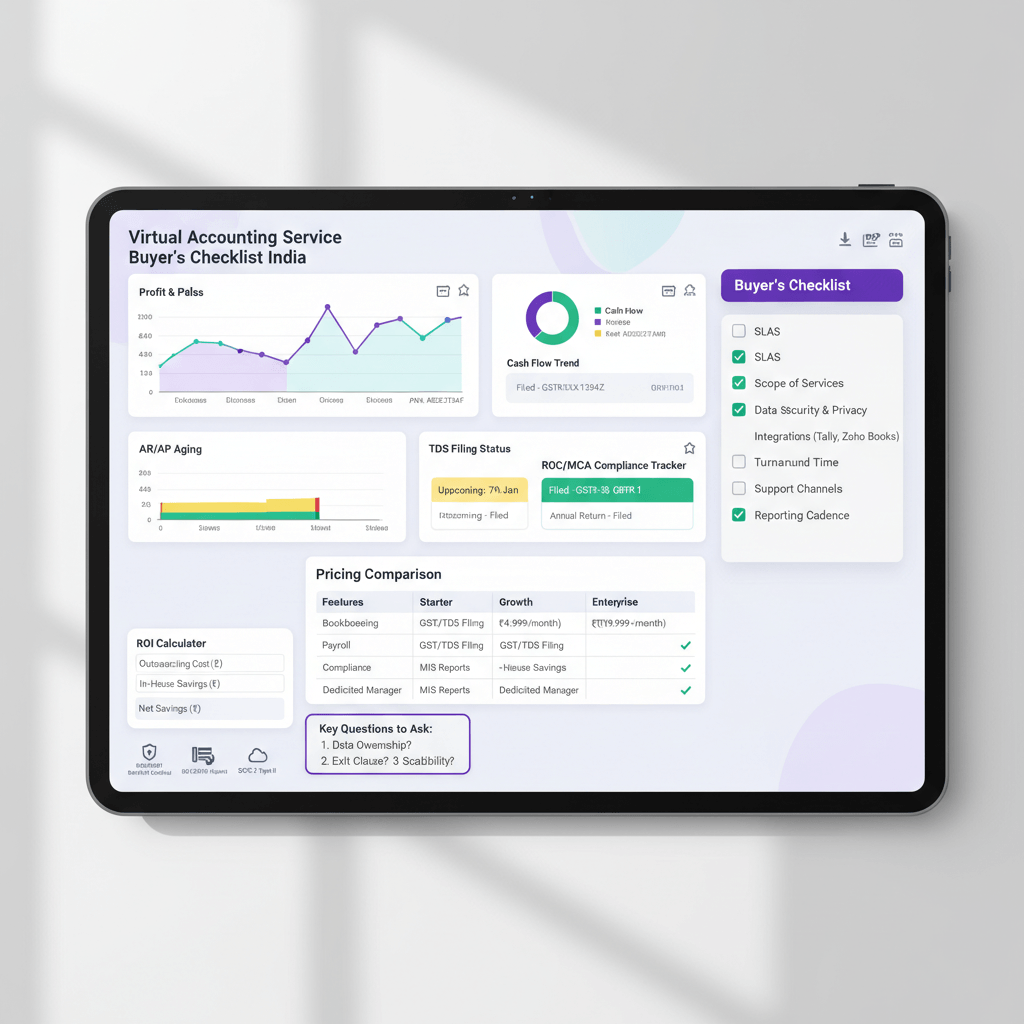
Key takeaways
- Define your scope, transaction volume, and industry needs before you talk to vendors, this stops overselling and surprises.
- Demand complete compliance coverage, GST, TDS, ITR, ROC, plus disciplined monthly bookkeeping and fast month-end closes.
- Insist on industry know-how, ecommerce reconciliations, SaaS revenue recognition, manufacturing inventory and GRN workflows.
- Pick providers with robust tech, real-time dashboards, OCR, AI alerts, and seamless integrations with gateways and marketplaces.
- Lock in SLAs for response times and on-time filings, verify security with encryption, backups, access logs, and NDAs.
- Use a structured scoring model and start with a low-risk pilot, then scale once trust and quality are proven.
- Watch for hidden fees, demand transparent pricing that maps to your exact scope, and get every promise in writing.
- For a strong benchmark, review Virtual Accounting by AI Accountant, CA-led teams, AI dashboards, and predictable monthly pricing.
What Is Virtual Accounting in India?
Virtual accounting gives you a CA-led finance team working remotely through cloud systems, you get clean books, on-time filings, and real-time visibility without hiring in-house. It works like your finance department, minus office overheads and hiring pain.
What Virtual Accounting Covers in India
Explore the full scope in What Virtual Accounting Covers in India. When you evaluate what to look for in virtual accounting India, expect coverage like:
- Bookkeeping and Accounting: Bank reconciliation, UPI and card statements, payment gateway settlements, AR and AP, fixed assets, inventory, month-end closes.
- GST Compliance: GSTR-1, GSTR-3B, GSTR-9 and 9C, GSTR-2B reconciliation, accurate Input Tax Credit claims.
- TDS Management: Deduction calculations, e-payments, quarterly returns, Form 16, annual TDS returns.
- Income Tax: ITR filing for individuals, partnerships, companies, proactive tax planning.
- ROC and Secretarial: MGT-7, AOC-4, statutory registers, AGM documentation for private limited companies.
- Payroll Processing: Monthly salaries, statutory deductions, PF and ESI, Form 16 for employees.
- MIS and Reporting: Real-time dashboards, cash flow trends, variance analysis, management insights.
Who Benefits Most from Virtual Accounting
Founders at early-stage startups, growing SMEs, D2C brands, SaaS companies, agencies, and busy freelancers benefit the most. If you are chasing GST deadlines or reconciling invoices on weekends, virtual accounting is built for you.
Great virtual accounting turns chaos into clarity, your team executes compliance while you focus on growth.
What to Look For in Virtual Accounting India: 10 Critical Factors
1. Complete Compliance Coverage
Your provider should handle GST, TDS, ITR, and ROC end to end so you avoid juggling vendors. Many follow a non-attest model, they execute compliance, your statutory auditor certifies. Insist on a proactive compliance calendar with before-deadline alerts.
2. Monthly Bookkeeping Discipline
Expect weekly bank reconciliations, daily settlement checks, and clean AR and AP aging. If you sell on Amazon or Flipkart, ask for their marketplace reconciliation workflow. A documented month-end checklist is non-negotiable.
3. Industry-Specific Knowledge
Generic accounting fails under complexity. Ecommerce needs marketplace and gateway reconciliation, SaaS needs deferred revenue and proper recognition, manufacturing needs inventory controls and GRNs. Ask for case studies from similar clients.
4. Technology Stack and Integrations
Support for Tally, Zoho Books, QuickBooks, or Wave is essential. Integrations with Razorpay or Stripe, OCR for invoices, AI alerts for anomalies and due dates, and mobile approvals give you speed and control.
5. Rock-Solid Security and Data Privacy
Confirm encryption, backups, access controls, and audit trails. Ask about data residency within India and role-based permissions. Get an NDA before sharing anything sensitive.
6. Dedicated Team and Clear Communication
You need a consistent CA-led team, not rotating contacts. Verify qualifications and escalation paths. Test responsiveness during evaluation, how they reply now predicts post-onboarding behavior.
7. Response Times and Service Level Agreements
Get SLAs in writing. Aim for 24 to 48 hour responses, books closed within 7 days of month-end, GST filed well before due dates. Clarify penalties and remediation if they miss deadlines.
8. Actionable Reporting and Business Insights
Reports must drive decisions. Ask for MIS samples, cash flow views, and variance narratives. Look for forecasting, working capital suggestions, and tax saving ideas throughout the year, not just in March.
9. Scalability Without Disruption
The service should scale from 50 to 500 transactions per month, or from proprietor to private limited, without chaos. Ask about SOPs, QA processes, and how they manage seasonal spikes.
10. Transparent, Predictable Pricing
Demand a clear scope matrix that separates what is included versus extra. Clarify catch-up work, correction charges, and multi-entity pricing. Very low quotes often lead to hidden fees or weak delivery.
How to Evaluate Accounting Service India: Your 10-Step Process
Step 1: Document Your Requirements
Entity type, volumes, compliance list, industry nuances, integrations.
Step 2: Create Your Shortlist
Pick 3 to 5 providers that match scope, budget, and tech. Verify CA credentials and experience.
Step 3: Schedule Live Demonstrations
Insist on real dashboards, reconciliations, and reports, not just slides.
Step 4: Request Work Samples
Seek anonymized GST workings, reconciliation templates, MIS packs.
Step 5: Verify Compliance Track Record
Ask for on-time filing rates and error percentages, speak to references.
Step 6: Confirm Team Structure and SLAs
Get names, qualifications, and response commitments in writing.
Step 7: Test Responsiveness During Evaluation
Send follow-ups and measure speed and clarity.
Step 8: Audit Security Measures
Review encryption, backups, access logs, disaster recovery.
Step 9: Review Contracts Carefully
Scope, exclusions, billing terms, change rules, exit clauses.
Step 10: Start with a Pilot
Run a 30 day trial or phased rollout before long-term commitment.
Quick Scoring Framework
- Scope and Compliance, 25%: How fully they cover your needs.
- Technology, 20%: Integrations, automation, dashboards.
- Team and SLAs, 20%: CA expertise, response time, continuity.
- Security, 15%: Data protection and auditability.
- Pricing, 10%: Clarity, value, scalability.
- References, 10%: Proof of satisfaction and reliability.
When you evaluate accounting service India with this structure, you remove bias and choose with confidence.
Essential Questions to Ask Virtual Accounting Service India
Compliance and Scope Questions
- Which GST returns will you file for us, and how do you reconcile GSTR-2B with our books?
- How do you manage TDS calculations, e-payments, and quarterly returns, plus Form 16?
- Will you own all ROC filings, MGT-7, AOC-4, and board resolutions?
- What does ITR support include, and do you provide year-round tax planning?
- Who prepares versus who certifies annual financial statements?
Bookkeeping Process Questions
- How often do you reconcile bank accounts, gateways, and marketplaces?
- What is your AR and AP aging process, and how do you chase overdue balances?
- Can we review your month-end checklist with timelines?
- How do you manage inter-company entries across entities?
- Will you manage depreciation, inventory valuation, and year-end adjustments?
Technology and Integration Questions
- Which accounting platforms do you support, and can you migrate our data safely?
- Can you demo dashboards, reports, and anomaly detection live?
- Do you integrate with Razorpay, Stripe, Amazon Seller Central, and others we use?
- What automation do you offer for compliance tracking and reminders?
- How do you store documents, and how easy is historical retrieval?
Security and Access Questions
- How is data encrypted in transit and at rest?
- Where are backups stored, and what is your recovery process?
- How do you manage user permissions and audit trails?
- Will you sign a comprehensive NDA before onboarding?
Team and Support Questions
- Who is our primary CA, and what are their credentials?
- What is the backup plan when our main contact is unavailable?
- What response times do you commit to for different query types?
- Which support channels do you offer, and during which hours?
Pricing and Contract Questions
- What exactly is included in monthly fees, please itemize it.
- Are there charges for corrections, revisions, or urgent requests?
- How do you price historical cleanup or spikes in volume?
- What are the notice periods and exit processes?
Onboarding Questions
- What documents and access do you need from us to go live?
- How quickly can we start after signing, and what are day one priorities?
- Which KPIs will you report every month?
- Can we speak with similar clients for references?
Understanding Costs and ROI
Traditional CA firms often quote ₹50,000 to ₹2,00,000 annually, plus extra for revisions and urgent work. Modern virtual providers offer predictable pricing, ₹4,000 to ₹6,000 monthly for startups, and ₹8,000 to ₹15,000 for growing SMEs, based on complexity.
Watch for Hidden Costs
- Penalty correction charges when the provider makes a mistake.
- Revisions beyond agreed monthly limits.
- Per entity pricing for subsidiaries.
- Marketplace integration platform fees.
- Rush charges for last minute filings.
Calculate Your ROI
- Avoided penalties, often ₹1,000 to ₹10,000 per missed filing.
- Timely ITC claims that improve cash flow.
- Founder time saved, often 10 to 15 hours monthly.
- Clean books that reduce audit friction and cost.
- Better visibility that drives smarter decisions.
Red Flags to Avoid
- Vague promises without written scope.
- No samples of workings or MIS packs.
- Poor communication during evaluation.
- Security gaps like shared logins or no audit logs.
- Shifting quotes or unclear extras.
- No references from satisfied clients.
- High team turnover that threatens continuity.
Preparing for Onboarding and Migration
Documents You Will Need
- Last 12 months of bank statements for all accounts.
- Current trial balance or general ledger.
- Previous 3 years of GST, TDS, ITR, and ROC filings.
- Fixed asset register with dates and values.
- Current inventory valuations if relevant.
- Updated customer and vendor masters.
- Opening balances aligned to the transition date.
Access Requirements
- Accounting software credentials with proper roles.
- Bank statement downloads or aggregator logins.
- Marketplace dashboards, Amazon, Flipkart, and others.
- Payment gateway APIs or exports.
- Government portal credentials for filings.
Cleanup Planning
- List unreconciled transactions and exceptions.
- Identify historical periods that need correction.
- Agree on what to fix versus what to start fresh.
- Set timelines and fees for catch-up work.
Go-Live Schedule
- Week 1: Data migration and system setup.
- Week 2: Training and process alignment.
- Week 3: Trial month-end close.
- Week 4: Final review and handover.
Real-World Scenarios to Guide Your Decision
Ecommerce Brand with Multiple Sales Channels
Your priorities: Automated reconciliations across Amazon, Flipkart, and your site, daily cash visibility, quick closes, complex GST compliance.
Key questions: Show us your multi-channel reconciliation flow. How do you resolve payment gateway settlement mismatches?
Service Agency with Project Billing
Your priorities: Project profitability, complex TDS, strong receivables aging, clean cutoffs.
Key questions: Can you produce project wise P and L statements, and manage milestone based revenue recognition?
SaaS Startup with Recurring Revenue
Your priorities: Accurate revenue recognition for subscriptions, MRR and churn tracking, cash and accrual reporting, scalable processes.
Key questions: Are you fluent with subscription revenue standards, and can you build MRR cohort views?
Manufacturing Business with Inventory
Your priorities: Inventory reconciliation and valuation, interstate GST, precise COGS, raw material tracking.
Key questions: How do you handle GRN matching, and what is your process for physical stock verification?
Top Virtual Accounting Services to Consider
- Virtual Accounting by AI Accountant — CA-led teams, AI dashboards, transparent pricing from ₹4,000 per month, 24 hour onboarding, complete compliance, GST, TDS, ITR, and ROC.
- Traditional CA Firms — Personalized support, variable pricing, slower tech adoption.
- Freelance Chartered Accountants — Cost effective for simple needs, limited scalability and backups.
- DIY Accounting Platforms — Software only, you own compliance, good for very early stages.
- Big Four Affiliated Services — Premium standards, enterprise pricing starting ₹50,000 plus monthly.
- Regional Accounting Firms — Local strengths, mixed technology and scalability.
How Virtual Accounting by AI Accountant Meets Your Needs
Virtual Accounting by AI Accountant aligns to the criteria above. You get CA expertise with modern tooling, covering bookkeeping, GST, TDS, ITR, payroll, and ROC in one place. Dashboards show both cash and accrual results, live filing status, and compliance calendars with automatic alerts. You work with a dedicated CA team over chat and email, with organized document storage and predictable pricing by transaction bands.
Onboarding completes within 24 hours in typical cases. The service follows a non-attest model, the team executes and advises, while your auditor certifies, you get reliability with controlled cost.
Your Action Checklist
- [ ] List your entity structure, monthly transactions, and compliance requirements
- [ ] Research and shortlist 3 to 5 providers
- [ ] Schedule demos with each shortlisted provider
- [ ] Ask all 30 evaluation questions during demos
- [ ] Request and review sample deliverables
- [ ] Check references from existing clients
- [ ] Score providers using the weighted framework
- [ ] Negotiate terms and clarify scope in writing
- [ ] Run a pilot with your preferred provider
- [ ] Prepare migration documents and set a go-live date
You are Now Ready to Choose Virtual Accounting Service India
You now have a practical framework, a question bank, and red flags to avoid. The right partner becomes your financial command center, not just a filing machine. Bring this checklist to vendor calls, compare with discipline, and pick the team that gives you clarity and confidence.
When you want a fast benchmark, book a demo of Virtual Accounting by AI Accountant, then compare others against the same yardstick. The best time to fix your accounting was yesterday, the second best time is now.
FAQ
How do I choose a virtual accounting service in India without getting trapped by hidden fees?
Start with a written scope that lists every deliverable, bookkeeping, GST, TDS, ITR, ROC, payroll, and MIS. Ask for a pricing matrix that shows what is included monthly and what triggers add-ons, such as catch-up work or urgent filings. Run a 30 day pilot to validate quality before a longer contract. As a benchmark, Virtual Accounting by AI Accountant provides transparent monthly pricing tied to transaction volume and written SLAs.
What SLAs should I demand from a virtual accountant so my filings never slip?
Commit to response times of 24 to 48 hours for queries, books closed within 7 days of month-end, GST filed several days before deadlines, and weekly reconciliation cadences. Add remediation terms if provider delays cause penalties. Providers like Virtual Accounting by AI Accountant share compliance calendars with proactive reminders.
Which accounting software stack works best for Indian SMEs selling on marketplaces?
Use Tally, Zoho Books, or QuickBooks with direct or automated imports from Amazon, Flipkart, and payment gateways like Razorpay or Stripe. Ensure your provider can run marketplace settlement reconciliations daily and produce SKU level or channel wise summaries. Virtual Accounting by AI Accountant integrates these feeds and flags mismatches early.
How do I verify a provider actually knows my industry, not just generic bookkeeping?
Request case studies, anonymized samples, and a live demo tailored to your workflows. For ecommerce, ask for settlement templates, for SaaS, show deferred revenue workings and MRR reports, for manufacturing, show GRN matching and inventory valuation. A good example is Virtual Accounting by AI Accountant, which demonstrates industry workflows during evaluation.
What security controls should I ask for before sharing financial data?
Confirm encryption at rest and in transit, daily backups, role based permissions, audit logs, and documented disaster recovery. Ask for an NDA and data residency details. Reputable services provide access logs on request and never share credentials across users.
How quickly can a startup go live with virtual accounting after signing?
With organized documents and access credentials ready, you can go live within 24 to 72 hours. Typical schedules include week 1 migration, week 2 training, week 3 trial close, week 4 handover. Virtual Accounting by AI Accountant often completes onboarding within 24 hours for straightforward setups.
What does great monthly reporting look like for founders who need decisions, not just numbers?
Expect a concise MIS pack, P and L, balance sheet, cash flow, AR and AP aging, variance notes, and a short commentary on risks, opportunities, and actions. Add cash flow forecasts and working capital levers. Providers like Virtual Accounting by AI Accountant also surface AI driven alerts for anomalies.
How do I estimate ROI from switching to a virtual accounting service?
Add avoided penalties, faster ITC realization, reduced audit time, and 10 to 15 founder hours saved each month. Factor in improved pricing and margin decisions from accurate dashboards. Many SMEs recover the monthly fee through penalties avoided and time saved alone.
Can virtual accountants handle multiple entities and inter-company transactions cleanly?
Yes, if they maintain entity specific ledgers, standardized charts of accounts, and inter-company reconciliation schedules. During evaluation, ask for their inter-company playbook and sample eliminations. Virtual Accounting by AI Accountant supports multi-entity setups with consolidated MIS.
What is the safest way to switch providers without breaking compliance mid-year?
Do a phased migration, complete the last clean month with the old provider, then cut over at a month-end. Move the trial balance, reconcile opening balances, and run a trial close in week 3 to catch issues. Sign off on a go-live checklist with roles and timelines. This is the approach used by Virtual Accounting by AI Accountant during onboarding.
How do I prevent last minute GST chaos during sales spikes or festive seasons?
Increase reconciliation cadence to daily, pre-schedule data pulls from marketplaces and gateways, and set buffer filing dates before peak rush. Lock SLAs for faster responses during spikes. Providers with mature SOPs, like Virtual Accounting by AI Accountant, plan seasonal capacity and keep filings ahead of deadlines.
What should I do if my books are messy and I am already behind on filings?
Split the work into two tracks, current month discipline so you stop the bleeding, and a catch-up plan for historical cleanup with clear timelines and fees. Prioritize statutory deadlines first, then fix historical reconciliations. Virtual Accounting by AI Accountant typically proposes a 30 day cleanup sprint with weekly milestones.

Rohan Sinha is a fintech and growth leader building aiaccountant.com, focused on simplifying accounting and compliance for Indian businesses through automation. An IIT BHU alumnus, he brings hands-on experience across 0 to 1 product building, growth, and strategy in B2B SaaS and fintech.


