-01%201.svg)
Key takeaways
- CA led, managed virtual accounting gives clean books, timely filings, and a real time dashboard that founders can trust
- End to end coverage includes bookkeeping, GST, TDS, income tax, payroll, and ROC, delivered with controls, audit readiness, and clear status
- A central dashboard shows cash, runway, burn, due dates, filings, and drill downs, it is the control panel for daily decisions
- Strong processes for bank reconciliation, payment gateway mapping, and e invoice reduce errors, notices, and revenue leakage
- Monthly close and MIS, with a focused metric set, make performance visible and action oriented
- Onboarding is structured, scope is clear, and the system scales from seed to growth, multi GSTIN and multi entity included
Virtual accounting made simple
Virtual accounting should remove worry, it should deliver books you can rely on, filings that are on time, and a clear view of cash. When expert CA support blends with a live dashboard, you get visibility and predictability, every day, not just at year end.
Virtual accounting is a managed finance engine, a CA team handles the heavy work, a dashboard keeps you informed, decisions become faster and safer.
In this guide, we explain how a CA led managed accounting service with a real time dashboard works in India, covering bookkeeping, GST, TDS, income tax, payroll, ROC, e invoice, bank reconciliation, and the metrics a founder should watch. The goal is simple, set up a steady finance engine that scales.
What is virtual accounting
Virtual accounting is managed accounting run by a CA team that works online using a cloud dashboard. You get end to end accounting, GST and TDS compliance, income tax support, and routine company filings, you see live numbers in one place, and you chat with your CA team inside the same system. You avoid hiring and training a full in house team too early, you get predictable delivery instead.
Virtual accounting overview for India
Core ideas
- CA led service for execution, review, advisory, and compliance
- Central dashboard for books, cash, documents, and status
- Standard workflows for sales, purchases, expenses, and payroll
- Monthly close and year end close with schedules and ledgers
- Built in alerts, due dates, and audit ready records
This model suits founders, finance heads, and teams who want clean books, a single source of truth, and less chaos in email and chat apps, it works for startups, D2C brands, agencies, SaaS, creators, freelancers, and small companies.
Why a CA led managed service
A CA led model blends human judgment with system driven control. Automation is helpful, but India compliance needs careful review. A CA team understands GST place of supply, RCM, HSN and SAC, TDS sections, e invoice rules, and timing, the dashboard gives scale and speed, together they reduce risk and improve quality.
Benefits
- Clean bookkeeping with ledger scrutiny and regular cleanup
- Correct GST treatment and reconciliations
- Accurate TDS deduction and returns
- Advance tax planning and estimates
- Ready support for tax audit preparation and statutory audit coordination
- Single window for ROC and secretarial for small companies
- Fast answers and simple status tracking
Accounting dashboard and real time visibility
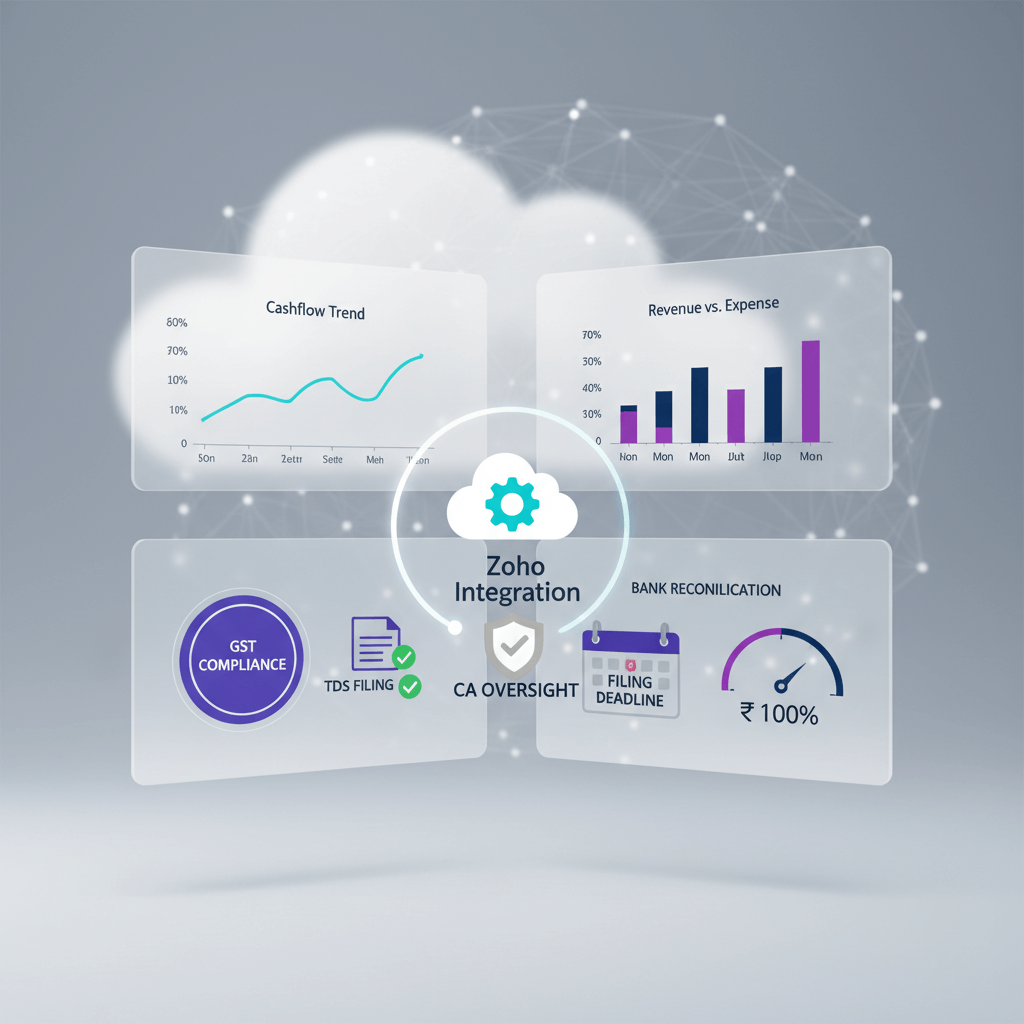
A good accounting dashboard shows health at a glance, you should see revenue, expense, profit or loss, and balances, you should see cash runway and burn, you should be able to drill into transactions, invoices, and vendors, and you should see due dates and filing status. The dashboard is the living map of your finance function.
What to expect in a real time dashboard
- Financial overview with monthly trends
- Income and expense category views
- Cash flow trends, burn rate, and runway
- Bank balance and payment gateway balances
- AI insights and alerts on anomalies
- Recent transactions for quick review
- Bank statement analysis and unmatched items
- Document library by period and type
- Compliance calendar and filing proofs
- Chat with your CA team inside the system
A dashboard is not a static report, it is a control panel, it helps you make decisions daily.
Bookkeeping services and monthly close
Your books are the base, if the base is firm, every report and return is smooth. Virtual accounting teams keep monthly books current and complete, then close months on a fixed cycle.
Key bookkeeping steps
- Sales capture from invoicing tools and e commerce channels
- Purchase and expense capture with vendor bills and receipts
- Bank feed mapping and manual postings as needed
- Payment gateway reconciliation for UPI and cards
- Accounts receivable and payable follow up
- Fixed asset register with depreciation
- Inventory records and reconciliation when applicable
- Prepaid and accrual entries for proper cut off
- Monthly MIS with P and L, balance sheet, cash flow
- Year end closing entries and schedules
Good books make audits smooth, they make tax filings accurate, and most of all, they give you a clear cash and runway view.
GST compliance and GST filing details
India GST needs careful setup and steady upkeep. You need the right registration type, correct place of supply on invoices, HSN or SAC with tax rates, and RCM checks when notified services or goods are received. You must file GSTR 1 for outward supplies and GSTR 3B for summary and payment, you must file annual return GSTR 9, and for some cases GSTR 9C self certification applies.
The GST cycle
- Configure GST registration, state wise GSTIN, and branch details
- Set up e invoice when you cross the threshold
- Apply correct HSN and SAC codes and tax rates by item
- Use correct place of supply rules for interstate and intrastate
- Identify RCM cases and book tax on reverse charge
- Reconcile GSTR 2B with purchase register for input tax credit
- File GSTR 1 and GSTR 3B on time and pay tax
- File annual return and reconciliations
- Maintain e way bills when movement of goods requires
Tips for GST accuracy
- Keep masters clean for items and customers
- Check your 2B every month, chase vendors for missing invoices
- Review credit ineligible cases such as blocked credit categories
- Map export and SEZ supplies with LUT or IGST as applicable
- Track advances and adjust on time
GST portal help and returns GST Council CBIC HSN
E invoice and IRN workflow
When aggregate turnover crosses the government limit, e invoice becomes mandatory. Each B2B invoice is reported to the invoice registration portal, the IRP returns an IRN and a QR code, your invoice must carry these, and your accounting system should integrate to avoid manual uploads.
Steps to manage e invoice
- Check if your prior year aggregate turnover meets the rule
- Enable e invoice on the portal, get API access when needed
- Map item details, GSTIN, HSN, and unit of measure
- Send invoice data to the IRP, capture IRN back
- Render the QR code on the invoice
- Handle cancellations within the allowed window
- Sync e invoice data with GSTR 1 to avoid mismatch
Key controls
- Lock invoice edits after IRN is generated
- Number series control for audit trail
- Error queue to fix IRP rejections promptly
E invoice portal E invoice FAQs GST e invoice
TDS compliance and income tax basics
Tax deducted at source applies to many payments, including contractor fees, professional fees, rent, and salary. You have to deduct the correct rate under the correct section, deposit TDS on time, and file returns, wrong mapping causes notices. A CA led team designs vendor masters and payroll setup to apply TDS correctly.
The TDS cycle
- Identify sections that apply to your payees and payments
- Collect PAN and other details, validate
- Deduct TDS on payment or credit as per section
- Deposit challan by due date
- File 24Q for salary and 26Q for domestic non salary
- Use 27Q for non resident payments and treaty cases
- Use 26QB, 26QC, 26QD as per property and rent cases
- Issue TDS certificates on time
- Match Form 26AS and AIS, resolve mismatches
Income tax support
- Compute advance tax and pay quarterly when applicable
- File company and individual returns by due date
- Prepare for tax audit when business crosses limits
- Manage international tax and expat salary structuring
- Prepare 15CA for foreign remittances, manage 15CB when required
Income Tax portal TRACES TDS help 15CA 15CB
Payroll services and salary tax
Payroll is more than net pay, it includes TDS on salary, employee declarations, proof checks, and Form 16. A virtual accounting team can run payroll workflows, compute TDS, and set smart CTC structures, guiding on tax saving benefits within law.
Key payroll tasks
- Capture employee details and declarations early in the year
- Compute monthly TDS on projected income
- Suggest salary structuring for tax efficiency
- Issue payslips and manage reimbursement claims
- Validate proofs during investment declaration windows
- File quarterly 24Q and issue Form 16 after year end
- Align payroll with PF, ESIC, and professional tax when applicable
Payroll has sensitive data, ensure strong access control and secure document storage in the dashboard.
ROC compliance and secretarial for small companies
Small companies under MCA rules still have a steady secretarial calendar, including board meetings, minutes, registers, MGT 7, AOC 4, and more. A managed service prepares, reviews, and files these, and keeps records in order.
Tasks to expect
- MSME vendor filings to MCA when applicable
- DIR 3 KYC for directors
- MGT 7 annual return and AOC 4 financial statements
- Board meeting and minutes, AGM support
- Statutory registers and board reports
- Increase in authorised share capital and share allotments
- Director appointments and resignations
- Event based filings as they arise
Keep signed copies in the dashboard document library, tie your accounting close to statutory filings for consistency.
MCA portal MCA forms DIN rules
Bank reconciliation and payment gateway mapping
Bank reconciliation is a daily or weekly practice, it ensures your cash in books matches bank statements, and that payment gateway reports for UPI and card collections match order level numbers. A good process reduces revenue leakage and speeds month end close.
Payment gateway integration for accounting
Best practices
- Set up direct bank feeds when safe and possible
- Pull daily bank statements in CSV or CAMT format when needed
- Map payment gateway fees and GST split properly
- Reconcile UPI, card, and net banking settlements to orders and invoices
- Use rules for recurring entries such as charges and interest
- Review unmatched items, chase for details
- Lock the period after reconciliation and close checklists
For India, payment gateway reconciliation can be tricky due to TDR, GST on fees, refunds, and chargebacks, use clear mapping and maker checker review to avoid errors.
Controls, security, and audit readiness
Controls give comfort, you want segregation of duties, approval flows, and an audit trail, and you want strong data security and privacy. A CA led service builds these into the way work gets done.
Key control areas
- Documented monthly close checklist with owners and dates
- Maker checker for payments, journals, and reconciliations
- Access control to the dashboard and software by role
- Number sequence integrity and period locks
- Vendor onboarding checks and master data control
- Tax master control for GST and TDS rates
- Backup policy and disaster recovery plans
- Data retention policy for statutory records
Security practices
- Encryption at rest and in transit for storage and transfers
- Strong password and multi factor options for tools
- Audit logs for sensitive actions
- Regular review of user access
- Vendor due diligence for cloud tools
Financial metrics and MIS that matter
A dashboard is useful only when it drives action, so focus on a few metrics that reflect reality and guide decisions, review them in your monthly MIS, tie them to your goals and cash plan.
Metrics to track
- Monthly revenue by channel or product
- Gross margin by product or service line
- Operating expense by function
- Burn rate and cash runway in months
- Collections cycle and ageing buckets
- Payables cycle and vendor terms
- Inventory days when applicable
- GST input credit utilisation and carry forward
- TDS deducted, and pending certificates
- Budget versus actual for key lines
Use a simple variance note, for each metric that moves, write why it moved and what you will do next.
Accounting tools and automation for Indian businesses
A practical tech stack keeps your finance function smooth, choose tools that are stable, supported, and common in India, ensure you can export data and integrate with your dashboard.
Recommended tools
- AI Accountant aiaccountant.com
- QuickBooks Online quickbooks.intuit.com
- Xero xero.com
- Zoho Books zoho.com
- TallyPrime tallysolutions.com/tally
- FreshBooks freshbooks.com
- Razorpay for payments and gateways razorpay.com
- PayU for online collections payu.in
- ICICI Bank corporate internet banking for statements and payments icicibank.com
- HDFC Bank corporate banking hdfcbank.com
Guidelines
- Keep core accounting in a robust general ledger
- Connect payment gateways and banks with feeds where feasible
- Use OCR and expense tools for bills and receipts when volume is high
- Keep master data clean and synced across systems
- Keep the dashboard as your single source of truth
aiaccountant.com Zoho Books QuickBooks Xero TallyPrime
How virtual accounting onboarding works
Onboarding sets the tone, a CA led team plans the handover, sets policies, and goes live in weeks.
Typical onboarding steps
- Discovery call and scope confirmation
- Data request for past books, returns, and documents
- Tool access setup and user roles
- Accounting policy review and choices
- GST and TDS master setup and mapping
- Opening balances import and validation
- Bank and gateway connection and test
- First month pilot close and fixes
- Finalise close checklist and cadence
- Go live with dashboard and routines
Founders should assign a single point of contact, set a weekly slot to clear open items, and keep a simple shared tracker for pending tasks, the dashboard can host all of this.
Case walk through for a growing startup
Consider a D2C brand with online sales through its website and a marketplace, one private limited company with GST in one state, two gateways, and a cash on delivery partner, ad spend, influencers, logistics, and a ten member team.
What the virtual accounting team does
- Sets up item masters with HSN and correct tax rates
- Enables e invoice because turnover crossed the threshold
- Builds payment gateway reconciliation rules for UPI and card
- Tracks COD settlements and holds
- Books ad spend with proper GST input credit checks
- Reconciles GSTR 2B with purchase register, flags mismatches
- Files GSTR 1 and 3B on time with tax payment
- Sets up payroll with TDS 24Q flow and Form 16
- Tracks vendor TDS with 26Q, issues certificates
- Runs monthly close and MIS with burn and runway
- Supports statutory audit with schedules and ledgers
- Files AOC 4 and MGT 7, maintains minutes
Impact after three months
- Month end close completed within five working days
- Bank and gateway reconciliation cleared weekly
- GST mismatches reduced, input credit optimised
- Clear view of ad spend ROAS in MIS
- Cash runway dashboard trusted by the founders
- Zero filing delays, no notices
E invoice portal GST returns help TRACES MCA
Risk areas to watch and how to avoid them
Every finance function has blind spots, name them early and set controls.
Common risks
- Wrong GST place of supply for interstate and export
- Missed RCM for notified services
- E invoice not applied after turnover crosses the limit
- TDS wrong section or rate applied to vendors
- Payment gateway fees and GST not booked correctly
- Bank reconciliation not closed, stale items pile up
- Expense claims without bills or GST details
- Access control too open for sensitive actions
Simple fixes
- Use checklists and maker checker
- Lock periods after closing
- Review 2B and reconcile monthly
- Run a vendor master review each quarter
- Run exception reports in the dashboard for odd entries
- Keep a short weekly sync with your CA team
GST portal E invoice FAQs TDS guide
How to choose a virtual accountant
Pick a partner who blends CA expertise with system thinking, ask how they close the month, not just how they make invoices, ask to see the dashboard, and ask about the delivery team, not just the pitch team.
Questions to ask
- Who is the signing CA or lead, who are the reviewers
- What is your month end close checklist and timeline
- How do you handle e invoice and IRP errors
- How do you reconcile payment gateways weekly
- What access controls and audit logs do you have
- How do you prepare for statutory audit
- What is your approach to GST 2B reconciliation and vendor follow up
- What is in scope, what is out of scope
- How do you handle urgent queries and SLAs
Prefer a partner comfortable with clean documentation and steady processes, a friendly tone helps, structure matters more.
Pricing and scope clarity
Virtual accounting works well when scope is clear, you want outcomes, not endless hours, agree on deliverables and timelines, and a change process for extra needs.
Define
- Monthly bookkeeping volume and entities covered
- Number of bank accounts and gateways
- GST registrations and return frequencies
- TDS sections and return forms
- Payroll headcount and cycles
- Secretarial items for the year
- Reporting pack and MIS formats
- Support windows and response times
- Out of scope items and rates when they arise
Clear scope avoids surprise bills, it keeps the team focused on outcomes.
Scaling from seed to growth with virtual accounting
Your needs change as you grow, the finance function must scale. Virtual accounting can scale with you when the foundation is solid.
Scale levers
- Multi entity and multi GSTIN handling in the dashboard
- Branch accounting and segment reporting
- Foreign currency invoicing and bank accounts
- Intercompany transactions and eliminations
- Inventory and landed cost calculations
- Deferred revenue for SaaS and subscription businesses
- Budgeting and forecasting routines
- Data room readiness for due diligence
Plan ahead, add structure before volume spikes, a CA team and dashboard help move from survival to scale with confidence.
Founders checklist for month end close
A short checklist keeps everyone aligned, use it each month.
Checklist
- All sales booked, e invoices generated
- All purchases and expenses in, bills attached
- Bank statements imported and reconciled
- Payment gateways reconciled, fees booked
- Payroll closed, TDS posted
- GST 2B reconciled, ITC reviewed
- TDS challans paid, returns queued
- Journal entries posted, approvals done
- Period locked, MIS published
- Dashboard updated, notes shared
Keep the checklist in your dashboard, track progress in real time.
Getting started with AI Accountant
AI Accountant offers a CA led virtual accounting service backed by a central dashboard, you get end to end bookkeeping, GST and TDS compliance, income tax support, payroll, and ROC compliance for small companies, with live numbers and filing status, a dedicated CA team, and one place for documents and conversations. It is simple to start, share your current books and tools, we set up your dashboard, clean ledgers, and run your first close, then we keep it steady.
If you want to explore, bring one concrete goal, for example, close the month in five days, reduce GST mismatches to near zero, or get a reliable cash runway view, we shape the workflow to the goal and show progress in the dashboard.
References and further reading
- GST portal for returns and help gst.gov.in/help/returns
- GST Council updates and resources gstcouncil.gov.in
- E invoice portal and FAQs einvoice1.gst.gov.in einvoice1.gst.gov.in/Others/Faqs
- Income Tax portal for TDS and returns incometax.gov.in
- TRACES portal for TDS tdscpc.gov.in
- MCA portal for company filings mca.gov.in
- NPCI UPI overview npci.org.in
- ISO 27001 information security iso.org
Final word
Virtual accounting is not just remote bookkeeping, it is a managed finance engine. A CA team brings judgment and discipline, a dashboard brings clarity, together they keep filings in line and free your time to build. When the base is strong, decisions are easier, growth is safer, try one month end close with a CA led team and a live dashboard, then judge the calm it brings.
FAQ
How does a CA led virtual accounting model blend automation with review, so my GST, TDS, and e invoice are accurate every month
A CA led model uses automation for ingestion, reconciliation, and alerting, then applies human review for judgement heavy items such as GST place of supply, RCM, e invoice edge cases, and TDS section mapping. AI Accountant’s dashboard surfaces anomalies in 2B versus purchase register, IRP rejections, and vendor rate exceptions, the CA team closes the loop with maker checker, monthly close checklists, and documented adjustments.
What monthly close SLA can I expect, and what artefacts do I receive for audit, MIS, and board reporting
Typical SLA is a five to seven working day close after month end, with P and L, balance sheet, cash flow, ageing reports, GST 2B reconciliation notes, TDS deduction and challan summary, and a variance note. AI Accountant also provides bank and gateway reconciliation proofs, period lock confirmations, and a document pack ready for statutory audit.
Can the virtual accounting stack handle multi GSTIN, branches, and consolidation across entities, including intercompany eliminations
Yes, multi GSTIN and branch accounting are configured in masters and reporting, intercompany transactions are posted with reciprocal entries and flagged for elimination in consolidation. AI Accountant’s dashboard supports segment reporting, entity filters, and consolidation views, with schedules for eliminations and minority interest when applicable.
How do you reconcile Razorpay or PayU settlements to orders, including TDR, GST on fees, refunds, and chargebacks
The team maps settlement files to order and invoice data, splits gateway fees between base and GST, books refunds and chargebacks to the correct periods, and ties net settlements to bank credits. AI Accountant maintains rules for common fee lines, runs daily or weekly reconciliations, and raises exceptions for missing references or timing differences, reducing revenue leakage and close delays.
What is your approach to TDS master setup, section selection, and 26AS or AIS alignment to avoid notices
Vendor and category masters carry section, threshold, and rate logic, PAN is validated, and deductions are computed on credit or payment per section. Monthly, the team reconciles challans and returns against 26AS or AIS, resolves mismatches, and issues certificates on time. AI Accountant’s exception report flags missing PAN, section anomalies, and rate deviations for review.
How do you handle e invoice IRP errors, cancellations, and changes to invoices after IRN generation
Invoices sent to IRP have validation checks, on rejection they enter an error queue with the reason code, and the team fixes data and resubmits quickly. After IRN generation, edits are locked, cancellations follow the allowed window rules, and GSTR 1 sync is maintained to prevent reporting mismatches. AI Accountant tracks IRN status and QR code rendering, with alerts for failures.
Can you coordinate tax audit preparation and statutory audit, what schedules and ledgers do you deliver
Yes, the service prepares fixed asset schedules with depreciation, receivable and payable ageing, bank reconciliations, inventory summaries, related party disclosures, and supporting ledgers. AI Accountant provides a clean working papers pack, ties numbers to trial balance, and coordinates with the statutory auditor on queries, reducing back and forth.
How does the dashboard present cash runway, burn, and budget versus actual, can I drill from charts to vouchers
Cash runway is computed from projected burn and available balances across bank and gateways, burn tracks operating cash flow components, and BvA shows variances by function or account. You can drill from a chart to a report, then to transactions and documents, AI Accountant enables quick review of recent entries and unmatched items directly in the dashboard.
What onboarding timeline and data requirements should my team plan for, especially when migrating from Tally to a cloud ledger
Plan two to four weeks depending on data quality, provide trial balance and ledgers, past GST and TDS returns, bank statements, gateway reports, and master data. AI Accountant sets policies, maps GST and TDS masters, imports opening balances, connects banks and gateways, runs a pilot close, and finalises cadence, keeping a shared tracker of open items.
Will you manage payroll end to end, including PF, ESIC, professional tax, Form 16, and investment proof validation, and how do you secure employee data
Yes, payroll workflows include declarations, monthly TDS computation, payslips, proof validation, 24Q filing, and Form 16. PF, ESIC, and professional tax are aligned, and sensitive data stays in a secure document library with restricted access. AI Accountant enforces role based access, audit logs, and encryption for storage and transfers.
How do you price virtual accounting and define scope, what happens when change requests or special projects arise
Pricing is outcome based for defined scope, such as monthly bookkeeping volume, number of bank accounts and gateways, GST and TDS returns, payroll headcount, and secretarial items. Change requests are estimated and agreed before execution, AI Accountant keeps scope, SLAs, and exclusions documented to avoid surprises.
Can you support cross border payments, 15CA or 15CB, and treaty rate application for non resident vendors, along with 27Q filing
Yes, the team prepares 15CA and coordinates 15CB when required, applies treaty rates with documentation, and files 27Q, matching entries to 26AS. AI Accountant tracks due dates, maintains remittance docs, and reconciles foreign currency movements to bank statements and expense ledgers.
Is virtual accounting workable for non tech businesses with inventory and COD, or for agencies and creators with high volume expenses
Yes, virtual accounting works as long as documents and statements can be digitised. For inventory and COD, AI Accountant sets up item masters with HSN, e invoice when needed, and COD reconciliation to settlement files, for agencies and creators, OCR or expense tools speed capture, with GST credit checks and monthly close discipline.
What controls do you implement for payments and journals, and how are period locks enforced to protect closed months
Maker checker applies to payments and journals, approval logs are maintained, and number sequences are controlled. At close, the period is locked, adjustments are documented, and reopening requires CA review. AI Accountant’s dashboard highlights sensitive actions and keeps an audit trail for review.
How do you minimise GST input credit loss, and what is your process for vendor follow up on missing invoices in 2B
The team reconciles 2B to the purchase register, flags missing or mismatched invoices, and follows up with vendors, blocked credit categories are identified, and export or SEZ supplies are mapped with LUT or IGST. AI Accountant’s alerts focus attention on recoverable credits, improving cash efficiency.